RBI Monetary Policy Framework: A Complete Guide for JAIIB IEIFS 2026
The RBI monetary policy framework is one of the highest-yielding topics in the JAIIB IEIFS paper, because it blends conceptual understanding with current affairs. A candidate who understands how RBI monetary policy is set, and who also knows the latest rates, walks into the exam with a clear advantage. This guide breaks the framework into exam-sized pieces and shows you exactly what to revise.
The Flexible Inflation Targeting Mandate
Since the amendment of the RBI Act in 2016, India follows a flexible inflation targeting (FIT) regime that anchors RBI monetary policy. The Government, in consultation with the RBI, sets the inflation target every five years. The current target is 4% Consumer Price Index (CPI) inflation, with a tolerance band of +/- 2%, so the comfortable range runs from 2% to 6%. If average inflation breaches the band for three consecutive quarters, the RBI is deemed to have failed and must report to the Government with reasons and remedial action.
For IEIFS, remember why CPI rather than WPI is the nominal anchor: CPI reflects the cost of living faced by households and is therefore a better measure of purchasing power. The framework deliberately uses the word "flexible" because the RBI also cares about growth. Candidates should distinguish the target (set by Government) from the instrument (the policy repo rate, set by the MPC). Keep the current numbers handy from our live RBI rates page, and test yourself on our IEIFS practice tests.

The Monetary Policy Committee (MPC)
The Monetary Policy Committee is the six-member body that decides the policy repo rate, the operational heart of RBI monetary policy. Three members are from the RBI — the Governor (who chairs it), a Deputy Governor in charge of monetary policy, and an officer nominated by the Central Board. The other three are external experts appointed by the Central Government for a four-year term. Each member has one vote, and in a tie the Governor exercises a casting vote.
The MPC meets at least four times a year and decisions are taken by majority. Minutes are published on the fourteenth day after each meeting, and each member records the reasons for their vote — a transparency feature examiners frequently test. A common trap is to confuse the MPC's role (setting the rate) with the RBI's operational role (managing day-to-day liquidity through the Liquidity Adjustment Facility). The composition and procedures of the MPC are documented by the Reserve Bank of India. Drill these distinctions on our banking terms match game.
The Toolkit: Repo, CRR, SLR and the Corridor
The RBI influences money and credit through quantitative and qualitative tools. The repo rate is the rate at which banks borrow overnight from the RBI against government securities; it is the single most important signalling rate in RBI monetary policy. The Standing Deposit Facility (SDF) now forms the floor of the corridor, while the Marginal Standing Facility (MSF) forms the ceiling, with the repo rate in the middle.
The Cash Reserve Ratio (CRR) is the share of net demand and time liabilities that banks must keep with the RBI as cash, earning no interest. The Statutory Liquidity Ratio (SLR) is the share held in liquid assets such as government securities, gold and cash. Raising CRR or SLR drains lendable resources and tightens credit; lowering them does the opposite. For IEIFS, memorise the current values and practise calculating the impact of a 50-basis-point change. Reinforce these definitions visually with our match game.
Monetary Policy Transmission
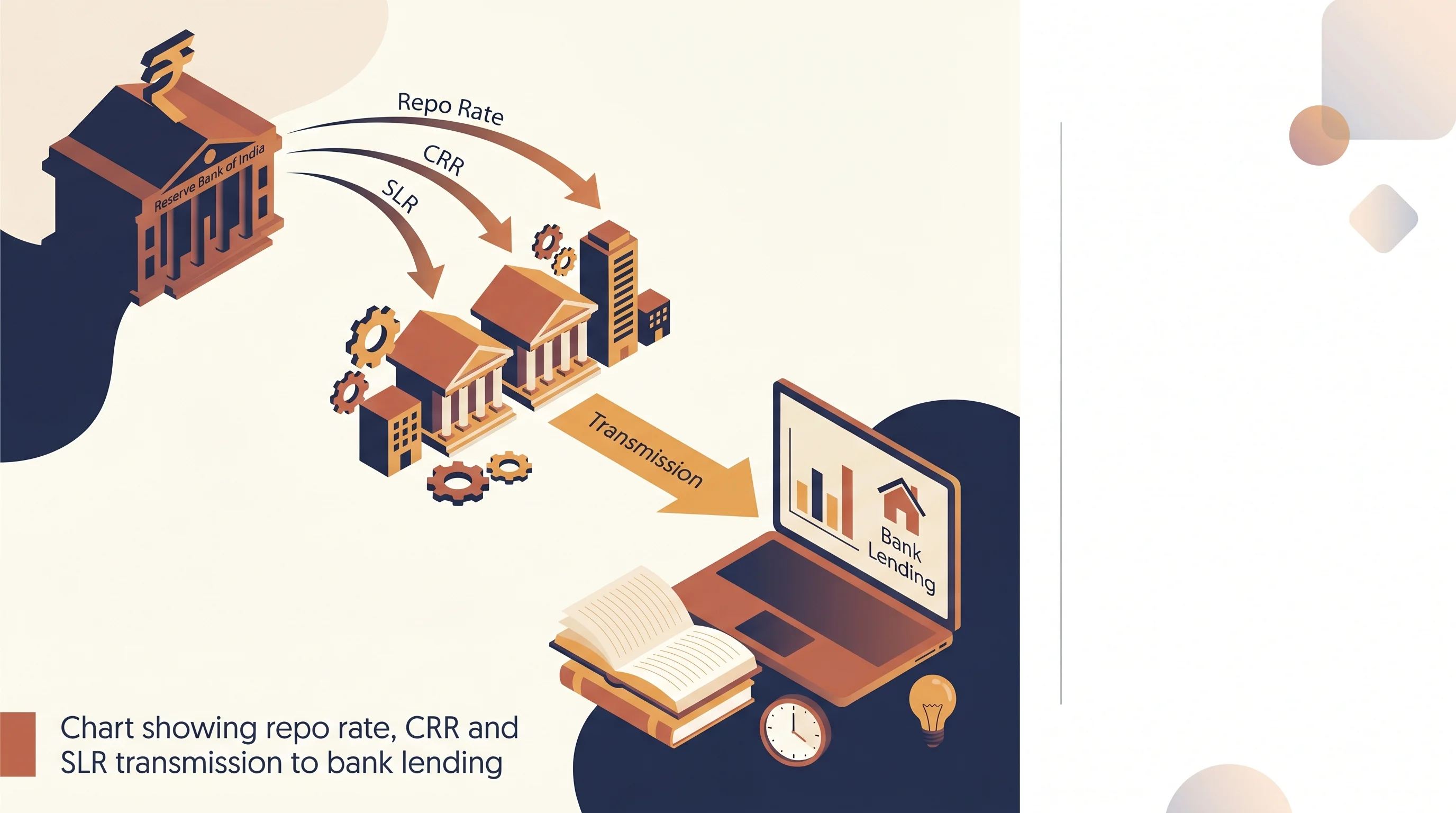
A policy change is only as good as its transmission to borrowers. To improve pass-through, the RBI mandated the External Benchmark Lending Rate (EBLR) for retail and MSME floating-rate loans, linking them to the repo rate or a market benchmark instead of the older internal MCLR. A repo cut now reaches home-loan and personal-loan customers faster than before, though transmission can still be sticky on the deposit side because banks reprice deposits more slowly.
Examiners may ask about the channels of transmission — the interest-rate channel, the credit channel, the exchange-rate channel and the asset-price channel. A strong answer notes that transmission depends on liquidity conditions, the health of bank balance sheets and the share of loans linked to external benchmarks. Effective transmission is what makes RBI monetary policy actually felt in the real economy. Stay current on the policy stance and rate actions through our IIBF and RBI news tracker.
Exam Strategy and Quick Revision
To score well on RBI monetary policy, build a one-page sheet listing the FIT mandate, the MPC composition, the policy corridor (SDF–repo–MSF), the CRR/SLR definitions and the transmission channels. Pair it with the current rates, since the examiner loves to combine a concept with a live number.
In the final week, shift from reading to active recall: attempt full mocks, review every wrong answer, and re-read only weak spots. Watch for negatively-phrased questions such as "which is NOT a quantitative tool". Combine this disciplined revision with our timed IEIFS mock tests and the explainers on our study blog, and you will handle any monetary-policy question with confidence.
What is the current inflation target under the RBI framework?
4% CPI inflation with a tolerance band of +/- 2%, so the acceptable range is 2% to 6%. The target is set by the Government in consultation with the RBI for a five-year period.
How many members are in the Monetary Policy Committee?
Six — three from the RBI (including the Governor as chair) and three external experts appointed by the Government. The Governor has a casting vote in a tie.
What is the difference between CRR and SLR?
CRR is the cash reserve kept with the RBI and earns no interest. SLR is held by the bank itself in liquid assets such as G-secs and gold. Both are computed on net demand and time liabilities.
What is EBLR and why does it matter?
The External Benchmark Lending Rate links floating retail and MSME loans to an external benchmark such as the repo rate, improving the speed and extent of monetary policy transmission to borrowers.
Conclusion
RBI monetary policy rewards candidates who pair conceptual clarity with up-to-date numbers. Lock in the FIT mandate, the MPC, the policy corridor and the transmission mechanism, then keep refreshing the live rates before exam day. Attempt a full JAIIB IEIFS mock, review every wrong answer, and explore more guides on our banking exam blog.
Take a free mock test, download chapter PDFs, or watch a video class — all included on iibf.store.