International Trade Finance: LC, Incoterms & ECGC Guide
International Trade Finance sits at the heart of the IIBF Certificate in International Trade Finance, and it is one of the most rewarding papers to master because the concepts are logical, recurring, and directly testable. At its core, trade finance solves a simple trust problem: an importer in one country wants to pay only after receiving the goods, while an exporter in another country wants to be sure of payment before parting with the shipment. Banks step into that gap with a set of trusted instruments that protect both sides, and this guide walks you through every one of them the way an examiner expects you to know them.
Whether you are preparing for your first attempt or revising before the exam window, this article covers letters of credit, Incoterms 2020, bank guarantees, documentary collections, export credit and ECGC cover in depth, with a practical study plan, a comparison table, common mistakes, and a snippet-ready FAQ. For specific exam dates and the syllabus weightage, always confirm against the latest released IIBF notification before you plan your timeline.
Key Takeaways
- Letters of credit (LC) are governed by UCP 600, and rest on two pillars: autonomy (the LC is independent of the sale contract) and strict compliance (documents must match the credit terms).
- Incoterms 2020 has eleven terms; the single most examined point is the difference between who bears the cost and who bears the risk.
- Bank guarantees split into financial and performance guarantees, and form a major source of non-fund-based income.
- Documentary collections turn on D/P versus D/A, governed by URC 522.
- Export credit (pre-shipment and post-shipment) plus ECGC insurance cover round out the high-frequency topics.
Why International Trade Finance Exists
International Trade Finance is the discipline that makes cross-border commerce possible despite distance, differing legal systems, and the absence of mutual trust between buyer and seller. When an exporter in India ships machinery to a buyer in Europe, neither party wants to take the full counterparty risk alone. The exporter fears shipping goods and never being paid; the importer fears paying and never receiving conforming goods.
Banks resolve this stand-off by substituting their own creditworthiness and by controlling the flow of documents that represent the goods. In doing so they earn fee income, manage their own exposure, and keep global trade moving. For the IIBF candidate, the takeaway is that every instrument you study, from the LC to the bank guarantee, is just a different way of allocating risk between three parties: the buyer, the seller, and the bank.
The Letter of Credit Under UCP 600
The documentary letter of credit is the cornerstone of International Trade Finance and the most heavily weighted topic in the paper. An LC is an undertaking by the importer's bank, called the issuing bank, to pay the exporter against the presentation of stipulated documents that comply with the credit terms. Because the bank substitutes its own creditworthiness for the buyer's, the exporter gains assurance of payment, while the importer gains assurance that payment is released only against proper documents.
LCs are governed by the Uniform Customs and Practice for Documentary Credits (UCP 600), published by the International Chamber of Commerce. Two principles dominate the exam:
- Autonomy: the credit is independent of the underlying sale contract, and banks deal in documents, not goods. A dispute over the merchandise does not, by itself, justify refusing payment on compliant documents.
- Strict compliance: the documents presented must conform to the credit terms. Even apparently minor discrepancies can entitle the bank to refuse payment.
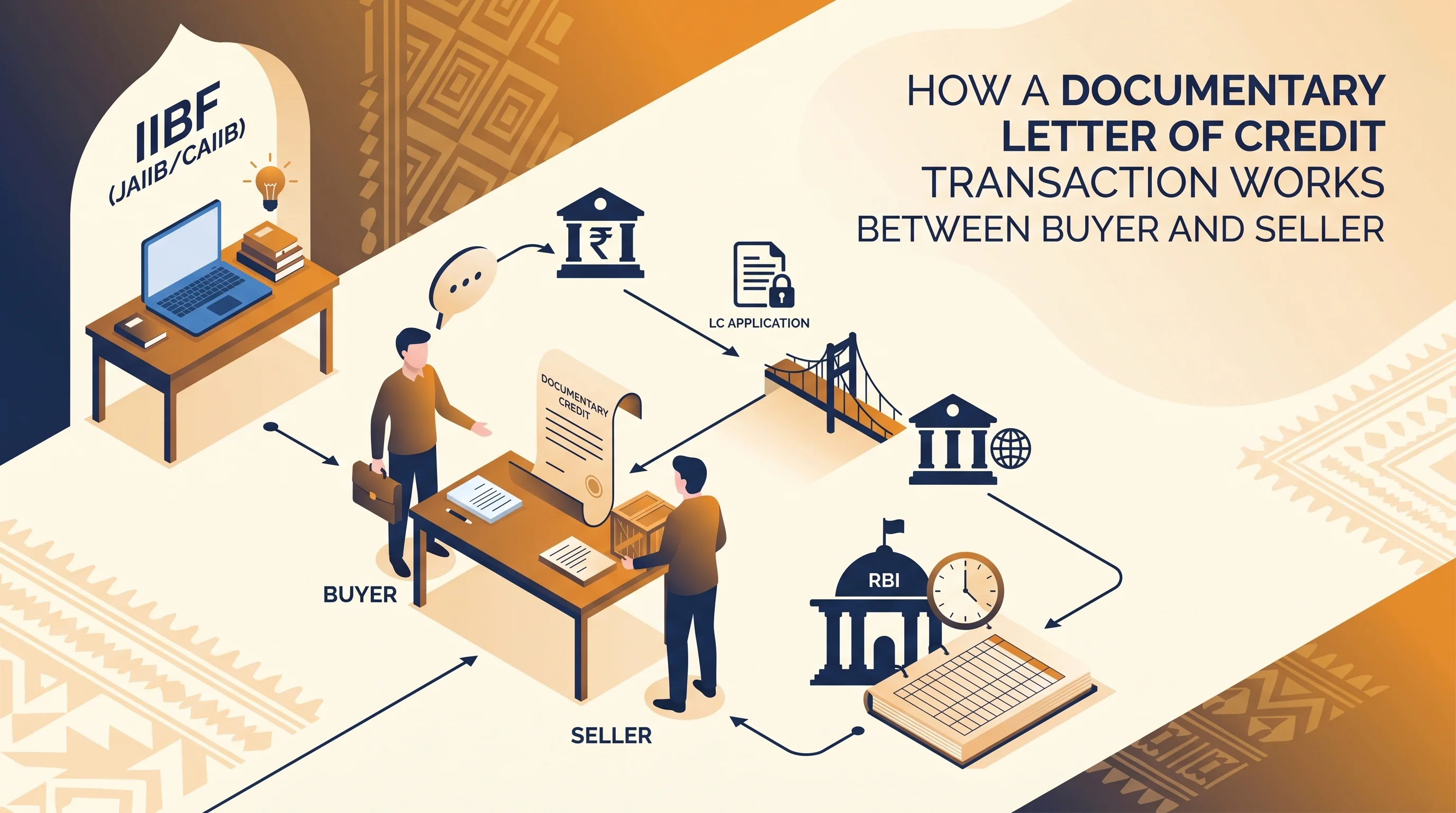
You must also be able to distinguish the main LC types, because they are tested directly: sight versus usance (immediate payment versus payment after a fixed period), confirmed versus unconfirmed (whether a second bank adds its own undertaking), and the specialised revolving, transferable and standby credits. A clear command of these categories will earn you steady marks. To deepen this single topic, read our focused guide on the Letter of Credit under UCP 600 and the companion explainer on LC types under UCPDC 600, then practise document-checking scenarios in our trade finance practice tests.
Incoterms 2020: Cost Versus Risk
Incoterms are the standardised three-letter trade terms, also published by the ICC, that define the responsibilities of buyer and seller for delivery, the transfer of risk, and the allocation of costs. The current edition is Incoterms 2020, comprising eleven terms.
Seven terms apply to any mode of transport: EXW (Ex Works), FCA (Free Carrier), CPT (Carriage Paid To), CIP (Carriage and Insurance Paid To), DAP (Delivered at Place), DPU (Delivered at Place Unloaded) and DDP (Delivered Duty Paid). The remaining four apply only to sea and inland waterway transport: FAS (Free Alongside Ship), FOB (Free On Board), CFR (Cost and Freight) and CIF (Cost, Insurance and Freight).
The single most examined idea is the point at which risk passes from seller to buyer, and how that can differ from who pays the cost. Under FOB, risk passes when the goods are loaded on board the vessel at the named port of shipment. Under CIF, the seller arranges and pays for carriage and insurance all the way to the destination port, yet risk still passes at the port of shipment, not at the destination. This split between who bears cost and who bears risk is the classic trap, so make sure you can explain it cleanly.
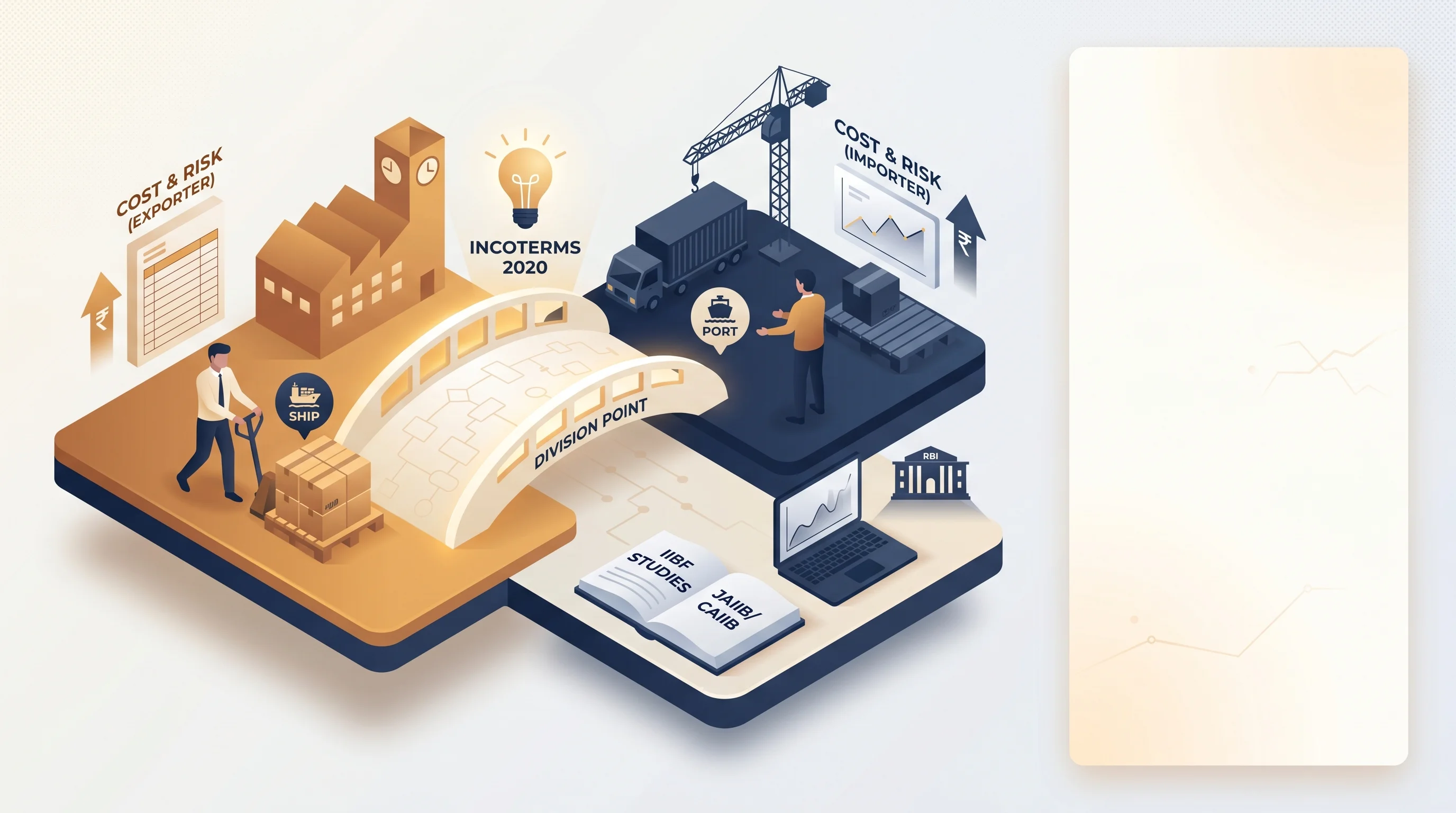
A banker financing trade must read Incoterms correctly to assess exposure, because the term chosen determines who is responsible for the goods, and who must insure them, at the moment something goes wrong. For a deeper treatment, see our complete guide to Letters of Credit and Incoterms 2020, then reinforce the eleven terms with our trade finance match game.
Bank Guarantees and Documentary Collections
A bank guarantee (BG) is an irrevocable undertaking by a bank to pay a beneficiary if the applicant fails to perform an obligation. Financial guarantees secure a payment obligation, such as the payment of customs duty or an advance, while performance guarantees secure the completion of a contract, such as building a plant to specification. The standby letter of credit serves a similar protective purpose and is governed by UCP 600 or by the ISP98 rules. Because guarantees do not involve an immediate outflow of the bank's funds, they are a major source of non-fund-based income, and a recurring exam topic.
Where the parties trust each other more, a cheaper documentary collection may be used instead of an LC. The two variants you must know cold are:
- Documents against Payment (D/P): the bank releases shipping documents to the buyer only on payment.
- Documents against Acceptance (D/A): documents are released against the buyer's acceptance of a time draft, with payment made later on maturity.
Collections are governed by the ICC's Uniform Rules for Collections (URC 522). The whole framework of foreign-exchange transactions, meanwhile, sits within FEMA, administered by the Reserve Bank of India. For more on guarantees and export terms, our Bank Guarantee and Export Credit guide ties these threads together for the ITF paper.
Export Credit, ECGC and Trade-Based Risks
Banks actively support exporters through two stages of finance. Pre-shipment credit, also called packing credit, finances the purchase and processing of goods before shipment. Post-shipment credit then bridges the gap until the overseas buyer pays. These facilities are often available at concessional rates under RBI schemes designed to promote exports, which is why every trade banker is expected to understand them.
Sitting alongside bank finance is the Export Credit Guarantee Corporation (ECGC), which provides insurance cover to exporters against the risk of non-payment by foreign buyers, and to banks against the risk of default on export credit facilities. ECGC is a high-frequency exam point, so be ready to state precisely what it covers and whom it protects.
International Trade Finance also carries distinctive risks that a prudent banker must manage:
- Country risk: the danger that political or economic conditions in the buyer's country prevent payment.
- Currency risk: the exposure created when receivables and payables are denominated in different currencies.
- Trade-based money laundering (TBML): the movement of illicit value through the over- or under-invoicing of goods.
Banks counter these through due diligence, price verification and sanctions screening. A banker who understands LCs, Incoterms, guarantees and export credit can structure trade finance that is both customer-friendly and prudent.
A Practical Study Plan for the ITF Paper
The fastest route to a high score in International Trade Finance is to build a tight, repeatable revision routine around the four pillars that generate the bulk of the questions. Here is a four-week plan you can adapt to your own timetable, and always cross-check the available window against the latest released IIBF schedule.
- Week 1 - Letters of credit: learn the parties, the LC types, and the UCP 600 principles of autonomy and strict compliance. Finish with a set of document-checking questions.
- Week 2 - Incoterms 2020: memorise the eleven terms grouped by transport mode, and drill the cost-versus-risk distinction until FOB and CIF are second nature.
- Week 3 - Guarantees and collections: separate financial from performance guarantees, and D/P from D/A, then add standby LCs and URC 522.
- Week 4 - Export credit and risks: nail packing credit, post-shipment credit, ECGC cover, and the country, currency and TBML risks, then sit two full timed mocks.
Make a one-page quick-reference card for each pillar; revising from these cards in the final days is far more effective than re-reading the whole syllabus. Track your progress with timed mocks from our ITF mock test bank and browse every related explainer in our collection of ITF guides.
Quick Comparison of Key Trade Finance Instruments
This table summarises how the main instruments differ on protection, cost, and the rules that govern them. Use it as a last-minute revision aid.
| Instrument | Primary Purpose | Governing Rules | Best When |
|---|---|---|---|
| Letter of Credit | Bank guarantees payment against compliant documents | UCP 600 | Trust between parties is low |
| Documentary Collection | Bank controls document release (D/P or D/A) | URC 522 | Moderate trust, lower cost wanted |
| Bank Guarantee / Standby LC | Pays beneficiary if applicant defaults | UCP 600 / ISP98 | Performance or payment must be secured |
| ECGC Cover | Insures against buyer non-payment / export-credit default | ECGC policy terms | Country or buyer risk is high |
Common Mistakes to Avoid
- Confusing cost with risk in Incoterms. Remembering that under CIF the seller pays for insurance but risk still passes at shipment is the difference between a right and a wrong answer.
- Treating the LC as tied to the sale contract. The autonomy principle means banks act on documents alone; forgetting this leads to wrong reasoning on dispute questions.
- Mixing up D/P and D/A. Payment first versus acceptance first is a small phrase with big marks attached.
- Assuming ECGC protects only the exporter. It also protects banks against default on export credit, which examiners love to test.
- Ignoring minor discrepancies in document checking. Strict compliance means even small mismatches matter; practise until you spot them quickly under time pressure.
Frequently Asked Questions
What is International Trade Finance in simple terms?
International Trade Finance is the set of banking instruments and techniques that allow exporters and importers in different countries to trade safely. It bridges the trust gap by having banks control documents and payments, so the seller is assured of payment and the buyer is assured of receiving conforming goods. The IIBF ITF paper tests these instruments in depth.
What is the autonomy principle of a letter of credit?
The autonomy principle means the letter of credit is independent of the underlying sale contract. Banks deal only in documents, not in the actual goods, and they pay against compliant documents regardless of any dispute in the sale. This protects the exporter and keeps the LC reliable as a payment instrument.
Under FOB, when does risk pass to the buyer?
Under FOB (Free On Board), risk passes from the seller to the buyer when the goods are loaded on board the vessel at the named port of shipment. Up to that point the seller bears the risk; after loading, the buyer does. This makes FOB one of the clearest illustrations of the Incoterms risk-transfer point.
What is the difference between D/P and D/A collections?
Under Documents against Payment (D/P), the bank releases the shipping documents to the buyer only when payment is made. Under Documents against Acceptance (D/A), the documents are released against the buyer's acceptance of a time draft, with payment due later on maturity. Both are governed by the ICC's URC 522.
What does ECGC provide?
The Export Credit Guarantee Corporation (ECGC) provides insurance cover to exporters against the risk of non-payment by foreign buyers. It also covers banks against the risk of default on export credit facilities they extend. This dual protection encourages banks to finance exports and helps exporters trade in riskier markets.
Is International Trade Finance a scoring paper for IIBF?
Yes. Because the syllabus is concept-driven and the same high-frequency areas, such as UCP 600 principles, Incoterms risk transfer, and ECGC cover, recur in every session, focused preparation pays off quickly. Building quick-reference cards for the four pillars and practising document-checking questions can turn International Trade Finance into one of your strongest papers. Always confirm the exam date and pattern on the official IIBF notification.
Conclusion
International Trade Finance rewards precise, structured knowledge more than rote memorisation. Master the UCP 600 principles of autonomy and strict compliance, lock down the Incoterms 2020 cost-versus-risk distinction, and keep the guarantees, collections, export-credit and ECGC topics sharp, because these themes recur in every exam session. Practise document checking until it is instinctive, sit regular timed mocks, and you will walk into the exam hall confident that this paper is working in your favour. Verify the latest exam schedule on the official IIBF website as you finalise your plan.
Related Guides
📚 Free Learning Sessions resources — connect & crack your exam
- 📝 Free mock tests — chapter-wise, exam-pattern, with instant solutions
- 🎮 Matching games — gamified revision of key terms & concepts
- 📄 Study notes & PDFs — downloadable chapter material
- 🎥 Video classes on YouTube — subscribe to @learningsessions
💬 Want the full course? WhatsApp your course name to 8360944207 and our team will set you up.
📱 Study on the go — get our iOS & Android app at iibf.store/app.
Practice this topic
Take a free mock test, download chapter PDFs, or watch a video class — all included on iibf.store.