The Compliance Function in Banks: FATCA, CRS and RBI Expectations
The compliance function in banks is the independent control unit that keeps a bank aligned with the law. RBI regulations, and its own internal codes of conduct. For candidates preparing for the IIBF Banking Compliance Professional certificate.
Understanding the compliance function in banks means mastering its role and independence. The responsibilities of the chief compliance officer. RBI guidance on compliance risk.
And cross-border tax transparency rules such as FATCA and CRS. This article walks through how a strong compliance framework is built. Assessed through RCSA.
And embedded into a healthy compliance culture that protects the bank from regulatory. Financial, and reputational harm.
Role and independence of the compliance function in banks
The compliance function in banks is one of the three pillars of a sound internal control architecture. Sitting alongside risk management and internal audit. Its core mandate is to identify.
Assess. Advise on. Monitor.
And report the bank's compliance risk. The risk of legal or regulatory sanctions. Material financial loss.
Or loss of reputation that a bank may suffer. It fails to comply with applicable laws and standards.
- Independence: The function must operate independently of business lines. Commercial pressure never dilutes a compliance opinion. It should have a formal status enshrined in a board-approved compliance policy.
- Adequate resources: Sufficient staff. Authority. And access to records. Personnel are essential for the function to discharge its duties effectively.
- Right to escalate: Compliance officers must have a direct reporting line to the board or its audit/risk committee. So material breaches reach the top without filtering.
- No conflict of interest: Staff in the compliance function should not hold responsibilities that they would later have to review.
This independence is what gives the function credibility. To test your grasp of these control structures, attempt the practice sets at iibf.store/tests and reinforce the vocabulary with the quick drills at our match game.

RBI guidance on compliance risk and the chief compliance officer
The Reserve Bank of India has issued detailed expectations for the compliance function in banks. Most notably through its framework on compliance functions. The appointment of a Chief Compliance Officer (CCO). RBI requires banks to establish an independent compliance function headed by a senior executive with stature. Authority, and unimpeded access to the Managing Director and the board.
- Seniority and tenure: The CCO should be of sufficient rank. Typically not below a General Manager equivalent. With a fixed minimum tenure (generally three years) to protect against arbitrary removal.
- Selection and removal: Appointment. Transfer. Or premature removal of the CCO is a board-level decision. And premature exits must be reported to RBI with reasons.
- Reporting: The CCO reports compliance breaches. The annual compliance review directly to the board or the Audit Committee of the Board (ACB).
- Coverage: RBI expects the function to track regulatory changes. Ensure timely implementation of new guidelines. And confirm that prior supervisory findings are remediated.
Compliance risk under RBI guidance is not limited to written rules; it extends to the spirit of regulation and to supervisory expectations. Candidates should follow live regulatory updates through IIBF news and keep an eye on the policy environment via RBI rates and policy, since monetary and prudential changes frequently create fresh compliance obligations.
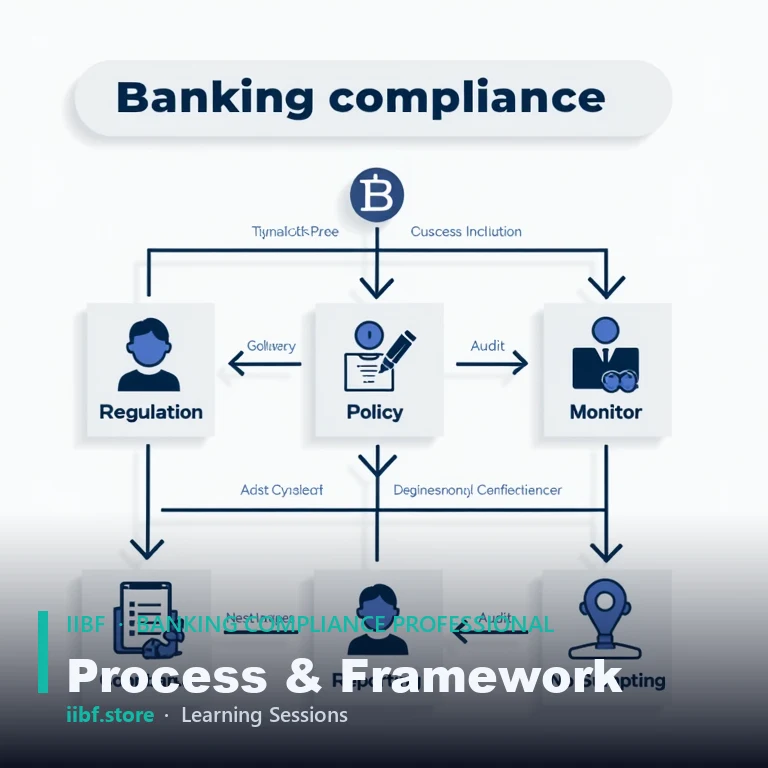
FATCA and CRS reporting obligations for Indian banks
Two of the most operationally demanding obligations handled by the compliance function in banks are FATCA (the US Foreign Account Tax Compliance Act). CRS (the OECD Common Reporting Standard). India is a partner under both regimes. And banks act as Reporting Financial Institutions that must collect. Validate, and report account information to the tax authorities for onward exchange.
- Due diligence: Banks must apply self-certification at account opening to determine a customer's tax residency. And run indicia searches on pre-existing accounts to flag US persons (FATCA) or other foreign tax residents (CRS).
- Reportable accounts: Identified accounts are reported in India through the income-tax e-filing portal. After. Information flows to the IRS (FATCA) or partner jurisdictions (CRS) via the competent authority.
- Documentation: A valid self-certification. TIN capture. And curing of any change-in-circumstances are central control points the compliance function must monitor.
- Penalties: Failure to maintain records. File accurately. Or obtain self-certification can attract penalties and reputational damage. So reconciliation and exception handling are critical.
FATCA and CRS sit at the intersection of KYC, tax law, and data governance, which is why the compliance function coordinates closely with operations and technology teams. For more conceptual coverage of related banking-law topics, browse the iibf.store blog.

Compliance risk assessment, RCSA and regulatory reporting
A mature compliance function in banks does not merely react to breaches. It proactively measures where compliance risk concentrates. The principal tool for this is the Risk and Control Self-Assessment (RCSA).
A structured exercise in which business units identify inherent compliance risks. Evaluate the strength of existing controls. And arrive at a residual risk rating.
- Risk identification: Each process — onboarding. Lending. Trade finance. FATCA/CRS reporting — is mapped to the regulations it must satisfy.
- Control evaluation: Controls are tested for design and operating effectiveness. Gaps generate remediation action plans with owners and timelines.
- Residual rating: Inherent risk minus control effectiveness yields residual risk. Which is escalated where it breaches the bank's risk appetite.
- Regulatory reporting: The function ensures returns. Disclosures. And incident reports to RBI. FIU-IND. And other regulators are accurate and timely. Since a single late or wrong submission can itself be a compliance breach.
RCSA results feed the annual compliance review presented to the board, closing the loop between assessment and governance. Practising scenario-based questions on these frameworks at iibf.store/tests is one of the most efficient ways to prepare for the examination.
Building a strong compliance culture
Frameworks and reports are necessary but not sufficient. The decisive factor is compliance culture. The shared commitment across the bank to do the right thing even when no one is watching.
RBI repeatedly stresses that the tone is set at the top: the board. Senior management must visibly champion compliance. Fund it adequately, and refuse to reward results achieved by cutting corners.
- Tone from the top: Leadership behaviour. Not posters. Defines whether staff treat compliance as ownership or as a tick-box.
- Training and awareness: Regular. Role-specific training keeps frontline staff alert to KYC. FATCA/CRS, and conduct obligations.
- Accountability: Clear consequences for breaches. Balanced with protection for whistle-blowers, embed the right incentives.
- Continuous improvement: Lessons from audits. RBI inspections, and peer events are folded back into policy.
A bank with a strong compliance culture turns regulation from a cost into a competitive advantage. Earning supervisory trust and customer confidence.
What does the compliance function in banks actually do?
It independently identifies. Assesses. Advises on.
Monitors. And reports compliance risk — ensuring the bank follows all applicable laws. RBI regulations, and internal codes, and escalating breaches to the board.
Who is the Chief Compliance Officer and why is tenure protected?
The CCO is a senior executive who heads the compliance function. RBI prescribes a minimum tenure (generally three years). Board-level appointment so the role stays independent. Cannot be removed arbitrarily for raising uncomfortable findings.
How are FATCA and CRS different?
FATCA is a US law targeting US persons abroad. While CRS is an OECD multilateral standard covering many partner jurisdictions. Both require Indian banks to determine tax residency. Identify reportable accounts, and report them through the income-tax portal.
What is RCSA in compliance?
Risk. Control Self-Assessment is a structured exercise where business units rate inherent compliance risk. Test their controls. And arrive at a residual risk rating that feeds the annual compliance review to the board.
Conclusion: master the compliance function and pass with confidence
The compliance function in banks is where law, regulation, and ethics meet day-to-day banking operations. By understanding its independence, the role of the CCO, RBI guidance on compliance risk, FATCA and CRS reporting, RCSA-based assessment, and the importance of compliance culture, you will be well prepared for the IIBF Banking Compliance Professional certificate. Put this knowledge to the test now with full-length mock exams at iibf.store/tests, and keep learning with fresh explainers on the iibf.store blog.
Practice this topic
Take a free mock test, download chapter PDFs, or watch a video class — all included on iibf.store.
Keep reading