Banking Compliance Professional (BCP) Syllabus 2026 + Free PDF
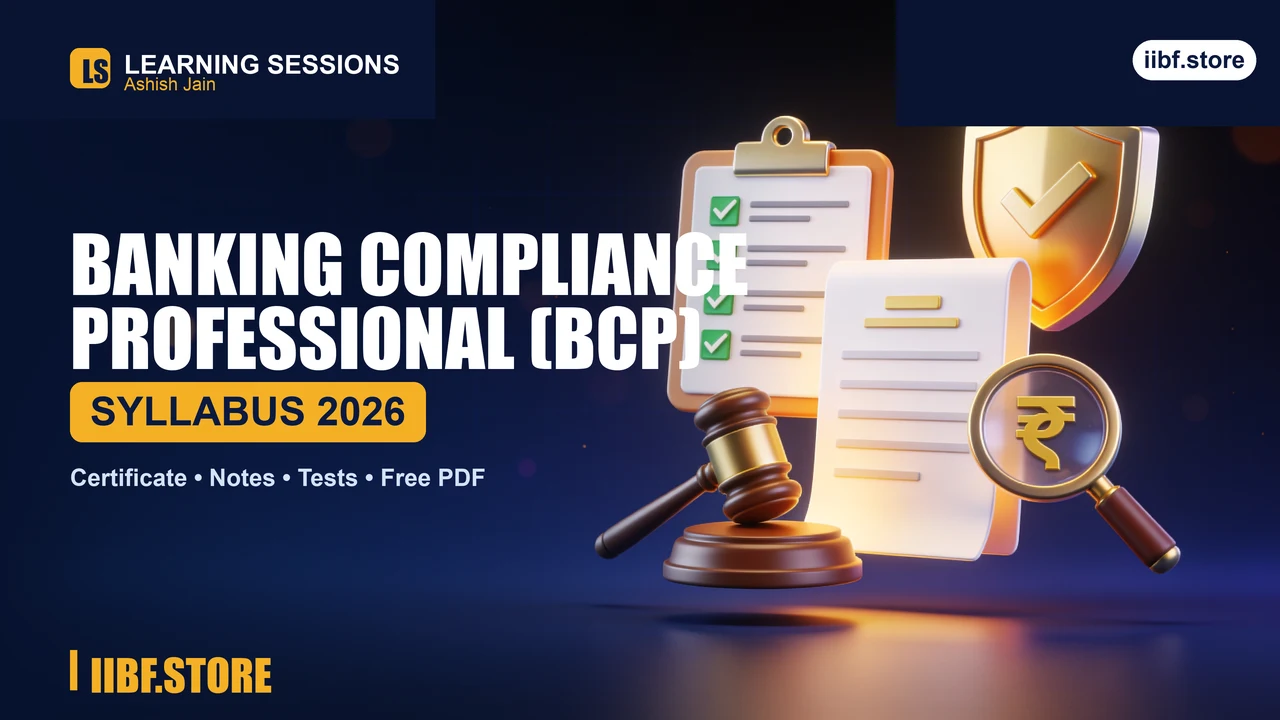
The Banking Compliance Professional (BCP) syllabus is the single most important document you will study before this IIBF certification, because every question on the paper traces back to one of its modules. The BCP qualification from the Indian Institute of Banking & Finance is built for officers who live in the compliance, risk, audit and regulatory corners of a bank, and clearing it cleanly comes down to three disciplines: knowing the syllabus map precisely, tracking what the Reserve Bank of India has recently changed, and practising application-style questions until they feel automatic. This guide walks through the complete 2026 Banking Compliance Professional syllabus module by module, flags the regulatory areas examiners love to test, and points you to free mock tests, notes and revision drills built around this exact blueprint.
Key takeaways
- The Banking Compliance Professional syllabus is organised into modules covering regulation & supervision, the compliance function, FEMA & forex, deposits & digital banking, customer protection and banking laws.
- FEMA and foreign-exchange operations form the largest, highest-scoring block, so they deserve the most study time.
- The exam is objective and case-study driven, rewarding conceptual clarity on RBI directions over rote recall.
- Always confirm question count, duration, marking, fees and passing marks from the latest IIBF notification, as IIBF revises these periodically.
- You can download the official BCP syllabus PDF and pair it with free mock tests on Learning Sessions.
Download the full BCP syllabus (PDF)
Keep the exam-ready Banking Compliance Professional syllabus open as you plan your study weeks across regulation, FEMA, KYC/AML and customer protection.
Download BCP Syllabus PDFWhat is the Banking Compliance Professional (BCP) course?
The Banking Compliance Professional certification is designed to build deep, practical expertise in the compliance function of banks. It covers banking regulation and supervision, risk management, the compliance governance structure, foreign-exchange operations under FEMA, deposit and digital-banking guidelines, customer service and protection, KYC/AML, and the key laws that touch a bank's business.
It is built for compliance officers, internal auditors, risk managers, branch heads and anyone whose daily work involves regulatory adherence. Because compliance is a frontline defence against regulatory penalties and reputational damage, the course trains bankers to spot compliance issues early, build a compliance culture, and apply RBI directions to real situations, from a forex remittance to a suspicious-transaction report.
Why the BCP syllabus matters more than any guidebook
Unlike a memory-heavy paper, the BCP rewards officers who understand why a rule exists. The syllabus is your contract with the examiner: it tells you exactly which RBI Master Directions, FEMA regulations and banking laws are in scope. Treat each unit as a checkpoint, and you convert a sprawling subject into a finite, conquerable list.
This matters because the regulatory landscape shifts constantly. Anchoring your revision to the official syllabus, then refreshing the specifics against current RBI circulars, keeps you from wasting hours on outdated figures or topics that fall outside the exam.
BCP exam pattern at a glance
The Banking Compliance Professional examination is an objective, MCQ-based test delivered through IIBF's mode of examination. Questions lean towards application and case studies rather than simple definition recall, so conceptual clarity on RBI directions and FEMA regulations matters far more than memorising lines.
Before you register, always confirm the current number of questions, duration, marking scheme and passing marks from the latest IIBF examination notification, as IIBF revises these periodically. The administrative section of the official BCP document also explains the study and examination process, classroom learning, fees and refund rules, examination-centre and conduct guidelines, and result and certificate details, so read those pages carefully at registration time.
Banking Compliance Professional syllabus 2026 module overview
The BCP syllabus is grouped into clear thematic blocks. The table below maps the major areas to what each one delivers, so you can budget your study weeks before diving into the detailed unit list.
| Module block | Core focus | Exam weight (relative) |
|---|---|---|
| Regulation & Supervision | Basel III capital, risk management, risk-based supervision | Medium |
| Compliance Foundations & Functions | Compliance scope, governance, CCO role, ethics, culture | High |
| FEMA & Forex | Exports, imports, ECB, LRS, overseas investment, FEMA reporting | Very high (largest block) |
| Deposits & Digital Banking | Deposit accounts, interest rates, NEFT/RTGS/UPI, cards, PPIs | Medium |
| Customer Service & Protection | KYC/AML, grievance redressal, IT security, outsourcing, frauds | High |
| Other Regulations & Important Laws | Disclosures, RBI returns, NI Act, SARFAESI, company law, global standards | Medium |
Exam weights above are indicative for planning only; confirm the authoritative module order in the downloadable BCP syllabus PDF and the latest IIBF notification.
Detailed chapter-wise BCP syllabus
Here is the unit-level breakdown of the Banking Compliance Professional syllabus, grouped by module so you can tick off topics as you cover them.
Regulation, supervision and the compliance function
- Basel III Capital Adequacy — CET1, Tier 1 and Tier 2 capital, buffers and capital adequacy ratio norms.
- Risks & Risk Management in Banks — credit, market, operational and liquidity risk frameworks.
- Risk Based Supervision — RBI's SPARC approach to supervising banks by their risk profile.
- Compliance — meaning, scope and importance of the compliance function.
- Compliance Governance Structure — role of the Chief Compliance Officer, the Board/Audit Committee and the independence of the function.
- Identification of Compliance Issues & Risks — mapping laws and directions to processes to find gaps.
- Compliance Culture, Banking Ethics in a Global Context and an Indian Case Study on real compliance failures.
FEMA and foreign-exchange operations (the scoring heart)
This is the largest module, so treat it as your anchor. The units run across the full life of forex compliance:
- Fundamental provisions and overview of FEMA 1999, including current vs capital account transactions.
- Export and import of goods & services — realisation, repatriation, advance remittances and documentation.
- External Commercial Borrowings (ECB) — eligible borrowers, lenders and end-use rules.
- Borrowing & lending in INR between residents and non-residents.
- Foreign investment in India (FDI/FPI routes, sectoral caps, reporting) and establishment of offices in India.
- Acquisition & transfer of immovable property, overseas investments (ODI/OPI) and money-changing activities (FFMC/AD licences).
- Remittance of assets out of India and Rupee/foreign-currency accounts — NRE, NRO, FCNR and resident foreign-currency accounts.
- Risk management & inter-bank dealing, reporting requirements under FEMA (FIRMS, FLA, ECB returns) and International Financial Services Centres (IFSC/GIFT City under IFSCA).
Deposits, digital banking and customer protection
- Operational aspects of deposit accounts, call/notice deposits and interest rates on deposits.
- Agency banking, the business-correspondent model and other financial services such as bancassurance and mutual-fund distribution.
- Electronic remittances — NEFT, RTGS, UPI and IMPS — plus cards and prepaid instruments (PPI) master directions.
- KYC & Anti-Money Laundering — KYC pillars, PMLA, CTR/STR reporting and customer due diligence.
- Guidelines on customer service, grievance redressal and the Banking Ombudsman scheme.
- IT & security norms, outsourcing of financial & IT services, and fraud & vigilance frameworks.
Other RBI regulations, banking laws and global standards
- Disclosure requirements (including Pillar 3) and the suite of returns to be submitted to RBI.
- Other relevant RBI regulations, recent initiatives and key committee/working-group reports.
- Laws for the bank's business — NI Act, SARFAESI, Contract Act and related statutes, plus company and labour law for support functions.
- Compliance case studies with global learnings and Basel Committee compliance principles.
Recently updated topics you must not miss
Compliance regulation moves fast, and the BCP paper increasingly tests the latest position. Give extra attention to these revised areas, and always cross-check exact figures against the current RBI Master Directions and the latest IIBF notification.
Compliance function & CCO norms: RBI has reinforced the independence, tenure and reporting line of the Chief Compliance Officer. Expect direct questions on governance structure, and verify the current requirements from RBI's circulars on the compliance function.
KYC / AML and digital KYC: the KYC Master Direction has evolved around periodic updation, the Video-based Customer Identification Process (V-CIP) and risk-based CDD. Study the current process and reporting obligations rather than older versions.
FEMA overseas-investment framework: the Overseas Investment Rules and Regulations consolidated ODI/OPI, and LRS-linked reporting has changed. Confirm the current ceilings, end-use conditions and reporting forms from RBI before relying on any specific figure.
How to prepare for the BCP exam: a module-by-module study plan
Because the paper is application-driven and regulation-heavy, a structured, module-led plan beats random reading. Here is a sequence that works for busy bankers:
- Build the base first. Lock in Basel III, risk management, risk-based supervision and the compliance governance structure so the rest of the syllabus has a frame to hang on.
- Master FEMA & forex next. This is the scoring heart of the paper. Drill exports and imports, ECB, LRS, overseas investment, NRI accounts and FEMA reporting until the answers come automatically.
- Cover deposits, digital banking and customer protection. KYC/AML, IT security, outsourcing and fraud frameworks carry direct, factual marks, so they are efficient to revise.
- Wrap up with laws and international best practices. The NI Act, SARFAESI, company law and Basel compliance principles round out the syllabus and often appear in case studies.
- Revise with mocks, one-liners and games. Alternate full-length BCP mock tests with quick one-liner revision and matching games so accuracy and speed climb together.
If you want the reasoning behind the governance and CCO rules explained in depth, our companion guide on the compliance function in banks for BCP is a natural next read.
Quick BCP one-liners for revision
Use these rapid-fire points to lock in the high-yield concepts in the days before the exam:
- Compliance function: an independent function that identifies, assesses and monitors compliance risk; the CCO reports to the Board/Audit Committee, not to business heads.
- Basel III capital: demands higher quality and quantity of capital — CET1, Tier 1 and total CAR plus a capital conservation buffer.
- KYC pillars: Customer Acceptance Policy, Customer Identification, Risk Management and ongoing monitoring of transactions.
- FEMA 1999: a civil law governing forex — current account transactions are generally free, while capital account transactions are regulated by RBI.
- LRS: the Liberalised Remittance Scheme lets resident individuals remit up to a prescribed annual ceiling for permitted current and capital account purposes.
- PMLA reporting: banks file CTR, STR, CCR and NTR with FIU-IND, and STRs carry no monetary threshold.
- Risk-based supervision: RBI's SPARC framework supervises banks on their risk profile, not a one-size-fits-all transaction check.
Common mistakes BCP aspirants make
- Under-investing in FEMA. Many candidates treat the largest module as the hardest and skim it. That single choice sinks more scores than any other.
- Memorising stale figures. Ceilings, thresholds and reporting forms change. Learn the framework, then confirm the exact number from RBI before the exam.
- Ignoring case-study technique. The paper poses situations, not definitions. Practise mapping a scenario to the relevant direction rather than reciting it.
- Skipping the administrative pages. Fees, refund rules and conduct guidelines rarely appear in questions, but missing a registration detail can cost you a cycle.
- Revising passively. Reading notes without timed mocks leaves you slow on exam day. Alternate reading with full-length practice from week one.
Free BCP study resources on Learning Sessions
A syllabus is only the start — you clear BCP by practising. Use the full toolkit, all built around this exact blueprint:
- Chapter-wise BCP mock tests — timed, exam-pattern MCQs with instant answers and explanations.
- Chapter one-liners — bite-sized revision points for last-mile prep.
- Matching games — gamified drills that make compliance terms, FEMA concepts and reporting types stick.
- Detailed notes & study-material PDFs — explore the Banking Compliance Professional subject hub for module-by-module material.
- The BCP course hub and all BCP guides — concept-building content for every compliance topic.
For deeper dives into the trickier areas, see our notes on RBI guidelines, the CCO role and FATCA/CRS and the banking compliance function with FATCA, CRS and risk management.
Frequently Asked Questions
What are the main modules in the BCP syllabus?
The Banking Compliance Professional syllabus spans regulation & supervision, compliance foundations and functions, FEMA & foreign-currency operations, deposits & digital banking, and customer service & protection including KYC/AML. It also covers other RBI regulations, important banking laws and international best practices. FEMA is the largest block and carries the most exam weight.
Where can I download the BCP syllabus PDF?
You can download the complete BCP syllabus PDF directly from Learning Sessions using the button near the top of this guide. It lists every module and unit in the official IIBF order, which makes it ideal for planning your study weeks. Keep it open alongside the latest IIBF notification so you always work from current information.
Is the Banking Compliance Professional course worth it?
Yes, for anyone in a compliance, risk, audit or branch-banking role. The BCP builds directly job-relevant skills and signals regulatory expertise to employers, which makes it one of the most practical IIBF certifications as compliance becomes central to banking. The knowledge also translates immediately into safer day-to-day decisions on the desk.
Which module should I study first for BCP?
Start with regulation and the compliance foundations so you understand the governance frame, then move to FEMA, which is the largest and highest-scoring module. Cover deposits, digital banking and customer protection next, and finish with banking laws and global standards. This order builds context before detail and keeps your hardest revision in the most rewarding area.
How is the BCP exam structured?
The BCP examination is an objective, MCQ-based test delivered through IIBF's mode of examination, with application and case-study questions rather than simple recall. The exact number of questions, duration, marking scheme and passing marks are set by IIBF and revised periodically. Always confirm the current pattern from the latest IIBF examination notification before you register.
How do I keep up with updated regulatory topics?
Follow the RBI Master Directions on KYC/AML, FEMA and the compliance function, since these are the areas examiners refresh most often. Pair them with regularly updated BCP notes and mock tests so the figures and circulars you revise stay current. When in doubt about a ceiling or threshold, always verify it on the official IIBF and RBI sources.
Start your BCP preparation today
A clear syllabus is half the battle. Download the Banking Compliance Professional syllabus PDF, map each module to a study week, revise with one-liners and matching games, and back it all with timed mock tests. With a structured plan and consistent practice, the BCP certification is well within reach. For the official source, always cross-check details on the Indian Institute of Banking & Finance website.
Related Guides
📚 Free Learning Sessions resources — connect & crack your exam
- 📝 Free mock tests — chapter-wise, exam-pattern, with instant solutions
- 🎮 Matching games — gamified revision of key terms & concepts
- 📄 Study notes & PDFs — downloadable chapter material
- 🎥 Video classes on YouTube — subscribe to @learningsessions
💬 Want the full course? WhatsApp your course name to 8360944207 and our team will set you up.
📱 Study on the go — get our iOS & Android app at iibf.store/app.
Practice this topic
Take a free mock test, download chapter PDFs, or watch a video class — all included on iibf.store.
Keep reading