Deposit Insurance & RBI Ombudsman Scheme: JAIIB 2026 Guide
Understanding deposit insurance and customer grievance redressal is essential for every JAIIB aspirant. The Deposit Insurance and Credit Guarantee Corporation (DICGC) provides deposit insurance cover of ₹5 lakh per depositor per bank, protecting millions of account holders across India. Alongside this safety net, the RBI Integrated Ombudsman Scheme (RBI-IOS) ensures that bank customers have a free, swift, and accessible forum to resolve complaints. Together, these two pillars of consumer protection form a major chunk of the Principles and Practices of Banking (PPB) paper. This guide breaks down every concept you need to score full marks — from DICGC premium rates and exclusions to the ombudsman's jurisdiction and award limits. Bookmark this page before your exam and test your knowledge on iibf.store practice tests.
DICGC and Deposit Insurance: The Foundation of Banking Safety
The Deposit Insurance and Credit Guarantee Corporation Act. 1961 established the DICGC as a wholly owned subsidiary of the Reserve Bank of India. Its primary mandate is to protect small depositors in the event of a bank failure.
The concept of deposit insurance is rooted in the principle that ordinary citizens. Who lack the expertise to assess a bank's financial health. Should not lose their hard-earned savings due to bank insolvency.
Under the current framework. Deposit insurance covers up to ₹5 lakh per depositor per registered bank. This limit was enhanced from ₹1 lakh to ₹5 lakh effective 4 February 2020.
A landmark revision after more than two decades. The ₹5 lakh protection encompasses both principal and interest combined. If a depositor holds accounts in multiple branches of the same bank.
All balances are aggregated for the purpose of this limit. However. Accounts held in different banks are treated independently.
Each qualifying for the full ₹5 lakh cover.
The types of deposits eligible for deposit insurance include savings bank deposits. Fixed deposits, recurring deposits, current account deposits, and cumulative deposits. Foreign currency deposits held by residents are also covered.
Importantly. Inter-bank deposits. Deposits of state and central governments.
State land development bank deposits with state co-operative banks. And deposits specifically exempted by the DICGC with RBI approval are excluded from coverage.
Every insured bank is required to display a notice that its deposits are insured by the DICGC, providing transparency and assurance to depositors. The DICGC insures all commercial banks including branches of foreign banks operating in India, local area banks, small finance banks, payments banks, and all eligible co-operative banks that have opted for coverage. For deeper conceptual clarity, you can explore related topics on the iibf.store blog.
DICGC Premium, Registration, and Claims Process
The DICGC charges an annual deposit insurance premium from all registered banks. The current premium rate is 12 paise per ₹100 of assessable deposits per annum (i.e.. 0.12% p.a.).
This premium is paid entirely by the insured bank. Not by the depositor. Banks pay the premium on a half-yearly basis.
In advance, for the periods April–September and October–March. Failure to pay the premium can lead to cancellation of the bank's insurance coverage.
The assessable deposit base for premium calculation includes all eligible deposits after deducting inter-bank deposits. Deposits by state and central governments, and other exempted categories. Banks must submit a statement of their deposit base to the DICGC within two months of the end of each half-year.
When Does the DICGC Pay Claims?
The DICGC pays claims when:
- A bank is placed under liquidation by the RBI or a court.
- A bank's licence is cancelled.
- A scheme of amalgamation or reconstruction leads to a merger where full deposits are not honoured.
When a bank is liquidated. The liquidator prepares a list of all claimants. Submits it to the DICGC within three months.
The DICGC is obligated to settle claims within two months of receiving the verified list from the liquidator. A crucial 2021 amendment to the DICGC Act introduced a significant change: depositors of banks under moratorium can now receive their insured amount up to ₹5 lakh within 90 days of the bank being placed under moratorium. A major reform ensuring timely relief rather than waiting for the lengthy liquidation process to conclude.
Stay updated on regulatory developments through IIBF News on iibf.store and brush up on key rates via the RBI Rates resource page.
| Feature | Details |
|---|---|
| Maximum Cover | ₹5 lakh per depositor per bank (principal + interest) |
| Premium Rate | 12 paise per ₹100 p.a. (paid by bank, not depositor) |
| Premium Payment | Half-yearly, in advance (April–Sept, Oct–March) |
| Claim Settlement | Within 2 months of liquidator's list; 90 days under moratorium |
| Established Under | DICGC Act, 1961 |
| Parent | Reserve Bank of India (wholly owned subsidiary) |
RBI Integrated Ombudsman Scheme: One Nation, One Ombudsman
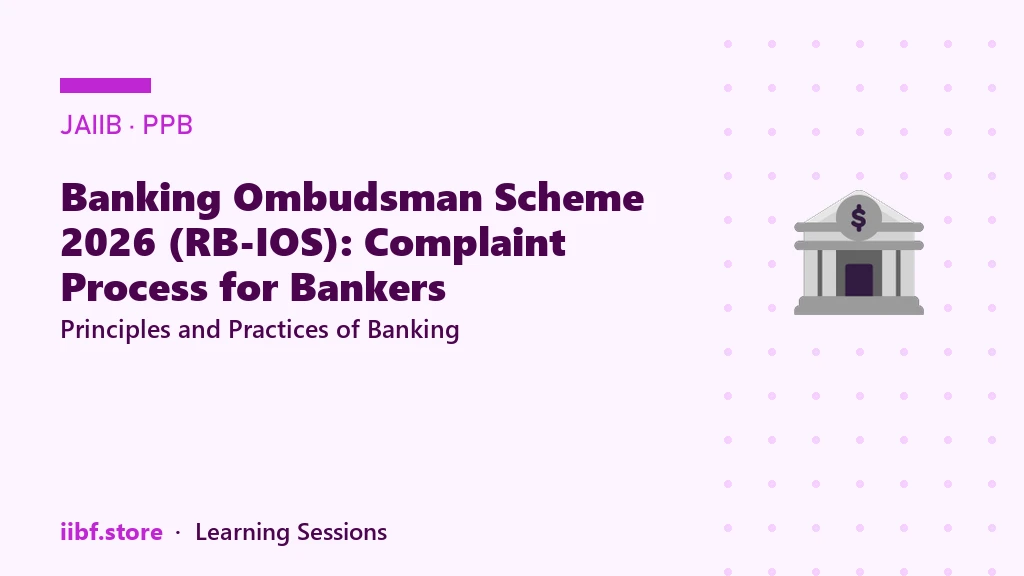
The RBI Integrated Ombudsman Scheme (RBI-IOS). Launched on 12 November 2021. Replaced the earlier separate ombudsman schemes for banks (Banking Ombudsman Scheme 2006).
NBFCs, and digital transactions with a single, unified scheme. The integration was a landmark reform aimed at simplifying grievance redressal. Making it truly customer-friendly.
Under the RBI-IOS. A customer need not identify which regulated entity's ombudsman to approach. The entire grievance is handled through a single-point contact (the Centralised Receipt.
Processing Centre at RBI. Chandigarh) and routed to the appropriate office. This removes the burden from complainants who were often confused about the right jurisdiction.
Who Can File a Complaint?
Any individual. Small business (turnover up to ₹10 crore). Or trust/association can file a complaint against a scheduled commercial bank.
A small finance bank. A payments bank. Or any RBI-regulated entity (including NBFCs.
Prepaid payment instrument issuers) that is a member of the scheme.
The complaint must first be lodged with the bank. Must remain unresolved for 30 days. Or the bank must have rejected the complaint.
Before escalating to the ombudsman. There is no fee charged to the complainant at any stage. The scheme is absolutely free.
Complaints can be submitted online at cms.rbi.org.in (the Complaint Management System), by post, or at any RBI office. The grounds for complaint include deficiency in service, non-payment or inordinate delay in payment, failure to observe RBI directions, unfair practices, and many others listed in the scheme. For JAIIB examination preparation, enrolling in a structured course at iibf.store/course/jaiib helps you master these topics systematically.

Ombudsman Awards, Jurisdiction, and Limitations
The RBI-IOS empowers the ombudsman to issue binding awards against regulated entities for deficiency in service. The maximum award that an ombudsman can grant is ₹20 lakh towards the loss suffered by the complainant. Additionally.
Compensation up to ₹1 lakh can be awarded for mental agony and harassment. The award is binding on the bank if the complainant accepts it within 30 days. The bank must implement the award within the same period.
The ombudsman can reject a complaint if it is frivolous. Vexatious, or pending before any other forum (court, consumer commission, etc.). Complaints must be filed within one year of the cause of action. The scheme does not cover complaints related to recruitment. Internal administration, or matters already adjudicated by a court.
Internal Ombudsman at Banks
Scheduled commercial banks with more than 10 branches are required to appoint an Internal Ombudsman (IO). The IO reviews complaints that have been partially or wholly rejected by the bank's grievance redressal machinery. The bank must send all such rejected complaints to the IO before a final decision is communicated to the customer. This ensures an independent internal review. Reducing avoidable escalations to the RBI ombudsman and improving first-line resolution.
Practice conceptual questions on grievance redressal and related topics using iibf.store's Match game, which tests your recall of regulatory facts in an engaging format.
Exam Strategy: Key Numbers and Facts to Remember
For the JAIIB PPB paper. Examiners frequently test numerical facts and procedural details. The following points are high-frequency exam targets:
- Deposit insurance limit: ₹5 lakh (enhanced from ₹1 lakh in February 2020).
- DICGC premium: 12 paise per ₹100 p.a.. Paid by the bank half-yearly in advance.
- DICGC established under: DICGC Act, 1961; wholly owned subsidiary of RBI.
- Moratorium claim period: 90 days (DICGC Amendment Act, 2021).
- RBI-IOS launch date: 12 November 2021 (replaced three earlier schemes).
- Ombudsman maximum award: ₹20 lakh (loss) + ₹1 lakh (mental agony).
- Bank must resolve complaint before ombudsman escalation: 30 days.
- Complaint time limit: 1 year from cause of action.
- Internal Ombudsman mandatory for: banks with more than 10 branches.
- Ombudsman fee for complainant: Nil (completely free).
Understanding the interplay between deposit insurance protection and ombudsman-based grievance redressal gives you a holistic picture of how the Indian banking system protects its customers. These are not isolated topics — they are complementary safeguards that together form the consumer protection architecture of Indian banking. For additional study material, explore the full JAIIB preparation course and CAIIB modules at iibf.store/course/caiib.
Conclusion and Key Takeaways
The DICGC's deposit insurance scheme. The RBI Integrated Ombudsman Scheme are two of the most important consumer protection mechanisms in Indian banking. For JAIIB PPB candidates.
Mastering the numerical thresholds. Timelines, and procedural requirements covered in this article is non-negotiable. Remember that deposit insurance covers up to ₹5 lakh per depositor per bank.
The DICGC premium is borne by the bank at 12 paise per ₹100. And the 2021 amendment ensures moratorium claims are settled within 90 days. On the ombudsman side.
The shift to the unified RBI-IOS in November 2021 simplified redressal. With a maximum award of ₹20 lakh. A free-of-cost process for all eligible complainants.
Use structured practice to reinforce these concepts. Take topic-wise mock tests, attempt the Match game for rapid-fire recall, and go through previous-year questions on DICGC and the Banking Ombudsman. Start your JAIIB mock test series today at iibf.store/tests and give yourself the exam-readiness edge you need to clear PPB on your first attempt.
What is the maximum deposit insurance cover under the DICGC?
The DICGC provides deposit insurance cover of up to ₹5 lakh per depositor per registered bank. This limit covers both principal. Interest combined and was enhanced from ₹1 lakh to ₹5 lakh effective 4 February 2020. Accounts in different banks are insured independently. Each eligible for the full ₹5 lakh protection.
Who pays the DICGC deposit insurance premium — the bank or the depositor?
The deposit insurance premium is paid entirely by the insured bank. Not by the depositor. The current premium rate is 12 paise per ₹100 of assessable deposits per annum (0.12% p.a.). Payable in advance on a half-yearly basis for the periods April–September. October–March.
How does a customer file a complaint under the RBI Integrated Ombudsman Scheme?
A customer must first lodge the complaint with the bank. Wait 30 days for a response (or receive a rejection). If unresolved.
The complaint can be filed online at cms.rbi.org.in. By post, or at any RBI office. The scheme is completely free for complainants.
The RBI-IOS was launched on 12 November 2021. Replaced the earlier separate ombudsman schemes for banks. NBFCs, and digital transactions.
What is the maximum award an RBI Ombudsman can grant against a bank?
The RBI Ombudsman can award up to ₹20 lakh towards the actual loss suffered by the complainant due to deficiency in service. In addition. Compensation of up to ₹1 lakh can be awarded for mental agony. Harassment. The award is binding on the bank if accepted by the complainant within 30 days.
Quick quiz on this topic
5 exam-style questions from our free test bank — check yourself before you move on.
Practice this topic
Take a free mock test, download chapter PDFs, or watch a video class — all included on iibf.store.
Keep reading