JAIIB Study Plan 2026: Why Chapter 1 Is the Worst Start
Almost every candidate builds the same JAIIB study plan on day one: open the first book, turn to Chapter 1, and begin. It feels responsible. It is also the reason so many people run out of time in the last three weeks with half the syllabus untouched. The order printed in a module is an editorial decision, not a difficulty ranking and not a marks ranking. A JAIIB study plan that follows it is optimising for tidiness instead of for the score.
JAIIB Chapter 1 se start mat karna · Watch on YouTube
Why Chapter 1 is usually the wrong first chapter
Open any of the four papers and look at what sits at the front. It is almost always definitional, historical or structural material — the kind of content that sets up the subject but carries a thin slice of the marks. It is slow to read, hard to test yourself on, and it gives you no early sense of progress.
Meanwhile the chapters that reliably carry weight in the question paper tend to sit in the middle and the back of the modules. Advances, deposits, negotiable instruments, ratios, taxation, retail products, digital channels. Those are the chapters with rules, numbers and slabs — the kind of thing an objective paper can actually ask about. If you spend your freshest three weeks at the front of the book, you meet the high-yield material when you are already tired and short of time.
There is a second, quieter cost. Starting at Chapter 1 hides the shape of the exam from you. You do not learn what a JAIIB question actually looks like until you are weeks in, so you cannot calibrate how deeply to read. Candidates who start with a heavy, question-rich chapter learn that calibration in week one and read everything else faster because of it.
What the rulebook actually rewards
Before ordering anything, it helps to know precisely what you are being scored against, because the rules shape the strategy. Per the Indian Institute of Banking and Finance Rules and Syllabus, JAIIB has four subjects: Indian Economy and Indian Financial System, Principles and Practices of Banking, Accounting and Financial Management for Bankers, and Retail Banking and Wealth Management.
Each paper carries approximately 100 objective multiple-choice questions for 100 marks, runs for two hours, is held online only, and — this is the strategically important part — carries no negative marking. The pass mark is 50 out of 100 in a subject. Alternatively, a candidate securing at least 45 in each subject with an aggregate of 50% across all subjects in a single attempt is also declared to have completed the examination. Credits for a subject you have passed are retained until your time limit expires.
That time limit is five attempts within a maximum of three years from first registration, whichever comes first. The attempts need not be consecutive, and an attempt is counted the moment you apply — whether or not you sit the paper.
| Rule | What it says | What it means for your order |
|---|---|---|
| Pass mark | 50 out of 100 in the subject | You need half, not all. Chase the reliable half first. |
| Alternate route | 45 in each plus 50% aggregate in one attempt | A strong paper can rescue a weak one — but only in the same sitting. |
| Negative marking | None | Never leave a blank. Breadth beats depth on the margin. |
| Credits | Retained till the time limit expires | Clearing two papers cleanly is worth more than four half-prepared ones. |
| Time limit | 5 attempts or 3 years, whichever is earlier | Attempts are scarce. Do not burn one as a rehearsal. |
Three rules that beat the printed order
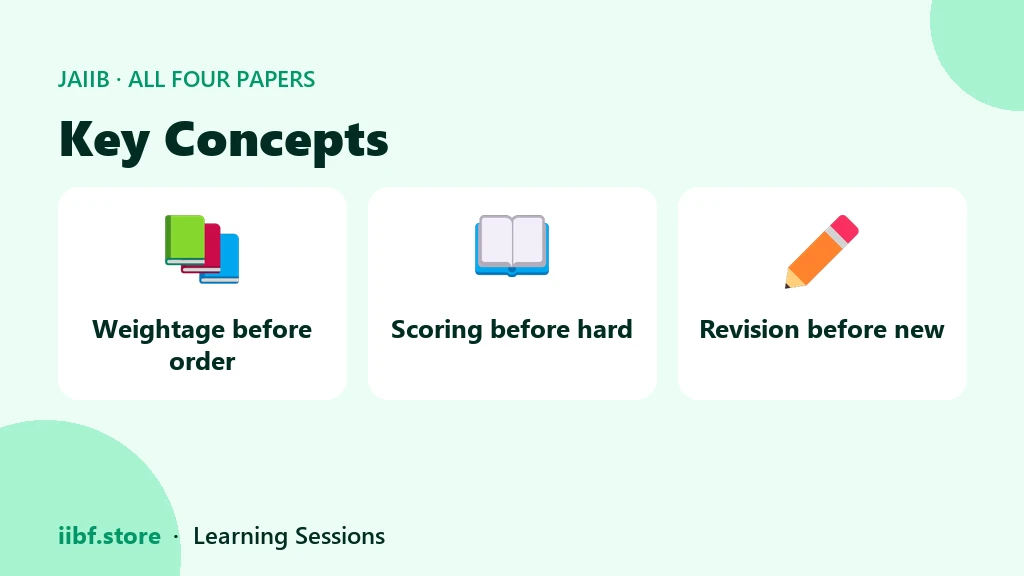
The first rule is weightage before sequence. Take each paper, list its modules, and mark the two or three that historically generate the most questions. Those go first, while your attention is cheap and plentiful. Chapter 1 can wait until week three, when it will take you an hour instead of an evening because you will already know the vocabulary.
The second rule is scoring before difficult. There is a persistent belief that you should attack your weakest area first because it needs the most time. With no negative marking and a 50% pass bar, that is backwards. Bank the chapters you can convert into near-certain marks, get yourself comfortably past the pass line on paper, and then spend whatever is left on the hard material. A JAIIB study plan built this way fails safely; one built the other way can leave you below 50 with nothing banked.
The third rule is revision before new material. From the halfway point onwards, no study day should be entirely new content. Roughly a third of each session belongs to what you covered last week, because a chapter read once and never revisited is, for scoring purposes, a chapter you did not read.
Building the order in one sitting
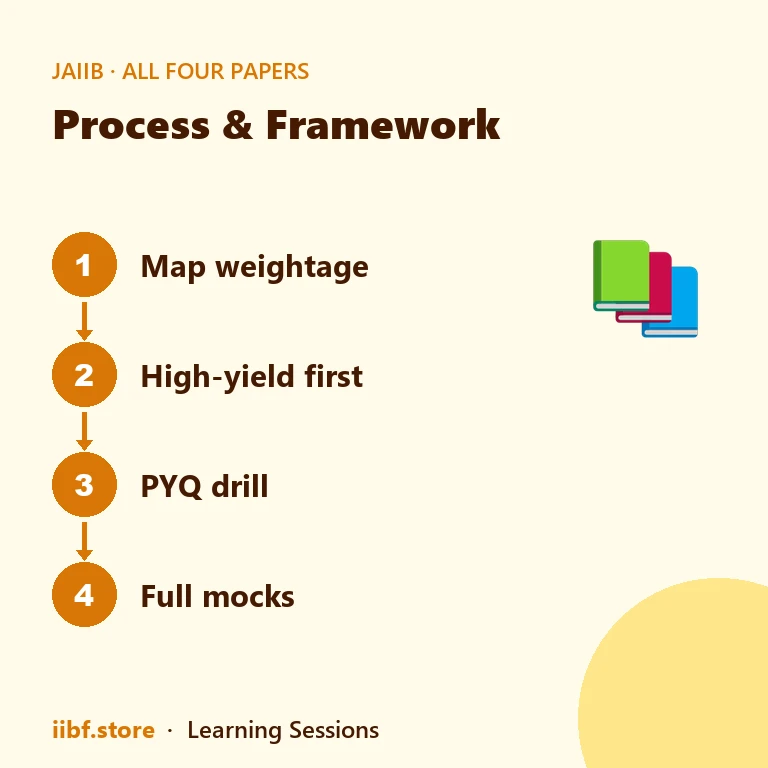
Give yourself ninety minutes before you study anything. Open all four syllabi side by side and write out every module. Against each, put a rough question count from previous papers and a personal confidence score out of five. You now have a grid, and the grid tells you the order: high weight and low confidence goes first, high weight and high confidence goes second, low weight and low confidence goes last.
Then convert the grid into dates. Assign each block a specific week rather than a vague position in a queue, and leave the final two weeks entirely free of new chapters — those belong to full-length mocks and error review. The study planner will hold that schedule for you so it survives the first week that goes badly, which it will.
From there the mechanics are ordinary. Read a chapter, then immediately attempt questions on it rather than moving on — the chapter-wise tests exist for exactly that loop, and the gap between what you think you understood and what you can answer is always wider than expected. Keep the full JAIIB course open for the module maps, and when your recall goes flat, the match game is a faster way to fix definitions than rereading them.
None of this is about studying more hours. It is about pointing the same hours at the chapters that pay. Start where the marks are, and Chapter 1 will still be there in week three — costing you far less than it would have cost you today.
So should I skip Chapter 1 entirely?
No. Skip it as a starting point, not as content. Foundational chapters are much faster to absorb once you already know the subject vocabulary from a heavier chapter, so read them in the middle of your schedule rather than at the front.
Is there negative marking in JAIIB?
No. The Rules and Syllabus state there is no negative marking for wrong answers, and each paper has approximately 100 multiple-choice questions for 100 marks over two hours. That is why you should never leave a question blank.
How many attempts do I get?
Five attempts within a maximum of three years from the date of registration for your first attempt, whichever comes earlier. The attempts need not be consecutive, and an attempt counts once you apply, even if you do not appear.
Should I prepare all four papers at once?
Credits for passed subjects are retained until the time limit expires, so clearing papers cleanly is what matters. If your time is tight, a JAIIB study plan that fully secures two or three papers usually beats one that leaves all four at 45%.
Prefer revising from a printed book?
Chapter-wise books with MCQs after every chapter — minimal pages, complete coverage, delivered anywhere in India. Every book has a free sample to read first.
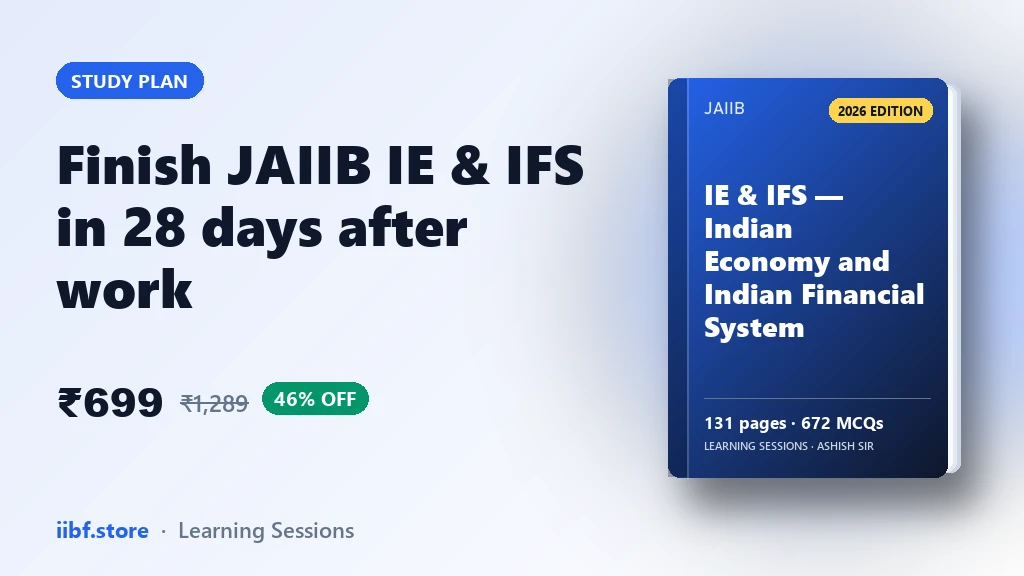
131 pages · 672 MCQs
Learning Sessions · Ashish Sir
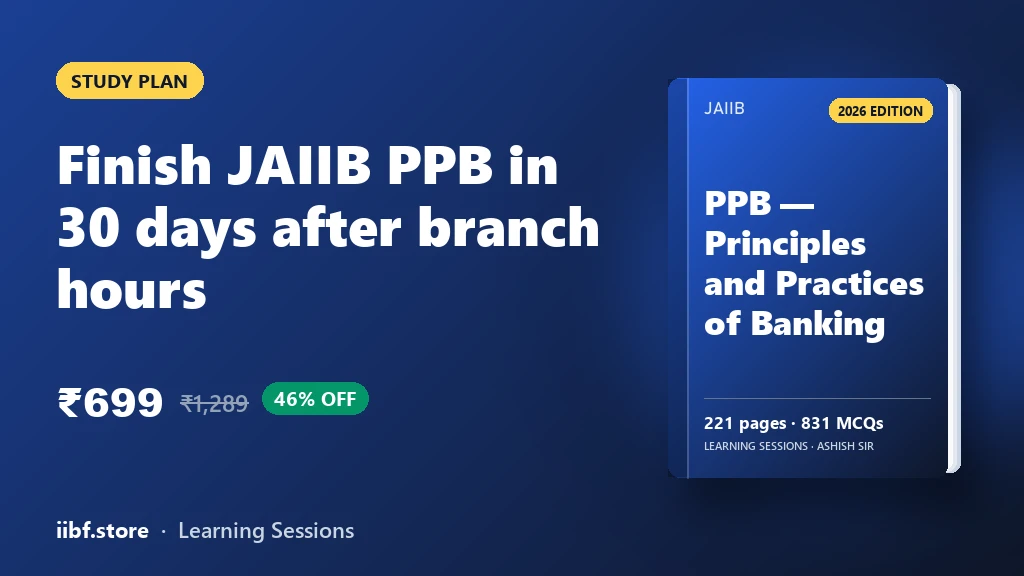
221 pages · 831 MCQs
Learning Sessions · Ashish Sir
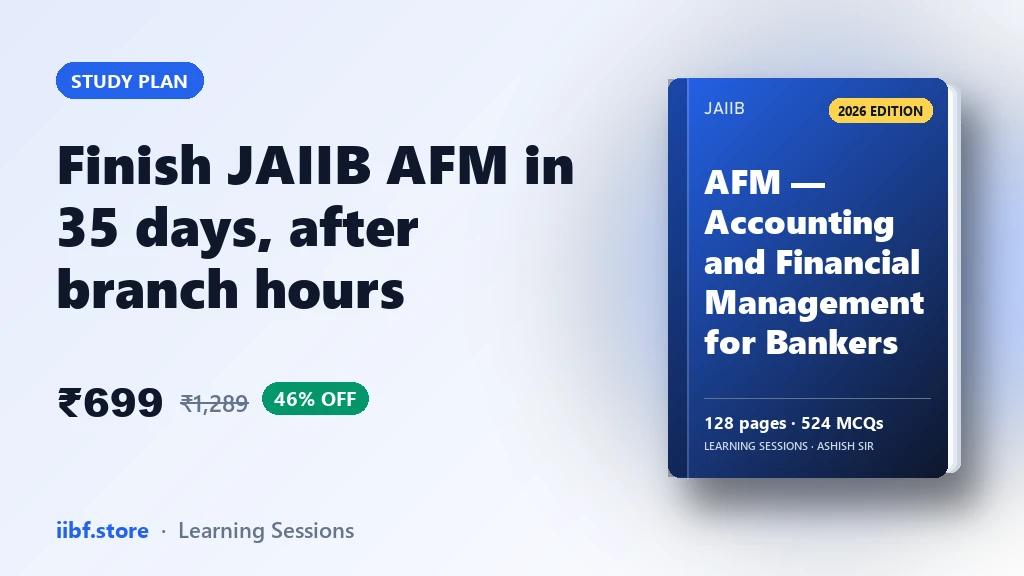
128 pages · 524 MCQs
Learning Sessions · Ashish Sir
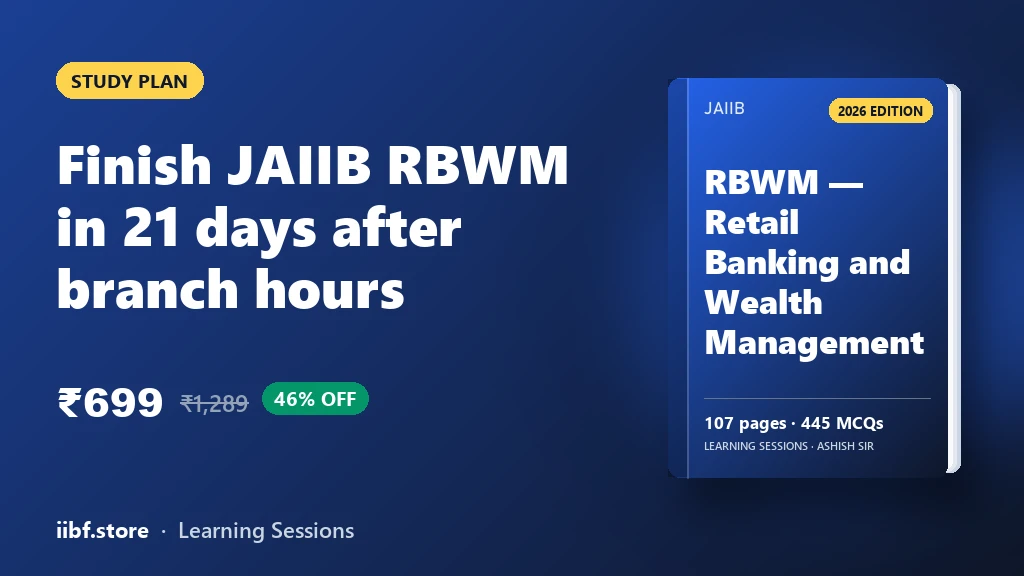
107 pages · 445 MCQs
Learning Sessions · Ashish Sir
148 pages · 478 MCQs
Learning Sessions · Ashish Sir
151 pages · 465 MCQs
Learning Sessions · Ashish Sir
148 pages · 375 MCQs
Learning Sessions · Ashish Sir
216 pages · 895 MCQs
Learning Sessions · Ashish Sir
109 pages · 300 MCQs
Learning Sessions · Ashish Sir
104 pages · 360 MCQs
Learning Sessions · Ashish Sir
82 pages · 297 MCQs
Learning Sessions · Ashish Sir
151 pages · 600 MCQs
Learning Sessions · Ashish Sir
98 pages · 282 MCQs
Learning Sessions · Ashish Sir
132 pages · 225 MCQs
Learning Sessions · Ashish Sir
188 pages · 435 MCQs
Learning Sessions · Ashish Sir
117 pages · 236 MCQs
Learning Sessions · Ashish Sir
Learning Sessions · Ashish Sir
118 pages · 299 MCQs
Learning Sessions · Ashish Sir
Learning Sessions · Ashish Sir
Learning Sessions · Ashish Sir
Learning Sessions · Ashish Sir
115 pages · 255 MCQs
Learning Sessions · Ashish Sir
Learning Sessions · Ashish Sir
334 pages · 936 MCQs
Learning Sessions · Ashish Sir
Learning Sessions · Ashish Sir
115 pages · 344 MCQs
Learning Sessions · Ashish Sir
107 pages · 240 MCQs
Learning Sessions · Ashish Sir
90 pages · 150 MCQs
Learning Sessions · Ashish Sir
Learning Sessions · Ashish Sir
Quick quiz on this topic
5 exam-style questions from our free test bank — check yourself before you move on.
Practice this topic
Take a free mock test, download chapter PDFs, or watch a video class — all included on iibf.store.