Small Finance Banks Exam Date July 2026: Full Prep Guide
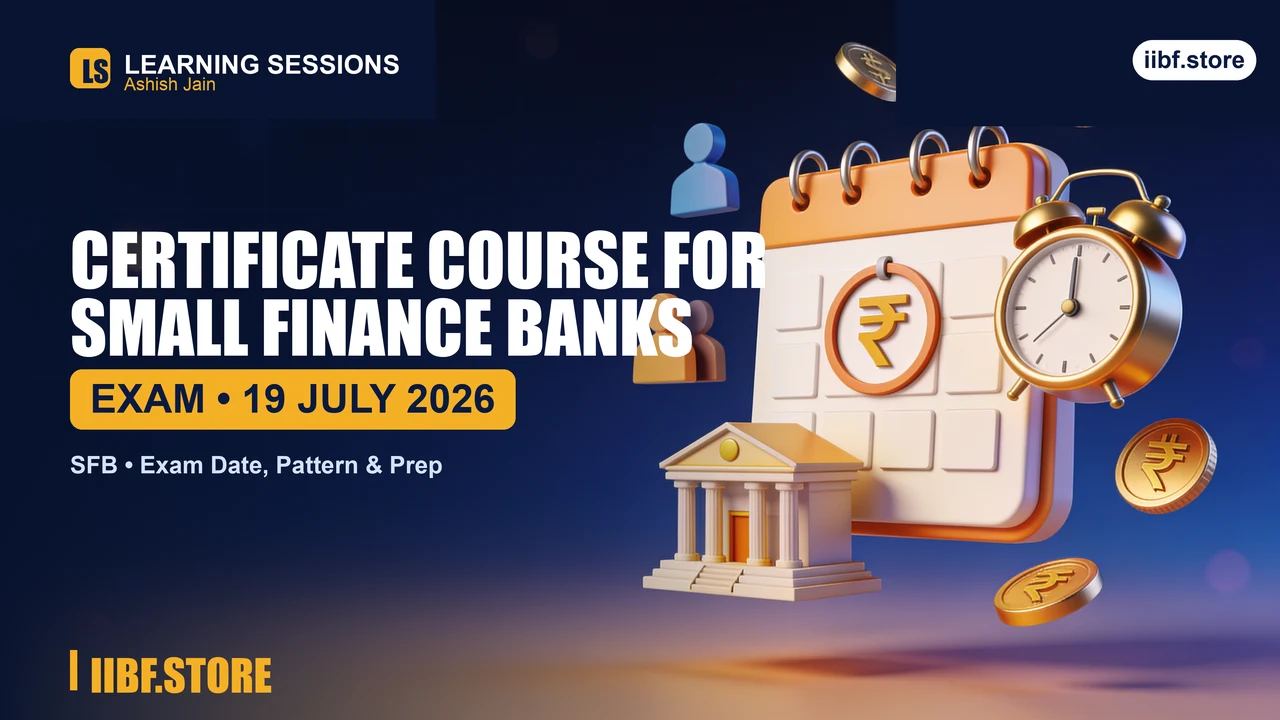
The Small Finance Banks exam date is the single anchor every serious candidate should build their preparation around, and for the upcoming cycle that date is 19 July 2026. The IIBF Certificate Course for Small Finance Banks is a focused, single-paper qualification, and the people who clear it on the first attempt are almost always the ones who planned backwards from this fixed date instead of cramming in the final fortnight. This guide walks you through every date that matters, what the paper actually tests, the mistakes that quietly cost marks, and a realistic week-by-week study plan that gets you to exam day genuinely ready.
Key takeaways
- The next Small Finance Banks exam date is 19 July 2026, with the following sitting around 17 January 2027 — both as per the latest released IIBF schedule.
- It is a fixed-date, objective (MCQ) single-paper exam — the day does not move to suit your slot, so you plan around it.
- Registration for the July cycle typically opens around April 2026; miss the window and you wait roughly six months.
- The syllabus runs from licensing and regulation to products, financial inclusion, risk and governance — concept-led, not rote.
- A backward-planned, mock-driven study schedule beats a last-month sprint every single time.
When is the Small Finance Banks exam date?
As per the latest released IIBF schedule, the next sitting of the Certificate Course for Small Finance Banks is fixed for 19 July 2026, with the subsequent cycle falling around 17 January 2027. Because this is a fixed-date exam — not a remote-proctored, pick-your-own-slot test — the date will not bend to fit your calendar. You build your plan around it, which is exactly why an early, disciplined start pays off.
Treat the gap between the two cycles as a feature, not a footnote. If July genuinely does not work for you, January gives you a clean fallback. The key is to commit to one date you can realistically prepare for and treat it as a hard anchor — a fixed deadline removes the temptation to keep postponing. Always confirm the exact day on the official IIBF notification before you lock your plan, as schedules can be revised.
Why the Small Finance Banks certificate is worth your time
Small finance banks occupy a very specific and fast-growing space in Indian banking: financial inclusion, micro and small enterprises, priority-sector lending and last-mile credit. The certificate signals that you understand how these banks are licensed, regulated and operated — precisely the knowledge an SFB wants in its people.
For working professionals it is a credibility marker on your profile and a clear nod to a recruiter or internal panel that you know the regulatory terrain. For newcomers it is a structured doorway into a segment that is hiring across credit, operations and compliance. Either way, the real value comes from clearing it cleanly and carrying the knowledge into the job, not from scraping a last-minute pass.
Registration: do not miss the window
Registration for the July sitting generally opens around April 2026. The window is short, and a missed deadline usually means waiting for the next cycle. Put a reminder in your phone today, and work through this quick checklist well before the portal goes live:
- Confirm your IIBF login and membership details before the window opens — recovering a forgotten password on day one wastes precious time.
- Apply early, not on the final day when the portal is busiest and upload errors are common.
- Keep your photo, signature and payment method ready in the correct formats to avoid rejected uploads.
- Double-check your name and contact details on the form; corrections later are a needless headache.
- Verify the exact dates and fee on the latest IIBF notification, as windows and amounts can shift slightly between cycles.
What the Small Finance Banks exam tests on paper
The Small Finance Banks exam is an objective, multiple-choice paper that rewards understanding over memorisation. Expect application and scenario-style questions spread across the core themes of the SFB model. Do not assume a fixed number of questions, duration or passing marks — these can change, so always confirm the current pattern and pass criteria on the latest IIBF notification before exam day.
- Concept and licensing: what small finance banks are, the RBI licensing framework, and how they differ from universal and payments banks.
- Regulatory framework: capital requirements, priority-sector and small-ticket lending obligations, and compliance norms.
- Products and operations: deposits, micro-loans, MSME finance, and day-to-day banking operations.
- Financial inclusion: the role of these banks in reaching the unbanked and underbanked, and the technology that powers it.
- Risk, governance and customer protection: credit and operational risk, governance standards, and fair-practice norms.
The smartest move is to know the syllabus cold rather than guess at the exam pattern. You can download the official syllabus PDF and map every chapter to a study week. To see how the licensing and obligation rules fit together, our deep-dive on Small Finance Bank Licensing and Obligations is a strong companion read.
Two cycles at a glance: July 2026 vs January 2027
Choosing between the two upcoming windows comes down to how much clean preparation time you have. The comparison below frames the decision; treat the dates as per the latest released IIBF schedule and reconfirm on the official notification.
| Factor | July 2026 cycle | January 2027 cycle |
|---|---|---|
| Exam date | 19 July 2026 (fixed) | Around 17 January 2027 (fixed) |
| Registration | Typically opens around April 2026 | Opens later in 2026 — confirm on IIBF |
| Best for | Candidates with a few clear months to study | Beginners or those tied up through summer |
| Runway | ~8 focused weeks from registration | A longer ramp for a from-scratch start |
| Exam mode | Objective MCQ, single paper | Objective MCQ, single paper |
If you are reading this with a few months in hand, the 19 July 2026 sitting is usually the practical choice — the April registration window hands you a clean, focused runway. The January cycle suits anyone starting from zero or blocked by work commitments. Whichever you pick, register on the first day the window opens and protect your mock-test weeks.
Week-by-week study plan for the Small Finance Banks exam date
Counting back from 19 July 2026, here is a realistic schedule that keeps the pressure low and the coverage complete. Anchor every week to the date and you arrive calm, not crammed.
- Weeks 1–3 — Foundation: cover the concept, licensing and regulatory framework. This is the backbone of the paper, so go slowly and get it right. Pair your reading with our explainer on the RBI licensing framework for SFBs.
- Weeks 4–6 — Products and operations: work through deposits, micro and MSME lending, and operations. Start one timed mock test each weekend to build stamina under the clock.
- Weeks 7–8 — Inclusion, risk and governance: finish financial inclusion, risk and governance, and begin mixing full-length mocks with quick one-liner recaps.
- Final 1–2 weeks — Revision only: pure revision and mocks. Fix weak chapters and review high-yield definitions; do not chase brand-new topics this close to the date.
If you only have four or five weeks, compress the foundation phase but never skip the mock-test weeks — that is where weak chapters surface while there is still time to fix them. You can run timed, exam-pattern questions any time on our Small Finance Banks mock tests, and lock in tricky terminology with the SFB matching games.
Common mistakes to avoid
- Treating it as memorisation: the paper rewards concepts. Understand why a licensing or lending rule exists, not just its wording.
- Confusing bank types: small finance banks, payments banks and universal banks follow different rules. Mixing them up is a classic trap — our PSL 75 percent requirement explainer makes the SFB-specific norms stick.
- Relying on outdated figures: regulatory limits evolve. Keep your numbers current rather than trusting old notes or screenshots.
- Skipping mocks: reading is not the same as attempting under time pressure. Mocks expose gaps early, while you can still act on them.
- Leaving registration late: the April window is short, and a missed deadline can mean a roughly six-month wait for the next cycle.
Free resources to prepare faster
Everything on Learning Sessions is built around this exact syllabus, so your prep stays on target from day one. Browse every guide for this exam in one place via the SFB blog hub, and lean on these for speed:
- Chapter-wise mock tests — timed, exam-pattern questions with instant explanations.
- Chapter one-liners for fast last-mile revision.
- Matching games that make regulatory terms and product concepts stick.
- Downloadable notes and study-material PDFs mapped to each module.
- Recorded and live classes by Ashish Jain covering every section of the syllabus.
Exam-day checklist
- Admit letter (printed) and a valid photo ID — carry both, no exceptions.
- Reach the centre early — aim for around 45 minutes before reporting time.
- Read each question fully; distractors are deliberately close, so do not skim.
- Attempt every question and confirm the marking scheme printed on your admit letter.
- Watch the clock: budget your time per question and flag tough ones for a second pass.
Frequently Asked Questions
What is the Small Finance Banks exam date in 2026?
As per the latest released IIBF schedule, the next Certificate Course for Small Finance Banks exam is on 19 July 2026. The following sitting falls around 17 January 2027. Always reconfirm the exact day on the official IIBF notification before finalising your plan.
When does registration for the July 2026 sitting open?
Registration for the July cycle typically opens around April 2026. The window is short, so apply early rather than on the final day. Confirm the precise dates and fee on the official IIBF site, as they can shift slightly between cycles.
Is the Small Finance Banks exam fixed-date or remote-proctored?
It is a fixed-date exam. IIBF announces specific dates rather than letting you pick a slot on demand, so you plan your preparation around 19 July 2026. This is why a backward-planned schedule works so well for this paper.
How many attempts do I get?
IIBF generally allows multiple attempts within a fixed time limit from your first registration. The exact limit can vary, so check the current rule on the official notification. The smart goal, of course, is to clear it on the first try.
What does the Small Finance Banks paper cover?
The syllabus spans licensing and the RBI framework, the regulatory and capital norms, products and operations, financial inclusion, and risk and governance. It is an objective MCQ paper that leans on application and scenarios. You can download the official syllabus PDF to map every chapter to your study weeks.
Where can I get the official syllabus?
You can download the official syllabus PDF directly and use it to plan your study calendar before you register. For the authoritative exam notification and any pattern changes, always check the official IIBF website.
Final word
The 19 July 2026 Small Finance Banks exam date is closer than it looks once the April registration window opens. Lock the date, register on time, and work a steady week-by-week plan instead of a last-month sprint. Start with the syllabus, layer in mock tests and one-liners, and fix your weak chapters through repeated practice rather than passive re-reading.
Do that, and you will not only clear the Small Finance Banks certificate on your first attempt — you will carry genuinely useful knowledge straight into the work. Pick your cycle, commit to it today, and let the date pull your preparation forward.
Related Guides
📚 Free Learning Sessions resources — connect & crack your exam
- 📝 Free mock tests — chapter-wise, exam-pattern, with instant solutions
- 🎮 Matching games — gamified revision of key terms & concepts
- 📄 Study notes & PDFs — downloadable chapter material
- 🎥 Video classes on YouTube — subscribe to @learningsessions
💬 Want the full course? WhatsApp your course name to 8360944207 and our team will set you up.
📱 Study on the go — get our iOS & Android app at iibf.store/app.
Practice this topic
Take a free mock test, download chapter PDFs, or watch a video class — all included on iibf.store.
Keep reading