CAIIB ABM Book: A Chapter-by-Chapter Look Inside the Printed Edition
The CAIIB ABM book you pick matters less than how you use it. It is 10:40 at night. You have closed the branch, reconciled the day, answered one last call from the regional office, and now there is a CAIIB paper waiting on your table. Advanced Bank Management is the paper that scares many people, because it mixes things that do not belong together in a banker's head: statistics and linear programming in one module, human resources in another, credit and insolvency law in a third, compliance and fraud in the fourth. If you have postponed before, this mix is usually the reason.
This article is a guided tour of the CAIIB ABM book from iibf.store: how it is organised, what a chapter looks like when you open it, and what the extras are. Even if you never buy it, you will leave with a way to break ABM into pieces small enough to finish on a tired weekday evening.
Why ABM feels harder than it is
ABM is not one subject. It is four small subjects stapled together, and each one asks your mind to work differently. Statistics wants you to calculate. Human resource management wants you to recall concepts and frameworks. Credit management wants you to apply judgement to a borrower's numbers. Compliance wants you to remember structures, roles and responsibilities.
When you study all of this as a single heap, every sitting starts with a decision about where to begin, and that decision alone burns ten minutes of energy you do not have after work. The fix is not more hours. The fix is a map: a clear list of modules, a clear list of chapters inside each module, and a fixed rhythm for each chapter.
- Calculation topics (most of Module A) need pen, paper and repetition. Do them when you are fresh.
- Concept topics (Modules B and D) can be read on a train, in a queue, or in the last twenty minutes before sleep.
- Judgement topics (Module C) need a quiet hour, because the chapters build on one another.
Sorting your syllabus this way is free, and it works with any material. Now let us look at how the printed book lays it out.
The layout of the CAIIB ABM book: four modules, 32 chapters
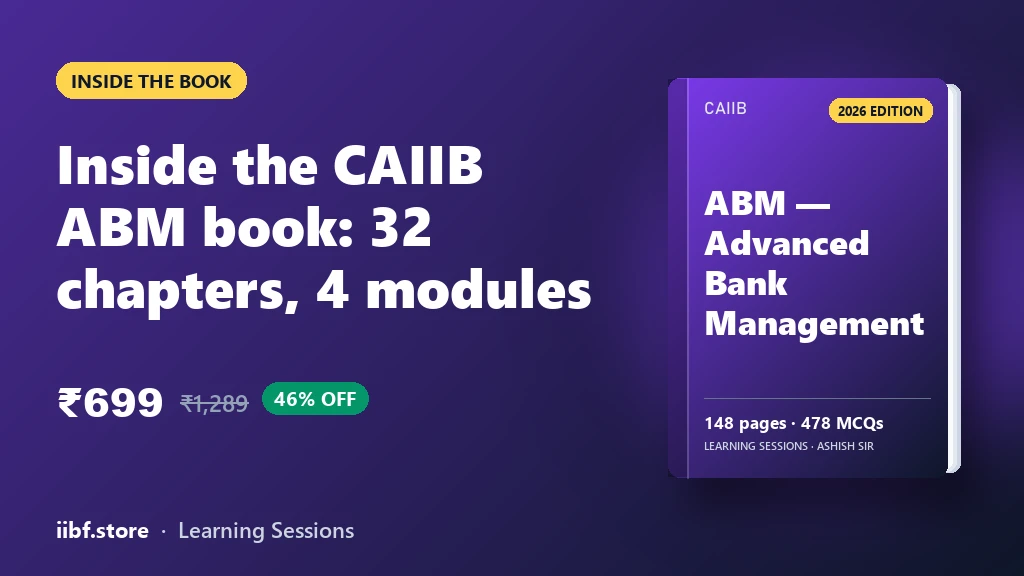
The printed edition runs to 148 pages and covers 32 chapters in four modules. Do the arithmetic and you get roughly four to five pages per chapter, which tells you the intent straight away: this is a concise revision-style book, not a thousand-page reference. It is meant to be finished, and then finished again.
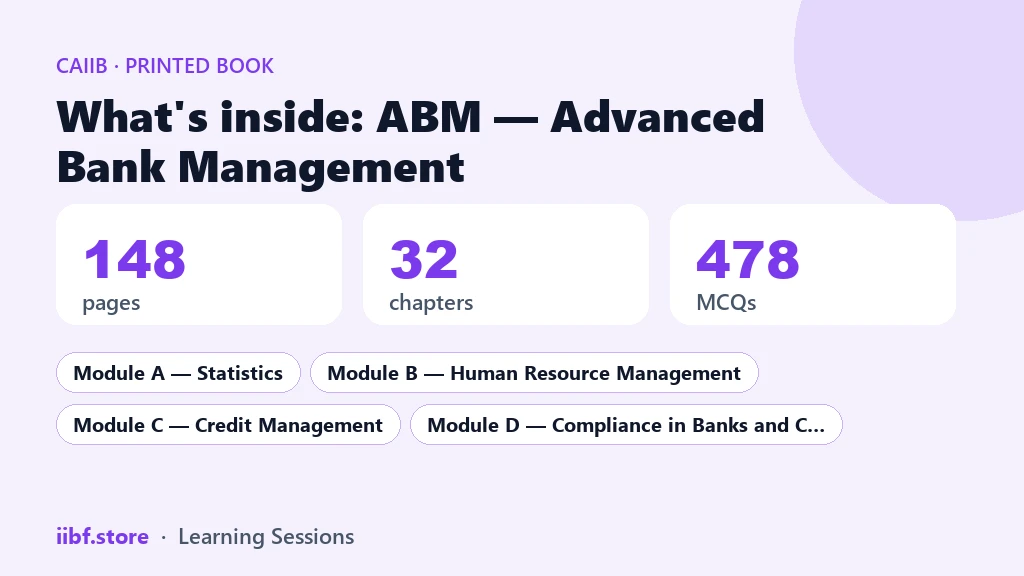
Here is how the chapters are distributed, taken straight from the book's contents.
| Module | Chapters | Nature of study |
|---|---|---|
| Module A — Statistics | 9 | Calculation and formulae |
| Module B — Human Resource Management | 7 | Concepts and frameworks |
| Module C — Credit Management | 9 | Application and judgement |
| Module D — Compliance in Banks and Corporate Governance | 7 | Structures, roles and rules |
Module A — Statistics (9 chapters)
This module begins with the definition, importance and limitations of statistics along with data collection, classification and tabulation, and then moves to sampling techniques. After that come measures of central tendency and dispersion with skewness and kurtosis, correlation and regression, time series, the theory of probability, estimation, linear programming and simulation. If statistics is the part that makes you freeze, the order matters: the early chapters are vocabulary and basic measures, and the later ones depend on them.
Module B — Human Resource Management (7 chapters)
The HR module covers the fundamentals of human resource management, development of human resources, human implications of organisations, employees' feedback and reward system, performance management, conflict management and negotiation, and HRM and information technology. These are readable chapters. They are also the ones most people underestimate and then lose easy marks on.
Module C — Credit Management (9 chapters)
Credit is the module closest to your daily work if you are on the advances side. It runs from an overview of credit management through analysis of financial statements, working capital finance, term loans, credit delivery and straight through processing, credit control and monitoring, and risk management and credit rating. It closes with restructuring, rehabilitation and recovery, and the resolution of stressed assets under the Insolvency and Bankruptcy Code, 2016.
Module D — Compliance in Banks and Corporate Governance (7 chapters)
The last module covers the compliance function in banks, compliance audit, the compliance governance structure, the framework for identifying compliance issues and risks, compliance culture and the GRC framework, the compliance function and the role of the Chief Compliance Officer in NBFCs, and fraud and vigilance in banks.
What one chapter looks like when you open it
A good way to judge any study book is to ignore the cover and read a single chapter. In this book, each chapter is built to be worked in a short, repeatable loop: a compact set of notes to read first, then the points worth remembering, then questions to test yourself on what you just read. The structure is deliberately the same chapter after chapter, so you never waste energy working out how to approach the page.
The book has 478 questions in total, so on average each chapter gives you a fair number of questions to attempt straight after reading. That ordering is the whole point. Reading feels productive, but it is the act of answering that shows you what actually stayed in memory.
The questions also tell you something notes cannot: what the examiner is likely to ask about. When you get one wrong, go back to that exact paragraph rather than re-reading the whole chapter. Over a few weeks you will find that your wrong answers cluster in a handful of topics, and that is where your remaining time should go.
The extra: 100 case studies
Beyond the chapter questions, the book carries 100 case studies with 400 questions attached to them. Case-based questions reward a different skill. You read a short situation, pick out the facts that matter, and decide. Credit management and compliance lend themselves to this style, and practising it on paper before the exam means a long scenario will not look unfamiliar to you on the day.
A fair word on limits: a book gives you structure and practice, but it will not give you exam-hall speed on its own. For that, pair it with timed tests. The free mock tests on iibf.store are a sensible place to start, and the free study PDFs can fill gaps on a topic you want to see explained a second way.
A four-step method to work through the CAIIB ABM book
Here is a routine that fits a working schedule. It does not need long sittings. It needs the same small loop repeated for each chapter.
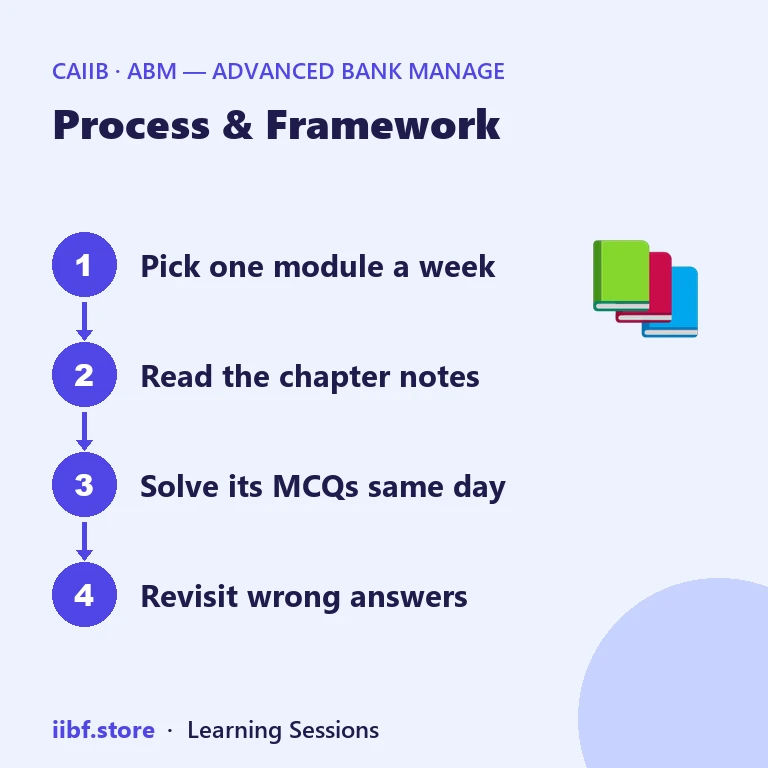
- Pick one module at a time. Do not hop between Statistics and Credit in the same week. Finish a module, then move on, so the vocabulary stays fresh in your head.
- Read the chapter notes in one sitting. With four to five pages per chapter on average, this is realistic even on a weekday. Mark anything you could not follow, but do not stop to chase it yet.
- Solve that chapter's MCQs the same day. Same day, not next weekend. The gap between reading and testing is where most of the learning leaks away.
- Revisit the wrong answers two days later. This is a short job, ten or fifteen minutes, and it is what turns a first pass into recall.
A sample week for a full-time banker
Suppose you take Module B first, because it is the lightest. Monday and Tuesday: one chapter each, read and then answer its questions. Wednesday: revisit Monday's errors. Thursday: another chapter. Friday: revisit Tuesday's errors. Saturday: two chapters and their questions. Sunday: a rest, or a short look at all the week's wrong answers. That is roughly four to five chapters in a week with no heroic effort. At that pace the whole book is a matter of weeks, not months, and you will have time left to attempt the case studies and full mocks.
Save the calculation chapters of Module A for the evenings when you still have some energy, and keep the compliance chapters for the days when you are only able to read. Matching the chapter to your tiredness level is a quiet advantage most candidates never use.
Pairing the book with the rest of your preparation
No single book clears a paper. Think of the printed edition as the spine of your preparation and put these around it:
- Official information. The syllabus, exam schedule and any rule changes come only from IIBF's official website. Check it for the upcoming exam cycle before you fix your plan.
- Timed practice. Use mock tests under a clock. The CAIIB course page lists what is available across the papers.
- Your own workplace. If you handle advances, you already see credit management daily. Connect each chapter to a file you have actually worked on. If you do not, treat the case studies as your borrowed experience.
- Other papers. If you are also thinking about your next paper, browse the full set of printed books so you can plan the order.
Who gets the most out of this book
Be honest with yourself about which of these describes you.
It suits you well if you have limited evenings, want a book that you can actually finish, learn better with pen and paper than from a screen, and like the discipline of questions after every chapter. It also suits you if you have studied the syllabus once and want a compact revision tool for the last stretch before the paper.
It suits you less if you need a long, deeply explained textbook for a topic you have never met, such as linear programming from absolute scratch. In that case, use the concise book as your anchor and add a longer explanation for the one or two chapters that need it.
The price on the book page is currently ₹699 against an MRP of ₹1,289, which is 46 percent off. Prices can change, so the book page is always the current word. If you want to see the writing and layout before deciding, there is a free sample on the book page, and that is the best test of all: read one chapter and see whether it speaks to a tired mind at 10:40 at night.
The takeaway
ABM becomes manageable the moment you stop seeing it as one mountain and start seeing four modules, 32 chapters and a repeatable loop. Whether you use the CAIIB ABM book or build your own notes, keep the same shape: one module at a time, notes then questions on the same day, wrong answers revisited two days later. For the full details, edition and sample pages, visit the book page, and for more preparation guidance see the iibf.store blog.
Frequently asked questions
How many chapters and modules does the book cover?
The printed edition covers 32 chapters in four modules: Statistics, Human Resource Management, Credit Management, and Compliance in Banks and Corporate Governance. It runs to 148 pages.
Does the book have practice questions?
Yes. It has 478 questions, and it also includes 100 case studies carrying 400 questions, so you can practise both short MCQs and longer scenario-style questions.
Can I see a sample before ordering?
Yes, a free sample is available on the book page. Reading one chapter is the quickest way to judge whether the style suits you.
Is the book enough to pass on its own?
It gives you structure, concise notes and a lot of practice, but exam-hall speed comes from timed mocks. Use it together with mock tests and check the official IIBF website for the exam schedule and syllabus.
Prefer revising from a printed book?
Chapter-wise books with MCQs after every chapter — minimal pages, complete coverage, delivered anywhere in India. Every book has a free sample to read first.
148 pages · 478 MCQs
Learning Sessions · Ashish Sir
151 pages · 465 MCQs
Learning Sessions · Ashish Sir
148 pages · 375 MCQs
Learning Sessions · Ashish Sir
216 pages · 895 MCQs
Learning Sessions · Ashish Sir
109 pages · 300 MCQs
Learning Sessions · Ashish Sir
104 pages · 360 MCQs
Learning Sessions · Ashish Sir
82 pages · 297 MCQs
Learning Sessions · Ashish Sir
151 pages · 600 MCQs
Learning Sessions · Ashish Sir
98 pages · 282 MCQs
Learning Sessions · Ashish Sir
131 pages · 672 MCQs
Learning Sessions · Ashish Sir
221 pages · 831 MCQs
Learning Sessions · Ashish Sir
128 pages · 524 MCQs
Learning Sessions · Ashish Sir
107 pages · 445 MCQs
Learning Sessions · Ashish Sir
132 pages · 225 MCQs
Learning Sessions · Ashish Sir
188 pages · 435 MCQs
Learning Sessions · Ashish Sir
117 pages · 236 MCQs
Learning Sessions · Ashish Sir
Learning Sessions · Ashish Sir
118 pages · 299 MCQs
Learning Sessions · Ashish Sir
Learning Sessions · Ashish Sir
Learning Sessions · Ashish Sir
Learning Sessions · Ashish Sir
115 pages · 255 MCQs
Learning Sessions · Ashish Sir
Learning Sessions · Ashish Sir
334 pages · 936 MCQs
Learning Sessions · Ashish Sir
Learning Sessions · Ashish Sir
115 pages · 344 MCQs
Learning Sessions · Ashish Sir
107 pages · 240 MCQs
Learning Sessions · Ashish Sir
90 pages · 150 MCQs
Learning Sessions · Ashish Sir
Learning Sessions · Ashish Sir
Quick quiz on this topic
5 exam-style questions from our free test bank — check yourself before you move on.
Practice this topic
Take a free mock test, download chapter PDFs, or watch a video class — all included on iibf.store.