CAIIB ABM Study Plan: 30 Days Alongside a Bank Job
It is 9:40 pm. The branch closed hours ago, the day-end cash balanced late, and a manager wants a report by morning. Somewhere in your bag is a CAIIB paper you have been meaning to start for weeks. Statistics, HR, credit, compliance: four modules that feel like four different exams. If that sounds familiar, you do not need more motivation. You need a CAIIB ABM study plan that fits the hours you actually have.
This article gives you one: a 30-day, chapter-by-chapter schedule for Advanced Bank Management, written for someone who studies for 90 minutes on weekdays and a little longer on weekends. Take the plan even if you never buy anything from us. Adjust the days to your own calendar, and it will still work.
Why ABM feels harder than it is
ABM is not one subject. It is four modules stitched together: Statistics, Human Resource Management, Credit Management, and Compliance in Banks with Corporate Governance. A banker who is comfortable with credit may freeze at probability. Someone who loves HR theory may dread linear programming. The syllabus feels endless because the brain keeps switching gears.
The fix is not to study harder. It is to study one module at a time, in a fixed order, and to test yourself at the end of every chapter so that you know where you stand on day 6, not on exam morning.
Three honest truths before you start
- You will not study on every day you plan to. Build in two or three slack days, as this plan does.
- Reading alone gives a false sense of progress. Questions show you what you have actually retained.
- Statistics rewards repetition. Do not skip the numerical practice because it feels slow.
How to set up your evenings
Before the table, fix the routine. A tired mind learns best in short, structured blocks, so use this pattern on a weekday:
- First 50 minutes: read one chapter, or half a chapter if it is long. Underline definitions and formulas only.
- Next 25 minutes: attempt the end-of-chapter MCQs without looking back at the text.
- Last 15 minutes: mark every wrong answer, write the correct reason in one line, and stop.
On weekends, add one block to redo that week's wrong answers. This is where marks are actually gained. Getting a question wrong once is cheap; getting it wrong again in the exam is not.
What the printed book gives you to work with
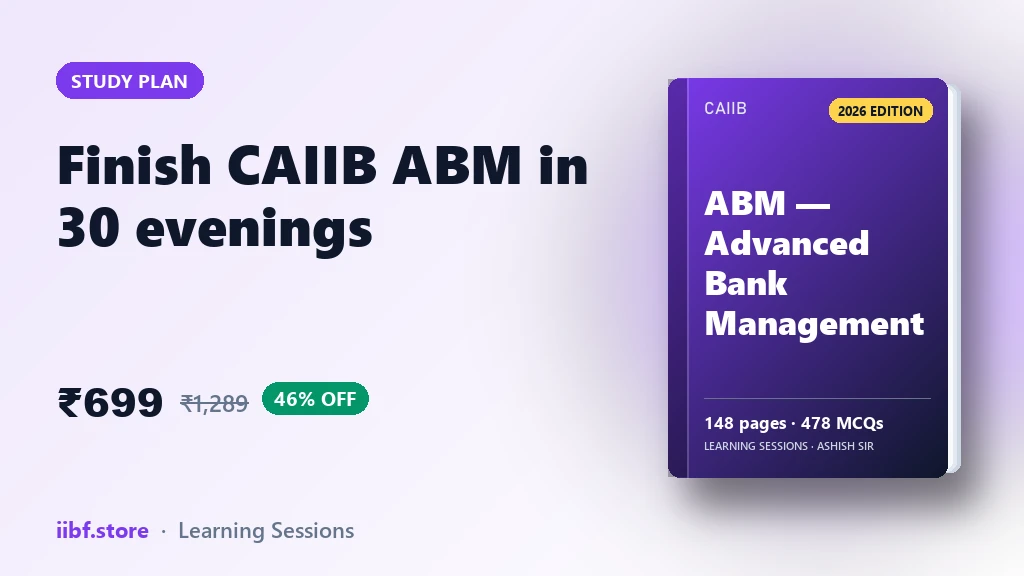
You can follow this plan with any study material that covers the full syllabus. We built it around the CAIIB ABM printed book because its structure matches the way the plan is paced. It is the 2026 edition, 148 pages in all, divided into 32 chapters across the four modules, with 478 questions placed after the chapters. It also carries an extra set of 100 case studies (400 questions) for the final stretch.
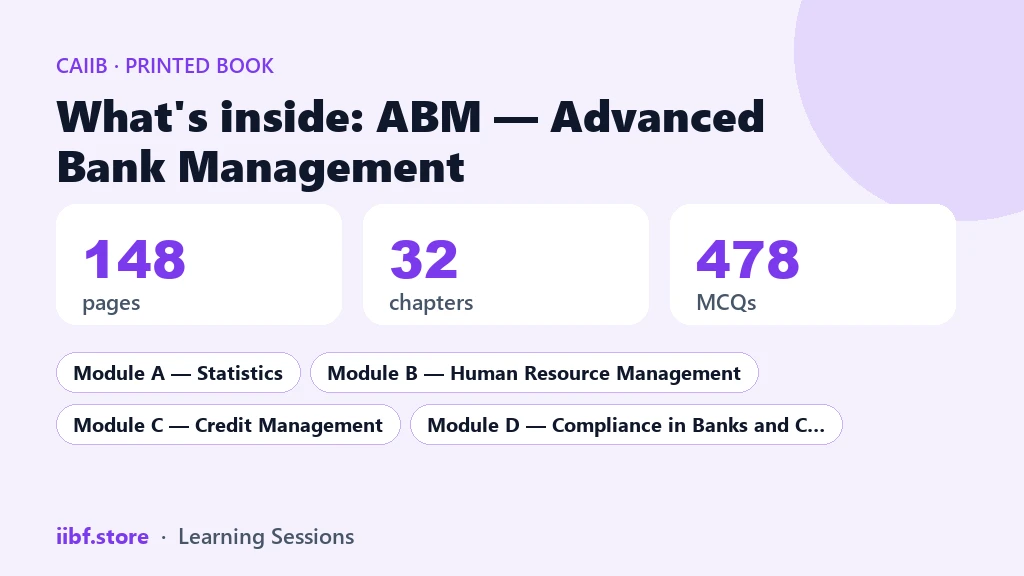
The chapters run in this order:
- Module A, Statistics (9 chapters): definition and data collection, sampling, central tendency and dispersion, correlation and regression, time series, probability, estimation, linear programming, and simulation.
- Module B, Human Resource Management (7 chapters): fundamentals, development of human resources, human implications of organisations, feedback and reward systems, performance management, conflict management and negotiation, and HRM with information technology.
- Module C, Credit Management (9 chapters): overview, financial statement analysis, working capital finance, term loans, credit delivery and straight through processing, credit control, risk and rating, restructuring and recovery, and resolution of stressed assets under the Insolvency and Bankruptcy Code 2016.
- Module D, Compliance and Corporate Governance (7 chapters): compliance function, compliance audit, governance structure, identifying compliance issues and risks, compliance culture and GRC, the Chief Compliance Officer's role in NBFCs, and fraud and vigilance.
A fair word on limits: a book gives you the content and the practice questions. It will not give you the speed of an exam hall. Pair it with timed mock tests, and we cover that in the plan below. The book is priced at ₹699 against an MRP of ₹1,289 at the time of writing; prices can change, so the book page always has the current figure, and there is a free sample you can read before deciding.
The 30-day CAIIB ABM study plan, day by day
Here is the table. The MCQ column is approximate: with 478 questions across 32 chapters, you can expect about 15 per chapter if you spread them evenly, but go by what the book actually shows. Use the table as your CAIIB ABM study plan and tick off each row.
| Days | What to read | MCQ practice |
|---|---|---|
| 1-2 | Module A: Definition of Statistics and data collection; Sampling Techniques | About 30 MCQs |
| 3-4 | Module A: Central Tendency, Dispersion, Skewness, Kurtosis; Correlation and Regression | About 30 MCQs, redo numericals |
| 5-6 | Module A: Time Series; Theory of Probability | About 30 MCQs |
| 7-8 | Module A: Estimation; Linear Programming; Simulation | About 45 MCQs, then redo Module A errors |
| 9-10 | Module B: Fundamentals of HRM to Employees' Feedback and Reward System (4 chapters) | About 60 MCQs |
| 11-12 | Module B: Performance Management; Conflict Management; HRM and IT | About 45 MCQs, then redo Module B errors |
| 13-14 | Module C: Overview of Credit Management; Analysis of Financial Statements | About 30 MCQs |
| 15-16 | Module C: Working Capital Finance; Term Loans | About 30 MCQs |
| 17-18 | Module C: Credit Delivery and STP; Credit Control and Monitoring | About 30 MCQs |
| 19-20 | Module C: Risk Management and Credit Rating; Restructuring and Recovery | About 30 MCQs |
| 21-22 | Module C: Resolution of Stressed Assets under IBC 2016; revise all of Module C | About 15 MCQs, redo Module C errors |
| 23-24 | Module D: Compliance Function; Compliance Audit; Governance Structure; Identifying Compliance Risks | About 60 MCQs |
| 25-26 | Module D: Compliance Culture and GRC; CCO in NBFCs; Fraud and Vigilance | About 45 MCQs, then redo Module D errors |
| 27-28 | Case studies from the book's extra set | Attempt a set each evening |
| 29-30 | Full revision of marked errors; two timed mock tests | Mocks only |
Why Module A takes eight days
Statistics is the module where working bankers lose the most marks, not because it is advanced but because it is unfamiliar. Giving it eight days, with questions after every chapter, is deliberate. If you are comfortable with maths, compress it into six and bank the extra days for credit.
The method behind the plan
The table works because of four habits, repeated all through the 30 days. Keep them simple and they will survive a bad week at the branch.
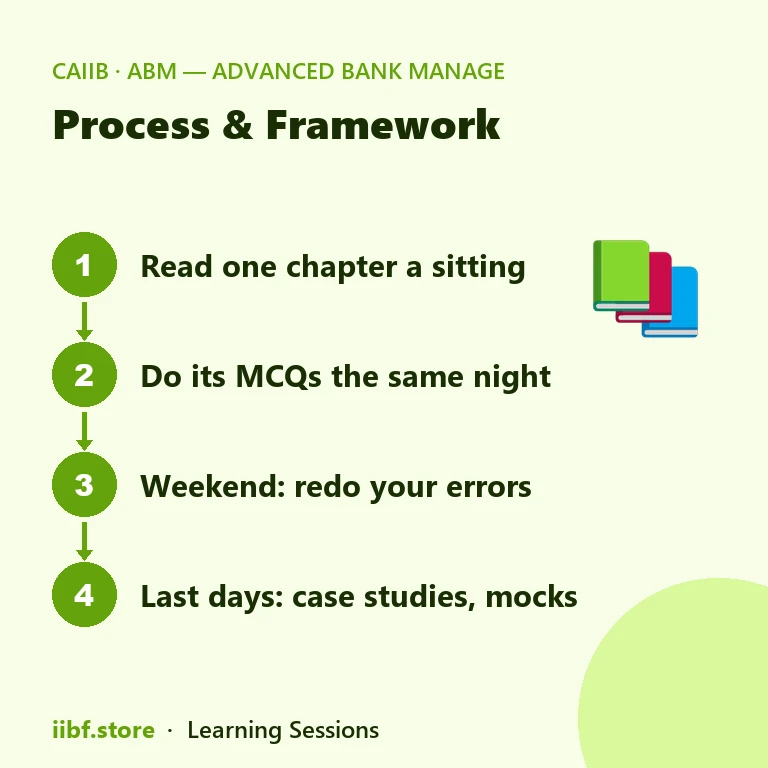
Step 1: read one chapter in a single sitting
Do not hop between modules. Finishing a chapter, even a dull one, gives you the small win that keeps you going tomorrow. If a chapter is long, split it, but finish it the next day before touching a new one.
Step 2: test yourself the same night
Memory fades fastest in the first 24 hours. Answering the chapter's questions straight away converts reading into recall. Do not worry if your first score is poor; the first pass is meant to find gaps.
Step 3: keep an error list
A small notebook is enough. Write the question, the right answer and one line on why. Before the exam, this notebook is worth more than any fresh chapter you could still read.
Step 4: finish with timed practice
Reading builds knowledge; timed tests build exam temperament. Use the free mock tests at iibf.store/tests in the last two days, and treat them as real: no phone, no notes, a fixed time limit. Free PDFs on iibf.store/free-material can supplement any chapter you find thin.
Module-wise tips for the tired banker
Statistics
Write each formula on a single page and keep it near your desk. Revise it for five minutes in the morning. Most statistics questions fail because of a forgotten formula, not a misunderstood concept.
Human Resource Management
This module is mostly conceptual. Connect each idea to something you have seen in your own branch: a performance appraisal cycle, a conflict between two departments, a training programme. Examples you have lived stay in memory.
Credit Management
This is where your day job helps you. Working capital, term loans and monitoring will feel familiar; the new parts are the ratio logic, rating, and the IBC 2016 resolution process. Spend your extra time there.
Compliance and Corporate Governance
Read for structure: who is responsible for what, and what the three lines of defence mean in practice. The fraud and vigilance chapter is a good one to finish with because it ties earlier ideas together.
What to do if you fall behind
You will. Everyone does. The rule is never to compress the question practice to catch up; compress the reading instead. Skim the chapter for definitions and headings, then do the questions, and let the questions tell you what you need to go back to.
If a whole week disappears, push the plan back by seven days and keep the revision days at the end. A 37-day plan that you finish beats a 30-day plan you abandon.
Putting your CAIIB ABM study plan to work
Print the table, stick it above your study spot, and start tonight with Chapter 1. For the exam schedule and any rule updates, always check the official site, www.iibf.org.in, and plan around the upcoming exam cycle, not around what a friend told you. If you want the whole syllabus, the module order and the questions in one place, the ABM book follows exactly this sequence, and you can browse other titles at iibf.store/books. For more preparation guides, the blog has them.
Whatever you use, a plan only works on the nights you open it. Start small, keep going, and let the evening routine do the work.
Frequently asked questions
Can I really finish ABM in 30 days while working full-time?
For many bankers, yes, if you can give 90 minutes on weekdays and a bit more on weekends. If your work is heavier, stretch the plan to 40 days. The order of modules and the habit of same-night questions matter more than the exact day count.
Which module should I start with?
Start with Module A, Statistics, in book order. It is the one most people postpone, and leaving it to the end is the commonest reason for a poor attempt.
Is a printed book enough on its own?
It covers the syllabus and gives practice questions, but no book gives you timed exam-hall speed. Add mock tests in the final days, and check the official IIBF site for current exam details.
How much does the ABM printed book cost?
At the time of writing it is ₹699 against an MRP of ₹1,289. Prices can change, so check the book page for the current price and the free sample.
Prefer revising from a printed book?
Chapter-wise books with MCQs after every chapter — minimal pages, complete coverage, delivered anywhere in India. Every book has a free sample to read first.
148 pages · 478 MCQs
Learning Sessions · Ashish Sir
151 pages · 465 MCQs
Learning Sessions · Ashish Sir
148 pages · 375 MCQs
Learning Sessions · Ashish Sir
216 pages · 895 MCQs
Learning Sessions · Ashish Sir
109 pages · 300 MCQs
Learning Sessions · Ashish Sir
104 pages · 360 MCQs
Learning Sessions · Ashish Sir
82 pages · 297 MCQs
Learning Sessions · Ashish Sir
151 pages · 600 MCQs
Learning Sessions · Ashish Sir
98 pages · 282 MCQs
Learning Sessions · Ashish Sir
131 pages · 672 MCQs
Learning Sessions · Ashish Sir
221 pages · 831 MCQs
Learning Sessions · Ashish Sir
128 pages · 524 MCQs
Learning Sessions · Ashish Sir
107 pages · 445 MCQs
Learning Sessions · Ashish Sir
132 pages · 225 MCQs
Learning Sessions · Ashish Sir
188 pages · 435 MCQs
Learning Sessions · Ashish Sir
117 pages · 236 MCQs
Learning Sessions · Ashish Sir
Learning Sessions · Ashish Sir
118 pages · 299 MCQs
Learning Sessions · Ashish Sir
Learning Sessions · Ashish Sir
Learning Sessions · Ashish Sir
Learning Sessions · Ashish Sir
115 pages · 255 MCQs
Learning Sessions · Ashish Sir
Learning Sessions · Ashish Sir
334 pages · 936 MCQs
Learning Sessions · Ashish Sir
Learning Sessions · Ashish Sir
115 pages · 344 MCQs
Learning Sessions · Ashish Sir
107 pages · 240 MCQs
Learning Sessions · Ashish Sir
90 pages · 150 MCQs
Learning Sessions · Ashish Sir
Learning Sessions · Ashish Sir
Quick quiz on this topic
5 exam-style questions from our free test bank — check yourself before you move on.
Practice this topic
Take a free mock test, download chapter PDFs, or watch a video class — all included on iibf.store.
Keep reading