Inside the JAIIB AFM Book: 35 Chapters, 4 Modules, 524 MCQs
It is 9:40 pm. The branch closed late, the day-end figures took longer than usual, and you have opened the Accounting and Financial Management syllabus on your phone. Thirty-five chapters stare back at you, from bank reconciliation to derivatives to marginal costing. Where do you even start?
This article is a guided tour of the JAIIB AFM book: how it is organised, what a single chapter looks like, and how to use it when you have only an hour or two a day. Even if you never buy it, the method here works with any study material, so take what is useful.
Why AFM feels heavier than it is
AFM is the paper where working bankers often feel they should be comfortable, because they handle vouchers and balances daily. Then the exam asks about Ind AS, cash flow statements, YTM, lease financing and standard costing, and the comfort disappears. The paper has four very different personalities in one syllabus: bookkeeping, financial statements, finance mathematics, and tax plus costing.
The first fix is not more hours. It is a map. Once you know which module you are in and what kind of thinking it needs (rules, layouts, formulas or procedures), the paper stops looking like one giant block.
Four modules, four kinds of effort
- Module A rewards clear concepts and entry-level accuracy.
- Module B rewards knowing formats: final accounts, company accounts, cash flow.
- Module C rewards formula recall and practice with numbers.
- Module D mixes statutory facts (income tax, GST) with costing techniques.
You can follow that map with any material. If you want it laid out for you chapter by chapter, that is what the JAIIB AFM book is built around.
The JAIIB AFM book at a glance
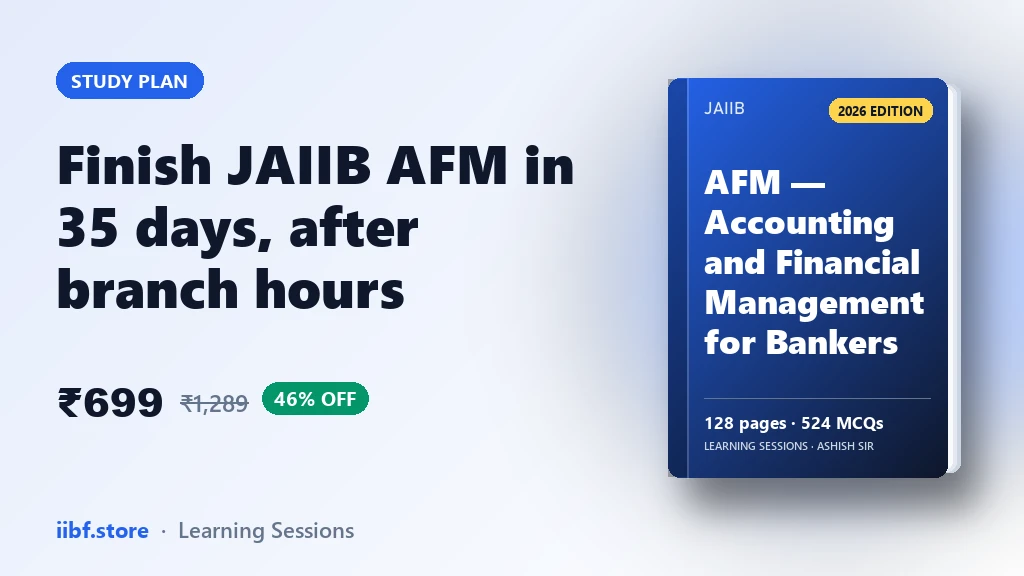
Here are the plain facts, as listed on the book page. It is a printed book of 128 pages, 2026 edition, with 35 chapters grouped into four modules, and 524 MCQs. Two extras come with it: a Numericals Compendium and a Formula Cheat Sheet.
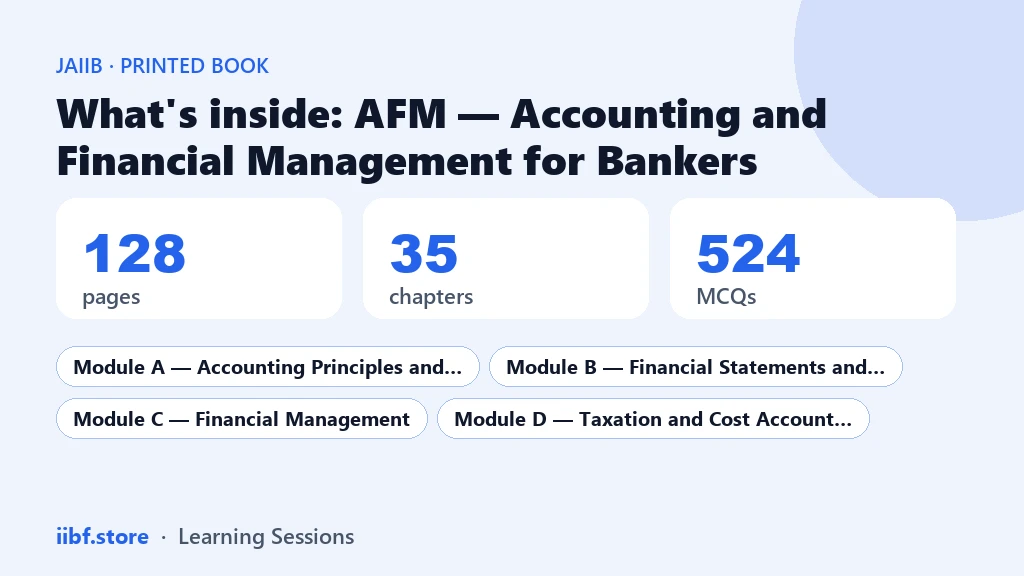
128 pages for 35 chapters is a deliberate choice. This is a concise, revision-oriented book. It does not try to replace a full textbook; it tries to be the thing you can finish, and then finish again before the exam.
Module by module: what you will find
Module A: Accounting Principles and Processes (11 chapters)
This module starts with the definition and scope of accounting, including accounting standards and Ind AS, then moves through basic accountancy procedures, cash and subsidiary books, ledgers and the bank reconciliation statement. It continues with the trial balance, rectification of errors, adjusting and closing entries, depreciation, capital versus revenue expenditure and bills of exchange. The last chapters are closest to your job: operational aspects of accounting entries, back office handling of unreconciled entries, and bank audit and inspection.
Module B: Financial Statements and Core Banking Systems (7 chapters)
Balance sheet equation, preparation of final accounts, Company Accounts I and II, cash flow and funds flow, final accounts of banking companies, and core banking systems with accounting in a computerised environment. This is the module where seeing the layout again and again matters more than reading the theory once.
Module C: Financial Management (10 chapters)
An overview of financial management, ratio analysis, then three financial mathematics chapters: interest and annuities, YTM, and forex arithmetic. After that come capital structure and cost of capital, capital investment decisions for term loans, equipment leasing, working capital management and derivatives. This is the numerical heart of the paper.
Module D: Taxation and Cost Accounting (7 chapters)
Income tax, TDS and deferred tax in one chapter, Goods and Services Tax, an overview of cost and management accounting, costing methods, standard costing, marginal costing, and budgets and budgetary control.
| Module | Theme | Chapters |
|---|---|---|
| A | Accounting principles and processes | 11 |
| B | Financial statements and core banking systems | 7 |
| C | Financial management | 10 |
| D | Taxation and cost accounting | 7 |
| Total | 35 |
What one chapter looks like
Every chapter follows the same rhythm, so you stop wasting energy deciding how to study and just start. Think of it as three steps:
- Concise notes. The concept in plain language, with the working shown where numbers are involved.
- Key points. The few things you must be able to recall without looking: definitions, formats, conditions.
- MCQs. Questions on that chapter alone, so you test what you just read while it is fresh.
Take the Bank Reconciliation Statement chapter as an example of how you would use it. Read the notes once, slowly. Close the book and write the reasons for differences between the cash book and the passbook from memory. Open the key points to check what you missed. Then attempt the MCQs. Twenty-five focused minutes, and you have actually studied, not just read.
The two extras that matter close to the exam
The Numericals Compendium and the Formula Cheat Sheet are the parts you will return to most often in the last weeks. AFM is a paper where a single forgotten formula costs marks, and where doing ten numericals in a row teaches more than reading ten pages. Keep the formula sheet where you see it daily, and use the compendium for short practice bursts, such as a quick set of YTM or ratio problems during a lunch break.
A four-step routine for tired evenings
Here is a routine that works with a full-time job. It does not need long blocks, only consistency, and it fits the JAIIB AFM book chapter structure naturally.
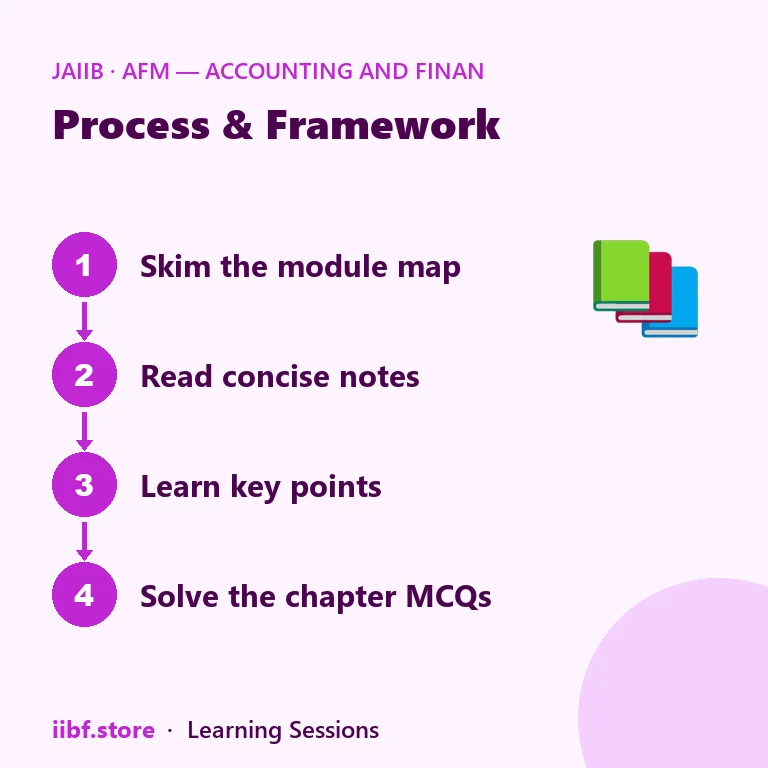
- Skim the module map (5 minutes). Know which module you are in and what it asks of you.
- Read the concise notes (20 to 30 minutes). One chapter, no phone.
- Learn the key points (10 minutes). Say them aloud or write them on a card.
- Solve the chapter MCQs (15 minutes). Note every mistake in one running list.
Mix the modules across the week. A numerical-heavy chapter from Module C on Saturday morning when you are fresh, and lighter theory chapters from Module A or D on weekday nights. Revisit your mistake list every Sunday.
Pair the book with free practice
One honest limit: a book alone will not give you exam-hall speed. Once you finish a module, take timed practice on the free mock tests, and look through the free study material for extra revision. If you want the full JAIIB path across papers, the JAIIB course page shows what is available.
Who gets the most out of this book
- Working bankers with limited time who need a finishable, chapter-wise route through AFM.
- Candidates revising after a first attempt, who already know the topics and need notes, key points and MCQs in one place.
- Anyone who prefers paper over screens after a day of screens at the branch.
It is less suited to someone who wants a detailed textbook with long derivations of every concept. Be honest with yourself about which learner you are. You can read the book page and the free sample before deciding, and browse the full range at iibf.store/books.
At the time of writing the book is listed at ₹699 against an MRP of ₹1,289 (46% off). Prices may change, so the book page always has the current figure. For the official exam schedule and syllabus for the upcoming exam cycle, check the IIBF website.
Final word
AFM stops being frightening when it becomes 35 small, repeatable sessions. Whether you use the JAIIB AFM book or another source, build the loop of notes, key points and MCQs, protect two or three evenings a week, and keep a mistake list. For more preparation guides, see the iibf.store blog.
Frequently asked questions
How many chapters and questions does the book have?
It has 35 chapters across four modules, 128 pages and 524 MCQs, in the 2026 edition.
What extras come with it?
A Numericals Compendium and a Formula Cheat Sheet are included.
Is there a free sample?
Yes. The book page has a free sample you can read before ordering.
Is the book enough on its own?
It gives you notes, key points and chapter MCQs, but timed mock tests are still needed to build exam-hall speed.
Prefer revising from a printed book?
Chapter-wise books with MCQs after every chapter — minimal pages, complete coverage, delivered anywhere in India. Every book has a free sample to read first.
128 pages · 524 MCQs
Learning Sessions · Ashish Sir
131 pages · 672 MCQs
Learning Sessions · Ashish Sir
221 pages · 831 MCQs
Learning Sessions · Ashish Sir
107 pages · 445 MCQs
Learning Sessions · Ashish Sir
148 pages · 478 MCQs
Learning Sessions · Ashish Sir
151 pages · 465 MCQs
Learning Sessions · Ashish Sir
148 pages · 375 MCQs
Learning Sessions · Ashish Sir
216 pages · 895 MCQs
Learning Sessions · Ashish Sir
109 pages · 300 MCQs
Learning Sessions · Ashish Sir
104 pages · 360 MCQs
Learning Sessions · Ashish Sir
82 pages · 297 MCQs
Learning Sessions · Ashish Sir
151 pages · 600 MCQs
Learning Sessions · Ashish Sir
98 pages · 282 MCQs
Learning Sessions · Ashish Sir
132 pages · 225 MCQs
Learning Sessions · Ashish Sir
188 pages · 435 MCQs
Learning Sessions · Ashish Sir
117 pages · 236 MCQs
Learning Sessions · Ashish Sir
Learning Sessions · Ashish Sir
118 pages · 299 MCQs
Learning Sessions · Ashish Sir
Learning Sessions · Ashish Sir
Learning Sessions · Ashish Sir
Learning Sessions · Ashish Sir
115 pages · 255 MCQs
Learning Sessions · Ashish Sir
Learning Sessions · Ashish Sir
334 pages · 936 MCQs
Learning Sessions · Ashish Sir
Learning Sessions · Ashish Sir
115 pages · 344 MCQs
Learning Sessions · Ashish Sir
107 pages · 240 MCQs
Learning Sessions · Ashish Sir
90 pages · 150 MCQs
Learning Sessions · Ashish Sir
Learning Sessions · Ashish Sir
Quick quiz on this topic
5 exam-style questions from our free test bank — check yourself before you move on.
Practice this topic
Take a free mock test, download chapter PDFs, or watch a video class — all included on iibf.store.