JAIIB AFM Study Plan for Working Bankers: 35 Days, One Book
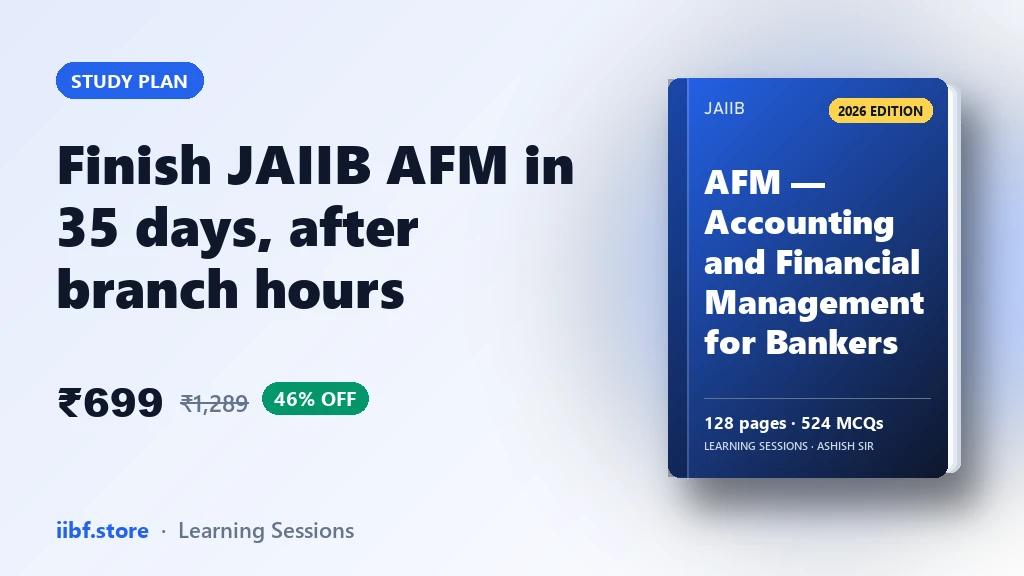
It is 9:40 pm. You have closed the branch, travelled home, eaten something, and now the AFM syllabus is open in front of you: balance sheets, depreciation, bills of exchange, ratios, YTM, GST, marginal costing. It feels endless, and the honest truth is that it is not a talent problem. It is a planning problem. A good JAIIB AFM study plan for someone working full time has to be built around the hours you actually have, not the hours a topper with no job had.
This article gives you that plan: a 35-day schedule, a table you can copy into your phone, a method for MCQs, and a revision split for the last week. You can follow it with any material you trust. We also show how it maps onto our own book, because that is the one we know chapter by chapter.
Why AFM breaks tired people (and what to do about it)
Accounting and Financial Management is the paper where people who "read" a lot still fail, because it is a doing paper. You cannot understand a bank reconciliation statement or a YTM calculation by reading it once in the metro. You understand it by doing one example with a pencil.
Three habits quietly sink working candidates:
- Starting with the hardest module. Many people open Financial Management or costing first, get stuck on day two, and postpone for a month.
- Reading without solving. Three hours of reading feels productive and leaves almost nothing in memory by Sunday.
- No fixed daily slot. "I will study when I get time" means you will not study on the days the branch runs late.
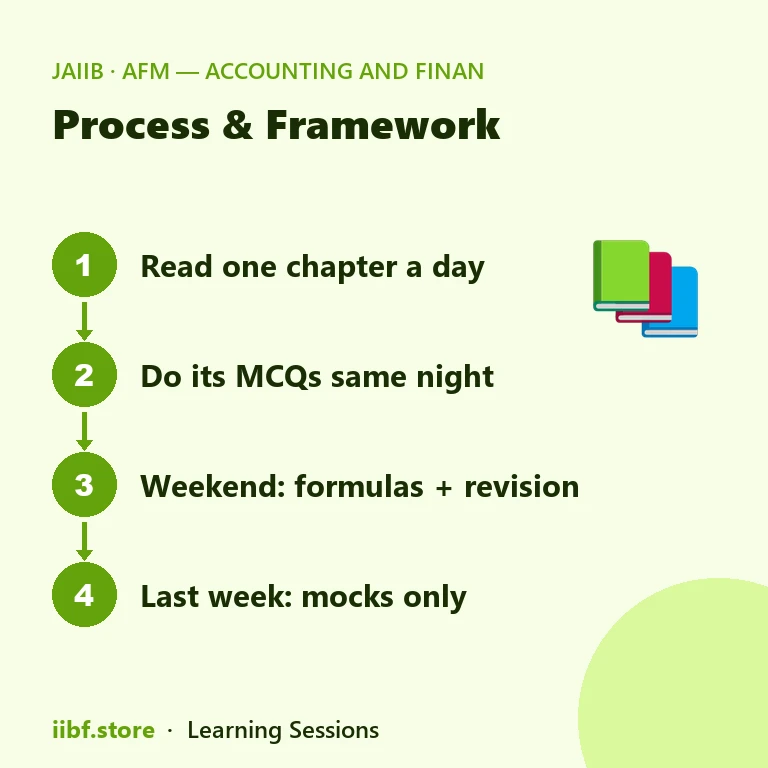
The fix is boring and works: a small daily slot of 60 to 90 minutes, one chapter at a time, MCQs the same night, and longer blocks only on weekends. Everything below follows that rhythm.
The syllabus in four blocks: where the marks really sit
The AFM syllabus is easier to handle when you stop seeing it as one mountain. It has four modules, and each behaves differently. Here is how we treat them, using the chapter structure of the JAIIB AFM book.
Module A: Accounting Principles and Processes (11 chapters)
This runs from definition, scope and accounting standards including Ind AS, through basic accountancy procedures, cash and subsidiary books, bank reconciliation, trial balance and rectification of errors, depreciation, capital and revenue expenditure, and bills of exchange. It ends with operational aspects of accounting entries, back office functions for unreconciled entries, and bank audit and inspection. Most of this is familiar from your daily work, so it is the best place to build momentum.
Module B: Financial Statements and Core Banking Systems (7 chapters)
Balance sheet equation, final accounts, Company Accounts I and II, cash flow and funds flow, final accounts of banking companies, and core banking with accounting in a computerised environment. This module rewards format memory: once you know the layout of a statement, the questions become mechanical.
Module C: Financial Management (10 chapters)
An overview, ratio analysis, interest and annuities, YTM, forex arithmetic, capital structure and cost of capital, term-loan investment decisions, lease financing, working capital management and derivatives. This is the numerical heart of the paper and needs the most pencil time.
Module D: Taxation and Cost Accounting (7 chapters)
Income tax, TDS and deferred tax, GST, an overview of cost and management accounting, costing methods, standard costing, marginal costing, and budgets with budgetary control. Learn the logic of each costing method once and the sums follow.
For the exact weightage and pattern, always check the official notices on the IIBF website. We do not quote percentages here because they can change between cycles.
What is inside the book, in plain numbers
Since this plan is built on it, here are the facts. The 2026 edition of the JAIIB AFM book is 128 pages, covers all 35 chapters across the four modules above, and carries 524 MCQs. There are two extras that matter for this plan: a Numericals Compendium for sums, and a Formula Cheat Sheet for last-week revision. It is priced at ₹699 against an MRP of ₹1,289 (46% off); prices can change, so the book page always shows the current one.
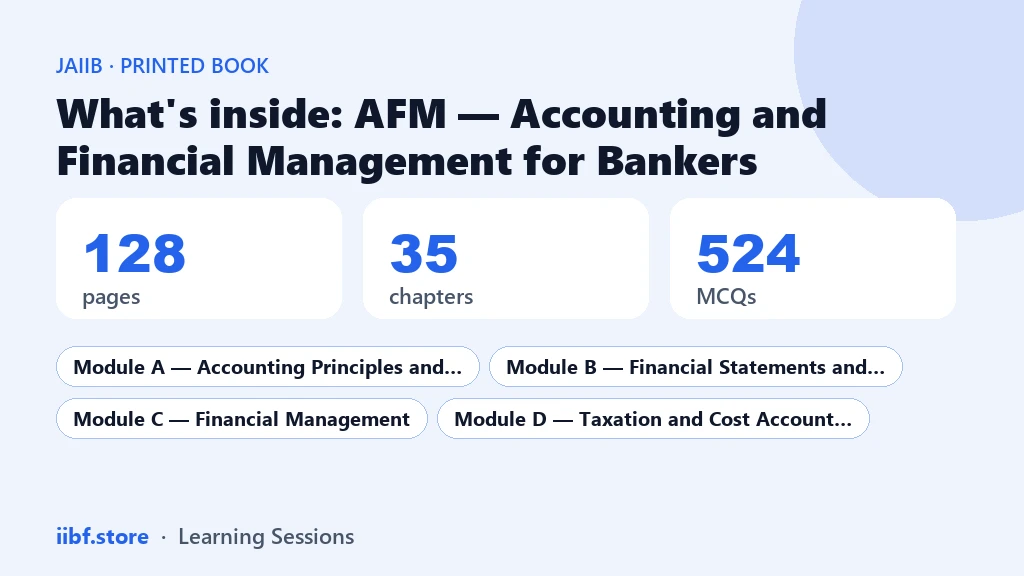
The arithmetic is useful for planning. 524 MCQs over 35 chapters is about 15 per chapter on average. That is roughly 20 to 25 minutes of solving, which fits comfortably after a chapter read on a weeknight. A 128-page book also means a chapter is a few pages, not a chore. If you want to judge the style before spending anything, read the free sample on the book page.
The 35-day JAIIB AFM study plan, day by day
The logic: easy and familiar first (Module A), formats next (Module B), a revision checkpoint, then the numerical-heavy Modules C and D when your confidence is already up. Weeknights are one chapter plus its MCQs. Weekends carry the heavier chapters and the review.
| Days | What to read | MCQs to solve |
|---|---|---|
| 1 to 6 | Module A, chapters 1 to 6: definition and Ind AS, basic procedures, cash-subsidiary books, bank reconciliation, trial balance, depreciation | All MCQs of these 6 chapters, same night |
| 7 to 9 | Module A, chapters 7 to 11: capital and revenue expenditure, bills of exchange, operational aspects, back office, bank audit | All MCQs of these 5 chapters |
| 10 to 12 | Module B, chapters 1 to 3: balance sheet equation, final accounts, Company Accounts I | All MCQs, redo the ones you missed |
| 13 to 15 | Module B, chapters 4 to 7: Company Accounts II, cash and funds flow, banking company accounts, core banking | All MCQs of these 4 chapters |
| 16 | Revision of Modules A and B only | Re-attempt every MCQ you got wrong so far |
| 17 to 20 | Module C, chapters 1 to 4: overview, ratio analysis, interest and annuities, YTM | All MCQs plus the matching sums in the Numericals Compendium |
| 21 to 24 | Module C, chapters 5 to 10: forex arithmetic, capital structure, term-loan decisions, leasing, working capital, derivatives | All MCQs, formulas written on one sheet |
| 25 to 27 | Module D, chapters 1 to 3: income tax and TDS, GST, cost and management accounting overview | All MCQs of these 3 chapters |
| 28 to 30 | Module D, chapters 4 to 7: costing methods, standard costing, marginal costing, budgets | All MCQs plus costing sums |
| 31 to 32 | Numericals Compendium drill, Modules C and D | Timed, no notes |
| 33 to 34 | Formula Cheat Sheet and a full-syllabus revision pass | Wrong-answer list only |
| 35 | Light read of your notes, early sleep | None |
If your branch has a month-end rush, do not abandon the plan. Slide the whole table by the days you lost and protect the order. The order matters more than the speed.
How to run a single weeknight in 75 minutes
- First 10 minutes: skim the chapter headings and the formulas, so your brain knows the shape.
- Next 35 minutes: read once, and work every worked example with a pencil. Do not just look at the answer.
- Last 30 minutes: solve the chapter MCQs. Mark every wrong answer and write the reason in one line.
That wrong-answer line is the most valuable thing you will create. By day 33 it is your personalised revision sheet.
How to use MCQs so they actually teach you
Most people treat MCQs as a test they take after learning. Flip it: treat them as part of the learning. When you solve a question about depreciation methods or the cash flow format right after reading, you see exactly which line you misunderstood while the chapter is still fresh.
- Attempt first, check later. Even a guess teaches more than reading the key.
- Re-attempt only the wrong ones after a gap of two or three days.
- For numericals, redo the full sum instead of just matching the option.
Once Modules A and B are done, take a free practice set from the mock tests on iibf.store to test yourself under a timer. This is where the plan meets reality. A book builds understanding, but speed under exam conditions comes only from timed practice, so do not skip the mocks.
Weekends and the last week: where the pass is decided
Weekends are your real study days. Use Saturday for the heavy numerical chapters, such as YTM, forex arithmetic or working capital. Use Sunday morning for a 90-minute review of the wrong-answer list from the week. Keep Sunday evening free; a rested mind remembers more.
In the final week the book changes role. You stop reading chapters and start using the Formula Cheat Sheet and your wrong-answer list. Then solve at least two full mock papers and note which module loses you the most time. If that module is C, give it one extra evening. For wider reading, the free study material section and the JAIIB course page are worth a visit, and you can compare other titles on the books page.
One honest limit: a book alone will not give you exam-hall speed, and it will not replace doubt-clearing if a topic simply refuses to click. Pair it with mocks, and ask a senior colleague or a class when you are stuck for more than two days.
Is this the right book for your JAIIB AFM study plan?
Choose it if you want one compact, chapter-wise book that matches the plan above: 35 chapters, 524 MCQs, a Numericals Compendium and a Formula Cheat Sheet, in 128 pages you can actually finish. Skip it if you already have a book you trust and are halfway through; switching mid-way costs more than it gives. You can look through everything on the AFM book page and decide with the sample in hand. Whichever material you pick, check the current exam schedule on the IIBF website before you fix your start date.
Conclusion: start with Day 1 tonight
A JAIIB AFM study plan does not need heroic hours. It needs a fixed slot, a sensible order, MCQs on the same night, and a revision week that uses your own mistakes. Open Module A tonight, read the first chapter, solve its questions, and tick Day 1. Thirty-five small evenings are far easier than one panicked month.
Frequently asked questions
Can I finish AFM in 35 days while working full time?
Yes, if you hold to roughly 75 minutes on weeknights and longer blocks on weekends, and you do the MCQs on the same night. If your branch is in a heavy period, stretch the plan to 45 days but keep the module order unchanged.
Which module should I start with?
Start with Module A, Accounting Principles and Processes. It is closest to your daily banking work, so it builds confidence before you reach the numerical chapters in Modules C and D.
Is one book enough to prepare for AFM?
For understanding and chapter practice, a well-organised book can be enough. For timing and exam temperament you also need mock tests, so pair the book with timed practice from the free mocks on iibf.store.
What should I do if I fall behind the schedule?
Do not skip chapters. Shift every remaining row of the table by the days you missed, and cut the weekend revision first, not the MCQs. Check the IIBF website for the official exam dates so you know how much slack you really have.
Prefer revising from a printed book?
Chapter-wise books with MCQs after every chapter — minimal pages, complete coverage, delivered anywhere in India. Every book has a free sample to read first.
128 pages · 524 MCQs
Learning Sessions · Ashish Sir
131 pages · 672 MCQs
Learning Sessions · Ashish Sir
221 pages · 831 MCQs
Learning Sessions · Ashish Sir
107 pages · 445 MCQs
Learning Sessions · Ashish Sir
148 pages · 478 MCQs
Learning Sessions · Ashish Sir
151 pages · 465 MCQs
Learning Sessions · Ashish Sir
148 pages · 375 MCQs
Learning Sessions · Ashish Sir
216 pages · 895 MCQs
Learning Sessions · Ashish Sir
109 pages · 300 MCQs
Learning Sessions · Ashish Sir
104 pages · 360 MCQs
Learning Sessions · Ashish Sir
82 pages · 297 MCQs
Learning Sessions · Ashish Sir
151 pages · 600 MCQs
Learning Sessions · Ashish Sir
98 pages · 282 MCQs
Learning Sessions · Ashish Sir
132 pages · 225 MCQs
Learning Sessions · Ashish Sir
188 pages · 435 MCQs
Learning Sessions · Ashish Sir
117 pages · 236 MCQs
Learning Sessions · Ashish Sir
Learning Sessions · Ashish Sir
118 pages · 299 MCQs
Learning Sessions · Ashish Sir
Learning Sessions · Ashish Sir
Learning Sessions · Ashish Sir
Learning Sessions · Ashish Sir
115 pages · 255 MCQs
Learning Sessions · Ashish Sir
Learning Sessions · Ashish Sir
334 pages · 936 MCQs
Learning Sessions · Ashish Sir
Learning Sessions · Ashish Sir
115 pages · 344 MCQs
Learning Sessions · Ashish Sir
107 pages · 240 MCQs
Learning Sessions · Ashish Sir
90 pages · 150 MCQs
Learning Sessions · Ashish Sir
Learning Sessions · Ashish Sir
Quick quiz on this topic
5 exam-style questions from our free test bank — check yourself before you move on.
Practice this topic
Take a free mock test, download chapter PDFs, or watch a video class — all included on iibf.store.
Keep reading