Inside the JAIIB RBWM Book: Modules, Chapters and MCQs
It is 9:40 pm. You have closed the branch, reached home, eaten something quickly, and now the JAIIB syllabus is waiting on the table. Retail Banking and Wealth Management looks friendly on paper because you deal with customers, loans and cards every day. Yet when you open a thick reference and see credit scoring, securitisation, mortgage advice and property valuation in one go, it suddenly feels like a different subject from the one you handle at the counter.
This article is a guided tour of the JAIIB RBWM book from iibf.store, written so you can picture how it is laid out before you decide anything. Even if you never buy it, the way we break the paper into modules and chapters below is a method you can copy on any study material you already own.
Why RBWM feels easy and still trips people up
Most bankers assume RBWM is the "scoring" paper because the words are familiar: savings account, home loan, credit card, remittance. The trouble is that familiarity makes you skim. In the exam, questions are framed in the language of the syllabus, not the language of your branch. A product you sell daily may be asked through its process, its risk, or its place in the bank's retail strategy.
Three habits usually cause the damage:
- Reading without a map. You start at chapter one, get tired by chapter six, and never reach wealth management at all.
- Treating all chapters as equal. Some chapters are short concept chapters, others carry process lists and terms that need repeated revision.
- Practising too late. Questions get attempted only in the last week, when there is no time left to fix what the questions reveal.
The fix is not more hours. It is a structure where each study session has a clear start, a clear end and a small test at the finish. That is exactly the thing a well-organised printed book can give you.
The four-module map of the paper
Before any chapter, learn the shape of the whole paper. The JAIIB RBWM book is organised into four modules, and thinking in modules lets you plan a week instead of a mountain.
Module A: Introduction to Retail Banking (4 chapters)
This is the warm-up module: retail banking an introduction, the role of retail within the bank's operations, how retail banking concepts apply, and branch profitability. It sets the vocabulary the later modules lean on. If you are a branch employee, you will move through it fastest, so use it to build momentum in your first sitting.
Module B: Retail Products and Recovery (12 chapters)
This is the heavyweight. It starts with customer requirement and the product development process, then credit scoring, retail liability products and retail asset products. It continues with credit and debit cards, remittance products, digitisation, and the role of AI and technology in retail banking. It closes with recovery of retail loans, management information systems and securitisation of assets. Twelve chapters in one module is the largest block of the paper, so give it the largest block of your calendar.
Module C: Support Services and Marketing of Banking Products (6 chapters)
Marketing an introduction, delivery channels, delivery models, customer relationship management, service standards, and the marketing information system. Many candidates from operations backgrounds underestimate this module because it reads like common sense. Treat it as a quick-win module, but do not skip the chapter tests.
Module D: Wealth Management (8 chapters)
The importance of wealth management, investment management, tax planning, other financial services provided by banks, lender appraisal procedure, housing finance and tax planning, mortgage advice, and valuation of real property. This module moves from products to advice, and it rewards slow, careful reading more than speed.
Add them up and you get 30 chapters across four modules. Written on one sheet of paper, that map is your first usable tool, whether you use this book or another.
What the JAIIB RBWM book contains, in numbers
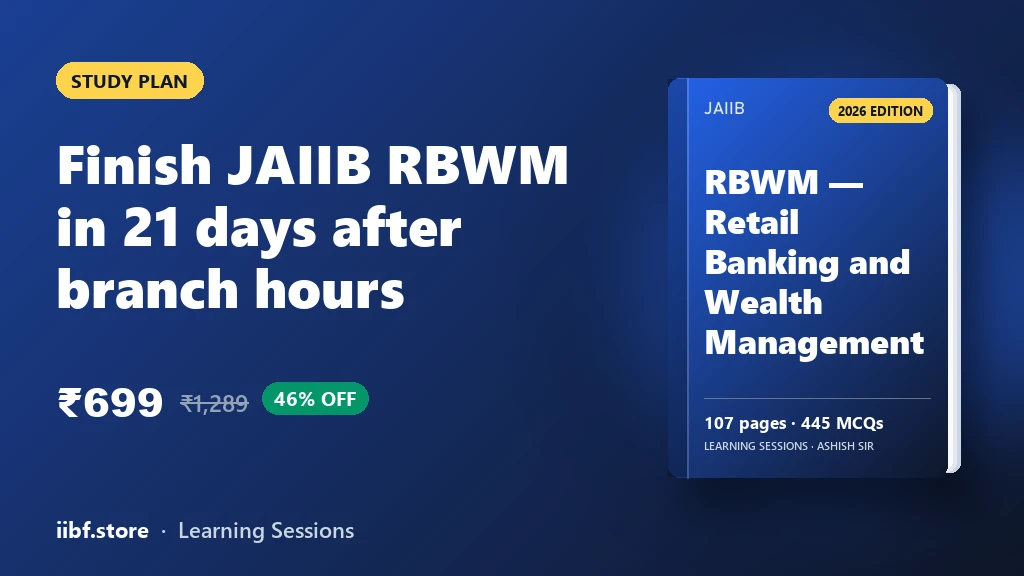
The facts are simple. The printed book runs to 107 pages in the 2026 edition, covers 30 chapters across the four modules above, and carries 445 questions. Beyond the chapters, it includes 63 case studies with 254 questions attached to them, which is useful because case-based thinking is where candidates tend to lose marks.
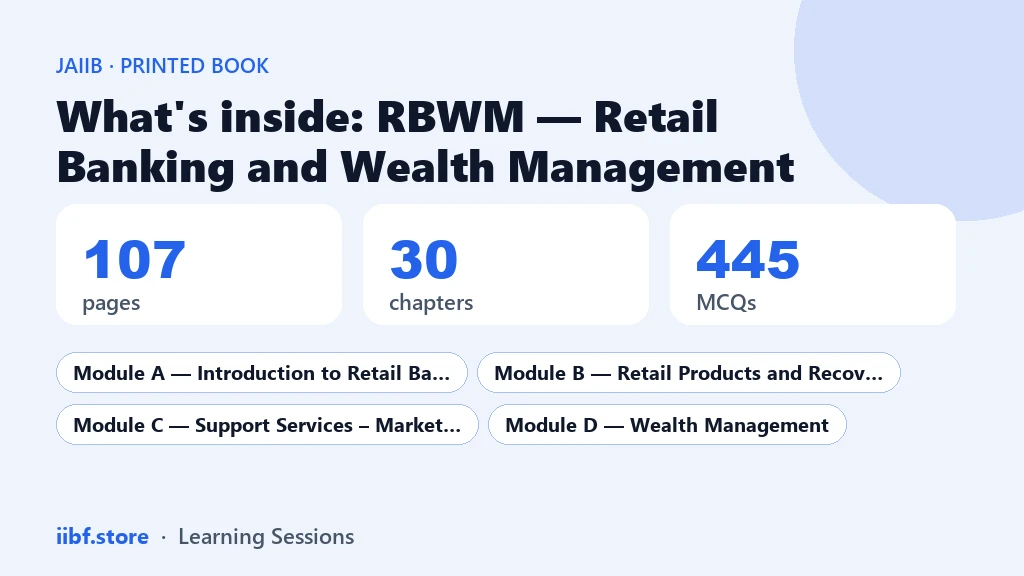
Notice what 107 pages across 30 chapters tells you: each chapter is short. This is a revision-friendly format, not a reference encyclopaedia. That suits a tired reader. A chapter you can finish in one sitting is a chapter you will actually finish, and finishing is what builds the confidence to start the next one.
Here is the layout at a glance, with the number of chapters in each module, so you can see where the weight sits.
| Module | Theme | Chapters |
|---|---|---|
| A | Introduction to Retail Banking | 4 |
| B | Retail Products and Recovery | 12 |
| C | Support Services and Marketing | 6 |
| D | Wealth Management | 8 |
Table: chapter spread inside the JAIIB RBWM book. Module B holds the most chapters, so plan the most time for it.
What one chapter looks like
The most useful way to judge any study book is to picture a single chapter. Take "Credit Scoring" from Module B as an example. The idea is a three-step flow: concise notes first, then the key points worth remembering, then questions to test what stayed in your head.
- Concise notes. The chapter explains the topic in short paragraphs, written to be read in one go rather than studied over days.
- Key points. The points that are likely to come back in the exam are pulled out, so your revision later is a quick scan and not a full re-read.
- MCQs. You close the loop immediately with questions on the same chapter, while the material is fresh.
Why does that order matter? Because memory fades fastest in the first day. A question attempted twenty minutes after reading shows you what actually stuck. A question attempted three weeks later mostly shows you what you forgot, which is demoralising and less useful.
To be honest about limits: a book alone will not give you exam-hall speed. Reading and short MCQs build understanding, but timed practice builds pace. Pair the chapter questions with free mock tests on iibf.store/tests, so you also practise under a clock.
A simple plan for using each chapter
Here is the routine we suggest for a working banker. It uses the JAIIB RBWM book as the base, but you can run the same loop on any chapter-wise material.
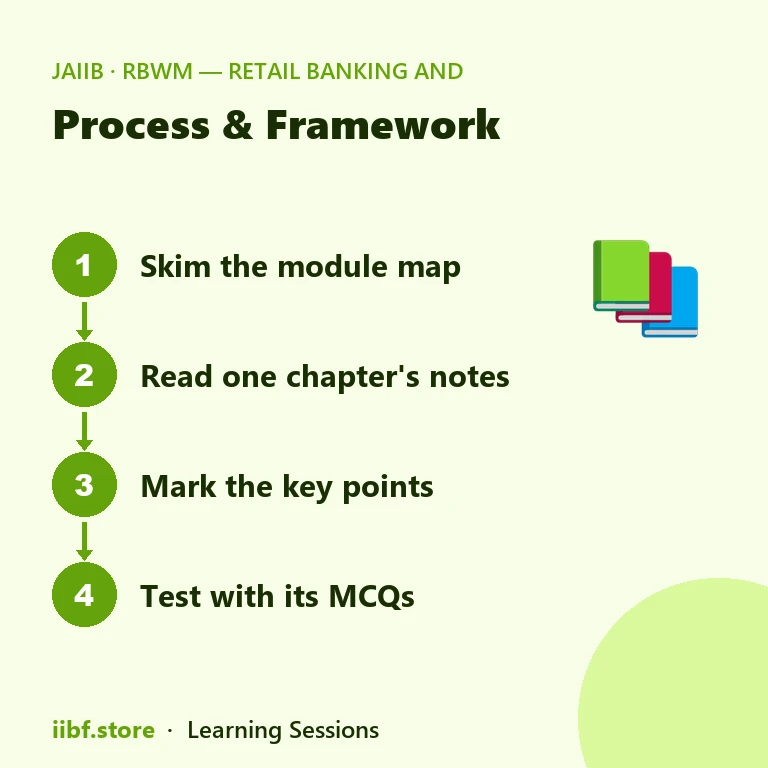
Step 1: Skim the module map (5 minutes)
Before you read, look at the list of chapters in the module and see where tonight's chapter sits. Knowing that "Recovery of Retail Loans" comes after loan products and before MIS helps you link ideas instead of memorising islands.
Step 2: Read the concise notes (20 to 30 minutes)
Read one chapter, nothing more. With 107 pages across 30 chapters, most chapters are short enough to complete in a single evening session. If your attention drops, stop, drink water, and finish the paragraph you are on. Do not start the next chapter just because you have time.
Step 3: Mark the key points (10 minutes)
Underline only what you would struggle to explain to a new colleague. Over-underlining is a quiet trap: if everything is marked, nothing is. Aim for a handful of marks per chapter.
Step 4: Attempt the chapter's MCQs (15 minutes)
Answer without looking back. Check the answers, then revisit only the paragraphs behind your wrong answers. This single habit turns 445 questions into a diagnostic tool, not just a score.
A realistic target is one chapter on a weekday and two or three on a weekend. At that pace, the four modules fit into a few weeks of normal life with room left for revision. The exact length depends on your job, your commute and your energy, so adjust it rather than copying it blindly.
Where the case studies fit
The book also carries 63 case studies with 254 questions. Case-style questions are different from one-line MCQs: they give you a small situation and ask you to apply what you read. Keep them for the second pass. First complete the chapter loop above, and only then turn to cases, because applying a concept you have not yet learned is frustrating and wastes your limited evenings.
A good rhythm is to finish one module, then do the case studies that relate to it before moving on. Module B and Module D, with their lending, recovery and property topics, are where scenario-based thinking will help most.
Who gets the most out of this book
Being direct, the JAIIB RBWM book is not for everyone. It is most useful for:
- Working bankers with limited evenings who prefer short chapters and a clear finish line to a heavy reference text.
- Candidates who read on paper and think better with a pen in hand than on a phone screen.
- People who have postponed before and want a visible structure: four modules, 30 chapters, questions at the end of the loop.
- Revision-stage candidates who already know the syllabus broadly and want a compact set to cycle through quickly.
It is a weaker fit if you want video lectures, live doubt-clearing or a detailed commentary on every regulation. In that case, combine it with other resources. You can browse the free PDF material and the JAIIB course page to see what else is available, and look through the full range at iibf.store/books.
Price, sample and what to check first
At the time of writing, the book is listed at ₹699 against an MRP of ₹1,289, which is 46% off. Prices can change, so treat the book page as the current source. Before you decide, read the free sample on the JAIIB RBWM book page. If the writing style and chapter layout suit your reading habit, that is a better signal than any description, including this one.
For the official exam schedule, syllabus and any rule on attempts, always rely on the institute itself at www.iibf.org.in. Plan against the upcoming exam cycle as published there, not against anything second-hand.
Your first week, in short
Whatever material you use, start small. Tonight, write the four modules and their chapter counts on one sheet. Tomorrow, read one Module A chapter and attempt its questions. By the weekend, you will know how long a chapter really takes you, and that number is more valuable than any ready-made timetable. The JAIIB RBWM book is built to make that loop short and repeatable; your job is only to keep turning up for it. For more preparation guides written for working bankers, browse the iibf.store blog.
Frequently asked questions
How many chapters and questions does the book have?
The 2026 edition runs to 107 pages with 30 chapters across four modules, and carries 445 questions. It also includes 63 case studies with 254 questions.
Can I read a sample before ordering?
Yes. A free sample is available on the book page at https://iibf.store/books/jaiib-rbwm-printed-book, so you can judge the layout and writing style first.
Is the book enough on its own for the exam?
It gives you a structured set of notes, key points and questions, but exam-hall speed comes from timed practice. Pair it with mock tests and check the official syllabus at the institute's website.
What is the price?
It is listed at ₹699 against an MRP of ₹1,289, but prices may change, so the book page always shows the current figure.
Prefer revising from a printed book?
Chapter-wise books with MCQs after every chapter — minimal pages, complete coverage, delivered anywhere in India. Every book has a free sample to read first.
107 pages · 445 MCQs
Learning Sessions · Ashish Sir
131 pages · 672 MCQs
Learning Sessions · Ashish Sir
221 pages · 831 MCQs
Learning Sessions · Ashish Sir
128 pages · 524 MCQs
Learning Sessions · Ashish Sir
148 pages · 478 MCQs
Learning Sessions · Ashish Sir
151 pages · 465 MCQs
Learning Sessions · Ashish Sir
148 pages · 375 MCQs
Learning Sessions · Ashish Sir
216 pages · 895 MCQs
Learning Sessions · Ashish Sir
109 pages · 300 MCQs
Learning Sessions · Ashish Sir
104 pages · 360 MCQs
Learning Sessions · Ashish Sir
82 pages · 297 MCQs
Learning Sessions · Ashish Sir
151 pages · 600 MCQs
Learning Sessions · Ashish Sir
98 pages · 282 MCQs
Learning Sessions · Ashish Sir
132 pages · 225 MCQs
Learning Sessions · Ashish Sir
188 pages · 435 MCQs
Learning Sessions · Ashish Sir
117 pages · 236 MCQs
Learning Sessions · Ashish Sir
Learning Sessions · Ashish Sir
118 pages · 299 MCQs
Learning Sessions · Ashish Sir
Learning Sessions · Ashish Sir
Learning Sessions · Ashish Sir
Learning Sessions · Ashish Sir
115 pages · 255 MCQs
Learning Sessions · Ashish Sir
Learning Sessions · Ashish Sir
334 pages · 936 MCQs
Learning Sessions · Ashish Sir
Learning Sessions · Ashish Sir
115 pages · 344 MCQs
Learning Sessions · Ashish Sir
107 pages · 240 MCQs
Learning Sessions · Ashish Sir
90 pages · 150 MCQs
Learning Sessions · Ashish Sir
Learning Sessions · Ashish Sir
Quick quiz on this topic
5 exam-style questions from our free test bank — check yourself before you move on.
Practice this topic
Take a free mock test, download chapter PDFs, or watch a video class — all included on iibf.store.