JAIIB RBWM Study Plan: 21 Days for a Working Banker
You reach home at 8 pm. The branch closed on time, but the day did not: a cash mismatch, two loan files, a customer who wanted a statement yesterday. Now you open the JAIIB syllabus and it looks endless. If that is you, this JAIIB RBWM study plan is written for you, not for a full-time student with six free hours a day.
Retail Banking and Wealth Management is often the paper bankers expect to be easy because "we do this every day". That is exactly the trap. The paper asks for definitions, product features and the language of the syllabus, not just what you do at your counter. A plan that respects your tiredness and gives every chapter a fixed slot beats a heroic plan you abandon on day four.
Why a JAIIB RBWM study plan has to be small and boring
Most working candidates fail a paper not because it is too hard, but because their plan needs three hours every night. Real life gives you 45 to 60 minutes on weekdays and perhaps three hours on a Sunday. So the plan below is built on a few plain rules.
- One chapter a night. Thirty minutes to read, fifteen to answer questions on it. Nothing more on a weekday.
- Questions the same night. Reading feels productive but fades by morning. Questions tell you what actually stayed.
- Weekends are for repair. Re-read only what you got wrong during the week.
- A buffer day every week. You will miss a night. The plan must survive that.
That is the whole method. The rest of this article is just the same idea applied to the actual chapter list.
Know the paper before you plan it: four modules, 30 chapters
A plan is only as good as the map under it. The JAIIB RBWM book from iibf.store covers the paper in four modules and 30 chapters across 107 pages, so an average chapter is only about three to four pages. That is the first good news for a tired reader: nothing here is a 40-page monster.
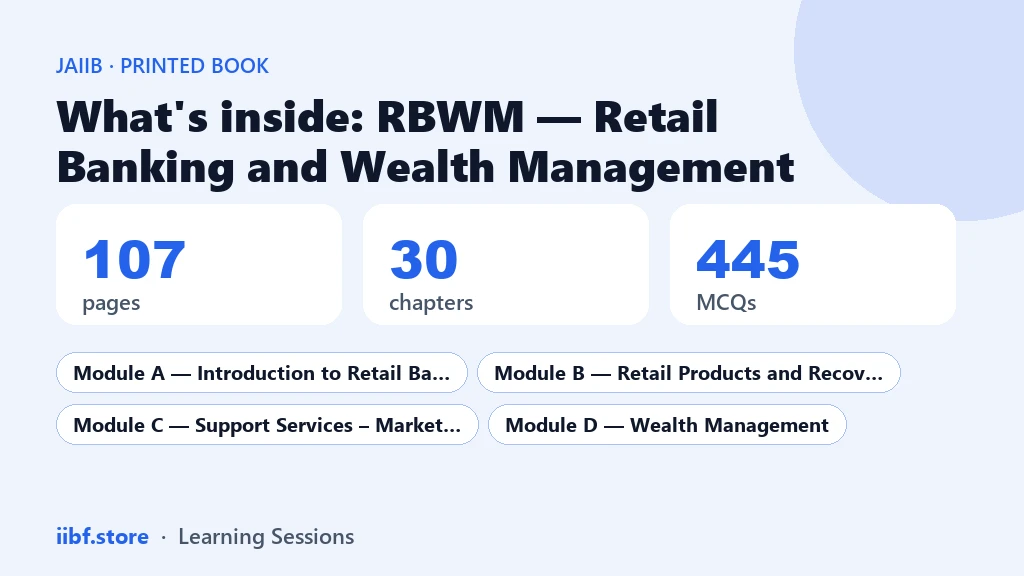
Module A: Introduction to Retail Banking (4 chapters)
Retail banking an introduction, its role within bank operations, where retail concepts apply, and branch profitability. This is the gentlest module. Use it to build the habit.
Module B: Retail Products and Recovery (12 chapters)
The heaviest module: customer requirement, product development, credit scoring, liability products, asset products, credit and debit cards, remittances, digitisation, AI and technology, recovery of retail loans, MIS and securitization of assets. Give it the most days.
Module C: Support Services and Marketing (6 chapters)
Marketing, delivery channels, delivery models, CRM, service standards and the marketing information system. Mostly conceptual, quick to read, easy to forget, so questions matter here.
Module D: Wealth Management (8 chapters)
Importance of wealth management, investment management, tax planning, other financial services, lender appraisal, housing finance and tax planning, mortgage advice and valuation of real property. This is where numbers and procedures appear, so schedule it when you are fresh, ideally on a weekend.
The 21-day JAIIB RBWM study plan, table first
Here is the schedule. It assumes one chapter on most weekdays, two on lighter days, and a catch-up slot at the end of each module. Adjust the dates to your own roster; the order is what matters.
| Days | What to read | Question practice |
|---|---|---|
| 1-2 | Module A, all 4 chapters | All end-of-chapter MCQs for each chapter, same night |
| 3-5 | Module B, chapters 1-6: Customer Requirement to Retail Asset Products | Chapter MCQs nightly; note every wrong answer |
| 6-8 | Module B, chapters 7-12: Credit Cards to Securitization of Assets | Chapter MCQs nightly; mixed set of 20 on day 8 |
| 9 | Buffer and repair: Modules A and B | Redo only the questions you got wrong |
| 10-12 | Module C, all 6 chapters (two a night) | Chapter MCQs; quick recap of Module C on day 12 |
| 13-17 | Module D, all 8 chapters (weekend double) | Chapter MCQs nightly; tax and appraisal chapters twice |
| 18-19 | Case studies from the whole paper | Case study questions, untimed first, then timed |
| 20-21 | Final revision of your wrong-answer notes | One full timed mock from the free tests page |
If you can only manage half the time, double the days, not the stress. A 40-day version of the same JAIIB RBWM study plan works equally well, as long as the order and the nightly questions stay.
How to run each night in 45 minutes
The table tells you what; this routine tells you how. It is the same every night, so you stop spending willpower on deciding.
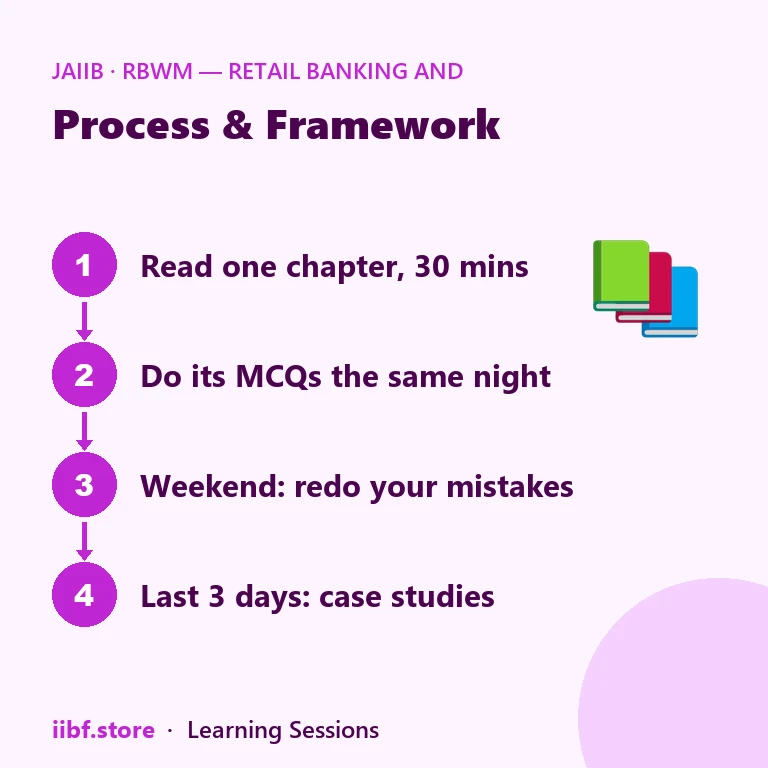
- Five minutes: skim the chapter headings before reading, so your brain knows the shape.
- Twenty-five minutes: read once, pen in hand. Underline definitions, features and lists only. Do not highlight whole paragraphs.
- Fifteen minutes: attempt that chapter's MCQs without looking back. Mark every wrong or guessed answer.
On the weekend, open only your marked questions. Read the relevant lines again and answer them a second time. This repeated contact with your own mistakes is worth more than a third full reading of the book.
Where the book's design helps
The RBWM book carries 445 questions along with its 30 chapters, and it also lists 63 case studies with 254 questions. Because each chapter is short and has its own practice, the nightly loop above is easy to follow without hunting for a separate question source. You can see exactly how it is laid out before buying: the book page has a free sample, linked in the card above.
Making the JAIIB RBWM study plan survive a bad week
Every plan breaks. Month-end, audits, a sick child, a transfer order. Decide in advance how you will recover.
- Missed one night: use the buffer day. Do not read two chapters to make it up.
- Missed three nights: skip the new reading for one evening and do only the wrong-answer repair, then restart where you stopped.
- Behind by a week: stretch the plan; never cut the question practice to save time.
Guilt is the real enemy of working candidates. A plan that says "resume at the next chapter" removes it.
What to do in the last three days
Stop reading new material. Go through your wrong-answer notes, do the case studies, and take one timed mock. The free mock tests are useful here because they train exam-hall speed, which no book can give you. Also keep an eye on the official schedule and instructions on the IIBF website, since the upcoming exam cycle details can change.
A free way to test this plan before buying anything
You do not need to commit money to try the method. Take the free PDFs in the free study material section, read one chapter tonight, and answer questions on it. If the loop works for you for three nights, it will work for twenty-one. If you prefer printed pages you can scribble on, the printed book page lists the current price of ₹699 against an MRP of ₹1,289, though prices may change, so check the books page for the latest.
One honest limit: a book and a schedule will not give you exam-hall speed by themselves. Pair this JAIIB RBWM study plan with at least two or three timed mocks, and read the paper's instructions carefully on the day. For other JAIIB papers and the full course, see the JAIIB course page.
The plan in one paragraph
Four modules, thirty short chapters, twenty-one days. One chapter a night, questions the same night, repair on weekends, case studies in the last stretch and a timed mock before the exam. That is a JAIIB RBWM study plan a tired banker can actually follow. Keep the RBWM book beside you, start tonight with Module A, and let the small habit do the heavy lifting.
Frequently asked questions
Can I finish RBWM in 21 days while working full time?
Yes, if you keep to roughly 45 minutes a night and use weekends for repair. The chapters are short, 30 chapters in 107 pages in this book, so one chapter a night is realistic. If your branch is under pressure, simply stretch the same plan to 30 or 40 days.
Which module should I start with?
Start with Module A. It is the lightest, and finishing it in two nights gives you momentum before the heavy Module B with its 12 chapters.
Is a book enough, or do I need mock tests too?
The book gives you content and chapter-wise practice. Mock tests give you timing and exam-hall pressure. Use both, and start with the free tests on iibf.store.
Where do I check the exam dates and rules?
Always on the official IIBF website, https://www.iibf.org.in. This article deliberately gives no dates or attempt rules because they can change.
Prefer revising from a printed book?
Chapter-wise books with MCQs after every chapter — minimal pages, complete coverage, delivered anywhere in India. Every book has a free sample to read first.
107 pages · 445 MCQs
Learning Sessions · Ashish Sir
131 pages · 672 MCQs
Learning Sessions · Ashish Sir
221 pages · 831 MCQs
Learning Sessions · Ashish Sir
128 pages · 524 MCQs
Learning Sessions · Ashish Sir
148 pages · 478 MCQs
Learning Sessions · Ashish Sir
151 pages · 465 MCQs
Learning Sessions · Ashish Sir
148 pages · 375 MCQs
Learning Sessions · Ashish Sir
216 pages · 895 MCQs
Learning Sessions · Ashish Sir
109 pages · 300 MCQs
Learning Sessions · Ashish Sir
104 pages · 360 MCQs
Learning Sessions · Ashish Sir
82 pages · 297 MCQs
Learning Sessions · Ashish Sir
151 pages · 600 MCQs
Learning Sessions · Ashish Sir
98 pages · 282 MCQs
Learning Sessions · Ashish Sir
132 pages · 225 MCQs
Learning Sessions · Ashish Sir
188 pages · 435 MCQs
Learning Sessions · Ashish Sir
117 pages · 236 MCQs
Learning Sessions · Ashish Sir
Learning Sessions · Ashish Sir
118 pages · 299 MCQs
Learning Sessions · Ashish Sir
Learning Sessions · Ashish Sir
Learning Sessions · Ashish Sir
Learning Sessions · Ashish Sir
115 pages · 255 MCQs
Learning Sessions · Ashish Sir
Learning Sessions · Ashish Sir
334 pages · 936 MCQs
Learning Sessions · Ashish Sir
Learning Sessions · Ashish Sir
115 pages · 344 MCQs
Learning Sessions · Ashish Sir
107 pages · 240 MCQs
Learning Sessions · Ashish Sir
90 pages · 150 MCQs
Learning Sessions · Ashish Sir
Learning Sessions · Ashish Sir
Quick quiz on this topic
5 exam-style questions from our free test bank — check yourself before you move on.
Practice this topic
Take a free mock test, download chapter PDFs, or watch a video class — all included on iibf.store.
Keep reading