Internal Financial Controls in Banks: IFCoFR Testing (CAAP 2026)
For CAAP candidates, internal financial controls in banks is one of the highest-yield topics in the audit paper. That is because it sits at the intersection of company law, RBI expectations, and the auditor's own testing methodology. A bank's financial statements are only as reliable as the controls behind loan sanctioning, interest application, reconciliation, and closing entries. Both the board and the statutory auditor are now expected to say so in writing. This article walks through IFCoFR design and the COSO 2013 building blocks. It also covers the testing approach examiners expect you to describe, deficiency classification, and how auditors report their conclusion.
🏦 What IFCoFR Means for a Banking Company
Internal Financial Controls over Financial Reporting (IFCoFR) are the policies and procedures a bank puts in place. They give reasonable assurance that financial reporting is reliable, and that financial statements are prepared for external purposes in line with generally accepted accounting principles. IFCoFR is broader than mere accounting controls. It also covers safeguarding assets, preventing and detecting fraud, and keeping accounting records accurate and complete.
Auditors and audit committees think of IFCoFR in three layers. Entity-level controls (ELCs) set the tone — the control environment, the board's oversight, whistle-blower mechanisms, and the risk-assessment process. Process-level (transaction) controls operate within specific cycles such as advances, deposits, and treasury. The topics you studied under banking operations and accounting functions map directly onto this layer. IT General Controls (ITGCs) — access management, change management, and batch job monitoring over the core banking solution — support every automated control sitting above them. A weak ITGC can therefore undermine an otherwise well-designed process control.
Banks run thousands of daily transactions through the CBS with limited manual intervention. Because of this, ITGC weaknesses are one of the most common root causes examiners expect you to identify. A control framework that looks strong on paper but rests on an unpatched access-review process is not effective in substance.
⚖️ Designing Controls: COSO 2013 and the Companies Act Mandate
The design obligation is not optional for banks incorporated as companies. Section 134(5)(e) of the Companies Act 2013 requires the directors of a listed company to state this in the Directors' Responsibility Statement. They must confirm that they have laid down internal financial controls, and that these controls are adequate and were operating effectively during the year. Section 143(3)(i) separately requires the statutory auditor to report on the adequacy of the internal financial controls system and the operating effectiveness of such controls. Read this section together with the Companies (Audit and Auditors) Rules, 2014.
Applicability nuance matters here. Private-sector banks and foreign banks incorporated as companies under the Companies Act fall squarely within sections 134(5)(e) and 143(3)(i). Public sector banks, however, are constituted under the Banking Companies (Acquisition and Transfer of Undertakings) Acts of 1970/1980 rather than the Companies Act 2013. So the literal statutory trigger under section 143(3)(i) does not apply to them in the same way. In practice, RBI's directions to Statutory Central Auditors and the Long Form Audit Report still require auditors of PSBs to comment on internal control systems. PSBs are also expected to align their control documentation with the same COSO-based framework for consistency.
Whichever route applies, the design reference point is the accounting process mapped against the five components of the COSO 2013 Internal Control – Integrated Framework. These five components are Control Environment, Risk Assessment, Control Activities, Information and Communication, and Monitoring Activities. The ICAI's Guidance Note on Audit of Internal Financial Controls Over Financial Reporting builds its testing methodology on exactly these five components. This is why examiners expect you to name them, not just the acronym.
💡 Exam Tip: Section 134(5)(e) is a directors' representation limited to listed companies; section 143(3)(i) is the auditor's reporting duty and has wider reach. Do not merge the two in an answer.
🔍 The Testing Approach: Design vs Operating Effectiveness
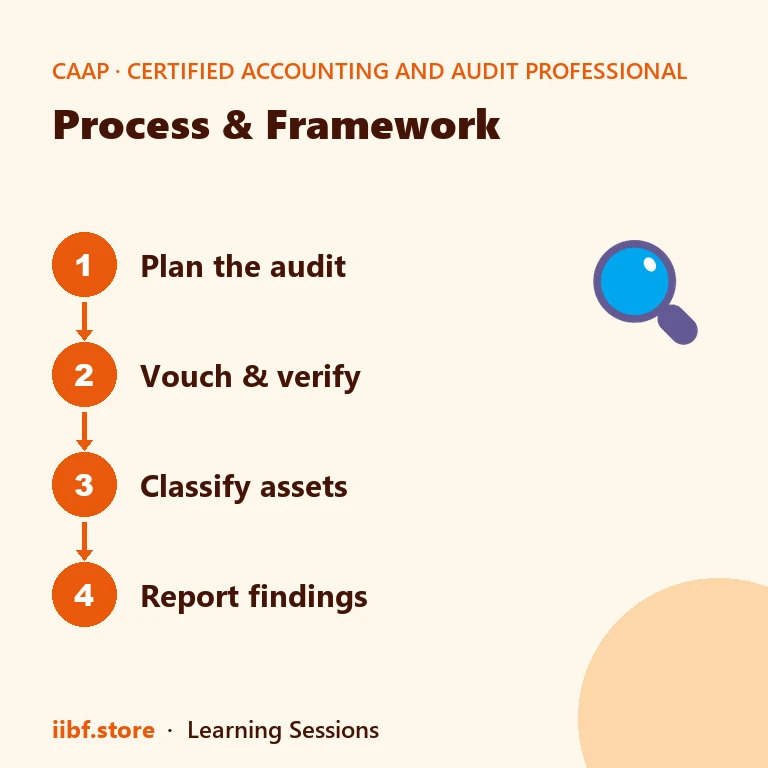
IFCoFR testing follows a top-down, risk-based approach. The auditor starts with entity-level controls, then identifies significant accounts, disclosures, and the relevant assertions within them. Only then does the auditor drill down to the process-level and IT controls that address those assertions. This scoping discipline stops the audit from turning into a mechanical, account-by-account checklist.
Two distinct tests follow. A test of design effectiveness asks whether a control, if operated as prescribed, would actually prevent or detect a material misstatement. Auditors typically evaluate this through walkthroughs that trace a transaction from origination to the general ledger. A test of operating effectiveness asks whether the control actually functioned as designed throughout the period. Auditors evaluate this through inspection of evidence, reperformance, observation, and inquiry. Sample sizes scale to how frequently the control operates, so daily controls need larger samples than quarterly ones.
Sampling and evidence-gathering here draw on the same discipline you studied for verification of advances in bank audit. A control can look adequate on the process note, yet still fail operating-effectiveness testing if sanctioning authority limits are routinely overridden without documented approval. Auditors also test controls over the accounting cycles covered under bank audit and various types of audits in banks. IFCoFR work overlaps heavily with the statutory audit's substantive procedures rather than replacing them.
⚠️ Common Mistake: Candidates often assume a control passing the design test automatically passes operating effectiveness. Design effectiveness is necessary but not sufficient — a well-designed control that nobody actually performs is still a failure.
📋 Deficiency Classification and Auditor Reporting
Once testing is complete, every exception is classified by severity. A deficiency exists when the design or operation of a control does not allow management or employees to prevent or detect misstatements on a timely basis. This applies to their normal course of duties. A significant deficiency is a deficiency, or combination of deficiencies, that is less severe than a material weakness. It is still important enough to merit attention from those charged with governance. A material weakness is a deficiency, or combination of deficiencies. It means there is a reasonable possibility that a material misstatement of the bank's financial statements will not be prevented or detected on a timely basis.
This classification directly drives the auditor's opinion on IFCoFR under section 143(3)(i). An unmodified opinion is possible only where no material weakness exists as of the balance sheet date. A qualified or adverse opinion follows where one or more material weaknesses are identified and not remediated before reporting.

| Classification | What It Means | Effect on IFCoFR Opinion | Reported to Audit Committee |
|---|---|---|---|
| Deficiency | Control gap that could delay timely detection of a misstatement | No opinion impact; noted in the management letter | ✅ Yes, as observation |
| Significant Deficiency | Deficiency important enough to warrant governance attention | Usually no opinion impact if remediated | ✅ Yes, formally |
| Material Weakness | Reasonable possibility a material misstatement is missed | Qualified / adverse opinion on IFCoFR | ✅ Yes, mandatory disclosure |
| Immaterial Isolated Exception | One-off error with no pattern or recurrence | No opinion impact | ❌ Not usually escalated |
Controls testing also feeds directly into disclosure and provisioning judgements elsewhere in the financial statements. For instance, the classification choices you studied under provisions vs reserves in bank books depend on the same underlying process controls being reliable. Weak controls over the schedules feeding the balance sheet are a recurring source of IFCoFR exceptions in practice, as discussed in bank balance sheet schedules. The same is true of weak controls over asset verification, as covered in audit of fixed assets in banks.
📌 Remember: A material weakness does not automatically mean fraud occurred — it means the control structure could not be relied upon to catch a material error if one existed.
🎯 Getting Exam-Ready on IFCoFR
The section 134(5)(e)/143(3)(i) distinction, the COSO five components, and the three-tier deficiency ladder are the exact building blocks CAAP examiners test repeatedly. They often test these through scenario questions rather than direct definitions. Read every case fact pattern to see which layer of control failed — entity, process, or IT general. Then decide whether the resulting gap is a deficiency, a significant deficiency, or a material weakness.
Build your revision around the source material in the Certified Accounting and Audit Professional tag hub on iibf.store. Pair topic reading with timed mock questions on the CAIIB course page, so you get used to applying the classification ladder under time pressure rather than just recalling it.
🧠 Practice MCQs: Internal Financial Controls in Banks
Q1. Under the Companies Act 2013, which section requires the directors of a listed banking company to state that internal financial controls are adequate and operating effectively? (a) Section 134(5)(f) (b) Section 143(3)(i) (c) Section 134(5)(e) (d) Section 138
Answer: (c) — Section 134(5)(e) is the directors' representation in the Directors' Responsibility Statement, applicable to listed companies.
Q2. The statutory auditor's duty to report on the adequacy and operating effectiveness of internal financial controls arises under: (a) Section 143(3)(i) (b) Section 129 (c) Section 92 (d) Section 149
Answer: (a) — Section 143(3)(i), read with the Companies (Audit and Auditors) Rules, 2014, places this reporting duty on the auditor.
Q3. Which of these is NOT one of the five COSO 2013 framework components used in the IFCoFR testing methodology? (a) Control Environment (b) Risk Assessment (c) Regulatory Capital Adequacy (d) Monitoring Activities
Answer: (c) — Regulatory capital adequacy is a prudential concept, not a COSO 2013 internal control component; the five components are Control Environment, Risk Assessment, Control Activities, Information and Communication, and Monitoring Activities.
Q4. A control gap where there is a reasonable possibility that a material misstatement will not be prevented or detected on a timely basis is classified as a: (a) Deficiency (b) Significant deficiency (c) Material weakness (d) Compensating control
Answer: (c) — This is the definition of a material weakness, the most severe classification, and it can lead to a qualified or adverse IFCoFR opinion.
Q5. In the top-down, risk-based approach to IFCoFR testing, the auditor begins with: (a) Entity-level controls (b) Vendor invoice testing (c) IT General Controls only (d) Substantive analytical review
Answer: (a) — The approach starts at entity-level controls, then moves to significant accounts and assertions, and finally to process-level and IT general controls.
Want chapter-wise mock tests with 100+ MCQs? Start practising free →
What is the difference between design effectiveness and operating effectiveness in IFCoFR testing?
Design effectiveness asks whether a control, if performed as prescribed, would actually prevent or detect a material misstatement — usually tested through a walkthrough. Operating effectiveness asks whether that control actually functioned consistently throughout the period, tested through inspection, reperformance, observation, and inquiry.
Do public sector banks fall under Companies Act section 143(3)(i) for IFCoFR reporting?
Not directly. Public sector banks are constituted under the Banking Companies (Acquisition and Transfer of Undertakings) Acts of 1970/1980 rather than the Companies Act 2013, so section 143(3)(i) does not apply in its literal form. RBI's directions to Statutory Central Auditors and the Long Form Audit Report still require comment on internal control systems, and PSBs are expected to follow the same COSO-based approach for consistency.
What is an IT General Control (ITGC) and why does it matter for banks?
ITGCs are controls over access management, change management, and IT operations for the core banking solution. Because most bank transactions flow through automated systems with minimal manual touch, a weak ITGC can undermine every automated process control that depends on it, even if that process control looks well designed on paper.
What happens if an auditor identifies a material weakness in a bank's IFCoFR?
The auditor must describe the material weakness in the audit report and issue a qualified or adverse opinion on the internal financial controls over financial reporting, in addition to the opinion on the financial statements themselves. Management is expected to disclose a remediation plan and timeline.
Practice this topic
Take a free mock test, download chapter PDFs, or watch a video class — all included on iibf.store.