Audit of Fixed Assets in Banks: What CAAP Auditors Check
An audit of fixed assets in banks looks simple on paper. A branch has a few buildings, some vehicles, computers and furniture. In practice, this is one of the areas where auditors find the most silent errors — assets still on the books years after disposal, wrong depreciation rates, and additions capitalised without proper approval.
This guide walks through what a branch auditor actually checks, the common mistakes examiners test, and how fixed asset audit work links to the bank's final accounts. It is written for CAAP candidates and working bank auditors who want a practical, exam-ready understanding rather than a textbook definition.
🏦 Why Fixed Asset Audit Deserves Real Attention
Fixed assets rarely move as fast as loans or deposits. That is exactly why they get neglected. A branch may not buy a new building for a decade, so nobody re-checks the old asset register.
Over time, small errors pile up. An asset scrapped in 2019 might still show a positive balance in 2026. A leasehold improvement might sit under the wrong head. None of this looks urgent, until the statutory auditor signs off on a balance sheet that overstates assets.
For CAAP candidates, this chapter matters because examiners like to test judgment, not just definitions. You are expected to know what a reasonable auditor would flag, not just recite an accounting standard. Understanding the basics in Accounting: An Introduction helps before you move into audit-specific checks.
Bank inspectors treat fixed asset mismatches as a governance signal. If a bank cannot maintain its own asset register accurately, examiners start asking harder questions about its internal controls elsewhere too.
📋 What the Auditor Physically Verifies
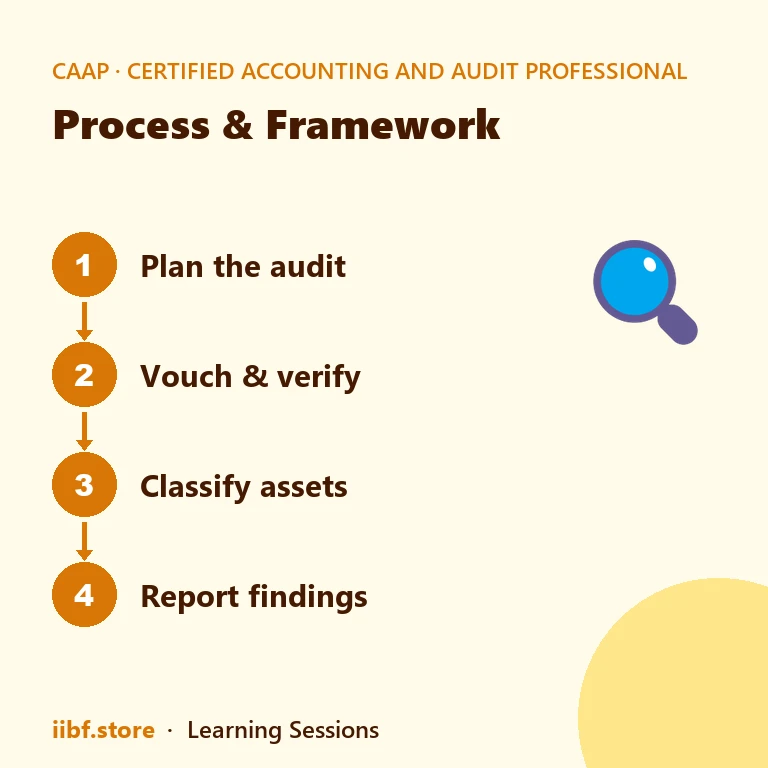
Physical verification is the backbone of any audit of fixed assets in banks. The auditor does not just tally numbers in a ledger. They walk the branch, or review a verification report if a full walk-through is not possible.
Key checks include matching each major asset to a physical tag or serial number, confirming that the asset is actually in use, and checking that insurance cover exists where required. Idle or damaged assets should be identified and reported separately.
💡 Exam Tip: If a question mentions an asset that cannot be physically located, the correct audit response is always to seek management explanation and report the discrepancy — never to simply ignore it or assume disposal.
Auditors also check ownership documents for immovable property, such as title deeds for bank-owned premises. A missing title deed is a red flag that must go into the audit report, not just a verbal query to branch staff. This ownership check is one reason a proper audit of fixed assets in banks cannot be rushed through in an hour at year-end.
For leased premises, the auditor checks the lease agreement, the rent schedule, and whether any capital improvements were wrongly booked as revenue expenses, or the other way round.
📉 Depreciation, Revaluation and the Errors That Repeat
Depreciation is where most fixed asset audit findings come from. A wrong rate, a wrong method, or a wrong start date can distort profit for years before anyone notices. The chapter on Depreciation Accounting covers the methods in detail, but the audit angle is about consistency and disclosure.
The auditor checks whether the bank has applied the same depreciation method and rate as the previous year. Any change must be disclosed, along with its financial impact. A silent change, buried in a footnote nobody reads, is a classic exam trap and a real-world red flag.
⚠️ Common Mistake: Assuming that once an asset is fully depreciated, no further audit work is needed. A fully depreciated asset still in active use must remain on the register at its residual value, not be quietly written off.
Revaluation of premises is less common but still tested. When a bank revalues a building, the auditor checks the valuer's credentials, the basis of valuation, and whether the resulting reserve is correctly credited to a capital reserve rather than treated as regular profit. The related chapter on Capital Reserves and Surplus explains this treatment in more depth.
🖥️ Fixed Assets in a Computerised Environment
Most banks today maintain their fixed asset register on a core banking or ERP module rather than a manual ledger. This changes how the audit is performed, though not what it is trying to achieve.
In a computerised environment, the auditor reviews system-generated depreciation runs, checks access controls over the asset master file, and confirms that additions and deletions go through proper authorisation before they hit the general ledger. The dedicated chapter on Audit in a Computerised Environment covers the control framework auditors rely on here.
A common weakness is a mismatch between the fixed asset sub-ledger and the general ledger control account. Reconciling the two, and understanding why a gap exists, is a standard audit step that examiners expect candidates to know cold.
📌 Remember: A system report is only as reliable as the controls around who can edit it. Auditors test the controls first, then trust the report.
Data migration during a core banking upgrade is another risk point. Assets can get duplicated, dropped, or assigned wrong opening balances during migration, and a careful auditor tests a sample of records against the pre-migration register.
📊 Fixed Asset Checks vs Other Bank Audit Areas
Fixed asset audit work is smaller in rupee terms than advances or investments, but it still connects directly to the bank's final accounts. The table below places it alongside other common bank audit areas so you can see where the emphasis differs.
| Audit Area | Main Focus | Physical Verification Needed | Typical Reporting Route |
|---|---|---|---|
| Fixed Assets | Existence, ownership, depreciation | ✅ Yes | LFAR and audit report |
| Advances | Recovery, classification, provisioning | ❌ No | Audit report and MOC |
| Cash and Bank Balances | Existence and reconciliation | ✅ Yes | Audit report |
| Investments | Classification and valuation | ❌ No | Audit report |
| Other Liabilities | Completeness of provisions | ❌ No | LFAR |
Notice that fixed assets and cash are the two areas where physical verification is unavoidable. You cannot audit existence from a ledger balance alone; someone has to actually look at the asset. The chapter on Other Liabilities and Provisions is a useful companion read, since fixed asset write-offs often create a corresponding liability or provisioning entry.

🧾 From Working Papers to the Bank's Final Accounts
Every fixed asset finding eventually flows into the bank's published balance sheet. Auditors preparing the final accounts of banks must ensure the fixed asset schedule ties back exactly to what was verified during fieldwork.
This is also where the asset side of the balance sheet gets its final scrutiny, covered in the chapter on Audit Aspects of a Bank's Financial Statements: Asset Side. Fixed assets sit alongside cash, advances and investments here, and a small error can distort more than one ratio at once.
If a candidate has already studied tax audit for banks, it helps to notice how depreciation figures feed straight into both the statutory audit working papers and the tax computation, so an error in one place shows up twice.
Auditors document every material fixed asset finding for inclusion in the Long Form Audit Report, a topic covered fully in our guide on the Long Form Audit Report for bank branch audits. Sampling which assets to physically verify, rather than checking every single item, follows the same logic explained in our piece on audit sampling in bank branch audits.
Working capital assessment in lending, by contrast, uses a different toolkit entirely — readers studying credit appraisal separately may find our note on the cash budget method useful for comparison.
🧠 Practice MCQs: Audit of Fixed Assets in Banks
Q1. During an audit of fixed assets in banks, an auditor finds an asset physically missing with no explanation from branch staff. What should the auditor do first? (a) Ignore it since the amount is small (b) Write it off directly in the audit working papers (c) Seek management explanation and report the discrepancy (d) Assume it was sold and move on
Answer: (c) — The auditor must always seek an explanation before drawing conclusions, and report any unresolved discrepancy.
Q2. A bank changes its depreciation method for vehicles mid-year without disclosure. This is best described as: (a) An acceptable operational decision (b) A disclosure failure requiring audit comment (c) A tax planning strategy (d) A routine accounting entry
Answer: (b) — Any change in depreciation method or rate must be disclosed along with its impact; an undisclosed change is an audit finding.
Q3. In a computerised environment, what should an auditor test before relying on a system-generated depreciation report? (a) Only the final total (b) Access controls over the asset master file (c) The branch manager's opinion (d) Nothing, system reports are always accurate
Answer: (b) — A report is only as reliable as the controls governing who can create or edit the underlying data.
Q4. When a bank revalues its premises, the resulting surplus should normally be credited to: (a) Profit and loss account as income (b) Capital reserve (c) General reserve for dividends (d) Interest income account
Answer: (b) — A revaluation surplus is a capital item and is credited to capital reserve, not treated as distributable profit.
Q5. Which of the following bank audit areas always requires physical verification, unlike investments or advances? (a) Fixed assets (b) Contingent liabilities (c) Interest accrued (d) Deferred tax assets
Answer: (a) — Fixed assets and cash are the two areas where existence cannot be confirmed from records alone and physical verification is mandatory.
Want chapter-wise mock tests with 100+ MCQs? Start practising free →
❓ Frequently Asked Questions
What is the main goal of a fixed asset audit in a bank?
The main goal is to confirm that assets recorded in the books actually exist, are owned by the bank, are correctly valued after depreciation, and are properly disclosed in the final accounts.
Does the auditor need to physically visit every branch to verify fixed assets?
Not always. Auditors typically rely on a sample of branches or on management's physical verification reports, but material or high-value assets usually warrant direct verification.
What happens if a fixed asset is fully depreciated but still in use?
It stays on the asset register at its residual value and continues to be reported. It should never be removed from the books simply because depreciation has reduced its value to near zero.
How does fixed asset audit connect to the Long Form Audit Report?
Material fixed asset observations, such as missing title deeds or unverified assets, are documented as specific points in the Long Form Audit Report so that bank management and regulators can act on them.
An audit of fixed assets in banks may never grab headlines the way loan fraud does, but it is a steady test of discipline, documentation and control. Candidates preparing for CAAP should treat it as a chance to show they understand real audit judgment, not just definitions. For structured practice on this and related topics, explore more guides on our Certified Accounting and Audit Professional hub, cross-check current disclosure norms on the RBI website, and try our full-length mock tests to reinforce what you have learned here.
Prefer revising from a printed book?
Chapter-wise books with MCQs after every chapter — minimal pages, complete coverage, delivered anywhere in India. Every book has a free sample to read first.
























Practice this topic
Take a free mock test, download chapter PDFs, or watch a video class — all included on iibf.store.