JAIIB November 2026 Study Plan to Clear All Four Papers
The hardest part of the JAIIB November 2026 attempt is not the syllabus. It is the calendar. Four papers are spread across four separate dates, the first one arrives sooner than most candidates expect, and the gap between papers two and three is only six days. Plan against the actual dates and roughly seventy-five days is comfortable. Plan against a vague "exam is in November" and you will run out of runway on the last paper.
How to clear all four JAIIB papers in one attempt · Watch on YouTube
The dates your plan has to respect
IIBF's published examination schedule for 2026–27 gives four distinct dates. Write them on the first page of your notebook before you write anything else.
| Paper | Subject | Exam date | Days from 19 August 2026 |
|---|---|---|---|
| 1 | Indian Economy & Indian Financial System | 1 November 2026 | 74 |
| 2 | Principles & Practices of Banking | 22 November 2026 | 95 |
| 3 | Accounting & Financial Management for Bankers | 28 November 2026 | 101 |
| 4 | Retail Banking & Wealth Management | 29 November 2026 | 102 |
Two features of that table should shape everything. First, IE&IFS stands alone with a three-week gap after it — it is the paper you must be finished with early. Second, AFM and RBWM fall on consecutive days, so the last two papers cannot be revised sequentially at the end; RBWM has to be exam-ready before you sit for AFM. Registration for the JAIIB November 2026 cycle opened in August 2026 and the window was subsequently revised, so confirm the live registration dates and fee slab on iibf.org.in rather than relying on any secondary source.
The passing rules, stated precisely
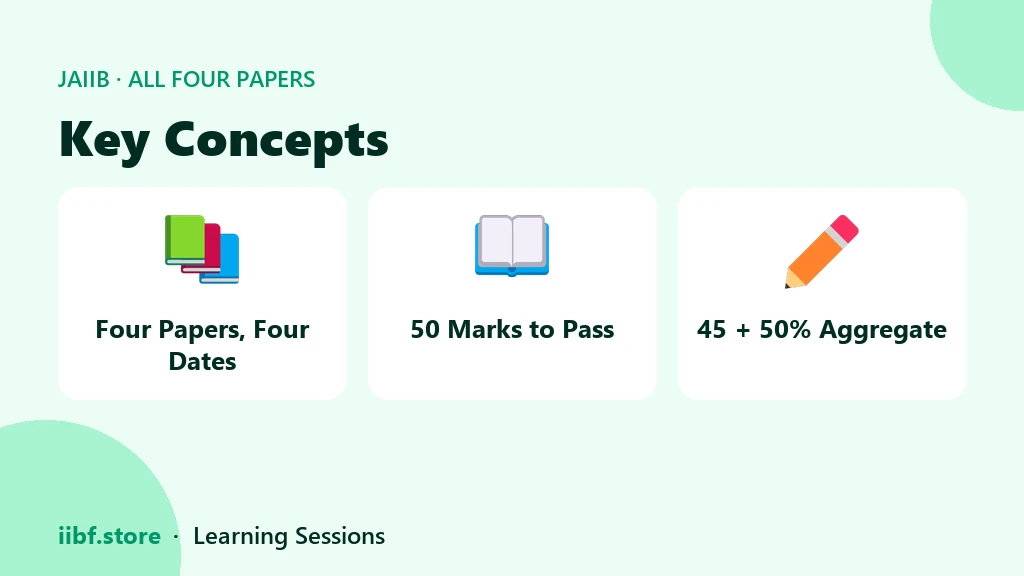
The minimum for a pass in a subject is 50 out of 100. There is a second route that candidates routinely misquote: a candidate who secures at least 45 marks in each subject with an aggregate of 50% across all subjects in a single attempt is also declared to have completed the examination. The "single attempt" condition is the part that gets dropped in retellings — 45 marks carried across two different attempts will not combine.
Credits for subjects you have passed are retained until the time limit for completing the examination expires. That limit is five attempts or three years from the date of registration for the first attempt, whichever comes earlier, and the attempts need not be consecutive. An attempt is counted when you apply, whether or not you actually appear. Miss the limit and you re-enrol afresh, losing the credits for subjects already passed — which is precisely why treating one paper as disposable is an expensive strategy.
The paper itself is roughly 100 objective multiple-choice questions for 100 marks, held online, with a duration of two hours and no negative marking for wrong answers. No negative marking has a direct tactical consequence: never leave a question blank. On class of pass, first class needs 60% or more in aggregate with a pass in all subjects in the first physical attempt, and first class with distinction needs 70% or more in aggregate with 60 or more in each subject.
A seventy-five day schedule that survives contact with real life
Most plans fail because they assume study time you do not have. Assume two hours on working days and four on a weekend day — roughly sixteen hours a week — and the plan below fits.
| Phase | Window | Focus |
|---|---|---|
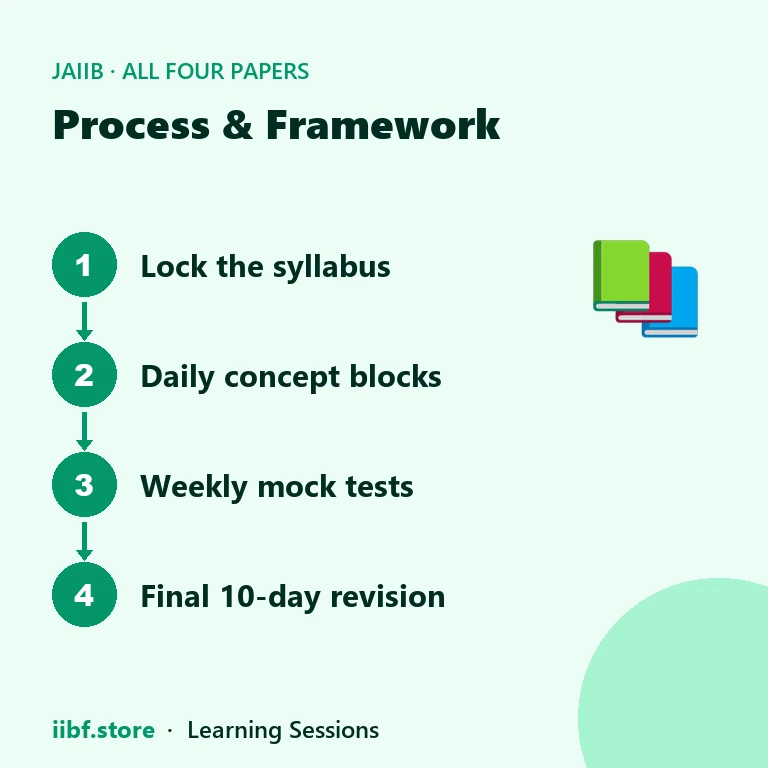
| Phase 1 | Now to end of September | IE&IFS end to end, plus AFM numericals started early because they need repetition, not reading |
| Phase 2 | 1–25 October | Finish IE&IFS revision and full mocks; begin PPB module by module |
| Phase 3 | 26 October to 1 November | IE&IFS only — one-liners, updates, two timed mocks. Paper 1 done |
| Phase 4 | 2–22 November | PPB to exam standard, RBWM covered in parallel because its exam is days after AFM |
| Phase 5 | 23–29 November | AFM numerical drills daily; RBWM revision from the notes already prepared, never from scratch |
Three rules make the difference in a JAIIB November 2026 attempt. Do AFM numericals daily rather than in blocks, because calculation speed decays fast. Attempt a full-length timed mock every weekend from October, since two hours of sustained attention is a skill of its own. And treat regulatory updates — policy rates, KYC norms, scheme limits — as a separate running list, because the examiner tests the current figure, not the one printed in an older edition.
Where candidates lose the attempt
The common failure is not weak preparation across the board — it is one abandoned paper. Because credits are retained only within the time limit, sacrificing a subject to "focus on the other three" usually means paying for another attempt and re-entering the same squeeze a cycle later. The second failure is reading AFM instead of solving it. The third is arriving at RBWM with nothing revised, having spent the final week entirely inside AFM, when the two exams are a day apart.
Work from a fixed source set so revision is compression rather than rediscovery. Start with the JAIIB course material, build the timetable on the study planner, and benchmark yourself with the full-length mock tests. Keep policy figures current using the RBI rates reference, and read related exam explainers on the blog. Always cross-check dates, fees and rules against the official IIBF website before you register.
Frequently asked questions
What are the exam dates for the four papers?
As per IIBF's 2026–27 schedule: Indian Economy & Indian Financial System on 1 November 2026, Principles & Practices of Banking on 22 November 2026, Accounting & Financial Management for Bankers on 28 November 2026, and Retail Banking & Wealth Management on 29 November 2026.
How many marks do I need to pass?
50 out of 100 in a subject. Alternatively, at least 45 marks in each subject together with an aggregate of 50% across all subjects in a single attempt also counts as completing the examination.
How many attempts do I get, and do my passed subjects carry forward?
Five attempts within a maximum of three years from first registration, whichever is earlier. Credits for passed subjects are retained until that limit expires; after that you must re-enrol afresh and the earlier credits are lost.
Is there negative marking?
No. The paper is approximately 100 objective multiple-choice questions for 100 marks over two hours, online, with no negative marking — so attempt every question.
Quick quiz on this topic
5 exam-style questions from our free test bank — check yourself before you move on.
Practice this topic
Take a free mock test, download chapter PDFs, or watch a video class — all included on iibf.store.
Keep reading