Bank Promotion Exam Notes 2026: Who the Complete Set Is For

It is 10 pm. You have closed the branch, the cash has tallied (finally), and you have perhaps ninety minutes of attention left before sleep wins. The promotion syllabus in front of you looks endless: banking law, deposits, credit, risk, recovery, forex, tax. If this is you, you do not need another "complete package" pitch. You need to know honestly whether a particular set of notes will fit your life.
This article is that honest check for the bank promotion exam notes we publish: the 2026 complete set of booklets. We will go through four kinds of candidates, say how each should use the set, and say plainly where notes alone will not be enough. If, by the end, you decide it is not for you, you will still leave with a plan.
First, what problem are you actually solving?
Before choosing any book, name your bottleneck. Working bankers usually have one of four:
- Coverage: you do not know what is in the syllabus, so you do not know what you do not know.
- Currency: you studied from old notes and fear that a rule has changed since.
- Time: you have the knowledge in patches but no hours to collect it.
- Speed: you know the content but lose marks in the exam hall to reading time and nerves.
A set of notes can fix the first three. It cannot fix the fourth. Speed comes only from timed practice, and no book, ours included, can give you that by itself. Keep this in mind through the rest of the article.
What the complete set contains
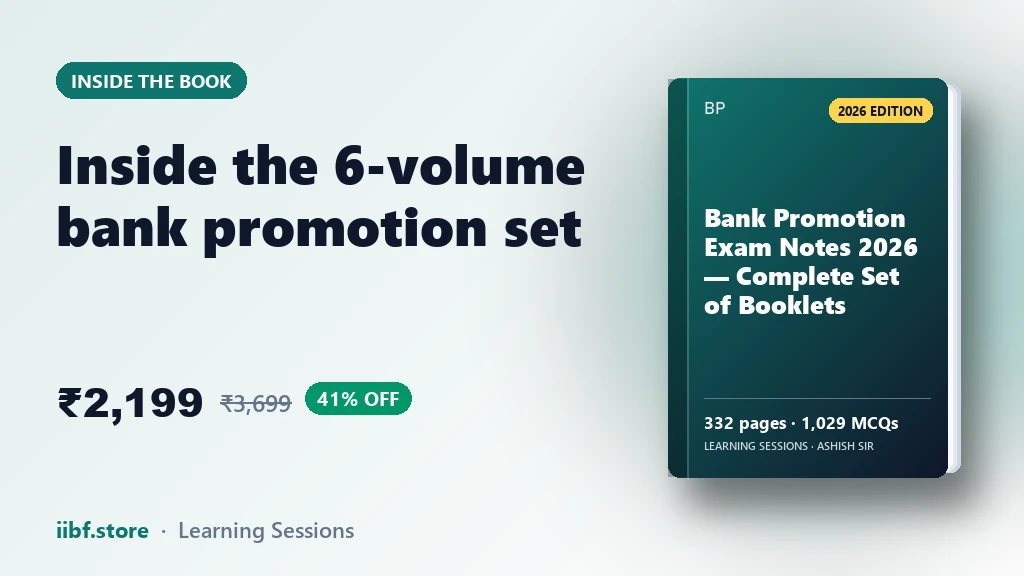
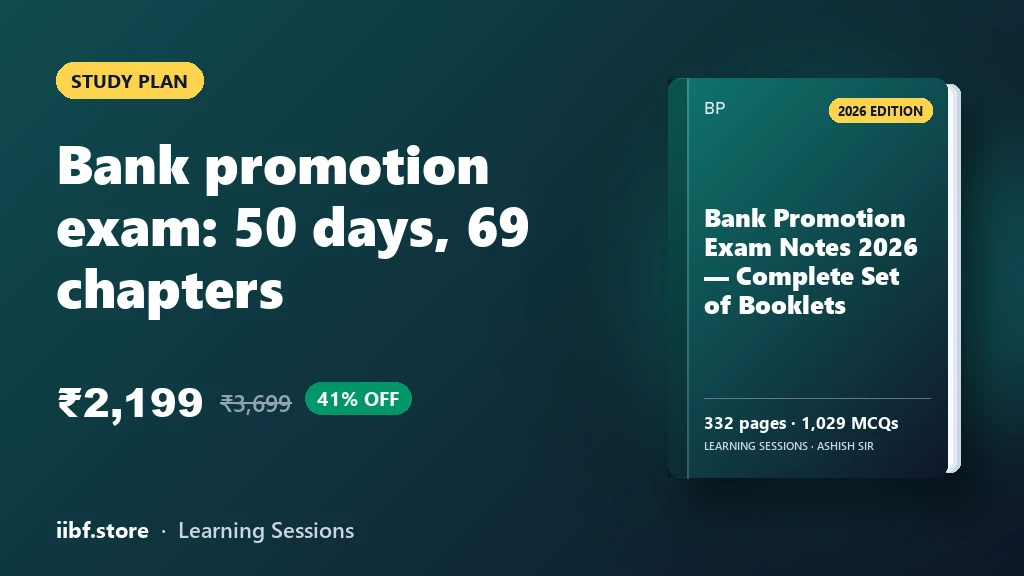
The Bank Promotion Exam Notes 2026 complete set is 332 pages across 69 chapters, divided into six volumes, with 1,029 questions to practise on. It also carries three extras: a Banking Awareness Capsule, an Economics section prepared for the PNB promotion exam, and General English.
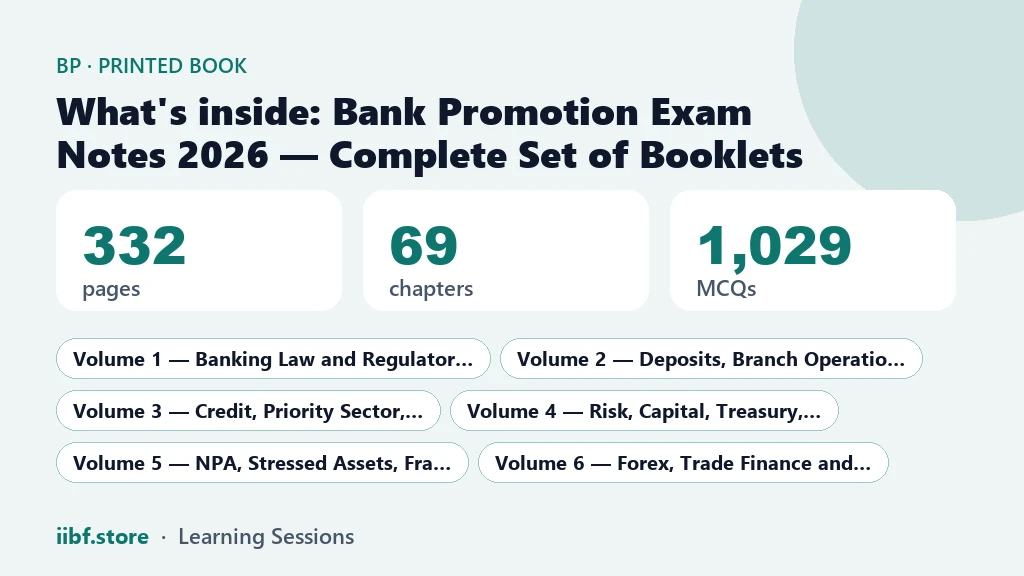
The six volumes are organised the way a banker actually thinks about the job:
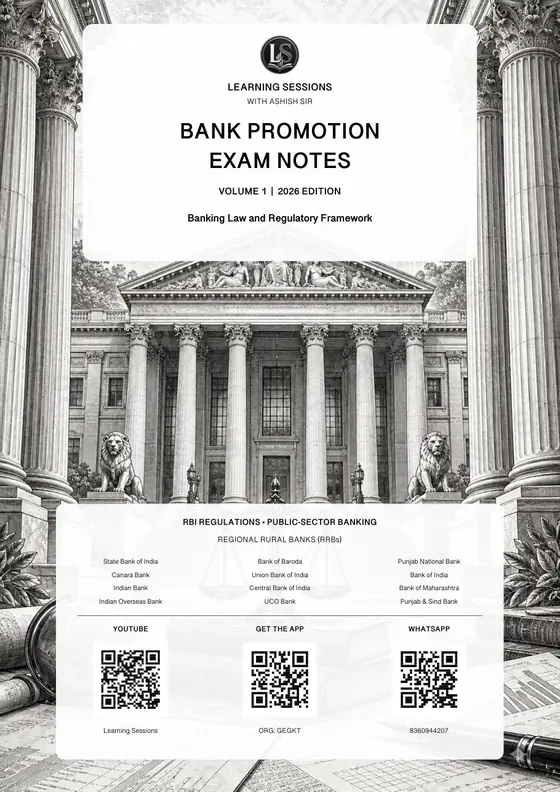
- Volume 1: Banking law and the regulatory framework (Banking Regulation Act, RBI Act, Negotiable Instruments Act, loan documentation, securities and charges).
- Volume 2: Deposits, branch operations and customer protection (nomination, lockers, KYC and PMLA, DICGC, ombudsman, cyber fraud, data protection).
- Volume 3: Credit, priority sector, MSME and government schemes (appraisal, PSL, TReDS, agriculture, housing and education loans, digital lending).
- Volume 4: Risk, capital, treasury, ALM and payment systems (monetary policy, Basel III, liquidity risk, CBDC, supervisory framework).
- Volume 5: NPA, stressed assets, fraud, recovery and insolvency (asset classification, SARFAESI, DRT, IBC, limitation).
- Volume 6: Forex, trade finance and taxation for bankers (FEMA, LRS, letters of credit, bank guarantees, GST, income-tax).
Notice what this is: a reading-and-revision set with questions, not a substitute for the bank's own circulars or for full-length mock papers. Now let us see who benefits most.
Profile 1: You are attempting for the first time
Your problem is coverage. You have never seen the whole map, and the danger is spending three weeks on a topic you love (usually the one from your own desk) while skipping others entirely.
How to use the set
Treat the six volumes as the map. Read one volume at a time, in order, and do not try to memorise on the first pass. After each chapter, attempt its questions cold, then check what you missed. A first-timer's real gain from bank promotion exam notes in this format is knowing the full territory early, so that your remaining weeks are spent deepening, not discovering.
When it is not enough
On its own, a first read gives you familiarity, not retention. Plan a second pass and, from about the halfway point, begin sectional practice on the free mock tests. Also confirm the pattern, syllabus and dates for the upcoming exam cycle in your own bank's promotion circular, because each bank sets its own promotion process and a book cannot track every notice. (If you are preparing for JAIIB or CAIIB alongside, those schedules are on the IIBF website.)
Profile 2: You have attempted before and want to fix the gaps
Your problem is usually currency and selectivity. You already know a lot, so reading everything again feels wasteful and demoralising.
How to use the set
Start from the questions, not the text. Take one volume's MCQs, attempt them untimed, and mark every one you got wrong or guessed. Only then open the matching chapters. This turns the set into a gap-finder: the chapters where you lose marks become your reading list. Repeat attempters often discover that their weak zone is not where they assumed. For many, it is the newer material such as the Banking Laws (Amendment) Act, 2025, the 2026 ombudsman scheme, digital lending rules and the Income-tax Act, 2025 chapters.
When it is not enough
If you failed last time on speed or on paper-pattern surprises rather than knowledge, more notes will not help. You need timed papers and a review habit: after every mock, write down why each wrong answer was wrong (did not know, misread, or panicked). Use the notes only to close the "did not know" bucket.
Profile 3: You are short on time
Your problem is hours. Perhaps you have six to eight weeks, a branch with month-end pressure, and a family that also needs you. Be realistic: 69 chapters in that window means roughly nine to twelve chapters a week, before any revision, so you will have to choose.
How to use the set
Do not read in order. Rank the volumes by your current weakness and by how heavily you expect each to count, then spend your best energy there. A workable split for a tired employee is:
- Weeknights: 30 to 40 minutes, one short chapter or one set of questions.
- Saturday: one long block on the weakest volume.
- Sunday: a short revision of the week plus a timed practice set.
The Banking Awareness Capsule is useful in the commute or lunch gaps, because it is built for quick revision rather than deep study.
When it is not enough
Be honest with yourself: if you have under a month and have not read the basics at all, no set will let you cover every volume well. Prioritise, accept that you will skim some chapters, and lean on free resources too. The free PDFs and blog articles can fill small gaps without adding to your reading load.
Profile 4: You prefer paper over screens
Your problem is attention. After a day of CBS screens, the last thing you want is another glowing rectangle, and you retain far more when you can underline, fold pages and scribble in margins.
How to use the set
This is where printed booklets suit you. Keep one volume in your bag and treat it as a working copy: highlight only definitions, limits and timelines, and write a one-line summary at the top of each chapter. Six separate volumes also help in a practical way: you can carry just the one you are on, and finishing a volume gives a visible sense of progress, which matters on tired days.
When it is not enough
Paper is slower to update and cannot give you instant answer feedback the way a test platform can. Pair your reading with a screen-based mock once a week so that you practise the real exam interface too. Check the books page for the current edition information before you order.
A simple four-step plan that works for all four profiles
Whatever your profile, the method underneath is the same. Use it with any good material, not only ours.
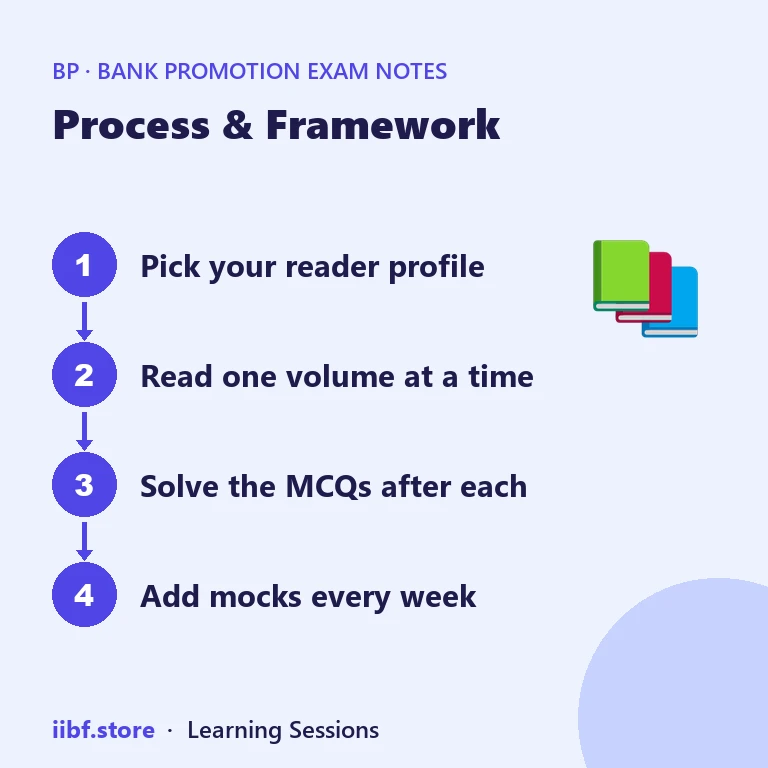
- Pick your profile and decide your bottleneck (coverage, currency, time or speed).
- Read one volume at a time. Finish it before starting the next, so that you always know exactly where you are.
- Solve that volume's questions and log the wrong ones in a notebook.
- Add a mock every week and review it properly. This is the step that is easiest to skip, and the one that builds exam-hall speed.
Quick comparison: which profile needs what
| Profile | Main bottleneck | Start with | Add alongside |
|---|---|---|---|
| First attempt | Coverage | Volumes 1 to 6 in order | Sectional mocks from the halfway point |
| Repeat attempt | Gaps and currency | MCQs first, then weak chapters | Timed full papers and error log |
| Short on time | Hours | Weakest volume, capsule for gaps | Free PDFs for small topics |
| Paper reader | Screen fatigue | One printed volume at a time | One screen mock per week |
Who should probably not buy it
In the interest of trust, here are the cases where we would say no:
- You only need a handful of topics, such as forex alone. A single free chapter or PDF may serve you better.
- You already have a thorough, current set of notes and only lack practice. Spend your money and time on mock tests instead.
- You are hoping a book will replace the habit of studying. It will not. It only reduces the effort of collecting material.
If you are still unsure, read the free sample on the complete set page first. The current price (listed at ₹3,400 at the time of writing) can change, so the book page is always the final word.
Conclusion
The right question is not "is this the best book?" but "does this fix my bottleneck?". The bank promotion exam notes complete set is built for coverage and revision: six volumes, 69 chapters and 1,029 questions that you can work through in short evening sessions. It will not give you exam-hall speed, so pair it with weekly mocks and keep an eye on your bank's promotion circular for the upcoming exam cycle. Choose your profile, follow the four steps, and keep going one volume at a time.
Frequently asked questions
Is one set enough to prepare for the promotion exam?
It can cover the content and give you questions to practise, but you should add timed mock tests and follow the official notices for the upcoming exam cycle. Notes alone do not build exam-hall speed.
Can I study just one volume instead of all six?
Yes. Each volume stands on a theme, such as credit or recovery, so you can start with your weakest one. Just make sure you do not leave a whole area unread without a reason.
Is there a sample before I pay?
Yes, a free sample is available on the book page, so you can judge the style and depth before ordering.
Where do I check the official exam schedule?
Promotion exams are run by each bank, so your bank's own promotion circular or HR notice is the authority for dates, eligibility and the current pattern. For JAIIB and CAIIB, use the official IIBF website at https://www.iibf.org.in. We do not quote dates or fees here because they can change.
Prefer revising from a printed book?
Chapter-wise books with MCQs after every chapter — minimal pages, complete coverage, delivered anywhere in India. Every book has a free sample to read first.











Quick quiz on this topic
5 exam-style questions from our free test bank — check yourself before you move on.
Practice this topic
Take a free mock test, download chapter PDFs, or watch a video class — all included on iibf.store.