Priority Sector Lending Norms for CAIIB Rural Banking 2026

For CAIIB candidates choosing the Rural Banking elective, few topics carry as much weight as priority sector lending. The priority sector lending framework decides how much of a bank's credit must flow to agriculture, small enterprises, weaker sections and other under-served segments. Mastering the targets, sub-targets and the PSLC mechanism is essential both for the exam and for day-to-day branch banking.
This guide breaks down the RBI norms as they stand for 2026, explains the supporting rural credit instruments, and shows how the pieces fit together for the CAIIB Rural Banking paper.
What Is Priority Sector Lending and Why It Matters
The priority sector lending regime is the RBI's principal tool for steering bank credit toward economically vital but commercially neglected sectors. The logic is simple: left to pure profit calculus, banks would concentrate lending on large, low-risk corporate borrowers, starving farmers, artisans and micro-entrepreneurs of formal credit. PSL norms correct this by mandating a minimum share of lending to defined categories.
The framework is governed by the RBI Master Directions on Priority Sector Lending, last comprehensively revised in 2020 and updated periodically thereafter. The recognised categories include:
- Agriculture - farm credit, agriculture infrastructure and ancillary activities.
- Micro, Small and Medium Enterprises (MSME) - manufacturing and services units.
- Export credit, education, housing (within ceilings), and social infrastructure.
- Renewable energy and lending to weaker sections.
For CAIIB Rural Banking students, the agriculture and weaker-section components are the most heavily examined. Understanding why PSL exists - financial inclusion, equitable growth and reducing dependence on informal moneylenders - frames every numerical question on targets. Strengthen your conceptual base through the CAIIB course on iibf.store before drilling into the percentages.

PSL Targets and Sub-Targets for 2026
The core number every candidate must memorise: the overall priority sector lending target for domestic scheduled commercial banks and foreign banks with 20 or more branches is 40% of Adjusted Net Bank Credit (ANBC) or Credit Equivalent of Off-Balance Sheet Exposure (CEOBE), whichever is higher. Within this 40% umbrella sit the critical sub-targets:
- Agriculture: 18% of ANBC, with a carved-out 10% for Small and Marginal Farmers (SMF).
- Micro Enterprises: 7.5% of ANBC.
- Weaker Sections: 12% of ANBC.
Regional Rural Banks and Small Finance Banks operate at a higher overall target of 75% of ANBC, reflecting their rural mandate, though some sub-target rules differ. Foreign banks with fewer than 20 branches have a phased structure with their own sub-targets.
The Small and Marginal Farmer sub-target has been progressively raised over the years, underlining the policy focus on the most vulnerable cultivators. RBI also assigns higher weights to lending in identified districts with low credit flow, nudging banks toward genuinely under-banked geographies. Keep the exact figures fresh by testing yourself on the CAIIB practice tests, where target-based numericals appear frequently. You can also cross-check current rate and policy references on the RBI rates resource page.
Priority Sector Lending Certificates and Compliance
Not every bank can meet every sub-target on its own. A cooperative bank deep in rural India may easily overshoot its agriculture quota but struggle elsewhere, while a metro-focused private bank faces the reverse. The RBI's answer is the Priority Sector Lending Certificate (PSLC) mechanism - a market for compliance.
Under PSLCs, a bank that exceeds a category target can sell certificates representing that surplus to a bank running a shortfall. Key features include:
- Trading occurs on the RBI's e-Kuber platform in standard lot sizes.
- Four certificate types exist: PSLC General, PSLC Agriculture, PSLC Small and Marginal Farmer, and PSLC Micro Enterprises.
- Only the priority-sector status is transferred; the underlying loan and its credit risk stay on the originating bank's books.
- Certificates expire on 31 March each year regardless of issue date.
If a bank still falls short after trading, it must contribute the deficit amount to the Rural Infrastructure Development Fund (RIDF) maintained with NABARD, or other funds the RBI specifies. These contributions carry below-market returns, making shortfalls genuinely costly. This penalty-and-market design is a favourite CAIIB exam theme because it links policy intent with practical treasury behaviour. Reinforce the terminology with the match-the-terms game for quick recall.
Supporting Rural Credit Instruments and NABARD
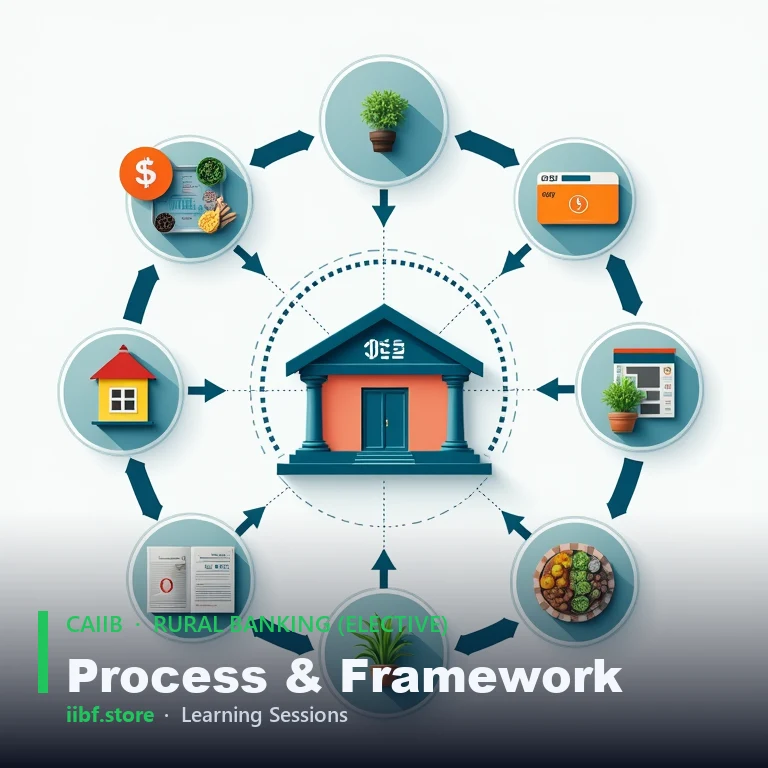
Priority sector targets do not operate in isolation - they are delivered through specific rural credit instruments that CAIIB Rural Banking covers in detail. The Kisan Credit Card (KCC) is the flagship vehicle for short-term agricultural credit, offering farmers a revolving limit for crop inputs, allied activities and consumption needs at concessional interest under the interest subvention scheme. KCC advances count directly toward the agriculture sub-target.
Other instruments and institutions you must know include:
- SHG-Bank Linkage Programme - Self Help Groups borrowing collectively, a cornerstone of microfinance and weaker-section lending.
- NABARD - the apex development bank that refinances rural lending, manages RIDF, and supervises RRBs and cooperative banks.
- Regional Rural Banks (RRBs) - sponsored by commercial banks specifically to deepen rural credit reach.
- Joint Liability Groups (JLGs) for tenant farmers and oral lessees who lack land title.
NABARD's role is pivotal: it not only refinances but also designs schemes that qualify for priority sector lending classification. The interplay between government financial-inclusion drives such as PM Jan Dhan Yojana and these credit instruments creates the ecosystem that PSL targets quantify. For exam updates and circular changes, follow the IIBF news page, and browse related explainers on the iibf.store blog.
For authoritative guidance, refer to the official resources of the Reserve Bank of India and the Indian Institute of Banking & Finance.
Frequently Asked Questions
What is the overall priority sector lending target for commercial banks?
The overall priority sector lending target is 40% of Adjusted Net Bank Credit (ANBC) or the Credit Equivalent of Off-Balance Sheet Exposure, whichever is higher, for domestic scheduled commercial banks and foreign banks with 20 or more branches. Regional Rural Banks and Small Finance Banks operate at a higher 75% target.
What are the key PSL sub-targets within the 40%?
Within the 40% umbrella, agriculture must receive 18% of ANBC, including 10% specifically for Small and Marginal Farmers. Micro enterprises must get 7.5% of ANBC, and lending to weaker sections must reach 12% of ANBC. These sub-targets are frequently tested in CAIIB Rural Banking numericals.
How do Priority Sector Lending Certificates work?
PSLCs let a bank with surplus priority-sector lending sell certificates to a bank facing a shortfall, traded on RBI's e-Kuber platform. Only the compliance status transfers; the loan and credit risk remain with the originating bank. Four types exist and all certificates expire on 31 March each year.
How does the Kisan Credit Card relate to PSL?
The Kisan Credit Card provides farmers a revolving short-term credit limit for crop inputs, allied activities and consumption at concessional rates under interest subvention. KCC advances are classified as agriculture credit and count directly toward the 18% agriculture sub-target, making it a primary delivery channel for priority sector lending.
Conclusion and Next Steps
The priority sector lending framework - its 40% overall target, the 18% agriculture and 10% SMF sub-targets, the PSLC market and NABARD's refinance backbone - sits at the heart of the CAIIB Rural Banking elective. Command these numbers and the instruments that deliver them, and you will handle both conceptual and numerical questions with confidence. Put your knowledge to the test with the CAIIB mock tests on iibf.store, and build your full preparation roadmap through the CAIIB course.
Take a free mock test, download chapter PDFs, or watch a video class — all included on iibf.store.