CAIIB ICAAP, Stress Testing & Basel III Pillar 2 Guide 2026
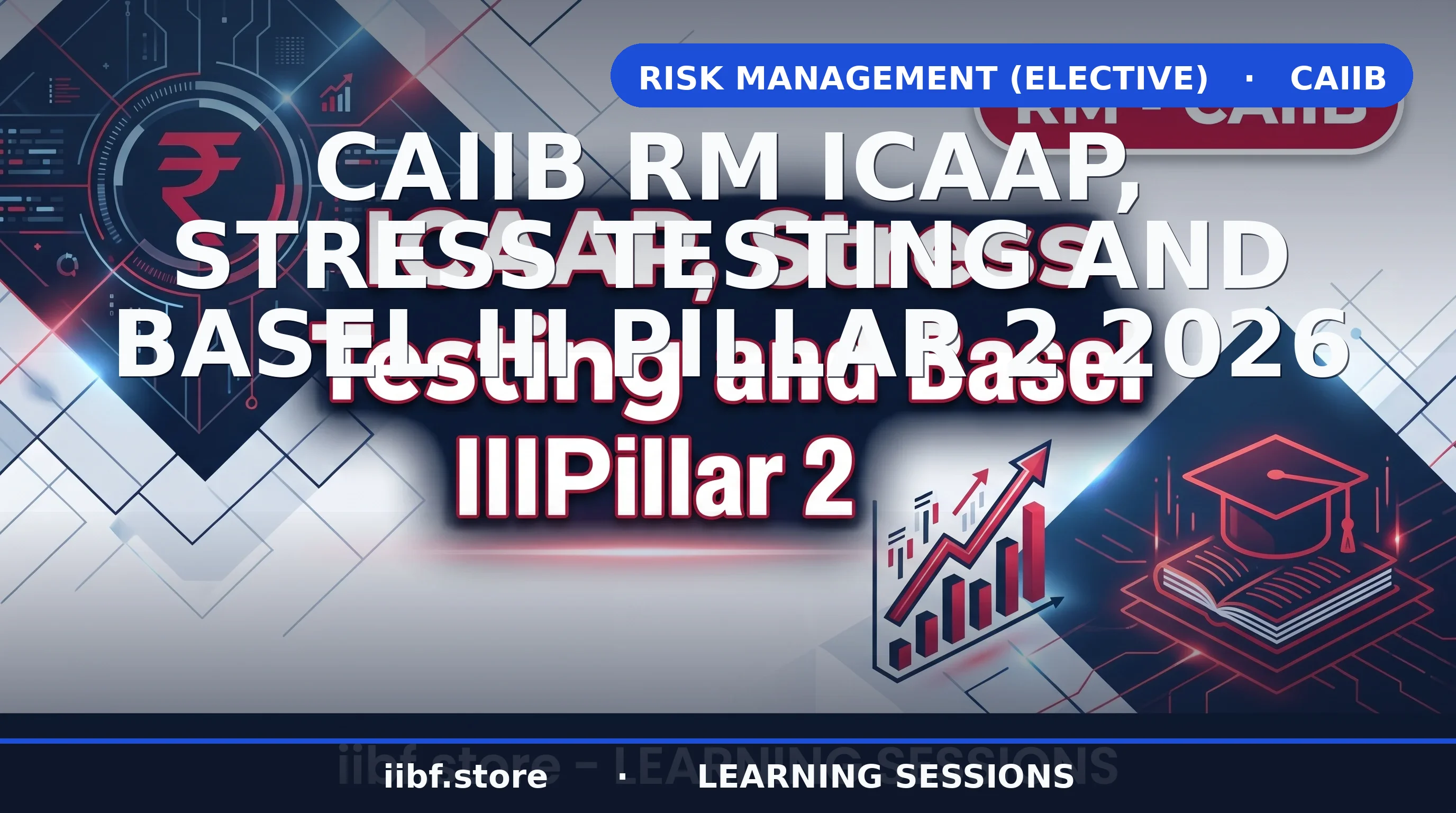
ICAAP, stress testing and Basel III Pillar 2 form one of the most heavily weighted clusters in the CAIIB Risk Management elective, and yet most candidates lose marks here because they memorise definitions instead of understanding how the three ideas lock together. The Internal Capital Adequacy Assessment Process (ICAAP) is, at its core, how a bank convinces itself and its regulator that it holds enough capital for every risk it actually runs, not merely the handful that the minimum-capital formula captures. Get the logic of this once and a whole section of the RM paper becomes easy marks.
This guide walks through the topic exactly the way examiners frame it: the three-pillar architecture of Basel III, the risks that escape Pillar 1, the full stress-testing toolkit, and the supervisory dialogue at the heart of Pillar 2. We will also build a one-page revision map and a study plan you can use right up to exam day.
Key takeaways
- ICAAP is the bank's own forward-looking assessment of capital adequacy against its full risk profile and business plan, owned by the board.
- Basel III rests on three pillars: minimum capital (Pillar 1), supervisory review and ICAAP (Pillar 2), and market discipline through disclosure (Pillar 3).
- Pillar 2 captures risks the minimum formula ignores: interest rate risk in the banking book, concentration, liquidity, and reputational or strategic risk.
- Stress testing uses sensitivity, scenario and reverse-stress methods to estimate how much capital a severe downturn would consume.
- Under the Supervisory Review and Evaluation Process, the RBI can impose a capital add-on if it judges a bank's ICAAP too optimistic.

The three pillars of Basel III
Basel III is built on three complementary pillars, and ICAAP, stress testing and Pillar 2 cannot be understood without first fixing how they fit. Pillar 1 sets a hard regulatory floor using prescribed formulae. Pillar 2 admits that those formulae miss several real-world risks and asks the bank to assess and cover them through its own process. Pillar 3 then forces transparency so the market can discipline the bank.
| Pillar | Focus | Who drives it |
|---|---|---|
| Pillar 1 | Minimum capital for credit, market and operational risk | Regulatory formula |
| Pillar 2 | Supervisory review and ICAAP for all other material risks | Bank board + RBI |
| Pillar 3 | Market discipline through public disclosure | The market |
A clean exam answer always starts here: name the three pillars, state that ICAAP sits inside Pillar 2, and explain that Pillar 1 is a floor rather than a ceiling. If you can map credit-measurement concepts onto Pillar 1, our companion guide on Credit Risk Measurement: PD, LGD, EAD and VaR for CAIIB shows exactly how those inputs feed the minimum formula.
What ICAAP actually does
ICAAP is the bank's own, forward-looking assessment of capital adequacy relative to its full risk profile and its business plan. The decisive feature, and the one examiners reward, is that it is owned by the board, not delegated to a formula or buried in a back-office spreadsheet. The board signs off on the numbers because the board is accountable for solvency.
In practice the process follows three logical steps:
- Identify every material risk the bank faces, across all business lines.
- Measure or estimate the capital needed for each risk, using models where data allows and judgement where it does not.
- Compare available capital with that requirement under both normal and stressed conditions.
The output is a formal ICAAP document submitted to the RBI, demonstrating that the bank can stay adequately capitalised through the economic cycle. When you write about ICAAP, always stress that it is forward-looking and board-owned, because those two phrases capture what separates ICAAP from a mechanical capital ratio.
Risks beyond Pillar 1
The whole purpose of ICAAP and Pillar 2 is to capture material risks that the minimum capital framework simply does not price. Be ready to list these and explain each in a sentence, because a one-line definition per risk is exactly the kind of snippet examiners look for.
- Interest rate risk in the banking book (IRRBB): the effect of rate movements on banking-book assets and liabilities, hitting both earnings and economic value.
- Concentration risk: excessive exposure to a single borrower, sector or geography, so one shock does outsized damage.
- Liquidity risk: the inability to meet obligations as they fall due without incurring unacceptable losses.
- Reputational and strategic risk: threats arising from a loss of stakeholder trust or from poorly chosen strategy.
Concentration and IRRBB sit right next to the measurement techniques you will have seen elsewhere in the elective. For a deeper treatment of how banks quantify tail losses, revisit Value-at-Risk and Operational Risk RCSA for CAIIB.
Stress testing explained
Stress testing asks a simple but powerful question that runs straight through ICAAP and Pillar 2: what happens to capital if conditions turn severe? It is an integral part of the ICAAP and one of the most frequently examined themes in the RM paper, so know the three methods cold.
| Method | What it does | Typical use |
|---|---|---|
| Sensitivity test | Shocks a single factor, such as a sharp rise in NPAs or a rate jump | Quick check of one vulnerability |
| Scenario test | Combines several shocks into one coherent adverse narrative | Whole-bank downturn analysis |
| Reverse stress test | Starts from failure and works back to the conditions that cause it | Finding the breaking point |
The results feed directly into capital planning, helping the board decide how large a buffer to hold above the regulatory minimum so the bank stays solvent in a downturn. A strong answer links stress testing back to the buffer decision rather than treating it as a stand-alone exercise.
Pillar 2 and the Supervisory Review Process
Under Pillar 2, the RBI conducts a Supervisory Review and Evaluation Process to challenge the bank's ICAAP. This is a genuine two-way dialogue: the bank proposes its capital number, the supervisor scrutinises the assumptions, and the outcome may be a capital add-on above the Pillar 1 minimum if the regulator judges the internal assessment too optimistic.
For the exam, remember two things. First, Pillar 2 is a continuous process, not a one-off filing. Second, the supervisor has the final word on adequacy, so a bank cannot simply assert that its own model says it is fine. The exact thresholds, add-on percentages and reporting timelines are set out in the latest released RBI Basel III master direction, so always confirm any specific figure against the current notification rather than relying on a number from memory.
Capital buffers and the risk-appetite link
ICAAP connects directly to the bank's risk appetite and to the Basel III capital buffers that sit above the minimum. Treating these as one integrated story, rather than three disconnected terms, is what lifts an answer from pass to distinction.
- Capital conservation buffer: a cushion built up in good times so the bank can absorb losses in bad times without breaching the minimum.
- Countercyclical buffer: raised by the regulator when system-wide credit growth looks excessive, then released in a downturn.
- Risk appetite statement: the board's explicit articulation of how much and what kinds of risk it is willing to accept.
A coherent framework aligns risk appetite, ICAAP capital and the buffers into a single narrative. Because capital adequacy also depends on the quality of the loan book, it is worth seeing how impaired assets are classified and provisioned in NPA Management and Asset Classification under Basel III, which dovetails neatly with the Pillar 1 credit numbers.
A practical revision plan for Risk Management
The RM paper rewards clarity on frameworks and the ability to explain why each control exists. Rote learning rarely survives a tricky scenario question, so build understanding in layers over your final fortnight.
- Day 1-3: Draw a one-page map of the three pillars, the three ICAAP steps and the three stress-testing types. Pin it above your desk.
- Day 4-7: Drill the difference between risks captured under Pillar 1 and those captured under Pillar 2. Write each from memory until it is automatic.
- Day 8-10: Practise short written answers that walk the ICAAP cycle end to end, then link it to buffers and risk appetite.
- Day 11-14: Sit timed mock papers, review every wrong answer, and re-read the relevant section the same day.
Keep testing yourself throughout with the full-length CAIIB mock tests, and use the broader library of CAIIB exam guides to plug gaps as they surface. You can browse the whole elective from the Risk Management elective hub, or step back to the complete CAIIB course page to plan your week.
How ICAAP knits the whole risk framework together
ICAAP is most powerful when you see it as the hub of a bank's risk architecture, and the Risk Management paper rewards exactly that systems-level perspective. It draws on the outputs of the credit, market, operational and liquidity risk functions, aggregates them, and translates the combined picture into a single capital number that the board can own. In effect, ICAAP is where risk measurement finally meets capital strategy.
It also closes a loop with the risk-appetite framework, because the capital a bank chooses to hold reflects how much risk the board is willing to accept, while stress testing reveals how much capital a severe scenario would consume. A top answer therefore references governance, data quality and the feedback into business planning, not just the capital calculation. When you show how ICAAP fuses the separate risk silos into one coherent view, you demonstrate the integrated thinking that distinguishes the strongest candidates in the elective. For the underlying regulatory text, you can consult the official resources and RBI Basel III master directions via IIBF.
Common mistakes to avoid
- Treating Pillar 1 as the whole story. It is only the floor; the marks in this topic live in Pillar 2 and ICAAP.
- Calling ICAAP a formula. It is a forward-looking, board-owned process built on judgement, not a single calculation.
- Confusing the stress-test types. Sensitivity shocks one factor, scenario combines many, and reverse stress starts from failure.
- Forgetting the supervisor's role. The RBI can override the bank's own number, so never present ICAAP as a self-certified filing.
- Quoting exact buffer percentages from memory. Frame time-sensitive figures as per the latest RBI Basel III notification and verify before the exam.
Frequently asked questions
What is ICAAP in simple terms?
ICAAP is the Internal Capital Adequacy Assessment Process, a bank's own forward-looking evaluation of whether it holds enough capital for all its material risks. It is owned and signed off by the board, and the resulting document is submitted to the RBI. Its purpose is to prove the bank can stay solvent through the full economic cycle.
How does ICAAP differ from Pillar 1?
Pillar 1 sets minimum capital using prescribed formulae for credit, market and operational risk, and acts only as a floor. ICAAP, which sits under Pillar 2, covers the additional risks those formulae ignore, such as interest rate risk in the banking book, concentration and liquidity risk. In short, Pillar 1 is the regulatory minimum while ICAAP is the bank's fuller, judgement-based view.
What is stress testing in banking?
Stress testing estimates the impact of severe but plausible adverse conditions on a bank's capital. It uses three main methods: sensitivity tests that shock a single factor, scenario tests that combine several shocks, and reverse stress tests that work back from failure. The results feed capital planning and help the board size its buffers above the minimum.
What is the Supervisory Review and Evaluation Process?
It is the process under Pillar 2 by which the RBI reviews and challenges a bank's ICAAP. The supervisor examines the bank's assumptions and can require additional capital if it considers the internal assessment too optimistic. This makes Pillar 2 a continuous two-way dialogue rather than a one-off submission.
What is the capital conservation buffer?
The capital conservation buffer is an extra layer of capital built up in good times so a bank can absorb losses during stress. Drawing it down is permitted in a downturn, but doing so triggers restrictions on discretionary distributions such as dividends. It sits above the Pillar 1 minimum, and its exact size is fixed by the prevailing RBI Basel III direction.
Why is ICAAP important for the CAIIB exam?
ICAAP ties together capital, risk and strategy, so it lets examiners test several concepts in one question. A candidate who can explain the three pillars, the risks beyond Pillar 1, the stress-testing toolkit and the supervisory review demonstrates genuine understanding rather than rote recall. That integrated view is consistently what earns full marks in the Risk Management elective.
Conclusion
Master ICAAP, stress testing and Basel III Pillar 2 as one connected story and you turn a feared section of the Risk Management paper into reliable marks. Understand the pillars, name the risks the formula misses, run the three stress tests in your head, and always respect the supervisor's final word. Keep your one-page map handy, drill it daily, and walk into the exam hall knowing this topic cold.
Related Guides
📚 Free Learning Sessions resources — connect & crack your exam
- 📝 Free mock tests — chapter-wise, exam-pattern, with instant solutions
- 🎮 Matching games — gamified revision of key terms & concepts
- 📄 Study notes & PDFs — downloadable chapter material
- 🎥 Video classes on YouTube — subscribe to @learningsessions
💬 Want the full course? WhatsApp your course name to 8360944207 and our team will set you up.
📱 Study on the go — get our iOS & Android app at iibf.store/app.
Prefer revising from a printed book?
Chapter-wise books with MCQs after every chapter — minimal pages, complete coverage, delivered anywhere in India. Every book has a free sample to read first.
































Quick quiz on this topic
5 exam-style questions from our free test bank — check yourself before you move on.
Practice this topic
Take a free mock test, download chapter PDFs, or watch a video class — all included on iibf.store.