Data Warehousing in Banking: BI, ETL and Dashboards (CAIIB ITDB 2026)
Every large bank generates millions of transactions a day across core banking, cards, payments and channel systems — and none of that data is useful for management decisions until it is organised. That is exactly the problem data warehousing in banking solves. For CAIIB ITDB candidates, this topic ties together three practical ideas you will meet on the job and in the exam: how transaction data is extracted and cleaned (ETL), how it is stored for analysis (data warehouses and data marts), and how it is finally presented to decision-makers (BI dashboards). This article walks through the architecture end to end, with the terminology the exam expects.
📊 What Is Data Warehousing in Banking?
A data warehouse is a subject-oriented, integrated, time-variant and non-volatile collection of data assembled specifically to support management decision-making — a definition that traces back to Bill Inmon and is still the one CAIIB question-setters use. In a bank, this means transaction records from the core banking system, card switch, loan origination system, treasury platform and channel logs are pulled out of their individual "silos" and consolidated into one analytical repository.
The key distinction candidates must hold onto is between operational systems and analytical systems. Core banking is an OLTP (Online Transaction Processing) system — it is optimised for fast, single-record reads and writes: post a cheque, update a balance, debit an account. A data warehouse is built for OLAP (Online Analytical Processing) — it is optimised for scanning millions of historical rows to answer questions like "what was branch-wise CASA growth over the last eight quarters?" Running such queries directly against the core banking database would slow down live banking operations, which is precisely why banks separate the two.
You can build foundational context for this separation in the Database Management Systems chapter, which covers how transactional databases are structured before they ever reach a warehouse.

💡 Exam Tip: If a question describes a repository that is "non-volatile" and used purely for reporting rather than updates, it is describing a data warehouse, not a transactional database.
🔄 The ETL Pipeline: Moving Data From Core Banking to the Warehouse
ETL stands for Extract, Transform, Load, and it is the backbone process that populates any bank's data warehouse. In the Extract stage, data is pulled from heterogeneous source systems — the core banking application, ATM switch, internet banking logs, loan and trade finance modules — often overnight in a batch window so live operations are not disturbed.
The Transform stage is where the real work happens. Raw extracts rarely match across systems: a customer ID format in the core banking system may differ from the one used in the card management system, currency values may need standardisation, duplicate or orphan records must be cleaned, and business rules (such as classifying an account as NPA per the ageing criteria) get applied here. Data quality checks, de-duplication and referential-integrity validation all sit inside this stage.
Finally, the Load stage writes the cleaned, conformed data into the warehouse's fact and dimension tables, usually structured in a star or snowflake schema for fast analytical querying. Modern banks increasingly also run ELT variants — loading raw data first and transforming inside a powerful cloud data platform — but the underlying logic candidates should know for the exam remains the classic Extract-Transform-Load sequence. A grounding in networked systems, covered in Networking Systems, helps explain how these overnight batch feeds actually move between a bank's data centres.

🗂️ Data Marts, ODS and the Layered BI Architecture
Very few bank employees query the enterprise data warehouse directly. Instead, most work through a data mart — a smaller, subject-specific slice of the warehouse built for one department. A retail-liabilities data mart might hold only CASA, term-deposit and customer-segment data; a credit-risk data mart might hold only exposure, collateral and rating data. Data marts are faster to query and easier for a business team to own than the full warehouse.
Many banks also run an Operational Data Store (ODS) as an intermediate layer — a near-real-time, lightly integrated store used for day-to-day operational reporting, sitting between the transactional systems and the historical warehouse. Together, source systems, ETL, ODS, the enterprise warehouse and department-level data marts make up the layered BI architecture that most large Indian banks run today, ultimately governed alongside the bank's broader IT setup as covered in IT governance framework for banks.
Sourcing and vendor questions matter here too — many banks contract specialist vendors for warehouse build and maintenance, which is why the principles in IT outsourcing guidelines for banks apply directly to data warehousing projects, and integration between the warehouse and dozens of source applications is frequently handled through the middleware patterns discussed in enterprise service bus in banking.

⚠️ Common Mistake: Candidates often treat "data mart" and "data warehouse" as interchangeable in exam answers. Remember: every data mart is fed by a warehouse (or directly by ETL), but a data mart is always narrower in scope.
📈 Dashboards, OLAP and Business Intelligence for Bank Management
The final layer is where the investment pays off — Business Intelligence (BI) tools that sit on top of the warehouse and data marts to give bank management a usable view of the numbers. OLAP cubes pre-aggregate data along dimensions such as branch, product, region and time, letting a manager "slice and dice" — drilling from a zonal NPA figure down to a single branch or account in seconds, something a raw SQL query against core banking could never do live.
Dashboards built on this layer typically track CASA and advances growth, NPA movement, cross-sell ratios, digital-channel adoption, and regulatory exposure limits — refreshed daily or near-real-time depending on the ETL schedule. This is also where risk-adjusted reporting connects across subjects: capital and risk-weighted exposure numbers shown on a management dashboard often originate from calculations such as the standardised approach for operational risk capital, which feeds into the same enterprise reporting stack from the risk-management side.
Well-designed dashboards reduce the turnaround time for MIS from days to minutes and are increasingly self-service, letting business users build their own views without waiting on the IT team for every new report. For the underlying computing concepts that make this possible, revisit Introduction to Computing. You can browse more elective-subject material on the Information Technology and Digital Banking tag hub.
📌 Remember: OLAP is about analysis and drill-down; OLTP is about transaction speed. Data warehousing in banking exists precisely to keep these two workloads from competing with each other.
🧮 Data Warehouse vs Data Mart vs Data Lake
The table below summarises how the three storage concepts most commonly confused in CAIIB ITDB questions differ in scope, structure and typical use in a bank.
| Feature | Data Warehouse | Data Mart | Data Lake |
|---|---|---|---|
| Scope | Enterprise-wide | Single department/subject | Enterprise-wide, any source |
| Data structure | Structured, schema-on-write | Structured, schema-on-write | Structured + unstructured, schema-on-read |
| Optimised for BI dashboards | ✅ Yes | ✅ Yes | ❌ Not directly |
| Typical user | Enterprise MIS/BI team | Department (retail, credit, treasury) | Data science/analytics team |
| Build effort | High | Low to moderate | Moderate to high |
Regulators themselves run large-scale statistical warehouses for this kind of analysis — the RBI's own Database on Indian Economy (DBIE) is a public example of a central-bank data warehouse used to publish time-series banking and macroeconomic statistics, and it is a useful reference for how warehoused data ultimately gets presented for analysis.
✅ Conclusion: Why Data Warehousing Matters for CAIIB ITDB
Data warehousing in banking is not a niche IT topic — it is the backbone of every MIS report, regulatory return and management dashboard a bank produces. For the exam, keep the pipeline straight in your head: source systems feed ETL, ETL populates the warehouse, the warehouse feeds data marts and an ODS, and BI tools turn all of that into the dashboards management actually uses. Understanding this flow, and how it differs from a data lake or a plain transactional database, covers the bulk of what CAIIB ITDB expects on this subject.
Ready to test yourself? Explore the full CAIIB course and work through subject-wise mock questions to lock in these concepts before exam day.
🧠 Practice MCQs: Data Warehousing in Banking
Q1. Which process extracts data from core banking and other source systems, cleans it and loads it into a data warehouse? (a) OLTP (b) ETL (c) API Gateway (d) RPA
Answer: (b) — ETL (Extract, Transform, Load) is the standard process for populating a data warehouse from source systems.
Q2. A subject-oriented, integrated, time-variant and non-volatile collection of data used for management decision-making is best described as a: (a) Data mart (b) Data warehouse (c) Operational data store (d) Data lake
Answer: (b) — This is the classic Inmon definition of a data warehouse tested in CAIIB ITDB.
Q3. A data mart differs from an enterprise data warehouse mainly because it is: (a) Larger in scope, covering the whole bank (b) Focused on a single department or subject area (c) Used only for real-time transaction processing (d) A replacement for the core banking system
Answer: (b) — A data mart is a narrower, department-specific subset built from the enterprise data warehouse or ETL feeds.
Q4. In a typical banking BI stack, which layer sits between the ETL/warehouse layer and the end-user dashboard? (a) Core banking application (b) OLAP/semantic/data mart layer (c) Payment switch (d) ATM switch
Answer: (b) — The OLAP or semantic/data-mart layer pre-aggregates warehouse data so dashboards can query it quickly.
Q5. What is a primary business benefit of a bank's data warehouse feeding BI dashboards? (a) Replacing RBI regulatory reporting entirely (b) A consolidated single source of truth for MIS and decision support across branches (c) Eliminating the need for a core banking system (d) Processing real-time NEFT transactions
Answer: (b) — The core value of a data warehouse is a consistent, consolidated view of enterprise data for management decisions.
Want chapter-wise mock tests with 100+ MCQs? Start practising free →
❓ Frequently Asked Questions
What is the difference between a data warehouse and a data mart in banking?
A data warehouse is an enterprise-wide, integrated repository covering the whole bank, while a data mart is a smaller, department-specific slice of that data — for example, a retail-liabilities or credit-risk data mart — built for faster, focused analysis by one business team.
Why do banks need ETL for their data warehouse?
Source systems like core banking, card management and loan origination store data in different formats and structures. ETL extracts data from each of them, transforms and cleans it into a consistent format, and loads it into the warehouse so it can be analysed reliably alongside data from every other system.
What is business intelligence (BI) used for in banks?
BI tools sit on top of the data warehouse and data marts to turn stored transaction history into dashboards and reports — tracking metrics like CASA growth, NPA movement, cross-sell ratios and digital adoption so management can make faster, data-backed decisions.
Is data warehousing part of the CAIIB ITDB syllabus?
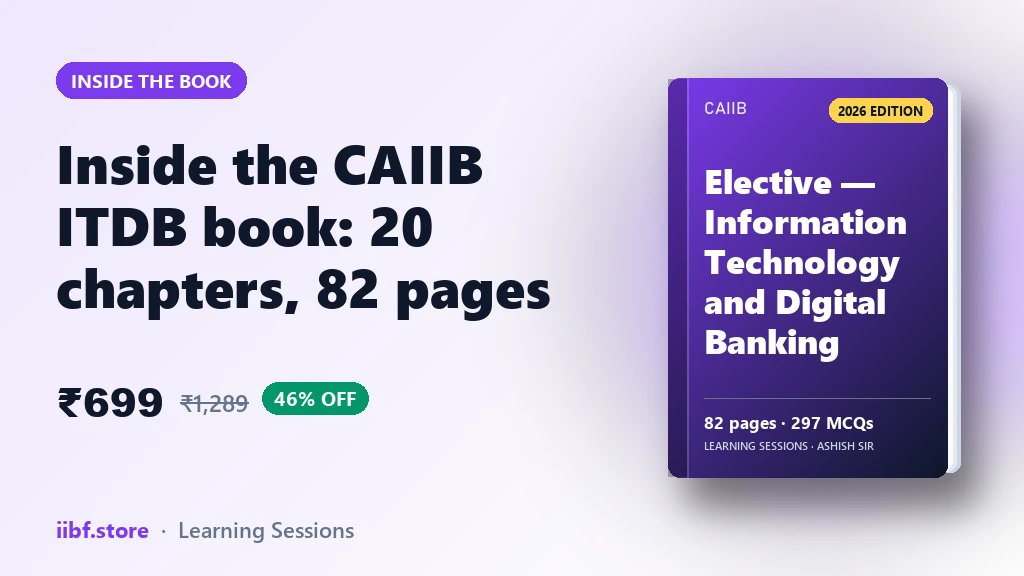
Yes. Data warehousing, ETL, data marts and business intelligence dashboards fall under the Information Technology and Digital Banking elective of CAIIB, and are commonly tested alongside related database and networking concepts.
Prefer revising from a printed book?
Chapter-wise books with MCQs after every chapter — minimal pages, complete coverage, delivered anywhere in India. Every book has a free sample to read first.

















Quick quiz on this topic
5 exam-style questions from our free test bank — check yourself before you move on.
Practice this topic
Take a free mock test, download chapter PDFs, or watch a video class — all included on iibf.store.