CAIIB Rural Banking Exam Date 2026: Schedule, Syllabus & Plan
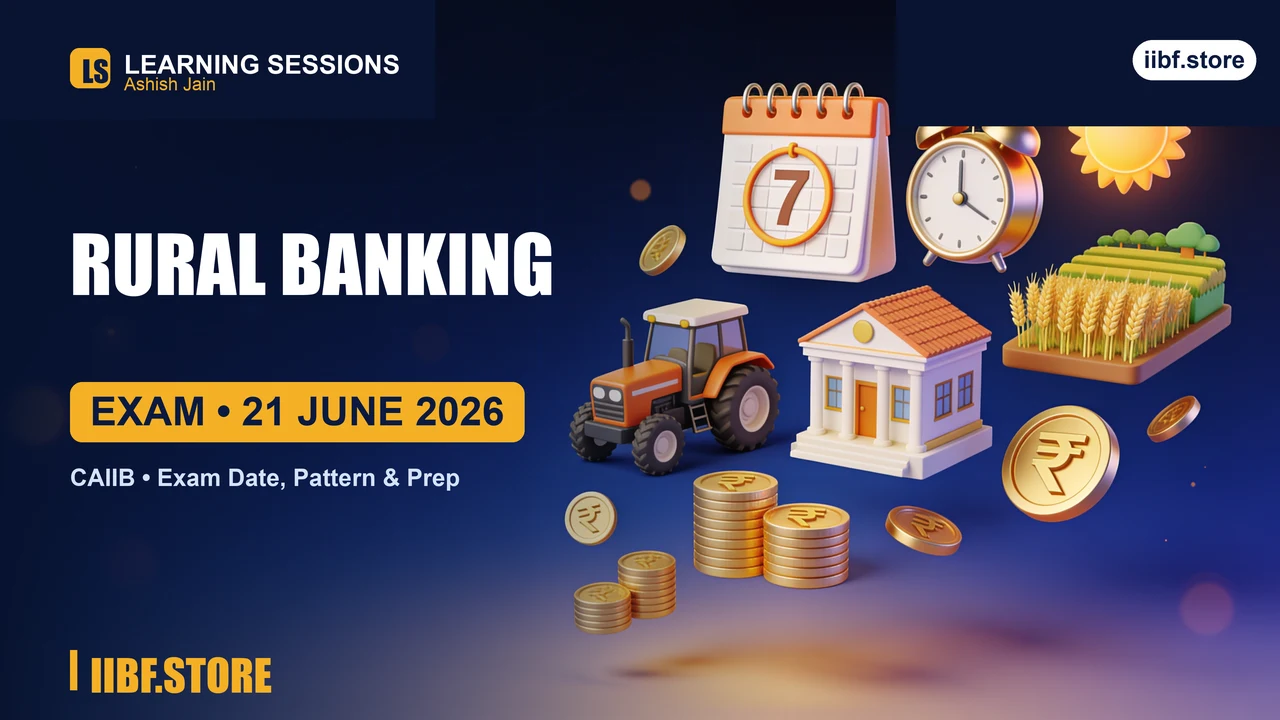
The CAIIB Rural Banking exam date is the single anchor that should shape every study week you plan this cycle, because Rural Banking is one of the most popular CAIIB electives and one of the most scoring papers when you prepare it the right way. As per the latest released IIBF schedule, this elective sits in the regular CAIIB examination window, and the smartest candidates lock that date the moment it is confirmed and then count backwards from it. This guide walks you through the schedule, the registration window, exactly what the paper tests, a realistic countdown plan, the mistakes that quietly cost marks, and the free resources that get you to exam day genuinely ready rather than rushed.
Key takeaways
- The CAIIB Rural Banking exam date falls within the standard CAIIB sitting window — always confirm the exact day on the official IIBF notification.
- CAIIB runs in two cycles a year, so there is a primary sitting and a later fallback sitting for the same elective.
- Registration usually opens roughly two to three months before the exam; preferred centres fill fast, so apply on day one.
- The paper is objective, application-driven and built around rural credit, agriculture finance, priority-sector lending and financial inclusion.
- A backwards-planned countdown that protects mock-test weeks is the most reliable route to a first-attempt pass.
When is the CAIIB Rural Banking exam date in 2026?
The CAIIB Rural Banking exam date is fixed by the Indian Institute of Banking & Finance (IIBF) as part of its half-yearly CAIIB calendar. Because CAIIB is conducted in two cycles every year, this elective is offered in a primary sitting and again in a later sitting in the same year, which gives you a fallback if your first attempt does not work out. As per the latest released IIBF schedule, treat the confirmed sitting as your fixed anchor and plan every study week from it — and always verify the precise date on the official IIBF notification, since the calendar can shift slightly between cycles.
One point trips up first-timers: Rural Banking is an elective, not a compulsory paper. You choose it in place of another optional subject rather than in addition to one. That means the date you target depends on when you slot this paper into your wider CAIIB plan alongside the compulsory papers. If you want to finish your qualification sooner, lock the earliest confirmed sitting you can realistically prepare for and commit to it.
CAIIB exam cycles at a glance
Understanding how IIBF structures CAIIB makes the timing decision much easier. The qualification is built from two compulsory papers plus one elective of your choice, and the whole exam runs twice a year. Rural Banking appears in both windows, so you are choosing the cycle that fits your runway, not a once-a-year deadline.
| Element | What to know | Action |
|---|---|---|
| Primary sitting | First CAIIB window of the year for the elective | Target this if you have a clear study runway |
| Fallback sitting | Later CAIIB window in the same year | Choose this if you need more preparation time |
| Registration window | Opens roughly 2-3 months before the sitting | Apply on day one to secure your centre |
| Membership | IIBF membership is required to apply | Sort it out before registration opens |
| Format | Objective, multiple-choice, application-based | Practise with timed mock tests |
For the full elective hub, eligibility and paper combinations, the CAIIB course hub on Learning Sessions keeps everything in one place, and you can confirm the official calendar on the IIBF website before you commit to a sitting.
Why the Rural Banking elective is worth choosing
Rural Banking is far more than a syllabus box to tick — it maps directly onto real branch work. Priority-sector lending, agricultural finance, financial inclusion and the institutions that serve rural India are not abstract topics here; they are the day-to-day reality of thousands of banking officers. For anyone posted in a rural or semi-urban branch, this paper simply formalises knowledge you already use.
It is also a genuinely high-scoring elective when prepared properly, because the questions reward applied understanding rather than rote recall. Concepts such as how a crop loan is structured, why a particular priority-sector target exists, or how a Self-Help Group links to a bank tend to stick once you understand the logic behind them. Pair a confident Rural Banking attempt with the two compulsory papers and you can close out the entire CAIIB qualification in one well-planned cycle instead of dragging it across multiple sittings.
If you are still weighing your options, our breakdown of the two quiet scorers in CAIIB ABM Module B shows how the right elective and module strategy can lift your overall score with less stress.
Registration: don't let the window slip
Registration for a CAIIB cycle generally opens a couple of months before the sitting, and the window is short. A few practical reminders so it never catches you out:
- Be a member first. You must be an IIBF member to apply, so complete or renew your membership well before the window opens.
- Apply on day one. Preferred exam centres fill quickly once registration goes live, and a closer centre means less travel stress on exam morning.
- Keep your documents ready. Have your photo, signature and payment method prepared in the correct format to avoid last-minute upload errors.
- Double-check your elective. Confirm you have selected Rural Banking and not a different optional paper — this is a surprisingly common slip.
- Verify every date. Reconfirm the exact registration and exam dates on the official IIBF notification, since the window can shift slightly.
What the CAIIB Rural Banking paper actually tests
The CAIIB Rural Banking exam is an objective, multiple-choice paper that leans heavily on understanding rather than memorisation. Expect application and scenario questions spread across the elective's modules, which broadly cover four pillars. Knowing these cold is the real key to walking in without surprises.
- Rural India & the rural economy: demographics, the agricultural landscape, and the role of rural finance in national development.
- Financing agriculture & allied activities: crop loans, investment credit, and the role of cooperatives and Regional Rural Banks (RRBs).
- Priority-sector lending & financial inclusion: sectoral targets, government schemes, Self-Help Groups and the broader inclusion agenda.
- Rural credit institutions & instruments: NABARD, RRBs, microfinance and the products that serve rural borrowers.
Do not lock in the exact number of questions, the duration or the passing marks from memory — confirm those on the latest IIBF notification before exam day, as they can vary by cycle. To map every chapter against the official structure, read our complete Rural Banking syllabus guide with free PDF and study from the syllabus rather than from scattered notes.

Your countdown plan to the Rural Banking exam date
Working backwards from the confirmed CAIIB Rural Banking exam date, here is a realistic schedule that keeps the pressure manageable across roughly eleven weeks. Adjust the phase lengths to your own runway, but never sacrifice the mock-test phase.
- Phase 1 (Weeks 1-4) — Build your base. Cover the rural-economy and agricultural-finance modules first. They anchor everything else in the paper, so a strong foundation here pays off throughout.
- Phase 2 (Weeks 5-8) — Layer the heavy modules. Move into priority-sector lending, financial inclusion and the rural credit institutions. Add one timed mock every weekend to build stamina and exam temperament.
- Phase 3 (Weeks 9-11) — Revise and test. Alternate full-length mocks with quick one-liner recaps. Fix weak chapters as they surface and resist the urge to chase brand-new topics this late.
- Final week — Taper, don't cram. Light revision only. Review high-yield schemes, institutions and definitions, sleep well, and add no new material.
Short on time? If you only have six weeks, compress the module phase to four weeks but ring-fence two full weeks for mock tests. The mock phase is what converts knowledge into marks, so it is the last thing you should ever cut.
Want structured practice from day one? Start with CAIIB mock tests on Learning Sessions and treat each one as a diagnostic, not just a score. If you prefer browsing by topic, the full mock-test library covers every CAIIB paper.
Common mistakes to avoid in Rural Banking
Most candidates who fall short of a comfortable pass make the same handful of avoidable errors. Watch for these:
- Treating it as pure memorisation. The paper rewards applied understanding. Always know why a scheme or lending norm exists, not just its name.
- Ignoring current figures. Priority-sector targets and scheme details evolve over time. Keep your numbers current instead of relying on old notes, and confirm anything specific against the latest IIBF material.
- Underestimating an elective. Some candidates assume any elective is easy and under-prepare. The questions here are practical but precise, so give the paper genuine study time.
- Skipping mocks. Reading is not the same as attempting under a clock. Mocks expose weak chapters while there is still time to fix them.
- Skimming the question. Rural Banking distractors are deliberately close. Read every option fully before you commit.
To see how the same applied, scenario-led style shows up across other CAIIB papers, our guide on Operational Risk and RCSA for CAIIB is a useful companion read.
Free resources to prepare faster
Everything on Learning Sessions is built around this exact syllabus, so your preparation stays precisely on target:
- Chapter-wise mock tests with timed, exam-pattern questions and instant explanations — the fastest way to find and fix gaps.
- Matching games that make schemes, institutions and rural-finance terms stick through active recall. Try the CAIIB matching games between study blocks.
- Chapter one-liners for fast last-mile revision in the final week.
- Downloadable notes and study-material PDFs mapped module by module.
- Recorded and live classes by Ashish Jain covering every Rural Banking module in depth.
For the complete library of CAIIB articles, exam-date pages and strategy guides, browse all CAIIB guides on the blog and bookmark the ones that match your weak areas.
Exam-day checklist
Once the date arrives, a calm, prepared morning protects all the work you put in. Run through this on the day:
- Carry your printed admit letter and a valid photo ID.
- Reach the centre early — aim for at least 45 minutes before reporting time.
- Read each question fully; with close distractors, skimming is risky.
- Attempt every question, but first confirm the negative-marking rule on your admit letter before you start.
- Watch the clock — bank roughly a minute per question and flag the tough ones for review. Use the in-built timer on every mock test so this pacing is automatic by exam day.
June or December — which sitting should you target?
If you have a clear study runway from the moment registration opens, the earlier sitting is usually the practical choice. It lets you finish the elective sooner and frees you to concentrate on your compulsory CAIIB papers. The later sitting suits candidates who need more preparation time, or who are deliberately slotting Rural Banking later in their overall CAIIB plan.
Either way, the strategy is identical: pick the date you can realistically prepare for, register on the first day the window opens, and protect your mock-test weeks. Switching dates late only resets your momentum, so commit early and hold the line.
Frequently Asked Questions
What is the CAIIB Rural Banking exam date in 2026?
The CAIIB Rural Banking elective is held within the standard CAIIB examination window as per the latest released IIBF schedule. Because CAIIB runs in two cycles a year, there is a primary sitting and a later fallback sitting for the same elective. Always reconfirm the precise date on the official IIBF notification before you plan around it.
When does registration for CAIIB Rural Banking open?
Registration generally opens roughly two to three months before the sitting. Apply on the first day, make sure you select Rural Banking as your elective rather than a different optional paper, and confirm the exact window on the official IIBF site. Preferred centres fill quickly once the window goes live.
Is Rural Banking a good CAIIB elective to choose?
Yes. It is practical, branch-relevant and high-scoring when prepared well, which is why it is among the most popular CAIIB electives. It is especially valuable if you work in, or expect to work in, rural or semi-urban branches where this knowledge is used daily.
Is there negative marking in CAIIB Rural Banking?
Marking rules can vary by paper and cycle, so do not assume. Confirm the current rule on your admit letter and the latest IIBF notification before exam day. Unless told otherwise, plan to attempt every question rather than leaving blanks.
How long should I prepare for the Rural Banking elective?
A focused runway of about eight to eleven weeks is comfortable for most working candidates. Spend the first half building module knowledge and the second half on revision and timed mocks. If you only have six weeks, compress the learning phase but never cut the mock-test phase.
Where can I get the CAIIB Rural Banking syllabus?
Read the complete Rural Banking syllabus guide on Learning Sessions to map every chapter, and cross-check it against the official IIBF material. Studying directly from the syllabus structure is the most reliable way to ensure nothing on the paper surprises you.
Final word
The CAIIB Rural Banking exam date always feels further away than it is — until the registration window opens and the weeks vanish. Lock the confirmed date, register on time, and work a steady countdown plan instead of a last-month sprint. Start with the syllabus, layer in mock tests and one-liners, fix your weak modules through repeated practice, and you will clear this elective on your first attempt and close out your CAIIB qualification with real momentum.
Related Guides
📚 Free Learning Sessions resources — connect & crack your exam
- 📝 Free mock tests — chapter-wise, exam-pattern, with instant solutions
- 🎮 Matching games — gamified revision of key terms & concepts
- 📄 Study notes & PDFs — downloadable chapter material
- 🎥 Video classes on YouTube — subscribe to @learningsessions
💬 Want the full course? WhatsApp your course name to 8360944207 and our team will set you up.
📱 Study on the go — get our iOS & Android app at iibf.store/app.
Quick quiz on this topic
5 exam-style questions from our free test bank — check yourself before you move on.
Practice this topic
Take a free mock test, download chapter PDFs, or watch a video class — all included on iibf.store.
Keep reading