CAIIB BFM Exam Date December 2026: Smart Prep Plan
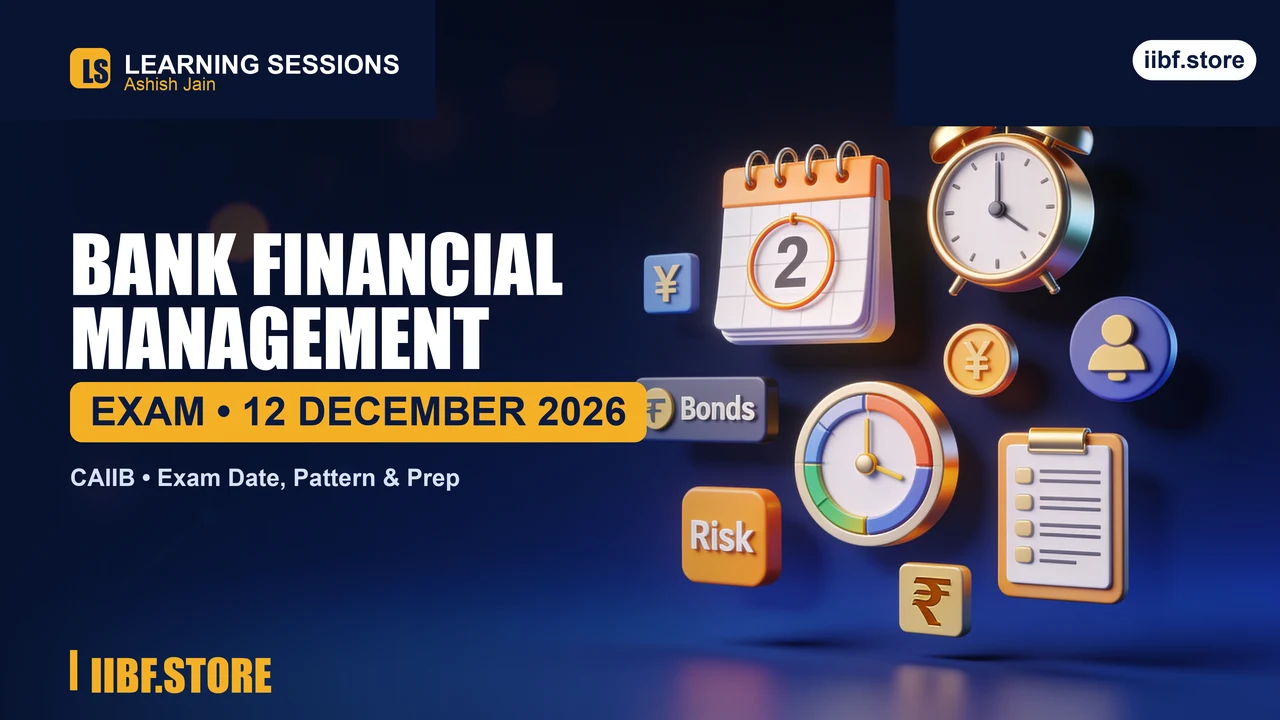
The CAIIB BFM exam date in the December 2026 cycle is the single fact that should shape your next few months of preparation. Bank Financial Management is the paper where careful strategy beats raw effort — treasury, risk, balance-sheet and forex topics all reward candidates who plan backwards from the exam day rather than cram at the end. Get the date fixed in your calendar, build a method around it, and BFM stops being the scary paper everyone warns you about.
This guide pulls together everything that matters: when the BFM exam falls, what the paper actually tests, the registration window, a realistic study plan, the mistakes that quietly cost marks, and a set of clear answers to the questions aspirants ask most. Wherever a specific day, fee or figure is involved, treat it as indicative and confirm it on the official IIBF notification, because the Institute can adjust the timetable from cycle to cycle.
Key takeaways
- The CAIIB BFM exam date falls within the December 2026 examination window — confirm the exact day on the latest IIBF notification.
- BFM is a fixed-date paper, not remote-proctored, so every candidate sits it on the same day at an allotted centre.
- It is one of the two compulsory CAIIB papers, alongside Advanced Bank Management.
- The paper is objective, multiple-choice and numerical-heavy across four modules.
- Registration for the December cycle typically opens around September — apply early for your preferred centre.
When is the CAIIB BFM exam date?
The CAIIB BFM exam date sits inside the December 2026 examination window set by the Indian Institute of Banking & Finance (IIBF). Bank Financial Management is scheduled as per the latest released IIBF schedule, and because it is a fixed-date paper you do not choose a slot — everyone attempts it on the same day at the centre allotted to them.
Your other CAIIB papers are spread across the same December window, so the practical first step is to map every exam day from the official timetable, then ring-fence enough preparation time for BFM specifically. Most candidates find it the heaviest of the lot, which makes the exam day a hard anchor worth planning around from day one. Always cross-check the precise date on the official IIBF website before you finalise leave or travel.
Why strategy matters more in BFM than hours
BFM is not a memory test. It blends conceptual questions with applied, calculation-style problems on interest-rate risk, bond pricing, capital adequacy and forex arithmetic. Two candidates with identical study hours can score very differently depending on how they prepare.
A plan that front-loads the heavy modules and then drills numericals under time pressure consistently outperforms passive reading. That is the core idea behind everything below: with the CAIIB BFM exam date as your fixed point, method and sequencing decide your result far more than the sheer number of hours you put in.
What the BFM paper actually tests
CAIIB BFM is an objective, multiple-choice paper with a strong applied and numerical element. Expect scenario-based and calculation questions spread across four modules:
- Module A — International Banking: forex markets, exchange-rate arithmetic, foreign-currency accounts, and exchange and trade-finance fundamentals.
- Module B — Risk Management: credit, market, operational and liquidity risk; the Basel framework; capital adequacy and risk-measurement tools.
- Module C — Treasury Management: treasury products, the role of the dealing room, ALM linkages, derivatives and treasury risk.
- Module D — Balance Sheet Management: asset-liability management, RAROC, capital planning, and managing interest-rate and liquidity risk on the balance sheet.
Do not rely on old question counts or pass marks — confirm the current number of questions, duration and pass criteria on the latest IIBF notification, as these can change. The bigger win is knowing the syllabus cold: download the official BFM syllabus PDF and map every chapter before you start. For a deeper read on the balance-sheet side, our guide to Asset-Liability Management for CAIIB BFM walks through the ALM concepts the paper leans on most.
How the four modules compare
A quick comparison helps you decide where to spend your richest study hours. Treat the weight column as a planning guide based on typical depth and difficulty, not a fixed mark allocation.
| Module | Core focus | Style | Planning weight |
|---|---|---|---|
| A — International Banking | Forex, trade finance | Numerical-heavy | High |
| B — Risk Management | Basel, capital adequacy | Conceptual + applied | Very high |
| C — Treasury Management | Dealing room, derivatives | Mixed | Medium |
| D — Balance Sheet Mgmt | ALM, RAROC, capital planning | Numerical-heavy | High |
Registration: lock your seat early
Registration for the December cycle typically opens around September. A few practical reminders keep the process smooth:
- You must be a member of the Institute to apply — sort out membership before the window opens.
- Apply in the first few days; preferred centres fill quickly.
- Keep your photograph, signature and payment method ready to avoid last-minute errors.
- Confirm the exact opening and closing dates on the official IIBF notification, as the window can shift slightly between cycles.
Your week-by-week plan to the BFM exam
Working backwards from the December exam date, here is a realistic schedule that keeps the load steady and protects your numerical practice. Adjust the start point to match the exact day on the IIBF timetable.
- Weeks 1–3 (start around mid-September): Module B — Risk Management. It is the largest and most conceptual block, so give it room and tie each idea to a real banking example.
- Weeks 4–6: Module A — International Banking, with daily forex-arithmetic drills until exchange-rate sums become automatic.
- Weeks 7–9: Modules C and D — Treasury and Balance Sheet Management. Practise ALM, RAROC and capital-adequacy numericals on paper, not just by reading.
- Weeks 10–11: Pure revision and full-length mocks. Alternate timed tests with quick formula recaps, and fix weak chapters instead of chasing new ones.
- Final week: Light revision of formulas and definitions, one calm mock, and proper sleep — no new topics.
Anchor every week to the exam date and you arrive methodical, not rushed. If you have only six weeks left, compress the module phase to four weeks but keep two full weeks for mocks — never skip the mock phase in BFM. You can run timed, exam-pattern papers anytime on our CAIIB mock tests, and reinforce vocabulary-heavy topics with the CAIIB matching games that make risk, treasury and forex terms stick.
Common mistakes to avoid in BFM
- Reading numericals instead of solving them: bond-pricing, duration and forex sums are only learned by working them by hand under time pressure.
- Underestimating Risk Management: Module B carries heavy weight and ties into every other module, so start with it — do not leave it last.
- Ignoring the formula sheet: capital-adequacy, RAROC and ALM formulas reappear constantly. Keep a one-page compendium and revise it daily.
- Skipping mocks: reading is not the same as attempting under the clock. Mocks expose weak chapters while there is still time to fix them.
- Treating modules in isolation: treasury, ALM and risk overlap heavily, so connect concepts across modules rather than memorising each in a silo.
Free resources to prepare faster
Everything on Learning Sessions is built around this exact BFM syllabus, so your preparation stays on target:
- Timed, exam-pattern chapter-wise BFM mock tests with instant explanations.
- Chapter one-liners and formula recaps for last-mile revision.
- Recorded and live classes by Ashish Jain covering every BFM module.
- Downloadable notes and study-material PDFs mapped to the four modules.
If you are sitting more than one paper this cycle, browse all CAIIB guides or jump straight to the dedicated Bank Financial Management course hub. Aspirants often pair BFM with an elective — if that is you, our UPI and Digital Banking Rails ITDB guide is a popular companion read, and the wider CAIIB exam hub ties every paper together.
Exam-day checklist
- Carry your printed admit letter and a valid photo ID.
- Reach the centre early — aim for around 45 minutes before reporting time.
- Read each numerical in full; BFM questions hide the trick in the data, so do not skim.
- Bank the easy conceptual marks first, then return to long calculations.
- Watch the clock and flag tough sums for review rather than getting stuck on one.
- Confirm the negative-marking rule on your admit letter before you start guessing.
Frequently asked questions
When is the CAIIB BFM exam date in 2026?
For the December 2026 cycle, the CAIIB BFM (Bank Financial Management) exam falls within the December examination window set by IIBF. It is a fixed-date paper, so all candidates sit it on the same day. Always confirm the exact date on the latest IIBF notification before planning leave or travel.
When does registration open for the December cycle?
Registration for the December cycle generally opens around September. Apply in the first few days to secure your preferred centre, since seats fill quickly. The precise opening and closing dates are published on the official IIBF site and can shift slightly between cycles.
Is BFM a numerical-heavy paper?
Yes. Alongside concepts, BFM tests applied and calculation-based questions on risk, treasury, forex and balance-sheet management. Regular numerical practice — solved by hand under time pressure — is essential. Module B and the forex arithmetic in Module A reward consistent drilling more than last-minute reading.
Is there negative marking in CAIIB BFM?
CAIIB objective papers generally do not carry negative marking, but rules can change between cycles. Always reconfirm the current marking scheme on your admit letter and the latest IIBF notification before you start guessing. When in doubt, attempt every question only after checking this.
Where can I get the BFM syllabus?
You can download the official BFM syllabus PDF from Learning Sessions to plan your chapters and map your revision around the four modules. Knowing the syllabus cold — rather than relying on old question counts — is the single biggest planning advantage for this paper.
How many hours a day should I study for BFM?
Quality beats quantity here. Two to three focused hours a day, with at least half spent solving numericals, is usually enough if you start with Module B and stay consistent. The candidates who clear BFM comfortably are rarely those who studied the most hours, but those who sequenced their preparation well and ran enough timed mocks.
Plan it like the compulsory paper it is
Because BFM is a compulsory CAIIB paper, there is no way around it — and no reason to fear it once you have a method. The candidates who clear it comfortably are rarely the ones who studied the most hours. They are the ones who started Risk Management early, solved numericals by hand, and ran enough timed mocks to stay calm on exam day.
Fix the CAIIB BFM exam date in your calendar, register on the first day the window opens, guard your mock-test weeks, and work a steady plan instead of a final-month sprint. Do that, and you will walk into the December 2026 cycle methodical, confident and ready to clear BFM on the first attempt.
Related Guides
📚 Free Learning Sessions resources — connect & crack your exam
- 📝 Free mock tests — chapter-wise, exam-pattern, with instant solutions
- 🎮 Matching games — gamified revision of key terms & concepts
- 📄 Study notes & PDFs — downloadable chapter material
- 🎥 Video classes on YouTube — subscribe to @learningsessions
💬 Want the full course? WhatsApp your course name to 8360944207 and our team will set you up.
📱 Study on the go — get our iOS & Android app at iibf.store/app.
Quick quiz on this topic
5 exam-style questions from our free test bank — check yourself before you move on.
Practice this topic
Take a free mock test, download chapter PDFs, or watch a video class — all included on iibf.store.
Keep reading