Consortium Lending in Credit Delivery: A CCP Exam Guide 2026
Consortium lending is one of the oldest credit delivery mechanisms Indian banks use to fund large borrowers, and it remains a favourite exam theme for the Certified Credit Professional (CCP) course because it blends credit policy, documentation and monitoring into one topic. This article walks through how consortium lending works, how it differs from multiple banking, and what examiners typically test.
🤝 What Is Consortium Lending?
Consortium lending is an arrangement where two or more banks jointly finance a single borrower's credit requirement — typically working capital or a term facility — under a common set of terms, a shared security charge and one master loan agreement. Instead of each bank sanctioning and documenting a facility independently, the banks agree on a total credit limit, apportion shares among themselves, and appoint one bank as the lead bank to coordinate the relationship. This structure grew popular for large manufacturing and infrastructure borrowers whose funding needs exceeded what a single branch or bank could comfortably underwrite within its exposure norms.
The core idea taught under credit policy frameworks is risk-sharing: no single lender carries the entire exposure, yet the borrower deals with a largely unified process for sanction, documentation and renewal. Consortium lending is commonly used for large working capital limits, but it also appears for term facilities financing capital expenditure, especially when the ticket size is too large for one bank's single-borrower exposure ceiling.
📜 The Lead Bank and Consortium Guidelines
Every consortium has a lead bank, usually the institution with the largest share or the one that originated the relationship. The lead bank convenes consortium meetings, circulates the borrower's financial data, coordinates the joint appraisal note, and negotiates common terms and conditions on behalf of all member banks. Once the consortium agrees on the overall limit, each member bank independently assesses the borrower and internally sanctions its own share, but all members sign a common loan agreement and hold security on a pari-passu basis.
💡 Exam Tip: Remember that under consortium (and multiple banking) arrangements, RBI has long expected banks with aggregate borrower exposure above a meaningful threshold to exchange credit information — illustratively framed around ₹5 crore in supervisory guidance — so watch for questions that test this information-sharing obligation rather than an exact rupee figure.
The credit delivery chapter frames the lead bank's role as administrative rather than supervisory — it does not dictate how member banks assess risk, but it does own the responsibility of keeping the group informed and calling meetings when the account shows stress.
⚖️ Consortium Lending vs Multiple Banking Arrangement
Candidates frequently mix up consortium lending with a multiple banking arrangement (MBA), where several banks lend to the same borrower independently, each with its own documentation, security and terms, without a lead bank or joint agreement. The table below captures the key differences that examiners like to test.
| Parameter | Consortium Lending | Multiple Banking Arrangement |
|---|---|---|
| Documentation | One common loan agreement for all members | Separate documentation with each bank |
| Lead bank concept | ✅ Formal lead bank coordinates the group | ❌ No lead bank; each bank acts alone |
| Structured information sharing | Built into the consortium process | Often ad hoc or absent |
| Security charge | Pari-passu charge shared among members | Independent charge, sometimes exclusive |
| Exposure visibility | Centrally tracked by the lead bank | Each bank sees only its own book |
⚠️ Common Mistake: Do not equate consortium lending with loan syndication. In syndication, one arranger bank originates and structures a single large facility and then sells down shares to participants; in a consortium, all member banks are involved jointly from the appraisal stage itself.
🔍 Monitoring and Information Sharing in a Consortium
Once the facility is disbursed, consortium banks are expected to monitor the account jointly. The lead bank circulates stock statements, quarterly operating data and inspection reports to all members, and consortium meetings are held periodically — more frequently if the account shows signs of stress. This joint monitoring is meant to prevent a situation where one bank continues fresh lending while another has already flagged early-warning signals, a gap that regulators have repeatedly pushed banks to close through better information exchange.
Where an account under a consortium slips into irregularity, the resolution path often runs alongside the stressed asset resolution framework that CCP candidates study separately, since a multi-bank exposure changes how restructuring decisions get approved — typically requiring lenders holding a specified majority of the exposure by value to agree before a resolution plan proceeds.
📌 Remember: Decisions on additional finance, extension of limits, or exit by a member bank from a consortium generally need approval from a majority of lenders by value of exposure, not simply a majority by number of banks.
📋 Documentation, Exit and Additional Finance
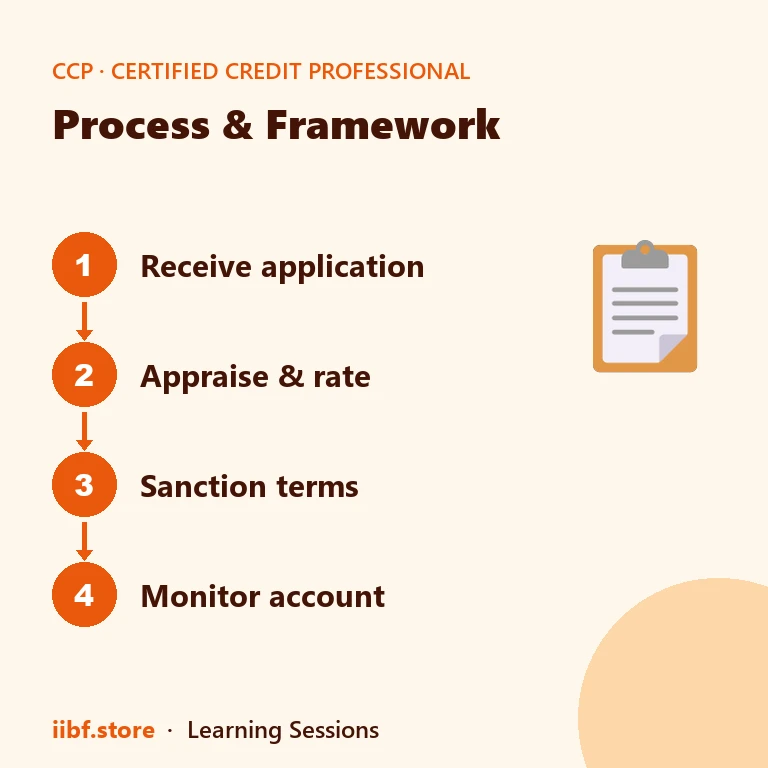
The documentation package in a consortium typically includes a common loan agreement, a joint deed of hypothecation over current assets, and an inter-se agreement among the banks defining each member's share, priority of charge and rights on enforcement. When banks assess how much working capital each member should fund, the underlying appraisal draws on the same methods used for standalone facilities, including the credit appraisal process and, where a large facility is being apportioned across borrower categories, the Maximum Permissible Bank Finance method for computing the eligible limit.
Exit of a member bank, admission of a new lender, or sanction of additional finance for capex or cost overruns are all consortium-level decisions that must be ratified in a consortium meeting and reflected in supplementary documentation. Lead banks are also expected to act even-handedly toward every member — a principle closely tied to the broader discussion of conflict of interest in banking, since a lead bank favouring its own recovery over that of smaller consortium members would breach both the spirit of the agreement and IBA's code of conduct for lenders.
For borrowers with multiple credit facilities across products, understanding how a bank classifies different types of borrowers and credit facilities helps explain why some limits sit inside the consortium and others — like a standalone letter of credit — may be arranged bilaterally outside it.
Official sources: cross-check the latest syllabus, circulars and rates on the IIBF official website and the Reserve Bank of India.
🧠 Practice MCQs: Consortium Lending
Q1. In a consortium lending arrangement, which bank typically coordinates documentation and calls consortium meetings? (a) The borrower's primary current account bank (b) The lead bank (c) RBI's regional office (d) The bank with the smallest share
Answer: (b) — The lead bank, usually holding the largest share, coordinates appraisal, documentation and meetings on behalf of all members.
Q2. What is the key structural difference between consortium lending and a multiple banking arrangement? (a) Consortium lending has no security (b) Multiple banking always involves foreign banks (c) Consortium lending uses one common loan agreement; multiple banking uses separate documentation per bank (d) There is no difference
Answer: (c) — Consortium lending is built around joint documentation and a shared charge, while multiple banking keeps each bank's relationship independent.
Q3. How does consortium lending differ from loan syndication? (a) They are identical terms for the same process (b) Syndication involves only one bank ever (c) In syndication an arranger structures and sells down a single facility, while a consortium is jointly involved from appraisal onward (d) Consortium lending is only for retail loans
Answer: (c) — Syndication is arranger-led with participants joining later; a consortium is a joint group from the start.
Q4. Decisions such as additional finance or a member bank's exit from a consortium usually require: (a) Unanimous agreement of all branch managers (b) Approval of RBI in every case (c) Agreement of lenders holding a specified majority of exposure by value (d) No approval at all
Answer: (c) — Such decisions typically need majority consent measured by value of exposure, not headcount of banks.
Q5. Security held by member banks under a consortium arrangement is usually structured as: (a) Exclusive charge for the lead bank only (b) Pari-passu charge shared among member banks (c) No charge at all (d) Charge held solely by the borrower
Answer: (b) — Members typically share a pari-passu charge over the borrower's assets in proportion to their exposure.
Want chapter-wise mock tests with 100+ MCQs? Start practising free →
Is consortium lending mandatory for large borrowers in India?
No. It is one option among several — including multiple banking and syndication — that banks and borrowers can choose based on the size and complexity of the credit requirement.
Who bears the loss if a consortium-financed account turns into an NPA?
Each member bank bears losses in proportion to its share of the sanctioned limit, since the underlying charge and exposure are apportioned among the members from the outset.
Can a borrower add a new bank to an existing consortium?
Yes, but admission of a new member bank requires the existing consortium's consent and updated documentation reflecting the revised shares and charge structure.
Does the lead bank get extra fees for coordinating a consortium?
Lead banks may charge an agency or coordination fee for the administrative work of managing documentation and meetings, though the exact structure varies by bank policy.
Master Consortium Lending for the CCP Exam
Consortium lending sits at the intersection of credit delivery, documentation and monitoring — exactly the mix CCP exams love to test through scenario-based questions. Revisit the lead bank's role, the consortium-versus-multiple-banking distinction, and the majority-by-value rule for consortium decisions, then reinforce it with full-length mocks on iibf.store/tests and browse more Certified Credit Professional articles to round out your CCP preparation.
Quick quiz on this topic
5 exam-style questions from our free test bank — check yourself before you move on.
Practice this topic
Take a free mock test, download chapter PDFs, or watch a video class — all included on iibf.store.
Keep reading