RAROC in Banking: CAIIB Risk Management Guide 2026
RAROC in banking is one of the most heavily-tested performance concepts in the CAIIB Risk Management (Elective) paper, and for good reason: it is the single metric that ties together credit risk, market risk, operational risk and capital allocation into one number a board can act on. Where traditional profitability ratios reward a business line for booking volume, RAROC asks a sharper question — how much economic capital did you consume to earn that return, and did you clear the bank's hurdle rate? This guide explains the formula, the intuition behind economic capital, how RAROC drives loan pricing and capital allocation, and the exact traps IIBF likes to set in the objective questions.
🎯 What RAROC Actually Measures
RAROC stands for Risk-Adjusted Return on Capital. It reframes profitability by putting risk-adjusted capital — not accounting equity — in the denominator. The standard expression examiners expect is:
RAROC = (Revenue − Operating Costs − Expected Loss + Return on Economic Capital) ÷ Economic Capital
Two ideas do the heavy lifting. First, Expected Loss (EL) is treated as a cost of doing business, not a surprise — it is provisioned and deducted in the numerator, computed as EL = PD × LGD × EAD. Second, the denominator is economic capital, the capital a bank must hold to absorb unexpected loss at a chosen confidence level (often 99.9% over a one-year horizon, mirroring Basel's credit-risk internal models). So RAROC deliberately separates the two: expected loss goes on top as a charge, unexpected loss sits underneath as the capital cushion.
The output is a percentage that is directly comparable across a retail portfolio, a corporate desk and a treasury book, because each has been normalised for the risk it actually runs. A mortgage book earning a thin spread can post a higher RAROC than a flashy high-yield corporate exposure once the corporate's fat economic-capital consumption is netted off. That comparability is precisely why RAROC became the backbone of risk-adjusted performance measurement (RAPM) and sits at the heart of the CAIIB risk management framework chapter.
🏦 Economic Capital vs Regulatory Capital
The commonest exam confusion is treating economic capital and regulatory capital as the same thing. They are not. Regulatory capital is the minimum a supervisor mandates — under Basel III, a total capital ratio of 9% of risk-weighted assets in India (8% globally) plus a 2.5% capital conservation buffer, giving Indian banks an effective 11.5% floor. It is a one-size framework applied across the system.
Economic capital is the bank's own internal estimate of the capital needed to stay solvent against its specific risk profile, at its own chosen confidence level and time horizon. It is model-driven, portfolio-specific, and captures diversification benefits that regulatory formulas ignore. A well-diversified bank's economic capital can sit below its regulatory capital; a concentrated bank's can sit above it.
| Feature | Regulatory Capital | Economic Capital |
|---|---|---|
| Set by | Supervisor (RBI/Basel) | The bank internally |
| Basis | Standardised RWA formula | Internal risk models |
| Captures diversification? | ❌ Largely no | ✅ Yes |
| Confidence level | Fixed by rule | Bank-chosen (e.g. 99.9%) |
| Used for RAROC denominator? | ❌ No | ✅ Yes |
| Drives pricing decisions? | Indirectly | ✅ Directly |
💡 Exam Tip: RAROC always uses economic capital in the denominator. If an option says "regulatory capital in the denominator", it is a distractor. Reconciling the two is exactly the job of the ICAAP.
This is also why RAROC feeds directly into a bank's Internal Capital Adequacy Assessment Process — the ICAAP under Basel Pillar 2 is where the bank demonstrates that its internally-assessed (economic) capital covers all material risks, not just the Pillar 1 minimums.
💰 How RAROC Prices a Loan
RAROC is not just a scorecard — it is a live pricing engine. To decide whether a proposed loan should be booked, a relationship manager runs the exposure through the RAROC formula and compares the result to the bank's hurdle rate, which is essentially its cost of equity capital. The decision rule is simple:
If RAROC > hurdle rate → the deal creates shareholder value → approve/price as is.
If RAROC < hurdle rate → the deal destroys value → reprice, add collateral, or decline.
Consider a ₹100 crore corporate loan. Suppose net interest and fee revenue is ₹4 crore, operating cost ₹0.5 crore, expected loss (PD × LGD × EAD) ₹1 crore, and the model assigns ₹8 crore of economic capital. Ignoring the return on capital for simplicity, RAROC ≈ (4 − 0.5 − 1) ÷ 8 = 31.25%. If the bank's hurdle rate is 15%, the deal comfortably creates value. Raise the borrower's PD — pushing EL to ₹2.5 crore and economic capital to ₹12 crore — and RAROC collapses to (4 − 0.5 − 2.5) ÷ 12 ≈ 8.3%, well below the hurdle. The same headline spread, a completely different verdict.
This is where RAROC connects to the granular credit inputs. Getting PD, LGD and EAD right is the whole game, which is why candidates should pair this topic with our deep-dive on CAIIB credit risk models: PD, LGD and EAD. On the market-risk and treasury side, positions in derivatives and risk management instruments carry their own economic-capital charge that must be folded into desk-level RAROC before hedging strategies are judged profitable.
📊 RAROC, RORAC and EVA — Don't Mix Them Up
IIBF loves testing the family of risk-adjusted metrics because the acronyms are so easy to confuse. Keep three straight:
- RAROC — Risk-Adjusted Return on Capital: the numerator is risk-adjusted (expected loss deducted), the denominator is capital. This is the classic Bankers Trust metric.
- RORAC — Return on Risk-Adjusted Capital: the numerator is ordinary return, the denominator is risk-adjusted (economic) capital.
- RARORAC — both numerator and denominator are risk-adjusted; the fullest form.
Alongside these sits Economic Value Added (EVA), which converts the same logic into a rupee amount rather than a ratio: EVA = Risk-adjusted profit − (Economic Capital × Hurdle Rate). A positive EVA means the business earned more than the cost of the capital it tied up — the absolute-value twin of "RAROC beats the hurdle rate".
⚠️ Common Mistake: Candidates assume RAROC and RORAC are interchangeable. They are not — the difference is which side of the fraction the risk adjustment sits on. Read the acronym letter by letter.
Because these metrics penalise capital-hungry, concentrated exposures, they also nudge banks toward the discipline that shows up elsewhere in the syllabus — sound liquidity risk management, forward-looking stress testing framework design, and robust operational risk management that keeps the operational-risk slice of economic capital in check. RAROC is the number; those disciplines determine whether the number is honest. For the full topic list, browse the Risk Management elective tag hub.
🔗 Where RAROC Sits in the Bigger Picture
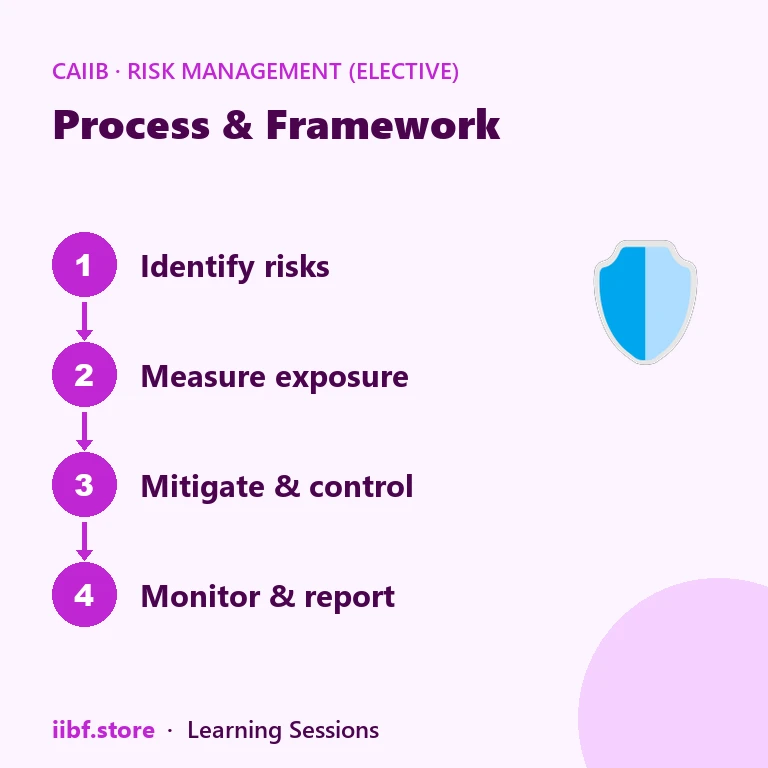
RAROC is the connective tissue between risk and strategy. At the transaction level it prices deals; at the portfolio level it drives capital allocation, steering scarce economic capital toward the business lines that generate the highest risk-adjusted return; and at the enterprise level it feeds performance-linked pay, so front-line incentives finally reward return-per-unit-of-risk rather than raw volume. That top-to-bottom reach is why regulators view a credible RAROC framework as evidence of risk-management maturity under Pillar 2.
It also stretches beyond the Risk Management paper. The same "hold capital against tail events, then price for it" logic underpins operational-resilience planning across the CAIIB syllabus — for instance, the recovery objectives in Business Continuity Planning for CAIIB ITDB: RTO, RPO & DR Sites are, in capital terms, another way of pricing the cost of an unexpected disruption. Master RAROC and you hold the thread that runs through credit pricing, capital planning and enterprise risk governance. Reinforce it with the full CAIIB course and timed practice on the IIBF mock tests.

📚 Official reference: Always verify the latest rules, circulars and thresholds on the Reserve Bank of India (RBI) website before your exam — regulations change and only primary sources are authoritative.
🧠 Practice MCQs: RAROC in Banking
Q1. In the RAROC formula, which figure occupies the denominator? (a) Regulatory capital (b) Tier 1 capital (c) Economic capital (d) Paid-up share capital
Answer: (c) — RAROC divides risk-adjusted return by economic capital, the internal estimate of capital needed to absorb unexpected loss.
Q2. Expected Loss (EL) used in the RAROC numerator is best computed as: (a) PD − LGD − EAD (b) PD × LGD × EAD (c) LGD ÷ EAD (d) EAD − Collateral
Answer: (b) — Expected Loss = Probability of Default × Loss Given Default × Exposure at Default.
Q3. A loan's RAROC is 9% and the bank's hurdle rate is 15%. The correct conclusion is: (a) The deal creates shareholder value (b) The deal destroys value and should be repriced or declined (c) The deal is capital-neutral (d) Economic capital must be zero
Answer: (b) — When RAROC is below the hurdle rate the transaction fails to cover the cost of capital, so it destroys value.
Q4. How does economic capital differ from regulatory capital? (a) It is always higher (b) It is fixed by the supervisor (c) It is the bank's internal, model-based estimate that can capture diversification (d) It ignores confidence levels
Answer: (c) — Economic capital is internally estimated at a bank-chosen confidence level and reflects portfolio diversification, unlike the standardised regulatory minimum.
Q5. In EVA = Risk-adjusted profit − (Economic Capital × Hurdle Rate), a positive EVA indicates: (a) The business consumed more capital than it earned (b) The business earned more than the cost of the capital it employed (c) Expected loss exceeded revenue (d) The hurdle rate was breached downward
Answer: (b) — Positive EVA means risk-adjusted profit exceeded the charge for the economic capital tied up, i.e. genuine value creation.
Want chapter-wise mock tests with 100+ MCQs? Start practising free →
❓ Frequently Asked Questions
Is RAROC part of the CAIIB Risk Management elective syllabus?
Yes. Risk-adjusted performance measurement, economic capital and capital allocation are core Pillar 2 / ICAAP topics in the CAIIB Risk Management (Elective) paper and appear regularly in the objective section.
What is the difference between RAROC and RORAC?
In RAROC the numerator is risk-adjusted (expected loss is deducted) while the denominator is capital. In RORAC the numerator is ordinary return and the denominator is risk-adjusted (economic) capital. RARORAC adjusts both sides.
What hurdle rate do banks use for RAROC?
The hurdle rate is broadly the bank's cost of equity capital — the minimum return shareholders require. A transaction is value-accretive only when its RAROC exceeds this hurdle.
Why is expected loss subtracted rather than treated as a capital item?
Expected loss is a predictable, provisionable cost of lending, so it is charged in the numerator. Only unexpected loss — the volatility around the average — is buffered by economic capital in the denominator.
✅ Conclusion
RAROC turns risk into a price. By charging expected loss as a cost and holding economic capital against unexpected loss, it lets a bank compare a mortgage desk and a corporate book on equal, risk-adjusted terms — and reject deals that quietly destroy value. Nail the formula, keep economic capital and regulatory capital separate, and never confuse RAROC with RORAC, and you have secured some of the most reliable marks in the paper. Ready to test yourself under exam conditions? Take a free CAIIB Risk Management mock test → or enrol in the full CAIIB course to lock it in.
Quick quiz on this topic
5 exam-style questions from our free test bank — check yourself before you move on.
Practice this topic
Take a free mock test, download chapter PDFs, or watch a video class — all included on iibf.store.
Keep reading