Portfolio Management Services: JAIIB RBWM 2026 Guide
For JAIIB aspirants preparing the Retail Banking and Wealth Management (RBWM) paper, few topics reward exam-day confidence like portfolio management services. As Indian households accumulate more investable surplus, banks and their wealth arms increasingly cross-sell this SEBI-regulated offering to affluent clients. Understanding how it is structured, taxed and regulated is a recurring theme in the wealth management module — and this JAIIB RBWM guide breaks it down the way examiners actually test it.
🏦 What Are Portfolio Management Services?
Portfolio management services (PMS) is a professional, customised investment offering in which a licensed portfolio manager invests and administers a client's securities and funds on their behalf. Unlike a pooled vehicle, each PMS client typically holds securities directly in their own demat account, which keeps ownership — and the tax consequences — with the investor. In India, PMS is regulated by SEBI under the SEBI (Portfolio Managers) Regulations, 2020, and only entities registered with SEBI may offer it.
The most exam-relevant fact is the ticket size: the minimum investment for a PMS client is ₹50 lakh (raised from ₹25 lakh by SEBI in 2019–20). This threshold deliberately positions PMS as a product for high-net-worth individuals (HNIs) rather than retail savers. Managers may charge a fixed fee, a performance-linked (profit-sharing) fee, or a combination, but regulations prohibit any promise of assured or guaranteed returns. Because PMS sits at the top of a bank's retail product ladder, its economics tie back to the branch and relationship-banking concepts covered in retail banking concepts, where cross-selling to affluent segments drives fee income and branch profitability.
💡 Exam Tip: Remember the number — PMS minimum investment in India is ₹50 lakh, and PMS is regulated by SEBI, not RBI.
🧩 The Three Types of PMS
SEBI recognises three broad models of portfolio management services, and distinguishing them is a classic one-mark question. In a discretionary PMS, the portfolio manager has full authority to buy and sell securities and manage the portfolio independently, within the mandate agreed with the client. The client does not approve individual trades. This is the most common form in India because it lets the manager act quickly on market opportunities.
In a non-discretionary PMS, the manager suggests ideas but executes only after the client approves each transaction, so the final investment decision always rests with the investor. This suits clients who want professional input while retaining control. The third model, advisory PMS, is purely advice: the manager recommends investments but neither holds custody nor executes trades — the client (or their broker) does the buying and selling.
All three are documented in a mandatory disclosure document and a client agreement that specify fees, risk factors and the investment approach. For RBWM candidates, the key contrast is who makes the decision and who executes. If you can map "manager decides and executes" to discretionary, "client approves each trade" to non-discretionary, and "advice only" to advisory, you will score the question. These distinctions build directly on the customer-requirement themes in branch profitability and customer requirements.
📊 PMS vs Mutual Funds: The Key Comparison
Examiners love to contrast PMS with mutual funds because the two look similar but differ sharply on ownership, regulation cost and tax. A mutual fund pools money from thousands of investors into a single scheme and issues units; a PMS holds securities in each client's own name. That single difference cascades into most of the other distinctions below.
| Feature | Portfolio Management Services | Mutual Funds |
|---|---|---|
| Minimum investment | ₹50 lakh | As low as ₹100–₹500 (SIP) |
| Ownership of securities | Direct, in client's demat ✅ | Units of a pooled scheme ❌ |
| Customisation | Tailored to client ✅ | Standardised scheme ❌ |
| Regulator | SEBI (Portfolio Managers) Regulations, 2020 | SEBI (Mutual Funds) Regulations, 1996 |
| Taxation of gains | In investor's hands on each sale | On redemption of units |
| Target investor | HNI / affluent | Mass retail ✅ |
Because a PMS investor legally owns each stock, every sale inside the portfolio can trigger a capital-gains event in that investor's hands — a contrast with a mutual fund, where tax arises only when the investor redeems units. For a fuller primer on the pooled alternative, see our companion note on mutual funds basics.
⚠️ Common Mistake: Do not assume PMS gains are taxed only at the end like a mutual fund — in PMS, each in-portfolio sale can be a taxable event for the investor.
🛡️ SEBI Rules and Investor Safeguards
Investor protection is central to how portfolio management services are regulated, and this angle appears often in RBWM questions on ethics and compliance. Every SEBI-registered portfolio manager must issue a disclosure document covering fees, past performance, risk factors and conflicts of interest before onboarding a client. Client funds and securities must be kept segregated, and the manager cannot mix them with its own assets.
Managers are barred from promising guaranteed returns and must report portfolio performance to clients periodically — typically with a statement of holdings and transactions. SEBI also requires performance to be disclosed net of fees and expenses so investors see the real, after-cost outcome rather than a flattering gross figure. High-water-mark rules on performance fees prevent a manager from charging a profit share on gains that merely recover an earlier loss.
For banks distributing PMS through their wealth desks, suitability and disclosure obligations sit alongside the broader retail-banking operational controls introduced in retail banking role within bank operations. Candidates should also connect PMS to the affluent-segment focus discussed in our guide to retail banking customer segmentation, since suitability depends heavily on correctly identifying the client's risk profile and financial goals. Wider market plumbing — depositories, custodians and the entities behind them — is covered in our cross-subject explainer on banking structure in India.
👤 Who Should Consider PMS, and How Banks Position It
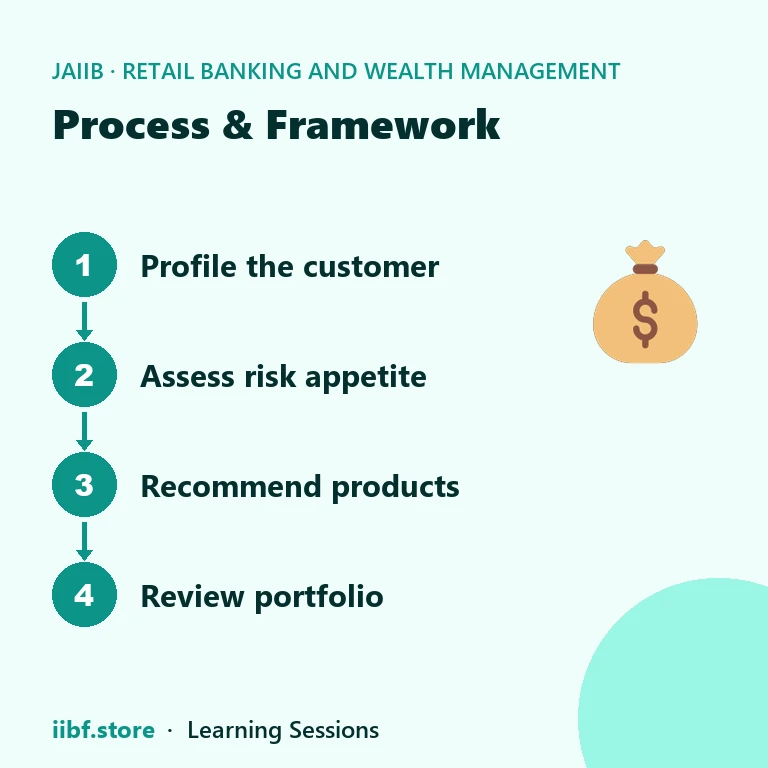
Portfolio management services are built for investors who have both scale and specific goals: HNIs, business owners with lumpy liquidity events, and families planning long-horizon wealth transfers. Because the entry ticket is ₹50 lakh and portfolios are concentrated rather than broadly diversified, PMS carries higher single-stock and manager-selection risk than a diversified mutual fund. That risk-return trade-off is exactly why suitability assessment matters so much.
From a bank's perspective, PMS is a high-value, fee-rich product that deepens the relationship with affluent clients and lifts per-customer profitability — the commercial logic threaded through the retail banking and wealth management tag hub. Relationship managers usually position PMS alongside other wealth solutions such as the NPS and retirement planning framework, so the client sees a coherent plan rather than isolated products. For the exam, remember that PMS is one instrument within a wider advisory conversation, and that regulation, cost transparency and suitability — not headline returns — are what IIBF tests. Ready to lock this in? Explore the full JAIIB course and practise more on the test series.
📌 Remember: PMS = HNI product, ₹50 lakh minimum, SEBI-regulated, direct ownership of securities, no guaranteed returns.
📚 Official reference: Always verify the latest rules, circulars and thresholds on the Reserve Bank of India (RBI) website before your exam — regulations change and only primary sources are authoritative.
🧠 Practice MCQs: Portfolio Management Services
Q1. What is the minimum investment amount for a Portfolio Management Services client in India? (a) ₹10 lakh (b) ₹25 lakh (c) ₹50 lakh (d) ₹1 crore
Answer: (c) — SEBI raised the PMS minimum ticket size to ₹50 lakh in 2019–20.
Q2. Which regulator oversees Portfolio Management Services in India? (a) RBI (b) SEBI (c) IRDAI (d) PFRDA
Answer: (b) — PMS is governed by the SEBI (Portfolio Managers) Regulations, 2020.
Q3. In which type of PMS does the manager execute trades only after the client approves each transaction? (a) Discretionary (b) Advisory (c) Non-discretionary (d) Passive
Answer: (c) — In non-discretionary PMS the investor approves every trade before execution.
Q4. A key difference between PMS and a mutual fund is that in PMS the investor: (a) holds pooled units (b) directly owns the underlying securities (c) is guaranteed returns (d) pays no fees
Answer: (b) — PMS clients hold securities directly in their own demat account rather than pooled units.
Q5. Which statement about PMS fees is correct? (a) Assured returns are permitted (b) Performance must be shown gross of costs (c) Managers may charge fixed and/or performance-based fees but cannot promise guaranteed returns (d) No disclosure document is required
Answer: (c) — Managers may levy fixed and/or profit-sharing fees, but guaranteed returns are prohibited.
Want chapter-wise mock tests with 100+ MCQs? Start practising free →
❓ Frequently Asked Questions
Is PMS the same as a mutual fund?
No. A mutual fund pools money and issues units, while a PMS holds securities directly in each client's own demat account, leading to different taxation, customisation and minimum-investment rules.
What is the minimum amount needed to invest in PMS?
The SEBI-mandated minimum investment for a PMS client in India is ₹50 lakh, which makes it primarily an HNI product.
Can a PMS manager guarantee returns?
No. SEBI regulations prohibit portfolio managers from promising or guaranteeing any assured return; performance must be disclosed net of fees and expenses.
How is PMS taxed?
Because the investor directly owns the securities, capital gains arise in the investor's hands whenever securities are sold within the portfolio, unlike a mutual fund where tax typically arises on redemption of units.
✅ Conclusion
Portfolio management services reward the affluent investor with customisation and direct ownership, but they demand a ₹50 lakh commitment, careful manager selection and a clear view of SEBI's disclosure and suitability rules. For JAIIB RBWM, focus on the numbers, the three PMS types, the PMS-versus-mutual-fund contrast and the investor safeguards — that is where the marks sit. Put it into practice on the IIBF test series or enrol in the complete JAIIB course to master the wealth management module.
Quick quiz on this topic
5 exam-style questions from our free test bank — check yourself before you move on.
Practice this topic
Take a free mock test, download chapter PDFs, or watch a video class — all included on iibf.store.
Keep reading