Core Banking Solution Architecture: How a CBS Actually Works
Every modern retail and corporate banking service — from an ATM withdrawal in Chennai to a UPI transfer initiated in Guwahati — depends on one foundational system, and understanding core banking solution architecture is exactly what separates a candidate who can explain "anywhere banking" from one who cannot. For CAIIB Information Technology and Digital Banking aspirants, this is a recurring exam theme: how a CBS is layered, why centralisation replaced branch-wise ledgers, and how the core plugs into payment rails, mobile apps and regulatory reporting. This article walks through the working layers, traces how a transaction actually flows through the system, and flags the exact spots examiners like to test.
🏦 What Is Core Banking Solution Architecture
Core Banking Solution (CBS) architecture refers to the layered technology design that lets a bank run all its branches, channels and products off a single, centralised software platform instead of dozens of disconnected branch-level systems. Before CBS became universal, a customer's account existed physically at one "home branch" — passbooks, ledgers and interest calculations were maintained locally, and a transaction at any other branch required manual advice or telex confirmation. CBS collapsed that model: the account master, transaction ledger and product rules now sit on a central server (or server cluster) in the bank's data centre, and every branch, ATM, and app simply becomes a terminal that reads and writes to that same central database over a secure network, as covered in our chapter on Networking Systems.
This is what makes "anywhere banking" possible — a customer can deposit cash at a branch in Pune and withdraw it the same evening from an ATM in Kochi, because both transactions hit the identical central account, not two separate local copies. Architecturally, a CBS environment typically comprises the core application servers, a high-performance relational database cluster, a resilient network backbone linking every branch and channel, and a mirrored disaster recovery site. Exam questions frequently test this centralisation concept as the single biggest architectural difference between legacy branch banking and modern CBS.
🧩 Key Layers and Modules Inside a CBS
A CBS is best understood as three logical layers stacked on top of each other. The presentation layer is what users actually see — the teller's branch screen, the internet banking portal, the mobile banking app and the API storefront used by fintech partners. The application or business-logic layer sits underneath and enforces the bank's rules: interest accrual and compounding, KYC and limit checks, standing-instruction execution, and posting entries to the general ledger. The data layer is the centralised database itself, holding the customer master, account master, and the full transaction history in a structure designed for accuracy and auditability, a topic explored further in Database Management Systems.
Functionally, CBS software is organised into modules rather than one monolithic block — separate modules typically handle savings and current deposits, term deposits, loans and advances, trade finance and letters of credit, treasury operations, and the general ledger that consolidates everything into the bank's books. Most CBS platforms run on a hardened relational database management system chosen specifically for its ACID (Atomicity, Consistency, Isolation, Durability) guarantees, because a banking ledger cannot tolerate a half-completed debit or a duplicated credit. Module-level access is also tightly role-based, so a branch teller, a loan officer and a treasury dealer see only the functions relevant to their role.
💡 Exam Tip: If a question asks what made "anywhere banking" possible, the answer is always centralisation of the database under CBS — not internet banking, which is merely a channel that rides on top of it.
🔗 Centralised Processing vs Branch-Level Banking
Comparing the old branch-banking model with a CBS-enabled bank makes the architectural shift concrete. Under branch banking, each branch closed its own books at day end, reconciled its own vouchers, and had no real-time visibility of a customer's dealings at another branch. Under CBS, end-of-day (EOD) and beginning-of-day (BOD) batch processes still run, but they operate once, centrally, across the entire bank rather than branch-by-branch, and a customer's complete relationship — deposits, loans, cards, all of it — is visible from a single 360-degree customer view regardless of which branch they walk into.
The table below summarises the practical differences that CAIIB questions typically probe, including how disaster recovery and reconciliation change once a bank moves to a centralised core.
| Parameter | Traditional Branch Banking | CBS-Enabled Architecture |
|---|---|---|
| Account access | Only at home branch ❌ | Any branch/channel ✅ |
| Customer data | Fragmented per branch ❌ | Single central database ✅ |
| EOD/BOD processing | Branch-wise, manual-heavy ❌ | Centralised, automated ✅ |
| Real-time balance view | Not available across branches ❌ | Available bank-wide ✅ |
| Disaster recovery | Ad hoc, branch-level ❌ | Centralised DR site with replication ✅ |
| Digital channel integration (UPI, mobile, ATM) | Very limited ❌ | Native via middleware/API layer ✅ |
🌐 Integration With Digital Channels, APIs and Payment Rails
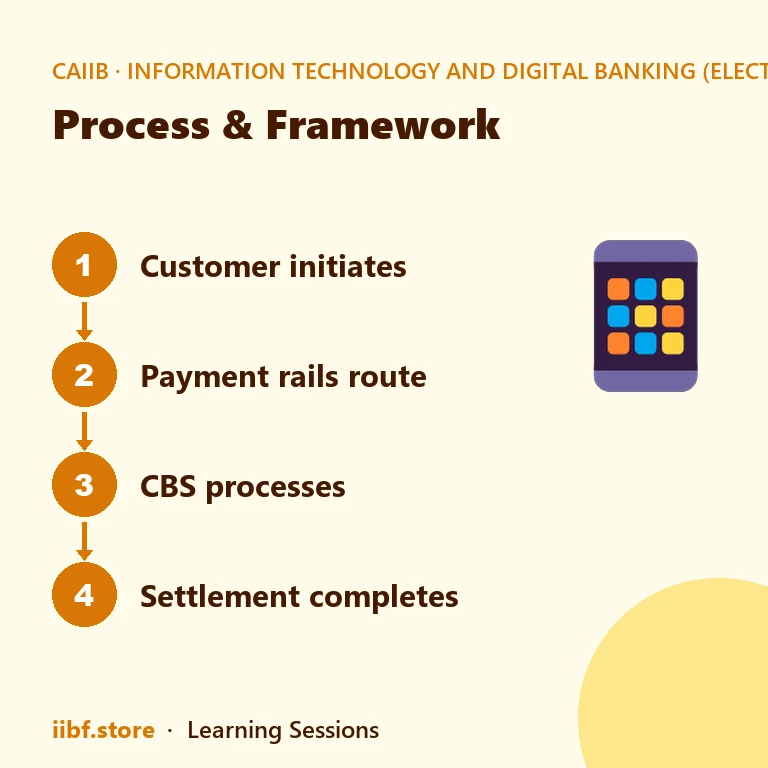
A CBS core rarely talks directly to every channel; instead, a middleware or API gateway layer sits between the core and the outside world, translating requests from internet banking, the mobile app, ATM switches, POS networks and UPI into a format the core engine understands, and vice versa. This is why a UPI transaction initiated through an app is actually routed through the NPCI switch, into the bank's payment gateway, and only then posted onto the CBS ledger — the CBS itself never talks to NPCI directly. This layered design, built on the fundamentals covered in Introduction to Software and Information Technology and its Implications, is what allows banks to launch new digital channels without re-engineering the core itself.
Increasingly, banks wrap their legacy CBS core with a layer of microservices and open APIs so that third-party fintech apps, account aggregators and payment aggregators can plug in under India's evolving open-banking and Account Aggregator framework, without those external parties ever getting direct access to the core database. For a deeper look at how banks are also modernising their payment message formats around this same API-driven architecture, see our guide on ISO 20022 migration in banking, and for the fraud-control layer that typically sits alongside these APIs, read AI fraud detection in banks.
⚠️ Common Mistake: Candidates often assume the API/middleware layer stores account balances. It does not — it only carries messages between the channel and the CBS; the ledger of record always remains inside the core database.
🛡️ High Availability, Disaster Recovery and Security in CBS
Because the CBS holds every branch's live transaction data, any outage disrupts the entire bank simultaneously rather than one location, which is why CBS environments are built for high availability — typically an active data centre paired with a near-real-time replicated disaster recovery (DR) site, so that a failure at the primary site can be switched over with minimal data loss. Two metrics dominate this planning: Recovery Time Objective (RTO), how quickly systems must be restored, and Recovery Point Objective (RPO), how much data (measured in time) the bank can afford to lose. RBI's supervisory expectations, most recently consolidated in its Master Direction on Information Technology Governance, Risk, Controls and Assurance Practices, require that a bank's Board approve the IT and DR strategy and that DR arrangements be tested periodically rather than left as a paper policy — details worth cross-checking on the RBI Master Directions page.
Security around the core is equally layered: encryption of data at rest and in transit, strict role-based access control so no single user can both initiate and authorise a high-value transaction, maker-checker workflows built into the application layer itself, and comprehensive audit trails that log every field-level change to the customer or account master. Migrating urban co-operative banks from manual or standalone systems onto CBS has also been a long-standing supervisory priority for RBI, precisely because a non-centralised bank cannot be supervised, secured or reconciled with the same rigour.
📌 Remember: RTO and RPO are not the same — RTO measures how fast the system comes back online, RPO measures how much data (in time) can be lost. Exam questions frequently swap these two definitions as a distractor.
🧠 Practice MCQs: Core Banking Solution Architecture
Q1. In a Core Banking Solution, the fundamental shift from earlier branch-based systems is that: (a) Each branch maintains its own independent database (b) The customer's account resides on a central server accessible from any branch or channel (c) Only the home branch can process withdrawals (d) Interest calculation is done manually at each branch
Answer: (b) — CBS centralises the account and transaction data, which is what enables anywhere banking.
Q2. Which layer of CBS architecture is responsible for business rules such as interest computation, KYC validation and transaction limits? (a) Presentation layer (b) Network layer (c) Application/business-logic layer (d) Physical layer
Answer: (c) — The business-logic layer enforces the bank's rules and processing between the interface and the database.
Q3. In CBS disaster recovery planning, the maximum acceptable data loss measured in time is called: (a) Recovery Time Objective (RTO) (b) Recovery Point Objective (RPO) (c) Mean Time Between Failures (MTBF) (d) Service Level Agreement (SLA)
Answer: (b) — RPO defines the tolerable data-loss window; RTO measures downtime instead.
Q4. The middleware/API layer in a modern CBS architecture primarily enables: (a) Physical wiring between branches (b) Direct manual ledger posting (c) Integration of the core with channels like mobile banking, UPI and third-party fintech apps (d) Printing of passbooks only
Answer: (c) — Middleware/API gateways translate and route requests between external channels and the core without exposing the database directly.
Q5. Under RBI's IT governance expectations, a bank's CBS disaster recovery arrangement must be: (a) Optional and left to branch managers (b) Approved by the Board and periodically tested (c) Applicable only to co-operative banks (d) Limited to a single annual backup tape
Answer: (b) — RBI requires Board-approved, regularly tested IT and DR policies as part of sound IT governance.
Want chapter-wise mock tests with 100+ MCQs? Start practising free →
❓ Frequently Asked Questions
What does CBS stand for in banking?
CBS stands for Core Banking Solution — the centralised software platform that connects all branches of a bank to a single shared database, enabling customers to transact from any branch or digital channel.
How is CBS different from traditional branch banking?
In traditional branch banking, each branch kept its own ledgers and a customer could transact only at the home branch. CBS centralises data on a shared server so accounts are accessible bank-wide in real time.
What are the main layers of a CBS architecture?
A presentation layer for tellers and digital channels, a business/application-logic layer that runs processing rules, and a centralised database layer that holds customer, account and transaction data.
Why is disaster recovery important for a core banking solution?
Because CBS holds every branch's live transaction data, any downtime disrupts the whole bank at once, which is why RBI's IT governance framework requires a Board-approved, regularly tested DR arrangement.
Core banking solution architecture is one of those topics that looks purely technical but is really about how a bank organises trust, data and control across hundreds of branches and channels at once. Once you can explain the presentation-application-data layering, the role of middleware in connecting UPI and mobile banking, and the RTO/RPO distinction in disaster recovery, most CBS questions in the CAIIB ITDB paper become straightforward. If you're also revising valuation concepts for ABFM, our guide on free cash flow to firm is a useful companion read. For more on procurement and vendor contracts that govern CBS rollouts, see RFP and SLA in banking, and browse the full ITDB article archive for more exam-focused reading. Ready to test yourself? Explore the complete CAIIB course and start practising with topic-wise mocks today.
Quick quiz on this topic
5 exam-style questions from our free test bank — check yourself before you move on.
Practice this topic
Take a free mock test, download chapter PDFs, or watch a video class — all included on iibf.store.
Keep reading