Interest Rate Risk in the Banking Book (IRRBB): EVE, NII and RBI Norms
Every bank's balance sheet is a bundle of assets and liabilities that reprice or mature at different points in time, and when market rates move, the mismatch shows up directly in earnings and capital. This exposure — interest rate risk in the banking book (IRRBB) — sits outside the trading book and is one of the most heavily tested topics in CAIIB Bank Financial Management. Regulators everywhere, RBI included, expect banks to measure it through two lenses: Economic Value of Equity (EVE) and Net Interest Income (NII). This article walks through both measures, RBI's expectations, and exam-ready practice questions.
📊 What Is Interest Rate Risk in the Banking Book (IRRBB)?
IRRBB is the risk to a bank's capital and earnings arising from adverse movements in interest rates that affect banking-book positions — loans, deposits, investments held to maturity, and borrowings — as distinct from the trading book, which is governed by market risk capital charges. It is not a single risk but a family of four related exposures. Repricing risk arises when assets and liabilities reprice at different times (a five-year fixed loan funded by a three-month deposit). Yield curve risk emerges when the shape of the curve changes — a steepening or flattening that alters the spread between short and long tenors. Basis risk occurs when different instruments that reprice at similar intervals are linked to different reference rates, such as MCLR versus a repo-linked lending rate. Optionality risk comes from embedded options like prepayment of loans or premature withdrawal of term deposits, which change expected cash flows exactly when rates move against the bank. Banks running large foreign-currency banking books face the same four risks in dollar or euro terms, which is why treasury desks studying the chapter on Exchange Rates and Forex Business will recognise the identical repricing logic applied across currencies. Under Basel's framework IRRBB sits in Pillar 2, meaning it is assessed through the Internal Capital Adequacy Assessment Process (ICAAP) rather than a fixed Pillar 1 capital charge, though supervisors can still impose additional capital if a bank's exposure is judged excessive.
💡 Exam Tip: If a question asks which risk arises from an MCLR loan funded by a repo-linked deposit, the answer is basis risk, not repricing risk — the reference rates differ even though tenors may match.
💰 Economic Value of Equity (EVE) vs Net Interest Income (NII)
Banks measure IRRBB through two complementary metrics that look at the same balance sheet from opposite time horizons. Net Interest Income (NII) sensitivity is a short-to-medium-term, earnings-based measure: it estimates how a bank's interest income minus interest expense will change over the next one to three years under a given rate shock, holding the balance sheet largely static or applying a modest growth assumption. It matters to the P&L, to dividend capacity, and to how the market reads quarterly results. Economic Value of Equity (EVE) is a long-term, value-based measure: it discounts all future cash flows of assets, liabilities and off-balance-sheet items at current market rates and asks how the net present value of equity would change if rates shifted. EVE captures the full life of every instrument, so a long-dated fixed-rate loan portfolio that looks comfortable on a one-year NII view can still show a large EVE decline because its duration is long. A bank with a positive gap (more rate-sensitive assets than liabilities repricing in a given bucket) typically sees NII rise when rates go up, while a bank funding long fixed-rate assets with short-term deposits sees EVE fall as rates rise, because the liabilities reprice upward faster than the discounted value of the assets. Regulators require both measures because NII alone can mask value erosion that only reveals itself years later, and EVE alone would understate near-term earnings volatility that concerns depositors and rating agencies today.
⚠️ Common Mistake: Students often assume EVE and NII always move in the same direction under a rate shock. They frequently move in opposite directions precisely because they measure different horizons — that divergence is a favourite CAIIB trap.

🏨 RBI's Regulatory Framework for IRRBB
In India, IRRBB is supervised under RBI's guidance note on management of interest rate risk in the banking book, which draws on the Basel Committee's standardised IRRBB framework and requires banks to run both EVE and NII sensitivity under a defined set of interest rate shock scenarios — parallel shifts up and down, plus steepener, flattener, and short-rate shock scenarios applied separately to each significant currency. Banks must report the impact of these scenarios to their Board and Asset Liability Management Committee (ALCO) as part of the ICAAP, and hold additional capital under Pillar 2 if the EVE decline under the worst scenario is judged material relative to Tier 1 capital. RBI's broader oversight of banks' treasury and foreign-exchange operations — including the FEMA and FEDAI framework administered alongside institutions such as EXIM Bank, covered in the chapter on the Role of EXIM Bank, RBI, FEMA and FEDAI — feeds into the same IRRBB governance structure, since foreign-currency banking-book positions must also be stress-tested for rate shocks. The framework is principles-based rather than a fixed formula, so banks build their own EVE and NII models subject to supervisory review, and outlier banks whose EVE decline breaches a defined threshold of common equity Tier 1 capital attract enhanced supervisory attention. For the authoritative and current text of RBI's guidance, always cross-check against the official RBI Master Circulars and Directions page rather than relying on secondary summaries, since supervisory expectations are periodically refined.
🧩 Measuring IRRBB: Gap, Duration and Simulation Approaches
Three broad techniques feed the EVE and NII calculations. The repricing (gap) approach buckets assets and liabilities by their next repricing date and computes the net gap in each bucket; multiplying the gap by an assumed rate change gives an approximate earnings impact — simple to build but blind to the timing of cash flows within a bucket. The duration approach weights each cash flow by its present value and time to repricing, producing a single duration figure for assets and liabilities; the duration gap, multiplied by an assumed yield change, approximates the EVE impact and is far more sensitive to long-tenor instruments than the basic gap method. The simulation approach — the most sophisticated and now the industry standard for larger banks — models the full balance sheet cash flow by cash flow under multiple rate scenarios, incorporating behavioural assumptions such as prepayment speeds and non-maturity deposit stickiness, and produces both NII and EVE outputs directly. Behavioural assumptions are where most model risk hides: non-maturity deposits (current and savings accounts) do not reprice contractually, so banks assign them a modelled "core" portion treated as long-duration and a "volatile" portion treated as overnight, and getting this split wrong distorts both EVE and NII results materially. Duration-based BPV calculations used for EVE are the same mathematics tested in bond portfolio risk questions, so students comfortable with per-basis-point value work will find the EVE workings intuitive rather than a new topic to memorise from scratch.
📌 Remember: Gap analysis approximates NII impact; duration and simulation approaches are needed for a defensible EVE estimate — CAIIB questions often test which method suits which measure.
| Feature | NII Sensitivity | Economic Value of Equity (EVE) |
|---|---|---|
| Time horizon | Short term (1–3 years) | Full remaining life of instruments |
| What it measures | Change in earnings (P&L) | Change in present value of net worth |
| Typical method | Repricing gap analysis | Duration / discounted cash flow |
| Sensitive to long-tenor fixed-rate assets | ✗ Low | ✓ High |
| Used for Pillar 2 / ICAAP capital add-on | ✗ Supporting input only | ✓ Primary measure |
| Reported to ALCO / Board | ✓ Yes | ✓ Yes |
🌐 IRRBB, Hedging and Treasury Operations
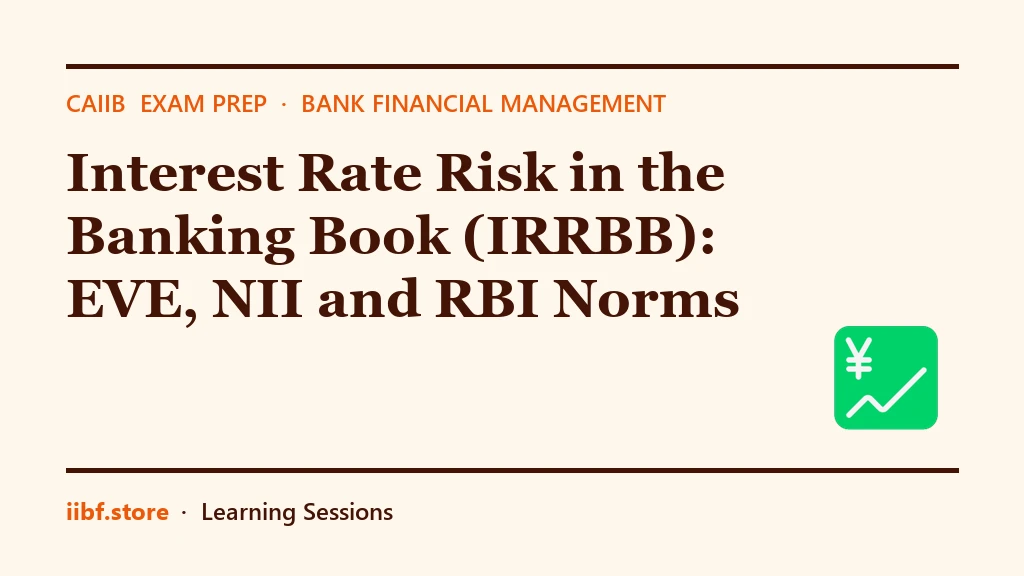
Banks do not simply measure IRRBB and report it — ALCO uses the output to decide on hedging and balance-sheet strategy. Common responses include lengthening or shortening the duration of the investment book, using interest rate swaps to convert fixed-rate exposures to floating (or vice versa), adjusting deposit pricing to attract stickier tenors, and re-pricing loan products off benchmarks that better match the funding mix. For banks with meaningful cross-border business, IRRBB analysis must be run currency by currency because rate cycles in India, the US and the Eurozone rarely move in sync; a book that looks balanced on a blended basis can hide a significant EVE exposure in a single foreign currency. This is why treasury teams handling correspondent banking relationships and NRI deposit books, as covered in the chapter on Correspondent Banking and NRI Accounts, must layer currency-wise IRRBB limits on top of their overall gap limits. Sound IRRBB governance also depends on broader enterprise risk discipline — just as banks must report cyber incidents within tight regulatory windows under the framework explained in our CAIIB ITDB guide to cyber incident reporting for banks, IRRBB breaches of Board-approved limits typically trigger similarly time-bound escalation to ALCO and the Risk Management Committee.

🧠 Practice MCQs: Interest Rate Risk in the Banking Book (IRRBB)
Q1. Interest rate risk in the banking book primarily arises from which of the following positions? (a) Positions held in the trading book for short-term profit (b) Loans, deposits and investments held in the banking book (c) Only foreign currency trading positions (d) Only derivative positions used for speculation
Answer: (b) — IRRBB relates to banking-book instruments like loans, deposits and held-to-maturity investments, not trading-book positions.
Q2. A bank funds a five-year fixed-rate loan with a three-month deposit. Which component of IRRBB does this best illustrate? (a) Basis risk (b) Optionality risk (c) Repricing risk (d) Currency risk
Answer: (c) — The mismatch in the timing of repricing between a long-tenor asset and a short-tenor liability is repricing risk.
Q3. Economic Value of Equity (EVE) measures the impact of interest rate changes on: (a) Next year's reported net interest income only (b) The present value of the bank's net worth over the full life of its instruments (c) The bank's foreign exchange trading profit (d) The bank's fee-based income
Answer: (b) — EVE discounts all future cash flows of assets and liabilities to estimate the change in the present value of equity.
Q4. Under RBI's IRRBB framework, which capital pillar primarily addresses interest rate risk in the banking book? (a) Pillar 1, through a fixed risk-weighted capital charge (b) Pillar 2, through the ICAAP and supervisory review (c) Pillar 3, through public disclosure alone (d) IRRBB is excluded from the Basel capital framework
Answer: (b) — IRRBB is assessed under Pillar 2 via ICAAP rather than a standard Pillar 1 capital charge, though supervisors may still require additional capital.
Q5. A loan reprices off MCLR while the deposit funding it reprices off a repo-linked rate, both at similar intervals. This mismatch is an example of: (a) Repricing risk (b) Basis risk (c) Yield curve risk (d) Optionality risk
Answer: (b) — Basis risk arises when instruments reprice at similar times but are linked to different reference rates.
Want chapter-wise mock tests with 100+ MCQs? Start practising free →
❓ Frequently Asked Questions on IRRBB
What is the difference between IRRBB and market risk in the trading book?
IRRBB covers banking-book instruments like loans and deposits that are usually held to maturity and assessed under Pillar 2 via ICAAP, while trading-book market risk covers positions held for short-term profit and is capitalised separately under Pillar 1.
Why do banks need both NII and EVE measures for IRRBB?
NII sensitivity captures near-term earnings impact while EVE captures long-term value impact; the two can move in opposite directions, so relying on only one measure can miss a significant part of the bank's true rate exposure.
What is optionality risk in IRRBB?
Optionality risk arises from embedded options such as loan prepayment or early withdrawal of term deposits, which change a bank's expected cash flows exactly when interest rate movements make that behaviour more likely.
How does RBI expect banks to manage IRRBB?
RBI expects banks to measure both EVE and NII sensitivity across defined rate shock scenarios, report the results to ALCO and the Board as part of the ICAAP, and hold additional Pillar 2 capital if the measured exposure is judged material.
IRRBB is a recurring, high-weightage topic across CAIIB Bank Financial Management, and the EVE-versus-NII distinction alone accounts for several marks in most attempts. Reinforce the concept alongside related risk measures such as our guides on earnings at risk in banks and basis point value in bond portfolios, and check your liquidity-side fundamentals with our liquidity coverage ratio guide. Browse every Bank Financial Management article on the BFM topic hub, then lock in the concept with a full CAIIB BFM course or a quick round of chapter-wise practice tests.
Quick quiz on this topic
5 exam-style questions from our free test bank — check yourself before you move on.
Practice this topic
Take a free mock test, download chapter PDFs, or watch a video class — all included on iibf.store.
Keep reading