Flexible Inflation Targeting Framework: How RBI Sets the 4% Target

Every CAIIB candidate preparing the Central Banking Elective must master the flexible inflation targeting framework that has anchored India's monetary policy since 2016. Under this framework, the Reserve Bank of India targets Consumer Price Index (CPI) inflation at 4%, with a tolerance band of plus or minus 2 percentage points, giving the Monetary Policy Committee (MPC) room to look through short-term supply shocks while still holding a hard, legally binding target. This article explains the legal basis, the MPC's structure, the tolerance-band mechanics, the accountability provisions, and how India's approach compares with rigid inflation-targeting regimes elsewhere.
📊 What Is Flexible Inflation Targeting?
Flexible inflation targeting (FIT) is a monetary policy regime in which a central bank commits to a numerical inflation target but is given explicit room — through a tolerance band and escape clauses — to look past temporary, supply-side price shocks rather than chase every fluctuation with interest-rate changes. India moved to this regime on the recommendation of the Urjit Patel Committee (2014), which found that a clear, publicly announced target would anchor inflation expectations far better than the earlier multiple-indicator approach. The Government of India and the RBI signed a Monetary Policy Framework Agreement in February 2015, and Parliament gave it statutory teeth by amending the RBI Act, 1934 to insert a new Chapter III-F (Sections 45ZA to 45ZO), effective from mid-2016. For the underlying institutional design, read the chapter on functions of central banks, which sets out price stability as a core central-banking objective before this framework is layered on top.
💡 Exam Tip: Section 45ZA of the RBI Act is the single most quoted section on this topic — remember that the inflation target is fixed by the Central Government, in consultation with the RBI, once every five years, not by the RBI alone.
🎯 The 4% Target and the Tolerance Band
The flexible inflation targeting framework fixes the target at 4% CPI inflation, with an upper tolerance limit of 6% and a lower tolerance limit of 2%. The 4% figure is the number the MPC is judged against; the band exists precisely because headline CPI in India is heavily weighted toward food and fuel, which can swing sharply for reasons monetary policy cannot control — a poor monsoon or a global crude spike, for instance. The Act requires the target and band to be reviewed at least once every five years. Every review conducted so far has retained the same 4% mid-point and the same ±2% band, which tells you how central this number is to India's policy credibility — do not assume it changes without an explicit government notification. Students revising the broader toolkit RBI uses around this target should also work through Theory and Practice of Central Banking, which covers the instruments side of the same story.
🏛️ The Monetary Policy Committee and Its Accountability
The MPC is a six-member statutory body: three RBI representatives — the Governor (who chairs it), the Deputy Governor in charge of monetary policy, and one RBI officer nominated by the Central Board — and three external members appointed by the Central Government on the recommendation of a search-cum-selection committee. Decisions are taken by majority vote, with the Governor holding the casting vote in the event of a tie. The MPC must meet at least four times a year and is required to publish its resolution and, subsequently, the minutes of its meeting, which is what makes the framework transparent rather than a closed-door exercise. Accountability is written into the law itself: if CPI inflation stays outside the 2–6% band for three consecutive quarters, the RBI is deemed to have failed to meet the target and must send a report to the Central Government under Section 45ZN explaining the reasons for the failure, the remedial actions it proposes, and an estimate of the time period within which the target will be restored. This governance layer sits on top of the broader liquidity and reserve functions covered in Liquidity Management in the System.
⚠️ Common Mistake: Candidates often assume "flexible" means the target itself can shift or be ignored. It cannot — the 4% target remains legally binding; only the band width and the escape clause for genuine supply shocks make the regime "flexible" rather than rigid.
🌐 Global Practice and India's Distinct Approach
Inflation targeting was pioneered by New Zealand in 1990 and has since been adopted, in varying forms, by dozens of central banks. Some regimes are closer to "strict" or "rigid" inflation targeting — a single point target with little formal tolerance for deviation, forcing the central bank to react to almost every shock. India's framework was deliberately designed as flexible from the outset: the explicit band, the five-year review cycle, and the statutory escape clause for supply-driven inflation all give the MPC space to also weigh growth and financial-stability concerns, rather than treating inflation control as the only variable that matters. This is consistent with the broader theme covered in Contemporary Issues in Central Banking, where the trade-off between price stability and growth objectives recurs across jurisdictions. For candidates also revising Rural Banking, it's worth noting that financial-inclusion channels such as the business correspondent model operate alongside — not in conflict with — this monetary framework, since transmission of policy rates ultimately has to reach the last-mile borrower.
🛠️ How RBI Operationalises the Target
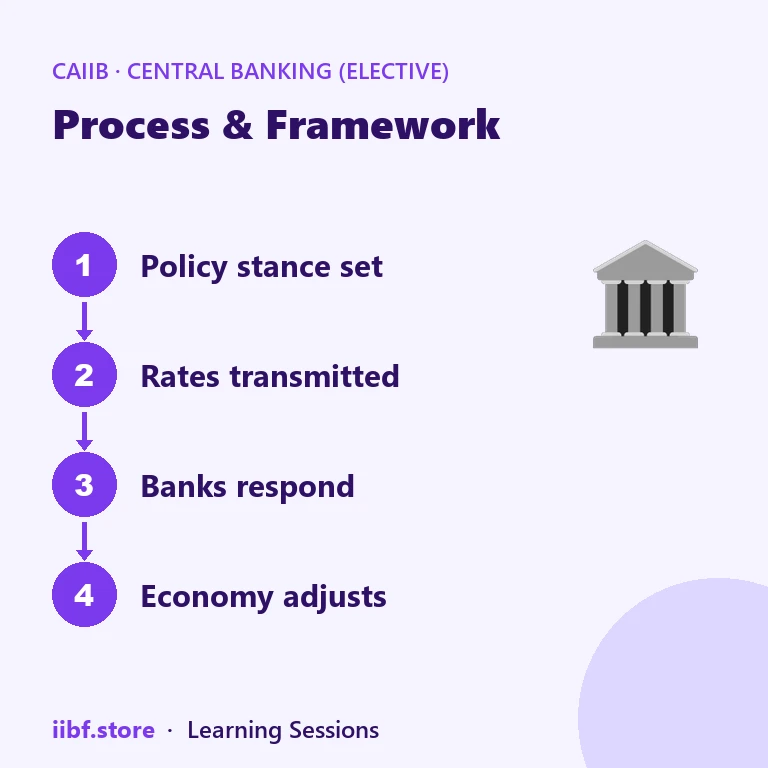
Setting a target on paper is only half the job; RBI transmits it through the Liquidity Adjustment Facility (LAF), using the repo rate as its main policy instrument and a corridor built around the Standing Deposit Facility and Marginal Standing Facility rates. Day-to-day liquidity is fine-tuned through tools such as variable rate repo auctions, which let RBI inject or absorb liquidity at market-discovered rates rather than a fixed rate, keeping short-term money-market rates aligned with the repo rate. On the government-securities side, primary dealers in government securities help transmit policy signals into the bond market by underwriting and market-making in G-Secs, which in turn affects the yield curve that banks price loans against. Without this transmission chain, a 4% target announced by the MPC would remain a number on paper rather than something that actually shows up in lending rates.
📌 Remember: The MPC has 6 members — 3 from RBI (Governor + Deputy Governor + one RBI nominee) and 3 external members appointed by the Government. A tie is broken by the Governor's casting vote.
⚖️ Rigid vs Flexible Inflation Targeting: Quick Comparison
| Feature | Rigid Inflation Targeting | India's Flexible Framework |
|---|---|---|
| Single fixed point, no formal band | ✔ | ✘ |
| Explicit tolerance band (2%–6% around 4%) | ✘ | ✔ |
| Statutory escape clause for food/fuel shocks | ✘ | ✔ |
| Legally mandated review at least every 5 years | Varies | ✔ |
| Report to government if target missed 3 straight quarters | Varies | ✔ |
🧠 Practice MCQs: Flexible Inflation Targeting Framework
Q1. Under Section 45ZA of the RBI Act, who fixes India's inflation target? (a) The RBI Governor alone (b) The Central Government in consultation with the RBI (c) The Monetary Policy Committee (d) Parliament, by a fresh Act each time
Answer: (b) — The inflation target is determined by the Central Government in consultation with the RBI, once every five years.
Q2. What is the inflation target and tolerance band under India's flexible inflation targeting framework? (a) 2% fixed, no band (b) 4%, with a band of 2% to 6% (c) 6% fixed, no band (d) 5%, with a band of 4% to 6%
Answer: (b) — The target is 4% CPI inflation with an upper tolerance of 6% and a lower tolerance of 2%.
Q3. How many members does the Monetary Policy Committee have? (a) 3 (b) 4 (c) 6 (d) 9
Answer: (c) — The MPC has 6 members: 3 from the RBI and 3 external members appointed by the Government.
Q4. RBI is deemed to have failed to meet the inflation target if CPI stays outside the tolerance band for how many consecutive quarters? (a) 2 (b) 3 (c) 4 (d) 6
Answer: (b) — Failure is triggered by average inflation remaining outside the band for three consecutive quarters.
Q5. If RBI fails to meet the target, its report to the Central Government under Section 45ZN must cover all of the following EXCEPT: (a) Reasons for failure (b) Remedial actions proposed (c) Time period for restoring the target (d) A recommendation to replace the Governor
Answer: (d) — The report covers reasons, remedial steps and a time estimate for restoring the target; it does not touch personnel matters like the Governor's tenure.
Want chapter-wise mock tests with 100+ MCQs? Start practising free →
❓ Frequently Asked Questions
What is flexible inflation targeting?
It is a monetary policy regime where the central bank commits to a numerical inflation target but is allowed a tolerance band and escape clauses for supply-side shocks, instead of chasing every price fluctuation.
When did India adopt the flexible inflation targeting framework?
The Monetary Policy Framework Agreement was signed in February 2015, and it was given legal backing through a 2016 amendment to the RBI Act, 1934 that also created the Monetary Policy Committee.
What is the current inflation target and tolerance band?
The target is 4% CPI inflation, with a tolerance band of plus or minus 2 percentage points, meaning inflation between 2% and 6% is considered within the acceptable range.
What happens if RBI misses the inflation target?
If average inflation stays outside the 2–6% band for three consecutive quarters, RBI must send a report to the Central Government explaining the reasons for failure, the remedial steps proposed, and the expected time to restore the target.
The flexible inflation targeting framework is one of the most frequently tested topics in the Central Banking Elective, precisely because it ties together the legal provisions, the MPC's governance structure, and RBI's operational tools into one coherent story. For the official articulation of India's monetary policy objectives, see the Reserve Bank of India's website. Once you're comfortable with the concepts above, reinforce them with full-length mocks on the CAIIB course page and browse more topics on the Central Banking Elective tag hub.
Quick quiz on this topic
5 exam-style questions from our free test bank — check yourself before you move on.
Practice this topic
Take a free mock test, download chapter PDFs, or watch a video class — all included on iibf.store.
Keep reading