Ethics in Banking Exam Date 2026: Full IIBF Prep Guide
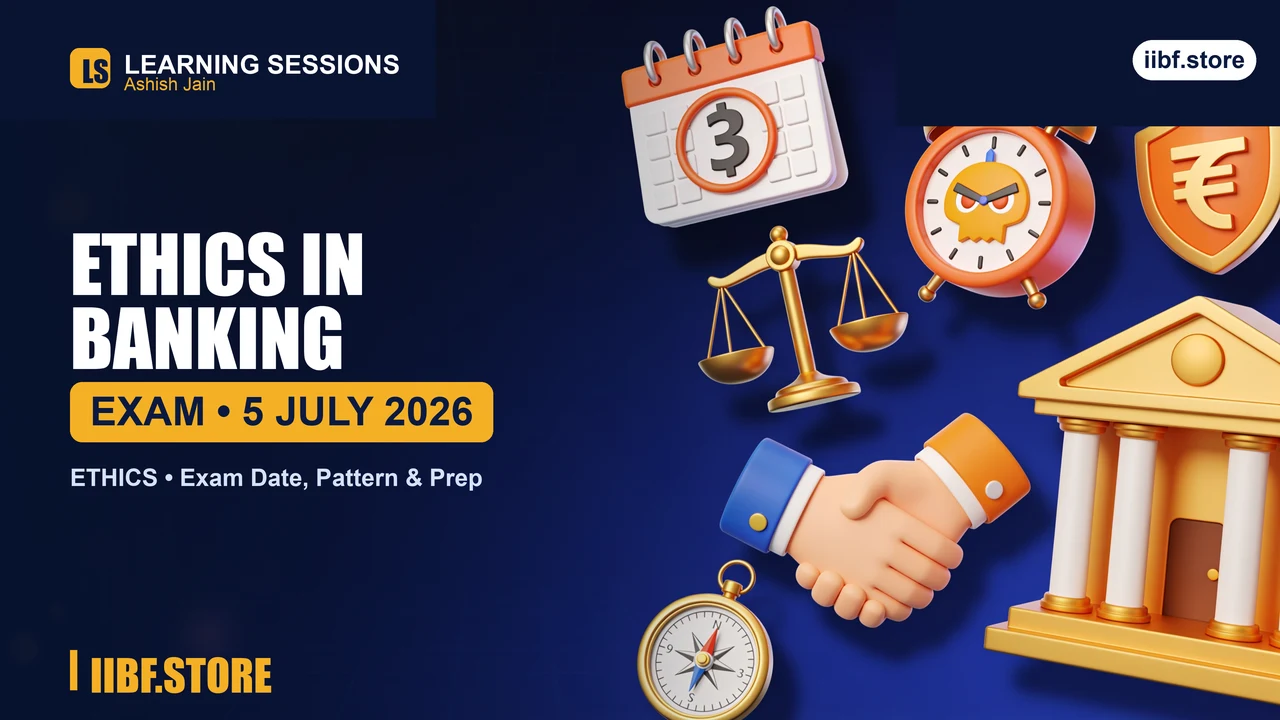
The Ethics in Banking exam date is one of the first things every candidate hunts for the moment they decide to chase this credential, so let us settle it up front: as per the latest released IIBF schedule, the Certificate in Ethics in Banking is set for 5 July 2026, with the next sitting on 3 January 2027. Always confirm both on the official IIBF notification before you lock your plan. This is a single, focused, objective paper rather than a sprawling multi-subject course, which means a disciplined six-to-eight-week run is usually enough to walk in genuinely ready.
Ethics has quietly become one of the most career-defining areas in modern banking. Regulators, boards, auditors and customers all now expect bankers to demonstrate conduct, fairness and accountability, not just product knowledge. The Certificate in Ethics in Banking is IIBF's way of letting you prove, on paper, that you understand the integrity standards the industry runs on. In this guide we map every date that matters, what the paper actually tests, a realistic week-by-week study plan anchored to your Ethics in Banking exam date, the mistakes that quietly cost marks, and the free resources that keep your prep on target.
Key takeaways
- As per the latest released IIBF schedule, the Ethics in Banking exam date is 5 July 2026; the following window is 3 January 2027.
- Registration typically opens around April 2026 through your IIBF login — apply early and confirm fees on the official notification.
- The paper is objective and scenario-driven; it rewards judgment and application, not rote definitions.
- A steady six-to-eight-week plan with weekly mock tests is enough for most candidates to clear it first attempt.
- Always reconfirm dates, duration, question count and marking on the official IIBF notification before exam day.
When is the Ethics in Banking exam in 2026?
As per the latest released IIBF schedule, the Ethics in Banking exam date for the Certificate in Ethics in Banking is 5 July 2026. Because this is a fixed-date paper rather than an on-demand one, you should treat 5 July as a hard anchor and plan everything backwards from it. If that window does not suit your other commitments, the next sitting falls on 3 January 2027 — but the sooner you certify, the sooner the credential lands on your resume and starts working for you.
The short, single-paper nature of this certificate is genuinely an advantage. You are not juggling four subjects across several months; you are preparing one well-defined syllabus. The real trick is to start early enough that you are revising in the final fortnight rather than still reading fresh material. Confirm the exact date, reporting time and duration on the official IIBF website before you finalise anything, since dates can occasionally shift.
Why the Ethics in Banking certificate matters
Ethics is no longer treated as a "soft" topic in banking. After successive waves of conduct, mis-selling and governance episodes across the financial sector, integrity has moved to the centre of how banks recruit, promote and assess people. Earning the Certificate in Ethics in Banking signals three things clearly to employers and seniors.
- Career signal: it shows you take governance, customer protection and fair conduct seriously — qualities that increasingly influence postings in compliance, audit and relationship roles.
- Daily relevance: the concepts map directly onto KYC, fair-practices codes, whistle-blowing and conflict-of-interest situations you already meet at the branch and desk level.
- Foundation value: the ethics knowledge you build here resurfaces across JAIIB, CAIIB and most compliance certifications, so the effort compounds.
Clear it once and you carry both the credential and the mindset through the rest of your banking career. If you want a deeper view of the underlying themes, our companion piece on corporate governance and ethical conduct in banking connects the syllabus to real boardroom practice.
Registration: do not miss the window
Registration for the July sitting typically opens around April 2026. The process itself is straightforward, but a few practical reminders save a lot of last-minute grief.
- You usually apply through your IIBF member or institutional login, so sort out portal access well before the window opens.
- Apply early in the window — the portal is busiest in the final days, and slow uploads cause avoidable errors.
- Keep your photo, signature and payment method ready in the correct formats to avoid upload rejections.
- Review the examination-centre options and pick one you can reach comfortably on exam morning.
- Reconfirm the exact registration window and fee on the official IIBF notification, as these can change slightly between cycles.
Once you have registered, your Ethics in Banking exam date stops being abstract and your countdown begins in earnest.
What the Ethics in Banking paper actually tests
The exam is an objective, multiple-choice paper built to reward understanding over memory. Expect a healthy share of scenario and application questions drawn from the core ethics syllabus, which typically spans four broad areas. Confirm the current number of questions, duration and passing marks on the latest IIBF notification, since these specifics can be revised between cycles.
- Ethics, business ethics and values: what ethics means, why it matters in finance, and how personal and organisational values shape decisions.
- Ethics at the workplace: professional conduct, conflicts of interest, fairness to colleagues and customers, and day-to-day behaviour standards.
- Banking ethics and corporate governance: the role of the board, transparency, disclosure, accountability and the governance architecture of a bank.
- Ethical dimensions and dilemmas: real-world situations involving whistle-blowing, customer protection, fair practices and the grey areas where there is no clean answer.
The smarter move is to know this syllabus cold. You can read our full Ethics in Banking syllabus guide and download the official syllabus PDF to map every chapter before you start. For the dilemma-heavy portions, our guide to the IIBF Ethics: whistle-blower mechanism in Banks is especially useful, because whistle-blowing scenarios appear repeatedly in this paper.
Ethics in Banking 2026 at a glance
Here is a quick reference table for the details candidates ask about most. Treat every time-sensitive figure as provisional and reconfirm it against the official IIBF notification.
| Detail | What to know |
|---|---|
| Certificate | Certificate in Ethics in Banking (IIBF) |
| Exam date | 5 July 2026 (fixed-date paper) — confirm on official notification |
| Next sitting | 3 January 2027 |
| Registration | Opens around April 2026 via IIBF login |
| Format | Objective MCQ, scenario and application focused |
| Ideal prep window | 6–8 weeks of steady study with weekly mocks |
| Questions, duration, marks | Reconfirm on the latest IIBF notification |
Your week-by-week plan to the Ethics in Banking exam date
Roughly six to eight weeks out from 5 July 2026, the schedule below keeps the pressure low while making sure you peak at the right time. Anchor every phase to your Ethics in Banking exam date so the final fortnight is pure revision, not first contact with the material.
- Weeks 1–2 — Foundations: cover what ethics, business ethics and values mean in a banking context. Build crisp definitions, because this is the vocabulary the entire paper leans on.
- Weeks 3–4 — Workplace and governance: work through workplace ethics and corporate governance. Tie each idea to a concrete banking example so the concept actually sticks.
- Weeks 5–6 — Dilemmas and practice: study ethical dilemmas and case-style situations, and begin one timed mock test every weekend to build exam stamina.
- Final week — Revision only: re-read weak topics, run quick one-liner recaps, take repeated mocks, sleep well and absorb no new material.
Tip: If you only have four weeks, compress the reading phase to about two-and-a-half weeks but protect a clean week-plus for mocks. Never sacrifice the mock-test phase — that is where scenario instincts are built.
To make practice efficient, lean on the platform's Ethics in Banking mock tests for timed, exam-pattern questions with instant explanations, and use the matching games to drill governance terms and ethical concepts until recall becomes automatic. You can also browse every guide for this paper on our Ethics in Banking blog hub.
Common mistakes to avoid
Most candidates who underperform on this paper lose marks for predictable reasons rather than gaps in effort. Watch for these four traps.
- Treating it as pure theory: the paper tests judgment. Practise applying principles to scenarios instead of only reciting definitions.
- Confusing ethics with law: an action can be perfectly legal yet clearly unethical. Examiners love that distinction, so learn to spot it quickly.
- Skipping case-style questions: dilemma questions carry real weight, and reading alone will not prepare you. Attempt them under timed conditions.
- Cramming the final week: ethics rewards reflection. Spread your preparation so the last days are revision, not your first read of a module.
Exam-day checklist
On the morning of 5 July, small habits protect your score. Run through this quick checklist.
- Carry your printed admit letter and a valid photo ID.
- Reach the centre early — aim for around 45 minutes before reporting time.
- Read each scenario fully; ethics distractors are deliberately close, so do not skim.
- Pick the most ethical option, not merely a defensible one — questions often hide the best answer among several reasonable ones.
- Watch the clock, bank roughly a minute per question, and flag tricky dilemmas for review.
- Confirm any negative-marking rules on the latest IIBF notification and your admit letter beforehand.
July 2026 or January 2027 — which sitting should you pick?
If you are reading this with a few months in hand, the 5 July 2026 sitting is usually the practical choice. The April registration window gives you a comfortable runway to read, revise and run mocks without rushing. The January 2027 date suits candidates who are mid-cycle on other IIBF papers and prefer to slot ethics in later.
Either way, the strategy is identical: choose the date you can realistically prepare for, register on the first day the window opens, and ring-fence your mock-test week. Pushing the date back later only resets your momentum, so commit early and hold the plan. If you are weighing this against another IIBF certification, our overview of IIBF preventive vigilance and fraud management can help you sequence your year sensibly.
Frequently Asked Questions
What is the Ethics in Banking exam date in 2026?
As per the latest released IIBF schedule, the Certificate in Ethics in Banking is set for 5 July 2026. If you miss that window, the next available sitting is 3 January 2027. Always reconfirm the exact date on the official IIBF notification, since dates can occasionally shift between cycles.
When does registration for the Ethics in Banking exam open?
Registration for the July sitting generally opens around April 2026. You apply through your IIBF member or institutional login, so arrange portal access in advance. Confirm the precise registration window and applicable fee on the official IIBF notification before you pay.
Is there negative marking in the Ethics in Banking exam?
Marking rules can vary by paper and by cycle, so do not assume. Always confirm whether negative marking applies on the latest IIBF notification and on your admit letter before exam day. Planning your time around a roughly one-minute-per-question pace is a safe default either way.
Is the Ethics in Banking certificate difficult to clear?
It is a focused, single-paper certificate that most candidates clear with six to eight weeks of steady preparation. The key is practising scenario and dilemma questions rather than only reading theory. Treat it seriously but without anxiety; the syllabus is well defined and very manageable.
What does the Ethics in Banking syllabus cover?
It broadly covers ethics and values, workplace ethics, banking ethics and corporate governance, and ethical dimensions and dilemmas. You can read our complete Ethics in Banking syllabus guide or download the official syllabus PDF to map every chapter. Knowing the syllabus thoroughly is the fastest route to a confident attempt.
How should I prepare for the Ethics in Banking exam?
Start about six to eight weeks before your Ethics in Banking exam date, build the core vocabulary first, then move into governance and dilemma practice. Add one timed mock test each weekend and keep the final week purely for revision. Use Learning Sessions mock tests, matching games and notes to stay aligned to the exact syllabus.
Final word
The 5 July 2026 Ethics in Banking exam date will arrive faster than it looks once April registration opens, so lock the date, register on time, and work a steady six-to-eight-week plan instead of a final-week sprint. Start with the syllabus, layer in mock tests and one-liners, and drill the dilemma-style questions until your judgment feels automatic. Do that and you will clear the Certificate in Ethics in Banking on your first attempt — and add a credential that says, plainly, that you do banking the right way.
Related Guides
📚 Free Learning Sessions resources — connect & crack your exam
- 📝 Free mock tests — chapter-wise, exam-pattern, with instant solutions
- 🎮 Matching games — gamified revision of key terms & concepts
- 📄 Study notes & PDFs — downloadable chapter material
- 🎥 Video classes on YouTube — subscribe to @learningsessions
💬 Want the full course? WhatsApp your course name to 8360944207 and our team will set you up.
📱 Study on the go — get our iOS & Android app at iibf.store/app.
Quick quiz on this topic
5 exam-style questions from our free test bank — check yourself before you move on.
Practice this topic
Take a free mock test, download chapter PDFs, or watch a video class — all included on iibf.store.