GST Rates 2026 for JAIIB AFM: Chapter 30 Module D Updates
Part 2 of the AFM GST class picks up where the basics stop, and it lands on the thing candidates keep getting wrong: the slab structure changed, and the old four-rate picture in many notes is out of date. If you are still revising 12 percent and 28 percent as live slabs, this session is for you. The GST rates 2026 position is different, and Chapter 30 of Module D is written against the current one.
JAIIB AFM GST Part 2, Chapter 30 Module D crash course · Watch on YouTube
Below, the same material laid out as a revision sheet. Use the video for the walkthrough and this page for the numbers you need to carry into the hall. Every figure quoted here reflects the GST rates 2026 position, not the pre-reform slabs.
What changed, and when
The 56th GST Council meeting overhauled the rate structure, effective 22 September 2025, in what is widely called the GST 2.0 reform. The twelve percent and twenty-eight percent slabs were largely dismantled. Most goods that sat at twelve percent moved down to five percent or up to eighteen percent. Most of the twenty-eight percent basket moved to eighteen percent. A new forty percent rate was created for a narrow list of luxury and sin goods, including tobacco products and pan masala.
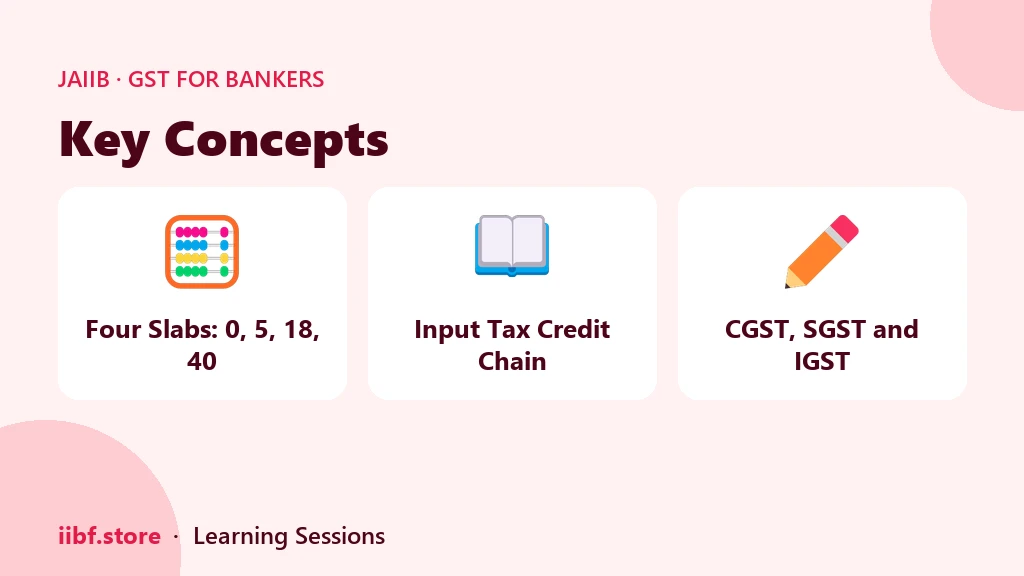
So the working structure behind GST rates 2026 is four rates: nil, five percent, eighteen percent, and forty percent. Two of those carry nearly everything. Five percent covers essentials and mass consumption. Eighteen percent has become the standard rate for most goods and services. Nil covers exempt and zero-rated supplies. Forty percent is a deliberate outlier.
The four components, and which one applies
GST is one tax collected under four heads, and the head depends on where the supply moves. This is the single most reliable source of objective questions in the chapter.
| Component | Levied by | Applies when | Example |
|---|---|---|---|
| CGST | Central Government | Intra-state supply, charged together with SGST | Bank in Maharashtra bills a customer in Maharashtra |
| SGST | State Government | Intra-state supply, charged together with CGST | Same transaction, state half |
| IGST | Central Government, shared with destination state | Inter-state supply, imports, and supplies to or from an SEZ | Branch in Delhi bills a customer in Haryana |
| UTGST | Union Territory | Intra-UT supply, in place of SGST | Supply within Chandigarh |
Under the GST rates 2026 structure the component split did not change at all, only the percentages sitting on top of it. The rule to memorise is short. One supply attracts either CGST plus SGST, or IGST. Never all three. If a question shows all three on a single invoice line, that is the error you are being asked to spot.
Input tax credit, the part that decides the marks
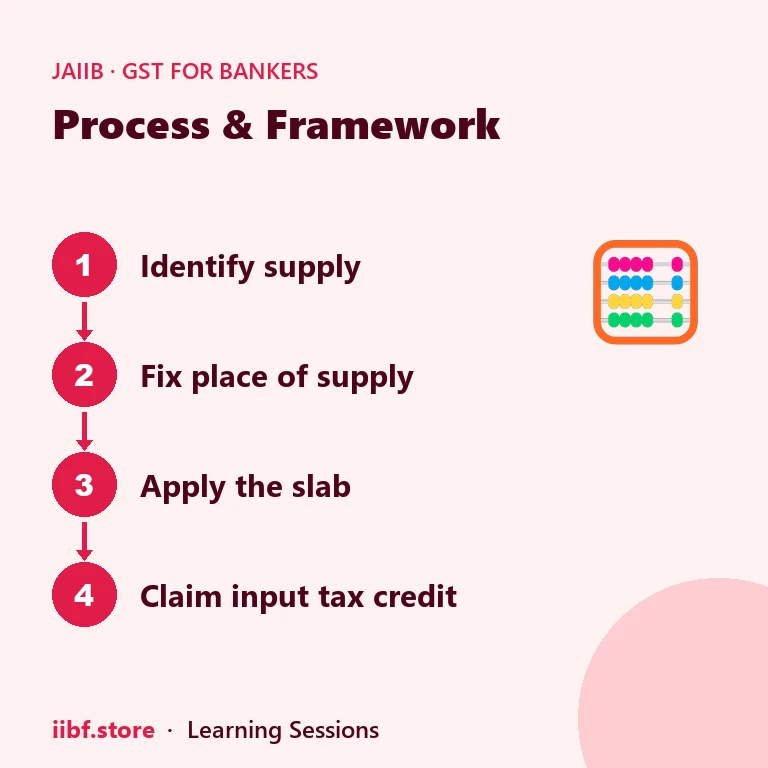
GST is a value added tax, and input tax credit is the mechanism that makes it one. A registered person pays tax on inputs, collects tax on outputs, and remits only the difference. Break the chain and the tax stops being a value added tax and becomes a cost.
Four conditions must all hold before credit can be claimed. The recipient must hold a tax invoice or an equivalent document. The goods or services must have been received. The supplier must have actually paid the tax to the government. And the recipient must have filed the relevant return. Miss any one and the credit fails.
Then learn the set-off order, because numericals live here. IGST credit is used first against IGST liability, then against CGST, then against SGST. CGST credit goes against CGST and then IGST, and can never be set off against SGST. SGST credit goes against SGST and then IGST, and can never be set off against CGST. That last pair, the cross-utilisation bar between CGST and SGST, is the trap in most set-off sums.
A worked set-off you can copy
Suppose output liability for the month is IGST Rs 40,000, CGST Rs 30,000 and SGST Rs 30,000. Available credit is IGST Rs 50,000, CGST Rs 20,000 and SGST Rs 20,000.
Start with IGST credit. Rs 40,000 clears the IGST liability in full, leaving Rs 10,000 of IGST credit. Apply that Rs 10,000 to CGST, reducing CGST liability to Rs 20,000. IGST credit is now exhausted. Use CGST credit of Rs 20,000 against the remaining CGST liability, which clears it. Use SGST credit of Rs 20,000 against SGST liability of Rs 30,000, leaving Rs 10,000 payable in cash. Total cash outgo is Rs 10,000.
Try the same sum with the cross-utilisation bar forgotten and you would wrongly wipe the SGST liability with leftover CGST credit and report nil cash. That single error is the difference between full marks and zero on a four-mark question.
Why AFM cares, and how it is asked
Chapter 30 sits in Module D because bankers meet GST from both sides. A bank is a supplier of services and charges GST on fees, commissions, locker rent and processing charges, so it must know the slab and the place of supply. A bank is also a lender assessing borrowers whose working capital cycle is shaped by GST timing, because tax is paid on the invoice date while cash may arrive much later.
Expect three question types. Direct rate and component questions on the GST rates 2026 structure. Eligibility questions on input tax credit conditions. And small set-off numericals like the one above. Interest is not typically charged to GST, but fee-based income is, and that distinction is worth a mark on its own.
Verify anything rate-specific against a primary source before you rely on it, because the Council revises rates more often than textbooks are reprinted. Read the current position on the Reserve Bank and government portals rather than trusting an old PDF. Then drill it: the JAIIB course page maps Module D chapter by chapter, and the mock tests will tell you within twenty minutes whether the set-off order has actually stuck. Keep a weekly revision slot in the planner for tax topics specifically, because they decay faster than accounting standards do.
What are the GST slabs after the 2025 reform?
The working structure is four rates: nil, five percent, eighteen percent and forty percent. The twelve and twenty-eight percent slabs were largely removed with effect from 22 September 2025.
Can CGST credit be used against SGST liability?
No. Cross-utilisation between CGST and SGST is barred. CGST credit may be used against CGST and then IGST only, and SGST credit against SGST and then IGST only.
Which supplies attract IGST?
Inter-state supplies, imports, and supplies to or from a special economic zone. Intra-state supplies attract CGST plus SGST instead, or CGST plus UTGST in a union territory.
Does a bank charge GST on interest?
Interest on loans and deposits is generally outside the tax net, but fee-based income such as processing charges, locker rent and commission is taxable. AFM questions often turn on exactly this split.
Rewrite your Chapter 30 sheet against the GST rates 2026 slabs before your next mock, because an outdated slab list quietly costs marks on questions you actually understand. Update your notes to the current structure, practise two set-off sums a week, and Chapter 30 becomes one of the easier scoring blocks in AFM. More AFM breakdowns are on the blog.
Quick quiz on this topic
5 exam-style questions from our free test bank — check yourself before you move on.
Practice this topic
Take a free mock test, download chapter PDFs, or watch a video class — all included on iibf.store.
Keep reading