CAIIB BFM Treasury Management: Chapter 18 Module C Simplified
Chapter 18 of Module C is where a lot of CAIIB candidates quietly lose marks. Not because treasury management is hard, but because it is taught as a list of desks and products with no story holding them together. This class fixes that. Watch it once, then use the framework below to lock the chapter down for good.
CAIIB BFM Treasury Management, Chapter 18 Module C crash course · Watch on YouTube
The trick with treasury management is to stop memorising and start following the money. A rupee enters the bank, sits somewhere, earns something, and carries a risk while it sits. Treasury is the department that decides where it sits. Everything in the chapter hangs off that one sentence.
Why a bank needs a treasury at all
A branch network raises deposits and makes loans. Those two flows never match, not by amount, not by tenor, not by currency. Deposits arrive short and loans go out long. Some money comes in dollars and goes out in rupees. Somebody has to sit in the middle and square the mismatch every single day. That somebody is treasury.
So treasury has three jobs. It keeps the bank liquid, so payments settle and reserve requirements are met. It manages the mismatches, so a rate move or a currency move does not blow a hole in the balance sheet. And it earns a return on surplus funds, because idle cash is a cost. Liquidity, risk, return. In that order, because a bank that chases return before liquidity does not survive to enjoy it.
Front office, mid office, back office
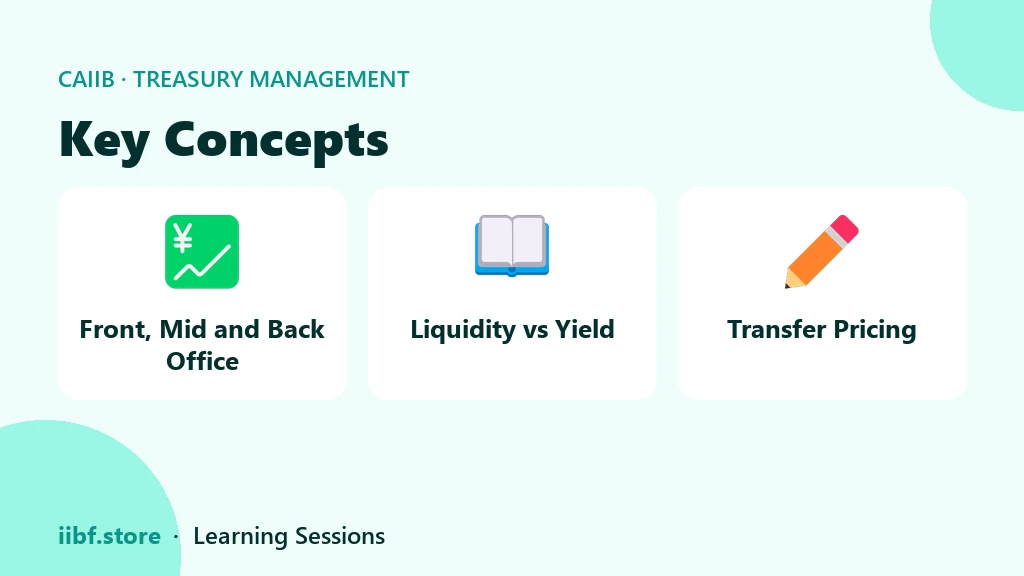
This is the highest-yield topic in the chapter, and it is pure segregation of duties. The person who takes the risk must not be the person who measures it, and neither may be the person who settles it.
| Office | Who sits there | What it does | Reports to |
|---|---|---|---|
| Front office | Dealers and traders | Quotes prices, executes deals, runs positions within limits | Head of Treasury |
| Mid office | Risk analysts | Sets and monitors limits, marks positions to market, measures VaR and duration, reports breaches | Risk function, independent of treasury |
| Back office | Settlement staff | Confirms deals, settles funds and securities, reconciles nostro accounts, maintains records | Operations |
Two exam points follow. The mid office reports outside the treasury chain, which is the whole point of independence. And every famous trading loss in banking history traces back to one of these three walls being breached, usually a dealer who also controlled confirmation or reconciliation. If a question describes a control failure, look for the merged role.
What treasury actually deals in
Treasury products split by market. In the money market you have call and notice money, term money, treasury bills, certificates of deposit, commercial paper, repo and reverse repo. In the securities market you have government securities and state development loans, held in the SLR portfolio and beyond it. In the forex market you have spot, forward and swap transactions, plus currency futures and options. And across all three sit derivatives: interest rate swaps, forward rate agreements and options used to hedge or to position.
Classification of the investment portfolio is examined constantly, so keep the current buckets straight: held to maturity, available for sale, and fair value through profit and loss, along with the valuation treatment that follows each. The classification decides where a price move lands, in the profit and loss account or in reserves, and that is exactly what a question will probe.
Transfer pricing and the link to ALM
Here is the idea most candidates skip and most examiners like. Funds transfer pricing is the internal rate at which treasury buys money from deposit-raising units and sells it to lending units. It exists so that branch profitability is measured on spread, not on luck.
Without transfer pricing, a branch that happens to sit in a low-cost deposit market looks brilliant and a branch funding long-tenor loans looks poor, regardless of how well either is run. With it, treasury absorbs the interest rate risk of the mismatch and each unit is judged on what it controls. That is why treasury management and asset liability management are two halves of one subject, and why the Asset Liability Committee, or ALCO, is the body that receives treasury's reporting.
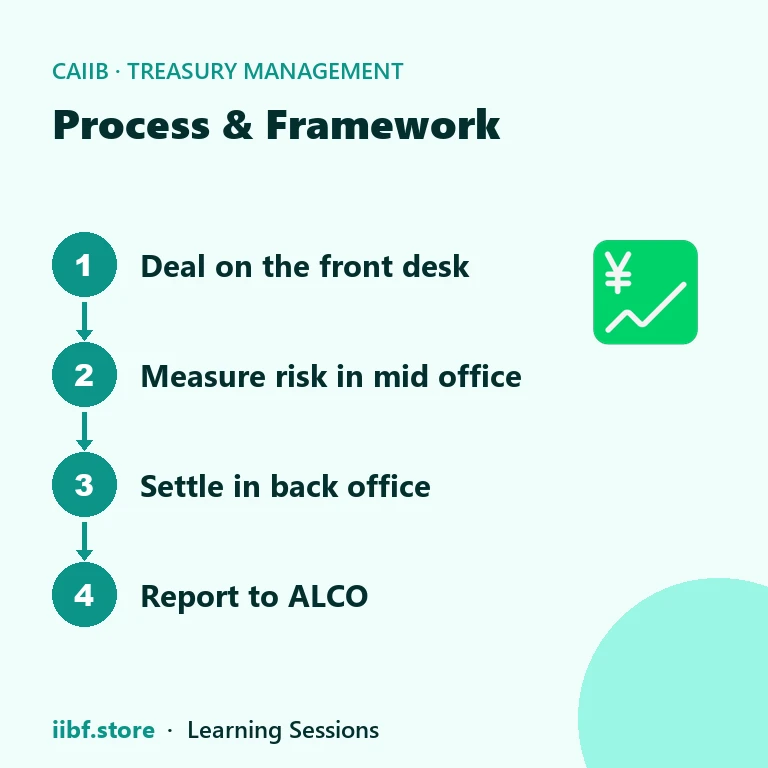
ALCO sets the tolerance. Treasury operates inside it. The mid office reports the breaches. Draw that triangle on your revision sheet and half the chapter becomes obvious. For a broader view of how the module fits together, the CAIIB course page maps Module C against the rest of the paper.
Risk measures you must be able to name
Four measures carry most of the marks. Value at Risk estimates the worst loss over a holding period at a confidence level. Duration measures price sensitivity to a change in yield. Modified duration converts that into a percentage price move per one percent yield move. And PV01, sometimes written DV01, gives the rupee change in value for a one basis point move in yield.
Know what each one answers. VaR answers how bad a normal bad day is. Duration answers how sharply this bond moves. PV01 answers how many rupees a single basis point costs on the current book. Questions often give you a scenario and ask which measure applies, rather than asking you to compute. Read the verb in the question and match it to the measure.
Alongside these, keep the regulatory anchor in view. The Reserve Bank's framework on interest rate risk in the banking book and its investment classification norms are the live rulebook behind the chapter, and updates arrive more often than textbooks do. The RBI website is the primary source; do not take a coaching slide as final on a number.
A revision routine that works
Give this chapter three passes. First pass, the three-office table until you can rebuild it from memory. Second pass, the product list grouped by market, said out loud. Third pass, the risk measures with one sentence each. Thirty minutes a pass, three days apart, and the chapter stays.
Then convert it to marks. Attempt a mixed set rather than a chapter-wise set, because in the real paper treasury management questions arrive interleaved with ALM and risk questions and the switching is what costs time. Timed practice on the mock tests page is the fastest way to build that switching muscle, and a weekly slot in the study planner keeps the revision honest.
Why must the mid office be independent of treasury?
Because it measures and limits the risk the front office takes. If it reported to the same head, limit breaches could be suppressed by the person whose desk caused them. Independence is the control.
What is the difference between duration and PV01?
Duration is a sensitivity expressed in years or, once modified, as a percentage price change per one percent yield change. PV01 expresses the same idea in rupees for a one basis point move, so it is directly usable on a live book.
What does funds transfer pricing achieve?
It charges lending units and pays deposit units at an internal rate, so each unit is measured on the spread it controls while treasury absorbs the mismatch risk centrally.
How is treasury linked to ALCO?
ALCO sets the risk tolerances and the balance sheet strategy. Treasury executes within them, and the mid office reports positions and breaches back to ALCO. Strategy, execution, feedback.
Get the structure right and the products stop feeling like a list. Follow the money, remember the three walls, and this chapter turns into free marks. More BFM breakdowns are on the blog.
Quick quiz on this topic
5 exam-style questions from our free test bank — check yourself before you move on.
Practice this topic
Take a free mock test, download chapter PDFs, or watch a video class — all included on iibf.store.
Keep reading