ECLGS 5.0 and NPA Accounts: Who Actually Qualifies in 2026
The question in this short is the one every credit officer hears across the counter: my account slipped, can I still get ECLGS 5.0? It is asked hopefully, and the honest answer disappoints people. But the rule behind that answer is clean, it is examinable, and once you see the logic you will never forget it. ECLGS 5.0 is a guarantee scheme, not a rescue scheme, and that single distinction decides the whole eligibility question.
NPA account and ECLGS 5.0 eligibility explained · Watch on YouTube
Watch the clip first, then read on. Below we take the same question and open it out into the full framework you need for CAIIB Advanced Bank Management, because the examiner will not ask you the yes-or-no. The examiner will ask you why.
What ECLGS 5.0 actually is
The Emergency Credit Line Guarantee Scheme began in May 2020 as a pandemic measure. Its fifth version, notified with operational guidelines dated 8 May 2026, is a different animal. It is aimed at borrowers who need additional working capital headroom, and at scheduled passenger airlines, which are carried as a separate category with their own limits.
The mechanics are simple. Your bank lends. The National Credit Guarantee Trustee Company, or NCGTC, guarantees that loan. If the borrower fails, the guarantee absorbs the loss. The bank takes no fresh collateral, charges no processing fee, and pays no guarantee fee. That is why the scheme is attractive to lenders and why the eligibility gate has to be tight.
The NPA question, answered
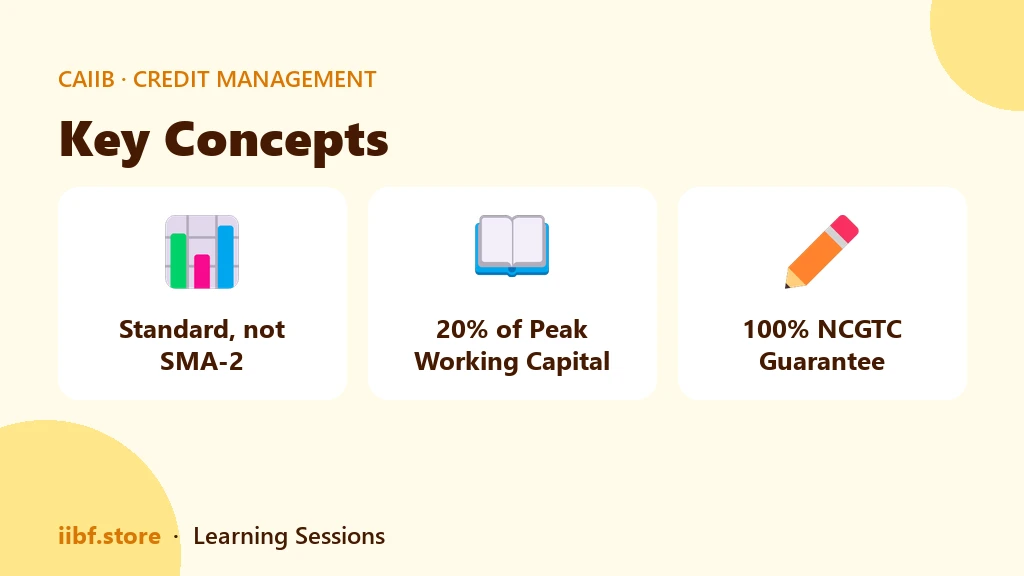
Here is the gate. The borrower account must not be classified as NPA with any lender at the time of sanction and at the time of disbursement. Separately, the credit facilities must have been standard, excluding SMA-2, as on 31 March 2026.
Read that as two tests, not one. The first is a status test on a fixed past date. The second is a live test on the day money moves. A borrower can clear the 31 March 2026 cut-off and still fail if the account has since slipped. A borrower who was already NPA on the cut-off date fails immediately.
Notice what the rule does not say. It does not say SMA-0 and SMA-1 are barred. They are not. An account that is overdue but still standard, and not in SMA-2, remains inside the gate. That is a deliberate design choice. The scheme reaches stress before it becomes default, which is exactly where a guarantee does useful work. Once an account is NPA, the loss is already crystallising, and a fresh guaranteed loan would simply move that loss onto the guarantor. No credit guarantee scheme in India is written that way.
Quantum, cover and pricing at a glance
Three numbers decide the size of the facility, and they differ by borrower class. Learn the table, not the paragraph.
| Parameter | MSME | Non-MSME | Scheduled passenger airline |
|---|---|---|---|
| Quantum | Up to 20% of peak fund-based working capital outstanding in Q4 FY 2025-26 | Up to 20% of peak fund-based working capital outstanding in Q4 FY 2025-26 | Up to 100% of peak credit outstanding, fund and non-fund based |
| Cap per borrower | Rs 100 crore | Rs 100 crore | Rs 1,500 crore |
| Guarantee cover | 100% | 90% | 90% |
| Tenor | 5 years including 1 year moratorium | 5 years including 1 year moratorium | 7 years including 2 year moratorium |
| Interest ceiling | EBLR + 0.75%, capped at 9% p.a. | MCLR + 0.75%, capped at 9% p.a. | As per non-MSME pricing |
| Collateral / fees | Nil additional security, nil processing fee, nil guarantee fee | Same | Same |
The scheme runs until 31 March 2027, or until guarantees totalling Rs 2,55,000 crore have been issued, whichever comes first. That second condition matters. A scheme can close early on corpus exhaustion, and questions love testing whether you noticed the word whichever.
Two pricing details reward attention. MSMEs are benchmarked to EBLR, while non-MSMEs are benchmarked to MCLR. If your grip on those two benchmarks is shaky, fix that before the exam, because the difference between an external benchmark and an internal cost-based benchmark is a favourite one-mark trap. Our RBI rates reference page keeps the current policy numbers in one place.
A worked example you can reuse
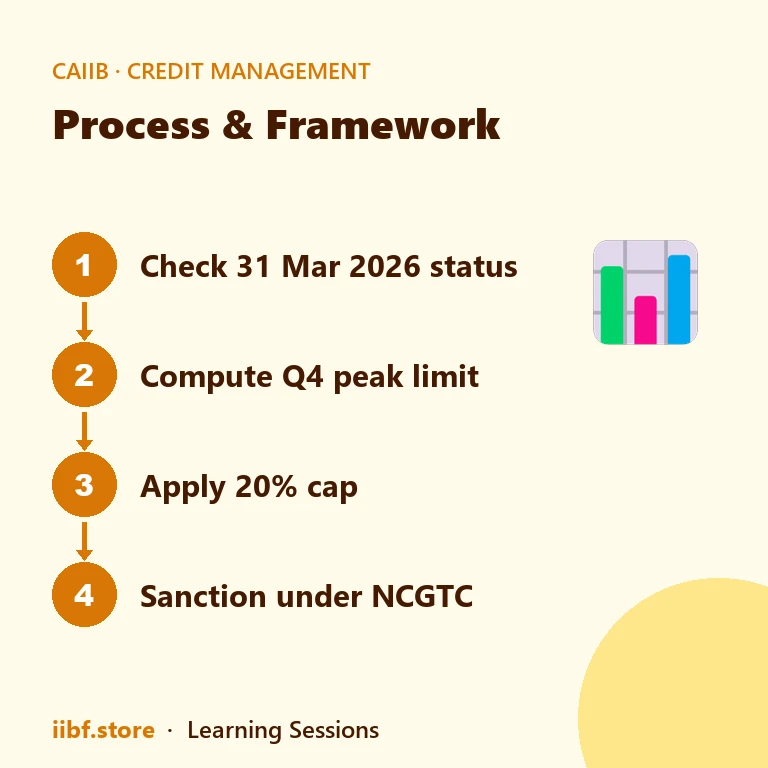
Take a manufacturing MSME. Its fund-based working capital outstanding peaked at Rs 8 crore during January to March 2026. The account was standard on 31 March 2026 and is in SMA-1 today, thirty days overdue, but not NPA.
Eligible quantum is 20% of Rs 8 crore, which is Rs 1.6 crore. The Rs 100 crore cap does not bite. Guarantee cover is 100% because the borrower is an MSME. Interest is EBLR plus 0.75%, and if that sum crosses 9% the ceiling pulls it back to 9%. Tenor is five years with the first year as moratorium, so repayment of principal begins in year two.
Now change one fact. Suppose the account turned NPA last week. Everything above collapses. Not because the quantum changed, but because the gate closed. That is the whole lesson of the video in one line: eligibility is tested at sanction and again at disbursement, and NPA status at either moment is fatal.
How this shows up in CAIIB ABM
Module B of Advanced Bank Management is credit management, and guarantee schemes sit naturally beside working capital assessment and asset classification. Expect three shapes of question. First, a direct eligibility question of the kind the short asks. Second, a numerical asking you to compute quantum from a peak outstanding figure. Third, a comparison question placing ECLGS 5.0 against CGTMSE or the older ECLGS versions.
Prepare for all three by memorising the table above and by keeping the asset classification ladder fresh: standard, SMA-0, SMA-1, SMA-2, then substandard, doubtful and loss. The scheme cuts the ladder between SMA-1 and SMA-2, which is an unusually precise cut and therefore a very likely question. You can drill classification quickly in our match-the-pairs game, and test yourself properly on the CAIIB ABM course page.
One habit worth building. Whenever a scheme is announced, write down five things: who is eligible, the cut-off date, the quantum formula, the guarantee percentage, and the sunset date. Those five carry almost every objective question ever set on a government credit scheme. For ECLGS 5.0 you now have all five, sourced and current. Keep a scheme sheet running through your preparation and revise it weekly using the study planner.
For the underlying policy language, the operational guidelines are published by lenders and by the guarantee trustee; the Reserve Bank's own master directions on income recognition and asset classification remain the reference for the NPA definitions the scheme leans on. Read the scheme rule and the classification rule together, because ECLGS 5.0 borrows its vocabulary directly from the latter.
Can an NPA account get ECLGS 5.0?
No. The borrower account must not be NPA with any lender at the time of sanction and at the time of disbursement. The facilities must also have been standard, excluding SMA-2, as on 31 March 2026.
Is an SMA-1 account eligible?
Yes, provided it is still a standard asset and was standard and not SMA-2 on 31 March 2026. The scheme bars SMA-2 and NPA, not every overdue account.
How much can an MSME borrow under the scheme?
Up to 20 percent of the peak fund-based working capital outstanding during the January to March 2026 quarter, subject to a maximum of Rs 100 crore per borrower.
When does the scheme close?
It runs until 31 March 2027 or until guarantees worth Rs 2,55,000 crore have been issued, whichever happens earlier. Corpus exhaustion can therefore close it before the calendar date.
Short clip, long rule. That is usually how credit works. Keep the five-point scheme sheet, keep the classification ladder sharp, and read more updates on the Learning Sessions blog.
Quick quiz on this topic
5 exam-style questions from our free test bank — check yourself before you move on.
Practice this topic
Take a free mock test, download chapter PDFs, or watch a video class — all included on iibf.store.
Keep reading