Mis-selling in Banks: Right to Suitability and the Ombudsman Route
The short does not teach a formula. It confesses. Month-end, targets pending, phone full of missed calls, and then an elderly customer walks in who wants exactly one thing — a safe fixed deposit. "Mujhe risk nahi chahiye beta." He leaves with the FD and one more product he never asked for. Target complete. And the last slide is the honest one: achievement mila, guilt bhi. That is mis-selling, described from the inside, and it is worth taking seriously because it is also an examinable topic sitting in the customer service module of JAIIB PPB.
Banker confession · target pressure and mis-selling · Watch on YouTube
Mis-selling is not the same as a bad outcome
This distinction decides most exam questions and most complaint files, so start here. A market-linked product that fell in value is not automatically mis-selling — markets fall, and a customer who understood the risk and chose it anyway has no grievance. Mis-selling is about the process of the sale, not the performance of the product. It happens when any of the following is true:
- The product did not match the customer's stated need, risk appetite or time horizon.
- Material features — lock-in, charges, surrender value, the fact that returns are not guaranteed — were not properly disclosed.
- The customer was given the impression that the extra product was necessary to get the one they came for.
- The customer could not reasonably have understood what they were signing.
In the video, the third one is what actually happened. The FD was fine. Bundling a second product onto it, for a customer whose entire stated requirement was "no risk", is where the sale went wrong. Note that nobody lied. Mis-selling rarely requires a lie — it usually requires only silence in the right place.
The Right to Suitability is an actual rule, not a slogan
The RBI's Charter of Customer Rights sets out five rights for bank customers, and they are worth memorising in order because they are asked directly:
| # | Right | What it demands of the branch |
|---|---|---|
| 1 | Right to Fair Treatment | No discrimination on age, gender, religion or physical ability |
| 2 | Right to Transparency, Fair and Honest Dealing | Plain-language terms, no hidden charges, no misleading claims |
| 3 | Right to Suitability | Products must fit the customer's needs, financial circumstances and understanding |
| 4 | Right to Privacy | Customer information kept confidential |
| 5 | Right to Grievance Redress and Compensation | A working complaint channel, and compensation where due |
The third right is the one the confession breaks. It is not phrased as "try to be helpful". It requires the product to be appropriate to the customer's needs, assessed against their financial circumstances and their understanding. An elderly customer who says he does not want risk has told you his risk profile, his horizon and his comprehension level in one sentence. Any recommendation made after that has to survive all three filters.
Target pressure is a control failure, not a character flaw
It would be easy to read the short as a story about one weak moment. It is more useful to read it as a systems problem, because that is how a regulator reads it. When incentives are weighted almost entirely toward volume, when the daily target board is visible from the counter, and when nobody in the reporting line ever asks "was this sale suitable", mis-selling stops being an individual lapse and becomes the predictable output of the design.
That is why banks are expected to build controls around third-party product distribution rather than rely on goodwill: staff must be appropriately certified for the products they sell, the sale must be kept clearly separate from the customer's core banking request, and grievance data has to be reviewed rather than merely counted. The Internal Ombudsman mechanism exists precisely so that rejected complaints get a second look inside the bank before the customer ever needs to go outside it.
Three questions before any sale
- What did the customer actually come in for? Fix that answer in your head before opening any other product screen. In the video it was one word: FD.
- Would this product survive being explained fully? Say the lock-in, the charges and the words "returns are not guaranteed" out loud. If the sale dies at that sentence, it was never a sale — it was a complaint waiting to be filed.
- Would I put my own parent in this? Unscientific, but it is the test the banker in the short applied afterwards instead of before, which is exactly the wrong order.
What the customer can do — and the numbers changed this year
This is the part most candidates are still revising from outdated notes. The Reserve Bank – Integrated Ombudsman Scheme, 2026 came into force on 1 July 2026 and replaces the 2021 scheme. Complaints received before that date, and appeals from decisions under the old scheme, continue to be governed by RB-IOS 2021. Everything else now runs on the new numbers:
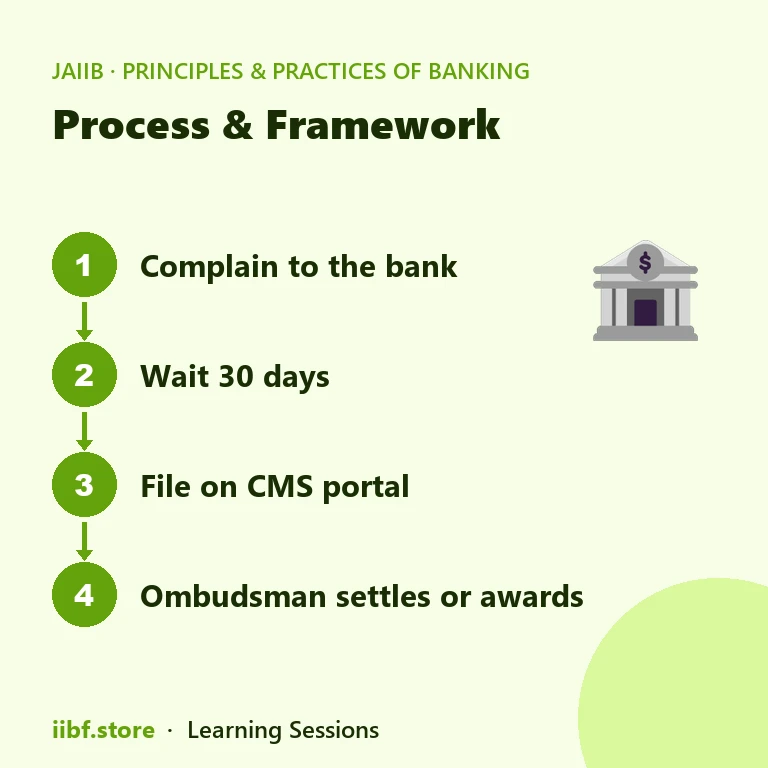
| Item | Position under RB-IOS 2026 |
|---|---|
| First step | Complain to the bank itself, with proof of having done so |
| Waiting period | 30 days, or the timeline specified by RBI, NPCI or the card network, whichever is higher |
| Filing window | Within 90 days of that timeline expiring, or of the bank's last communication, whichever is later |
| How to file | CMS portal, e-mail to CRPC, or a physical complaint to CRPC, Chandigarh |
| Fee | None |
| Compensation for consequential loss | Up to ₹30 lakh |
| Compensation for time, expenses, harassment | Up to ₹3 lakh |
| Helpline | Toll free 14448 |
Two boundaries matter for a mis-selling complaint specifically. First, the Ombudsman's jurisdiction runs on deficiency in service — a shortcoming or inadequacy in any service the bank is required to provide, which may or may not result in financial loss. A sale made without regard to suitability is argued on that footing. Second, matters relating to the commercial judgment or decision of a regulated entity are not maintainable, and a complaint disclosing no deficiency in service can be rejected at any stage. So "the fund did not perform" goes nowhere; "I was told this was a deposit and it was not" is a different case entirely. Current scheme documents and FAQs sit on the RBI complaints page.
How JAIIB PPB asks this
- Name the five customer rights. Straight recall, and Suitability is the one people forget.
- Which right was violated? A short case is given; you match it to fair treatment, transparency, suitability, privacy or grievance redress.
- Ombudsman timelines. The 30-day wait and the 90-day filing window, with the older one-year figure sitting in the options as a distractor.
- Compensation ceilings. ₹30 lakh and ₹3 lakh — both revised this year, so check that your source is current.
- Maintainability. Which complaints the Ombudsman will not entertain, with commercial judgment as the usual answer.
Customer service and grievance redress are among the most scoring parts of PPB because the answers are definitional rather than numerical. Drill them in our free JAIIB mock tests, keep the syllabus order straight on the JAIIB course page, and let the day-wise study planner put the customer service module somewhere it will actually get revised. Current rates and reference figures live on the RBI rates page, and more banking write-ups are in the blog archive.
Frequently asked questions
Is every loss-making investment a case of mis-selling?
No. It is judged on how the sale was made, not on how the product performed. If the need, risk and charges were properly assessed and disclosed and the customer chose knowingly, a subsequent fall in value is not a grievance.
Which customer right does an unsuitable product sale violate?
The Right to Suitability under the RBI's Charter of Customer Rights, which requires products to be appropriate to the customer's needs, financial circumstances and understanding. Where features were hidden as well, the Right to Transparency, Fair and Honest Dealing is breached too.
How long does a customer have to approach the RBI Ombudsman?
Under RB-IOS 2026 the complaint must first go to the bank. The Ombudsman can be approached after 30 days without a reply, or on dissatisfaction, and the complaint must be filed within 90 days of that timeline expiring or of the bank's last communication, whichever is later.
What compensation can the Ombudsman award?
Up to ₹30 lakh for consequential loss, plus up to ₹3 lakh for loss of time, expenses incurred and harassment or mental anguish. There is no limit on the disputed amount itself, and filing is free.
Quick quiz on this topic
5 exam-style questions from our free test bank — check yourself before you move on.
Practice this topic
Take a free mock test, download chapter PDFs, or watch a video class — all included on iibf.store.