IIBF ITF Exam Pattern: Module-Wise Weightage Guide
If you are preparing for IIBF's International Trade Finance certificate, the single biggest time-saver is understanding the IIBF ITF exam pattern before you open a single chapter. Most candidates read the whole study material cover to cover, in order, and run out of revision days on the modules that barely get tested.
This guide flips that habit. Instead of another generic syllabus list, we break the paper down module by module, show you which topics are asked most often, and point you straight to the chapters worth reading twice. Treat it as the study plan you build once and reuse right up to exam day.
📚 IIBF ITF Exam Pattern: What the Syllabus Actually Tests
The IIBF ITF exam pattern is built around six broad modules, moving from the trade environment to instruments, credit products, regulation, and risk. Module 1 sets the stage with the institutions that govern global trade, including the role of WTO and trade blocs and the facilitation bodies that support exporters and importers.
From there the paper moves into payment instruments, reimbursement mechanics, trade credit products, and finally the regulatory and risk layer. Each module builds on the previous one, so skipping the foundation module to jump straight to letters of credit usually backfires in the exam hall.
Exact question counts, marks distribution and passing criteria are revised by IIBF from time to time, so always cross-check the current pattern on the official IIBF website before you finalise your plan. What does not change as often is which modules dominate the question paper, and that is what the next section maps out.
🗂️ Module-Wise Weightage: Where to Focus Your Study Hours
Once you understand the IIBF ITF exam pattern, it becomes obvious that not every module deserves equal revision time. Based on how the syllabus is structured and how consistently topics recur across past papers, here is a practical weightage map you can use to plan your last three weeks before the exam.
| Module | Core Topics | Study Priority | Numerical Questions Likely |
|---|---|---|---|
| Module 1 – Trade Environment | WTO, trade blocs, facilitation bodies | High (foundation) | ❌ |
| Module 2 – Payment Instruments | Modes of payment, LC, bank guarantees | Highest | ✅ |
| Module 3 – Reimbursement & Collections | Uniform Rules for Reimbursement, documentary collection | Moderate | ✅ |
| Module 4 – Trade Credit Products | Factoring, forfaiting, ECGC cover | Moderate-High | ✅ |
| Module 5 – Regulatory Framework | DGFT, regulators of foreign trade | Moderate | ❌ |
| Module 6 – Risk & Compliance | Credit risk, trade-based money laundering | Growing emphasis | ❌ |
💡 Exam Tip: Modules 2 and 4 combined tend to carry the bulk of application-based questions, so practise numerical and scenario MCQs from these two modules first.
🌍 Module 1 and 5 Deep Dive: Trade Bodies, WTO and DGFT
Module 1 and Module 5 are often underrated because they feel like "general knowledge" rather than banking content. In practice, examiners like to test whether you can connect an institution to its actual function, not just recall its name.
Read the role of WTO and trade blocs chapter alongside the regulators of foreign trade chapter together. Both explain who sets the rules of international trade at the global and domestic level, and the exam often pairs them in a single case-based question.
The Director General of Foreign Trade (DGFT) chapter deserves special attention because DGFT administers India's Foreign Trade Policy and issues Importer-Exporter Codes, a fact that shows up repeatedly in objective questions. Do not treat this as a one-line definition to memorise; understand what DGFT actually does day to day for an exporter.
Similarly, revisit the facilitation bodies chapter with a simple table of your own: body name, one line on its role, and one example of when a bank would refer a client to it. This turns a dry list into something you can recall under exam pressure.
💳 Module 3 and 4 Deep Dive: Reimbursement, Factoring and Credit Risk
The Uniform Rules for Reimbursement chapter is short but heavily tested, because it sits at the intersection of letters of credit and correspondent banking. Read it right after you finish LC mechanics, not in isolation, since most questions test how a reimbursing bank acts on the issuing bank's authority.
Module 4 is where factoring and forfaiting live, and this is the single most confused topic pair in the entire ITF syllabus. The core distinction is recourse: factoring can be with or without recourse to the exporter, while forfaiting is almost always without recourse and covers medium to long-term receivables.
⚠️ Common Mistake: Candidates frequently swap the risk-bearing party in factoring versus forfaiting questions. Anchor the rule in your memory as "forfaiting removes the exporter from the risk chain completely."
Module 6 closes the loop with credit risk in trade transactions, which increasingly overlaps with compliance themes such as trade-based money laundering. If you are studying AML alongside ITF, it is worth revisiting record keeping obligations under PMLA, since examiners like to test how trade documentation and AML record-keeping rules intersect.
🧭 Building a Study Plan Around the ITF Weightage
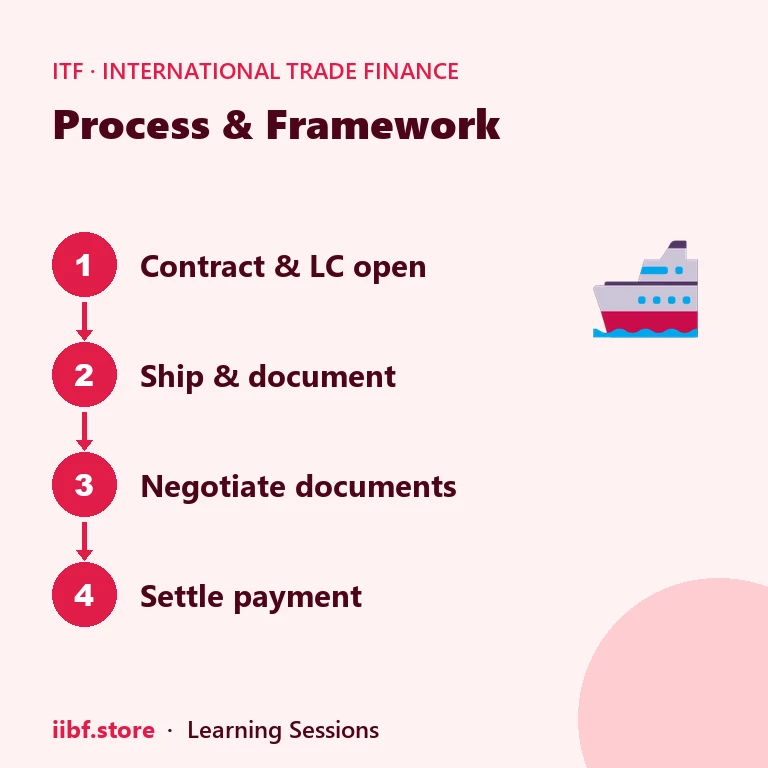
Once you know which modules carry more weight under the IIBF ITF exam pattern, sequence your revision instead of reading page by page. A workable three-week plan looks like this: week one covers Module 1 and Module 5 together since both deal with institutions and regulation; week two is entirely payment instruments and reimbursement, the highest-yield block; week three finishes with trade credit products and risk, then a full round of mixed mock questions.
If you have already read the broader IIBF International Trade Finance study material overview, use this article as the next layer, deciding how many hours to give each module rather than treating the syllabus as one flat list.
It also helps to study related products side by side. Compare URDG 758 Demand Guarantees against bank guarantee basics, and read up on post-shipment credit in export finance right after factoring and forfaiting, since all three sit under the same trade-finance-product umbrella and are easy to mix up under exam pressure.
📌 Remember: A weightage-based plan only works if you close each module with practice MCQs before moving to the next one. Reading without testing yourself will not stick under exam conditions.
For broader trade regulation updates that occasionally feed into ITF questions, keep an eye on RBI rate and policy updates and cross-check specific circulars on the RBI website when a chapter references a current rule.
🧠 Practice MCQs: IIBF ITF Exam Pattern and Module Weightage
Q1. In forfaiting, the risk of non-payment by the overseas buyer is ultimately borne by: (a) the exporter (b) the forfaiter, without recourse to the exporter (c) the advising bank (d) the DGFT
Answer: (b) — Forfaiting is a without-recourse product, so the forfaiter absorbs the payment risk once the receivables are purchased.
Q2. The Directorate General of Foreign Trade (DGFT) primarily administers: (a) India's monetary policy (b) India's Foreign Trade Policy and Importer-Exporter Codes (c) GST refund processing (d) exchange rate management
Answer: (b) — DGFT frames and implements the Foreign Trade Policy and issues IEC to exporters and importers.
Q3. The Uniform Rules for Reimbursement (URR) primarily govern the relationship between: (a) the buyer and the seller (b) the issuing bank and the reimbursing bank (c) the importer and customs authorities (d) the exporter and ECGC
Answer: (b) — URR sets out how a reimbursing bank honours a claim made by a claiming bank under the issuing bank's authorisation.
Q4. Under the ITF syllabus, the body responsible for global trade rules and dispute settlement among member nations is: (a) the WTO (b) the IMF (c) the FATF (d) the BIS
Answer: (a) — The World Trade Organization sets multilateral trade rules and administers dispute settlement between member countries.
Q5. Trade-based money laundering (TBML) most commonly relies on: (a) accurate, matching invoices (b) over-invoicing or under-invoicing of goods and services (c) cash smuggling only (d) domestic barter arrangements
Answer: (b) — TBML typically disguises illicit fund flows by misrepresenting the price, quantity or quality of traded goods on invoices.
Want chapter-wise mock tests with 100+ MCQs? Start practising free →
❓ Frequently Asked Questions
What is the exam pattern for IIBF's International Trade Finance certificate?
The IIBF ITF exam pattern is organised into modules covering the trade environment, payment instruments, reimbursement rules, trade credit products, regulation and risk. Exact question counts, marks and passing criteria change from time to time, so always confirm the current pattern from the official IIBF exam bulletin before your exam.
Which ITF module carries the most weightage in practice?
The payment instruments module, which covers letters of credit, bank guarantees and modes of payment, tends to generate the largest share of application-based and numerical questions, followed closely by the trade credit products module covering factoring and forfaiting.
Is International Trade Finance part of JAIIB or CAIIB, or a separate certificate?
IIBF offers International Trade Finance as a specialised certificate examination, distinct from the core JAIIB and CAIIB papers, though several CAIIB elective and advanced-banking topics overlap conceptually with trade finance products covered here.
How should I structure my revision using the module weightage?
Group modules by theme rather than reading in strict order: cover trade environment and regulation together first, spend the most time on payment instruments and reimbursement, and close with trade credit products and risk, testing yourself with MCQs after each block.
Getting the IIBF ITF exam pattern right is less about reading faster and more about reading the right modules harder. Use the weightage map above to rebuild your revision schedule, work through the linked chapters in order, and finish every module with a timed set of practice questions. For more module-wise breakdowns and updates, browse our full International Trade Finance article archive. When you are ready to test your recall across the full syllabus, explore CAIIB course resources or head straight to the mock test hub to start practising under real exam conditions.
Prefer revising from a printed book?
Chapter-wise books with MCQs after every chapter — minimal pages, complete coverage, delivered anywhere in India. Every book has a free sample to read first.









Practice this topic
Take a free mock test, download chapter PDFs, or watch a video class — all included on iibf.store.