Is the Digital Banking Book Right for You? An Honest Guide
It is 9:40 pm. You reached home late, the branch had a system slowdown, and tomorrow there is a target review. Somewhere in that evening you have decided to prepare for the Digital Banking certificate. The syllabus looks like a pile of cards, ATMs, apps and payment rails, and you do not know where to begin.
Before anything else: no single study material suits every candidate. So this is not a sales pitch. It is a plain guide to who the Digital Banking book helps, how each type of reader should use it, and where it will not be enough on its own. If you decide it is not for you, you will still leave with a plan.
First, what problem are you actually solving?
Most working bankers do not fail certificate exams because the content is too hard. They fail because of three quieter problems.
- Scattered sources. Notes from one place, a PDF from another, a video from a third. By week two you are managing material instead of studying it.
- No feedback. You read, you feel you know it, and you find out on exam day that you did not.
- Tired reading. After a full branch day, a 300-page tome is a wall. A short, structured text is a door.
Keep these three in mind. We will test every reader profile below against them. The question is simple: does this reader need one organised text, practice questions, or both?
What the printed book really contains
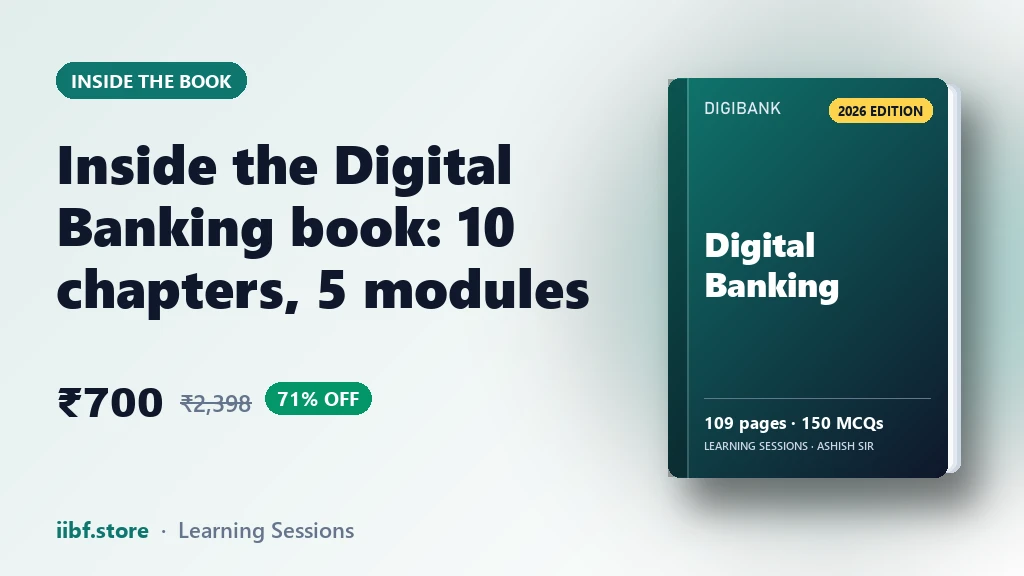
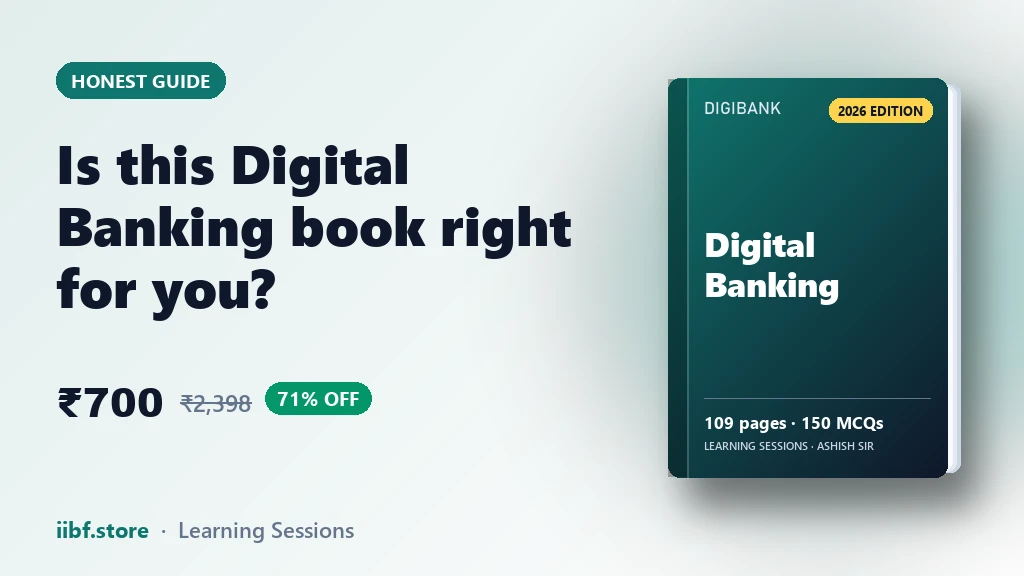
Here are the facts, so you can judge without guessing. The Digital Banking book is a 2026 edition printed book of 109 pages, split into 10 chapters across five modules.

The five modules
- Module A, Digital Banking Products: Digital Delivery Channels, Cards, Automated Teller Machines (ATMs), Mobile Banking, Internet or Online Banking, and POS Terminals. This is the biggest block, six of the ten chapters.
- Module B, Digital Banking and Financial Inclusion.
- Module C, Marketing of Digital Banking Products.
- Module D, Developments in Payment Systems in India and Digital Banking.
- Module E, Future Trends in Digital Banking.
The practice material
The book carries 150 questions. Alongside it come 30 case studies (120 questions) and 5 mega tests (500 questions). So the written content is compact, and a good share of the package is about testing yourself rather than only reading.
The listed price is ₹700 against an MRP of ₹2,398, which is 71% off. Prices can change, so the book page is always the current word.
Profile 1: You are attempting for the first time
You have never sat this paper. You may not even be sure how the questions are framed. Your risk is not difficulty but disorganisation.
How to use the Digital Banking book
Read it straight through once, one module at a time, without highlighting anything. The aim of the first pass is only to see the whole map: what a channel is, how cards work, where ATMs and POS fit, how mobile and internet banking differ. Because the text is 109 pages, a full first read is realistic in a couple of weeks of tired evenings.
On the second pass, underline definitions and lists. Digital banking papers love terms, features and distinctions, so a two-column note of "term and what it does" will pay off.
Where it is not enough
A first-timer has never felt the pace of the paper. Reading alone gives a false comfort. Start taking free mock tests at iibf.store/tests from the second week, even if your scores are low. Low scores early are information, not failure.
Profile 2: You have attempted before and want a cleaner route
You know the feeling of closing the answer sheet unsure. You have probably collected more material than you can finish. For you, the problem is usually too much, not too little.
How to use it
Do not start from page one. List the chapters where you lost marks last time, or where you honestly guess you did. Then use the Digital Banking book as a clean reference: read the weak chapters first, attack the chapter-end questions, and only then return to the chapters you feel good about.
The case studies matter most for you. A repeat candidate usually knows the facts but trips on the application. Working through the 30 case studies forces you to apply a product feature to a situation.
Where it is not enough
If you have failed twice with the same habits, a new book will not fix the habit. Fix the process: timed practice, an error log, and a fixed weekly slot. The five mega tests exist for exactly this. Treat them as exam rehearsals under a timer.
Profile 3: You are short on time
Maybe the exam cycle is close, or your branch is in an audit month. You do not have weeks. You have fragments of time.
How to use it
Ten chapters is a manageable unit. Think in chapters per evening instead of hours per week. A fragment-friendly split looks like this:
| Block | What to cover | Output |
|---|---|---|
| Block 1 | Module A: channels, cards, ATMs | One page of key terms |
| Block 2 | Module A: mobile, internet, POS | Comparison table of channels |
| Block 3 | Modules B and C | Five points per chapter |
| Block 4 | Modules D and E | List of developments and trends |
| Block 5 | Case studies and one mega test | Error log of wrong answers |
Stretch or shrink the blocks to match your days. Do not skip Block 5. A tired mind remembers what it was tested on far better than what it merely read.
Where it is not enough
Be honest with yourself: a book cannot create time. If you can give only a few evenings in total, cover the high-volume Module A first and use the free PDFs at iibf.store/free-material for quick revision. Also check the official schedule before you commit, on iibf.org.in.
Profile 4: You think better on paper than on screens
Many bankers stare at screens all day. Opening a PDF at night feels like more office work. If that is you, a printed copy is not a luxury, it is the difference between studying and not studying.
How to use it
Keep the printed Digital Banking book on your bedside or in your bag. Pencil in the margins, fold the corner of weak pages, and carry it on the commute. Paper also lets you flip back quickly, which matters when you want to compare, say, mobile banking against internet banking.
Where it is not enough
Paper cannot time you or score you. Mock tests live on screen, so plan for both: read on paper, test on a device. That split suits most tired readers well.
A simple four-step plan that works for all four profiles
Whichever profile you are, the same skeleton holds. Adjust the speed, not the order.

- Read one module at a time. Do not jump around in the first pass.
- Mark weak chapters. After each module, note what you could not explain in your own words.
- Solve case studies. Application is where marks are won or lost.
- Finish with mega tests. Time them, review every wrong answer, and repeat the weak chapters.
If you want more structured support beyond one text, the books section shows the other printed titles, and the blog carries study plans for other papers.
The honest limits
Let us be direct. This is a compact, 109-page text. It will give you structure and a sensible set of questions, but it will not give you exam-hall speed by itself, and it will not replace the official updates. Digital banking changes quickly, so use the official site for anything that must be current. Pair the book with timed practice, and you have a fair chance. Skip the practice, and even the best text only gives you a false sense of readiness.
Also remember that a book is a tool, not a result. The person who studies twenty minutes every night for a month will beat the person who buys three books and reads none.
So, is it right for you?
If you want one short, organised text, you are comfortable with printed pages, and you will actually do the case studies and mega tests, the Digital Banking book is a sound fit. If you need long video explanations or a live teacher, look at the course options instead, and use a book only as a companion. You can read the free sample on the book page and decide with the pages in front of you, which is the fairest test of all.
Frequently asked questions
Can I pass using only the book?
The book gives you structure and practice questions, but passing depends on your habits. Add timed mock tests and revise your error log. Treat the book as the core, not the whole plan.
How long does the book take to read?
It has 109 pages in 10 chapters. Most working candidates can finish a first read in a couple of weeks of evening study, then spend the remaining time on questions.
Is there a sample I can read first?
Yes. The book page offers a free sample, so you can judge the writing and layout before ordering.
Will the price stay at ₹700?
Prices can change. The book page always shows the current price against the MRP of ₹2,398.
Prefer revising from a printed book?
Chapter-wise books with MCQs after every chapter — minimal pages, complete coverage, delivered anywhere in India. Every book has a free sample to read first.


















































Quick quiz on this topic
5 exam-style questions from our free test bank — check yourself before you move on.
Practice this topic
Take a free mock test, download chapter PDFs, or watch a video class — all included on iibf.store.
Keep reading