Digital Banking Study Plan for Working Bankers: 14 Days, One Book
It is 9:40 pm. You have closed the branch, answered the last customer who walked in at closing time, eaten something quickly, and now the Digital Banking syllabus is sitting on the table looking much bigger than it did in the morning. If that is your evening, a Digital Banking study plan has to be built for that evening, not for a student with eight free hours.
This article gives you a plan you can actually follow: how to split the paper, how long to spend each night, how many questions to solve, and when to revise. You can use it with any good material. Where it helps, we will show how it maps onto one particular book, but the method matters more than the book.
Why a working banker needs a different plan
Most study advice assumes long, unbroken hours. You do not have them. What you have is 60 to 90 minutes on weekday nights, perhaps three or four hours on a Sunday, and a mind that has already done a full day of customer queries, targets and reporting.
That changes the design of the plan in three ways:
- Small units. One chapter per sitting. If a topic needs more than 90 minutes, you will not finish it on a tired night, so split it.
- Questions early. Reading without testing feels productive and fades by morning. Attempting questions the next day shows you what actually stayed.
- Built-in slack. You will miss days: a branch audit, a festival, a bad night's sleep. A plan with no spare day collapses the first time you slip.
One more point that bankers often miss: you already use most of this subject at work. Cards, ATMs, mobile banking, internet banking and POS terminals are things you handle every week. The exam asks you to put structure, terms and rules around what you already know. That is easier than learning from zero, so do not let the syllabus size scare you.
How the Digital Banking paper is organised
Before you plan days, plan the map. The Digital Banking content in the Digital Banking printed book is laid out in five modules and ten chapters over 90 pages (2026 edition):
Module A: Digital Banking Products (six chapters)
Digital Delivery Channels, Cards, Automated Teller Machines (ATMs), Mobile Banking, Internet or Online Banking, and POS Terminals. This is the heaviest module by chapter count, and it is the part most bankers find familiar.
Modules B to E (one chapter each)
- Module B: Digital Banking and Financial Inclusion
- Module C: Marketing of Digital Banking Products
- Module D: Developments in Payment Systems in India and Digital Banking
- Module E: Future Trends in Digital Banking
Notice the shape. Six chapters of product knowledge, then four shorter, more conceptual chapters. Your plan should spend its first week on Module A, because that is where the volume sits, and keep the second week for the four single-chapter modules, case studies and mock practice.
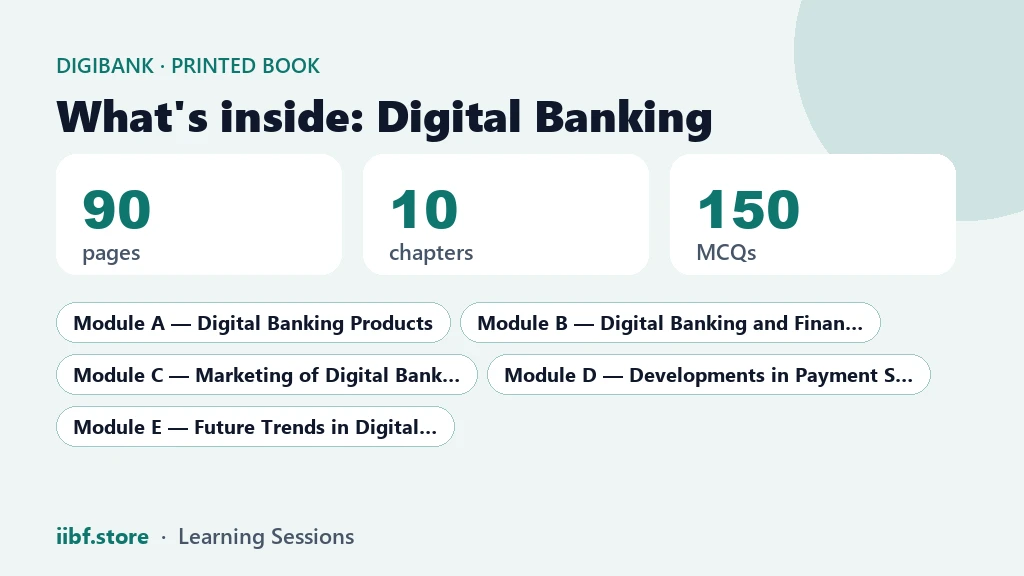
Besides the chapters, the book carries 150 MCQs, 30 case studies (120 questions) and 5 mega tests (500 questions). That is a lot of practice material for a 90-page text, and it is exactly why the plan below is question-led rather than reading-led.
The nightly routine: 75 minutes that actually work
Whatever material you use, keep each weeknight to the same simple shape. It removes the daily decision of what to do, which is half the battle when you are tired.
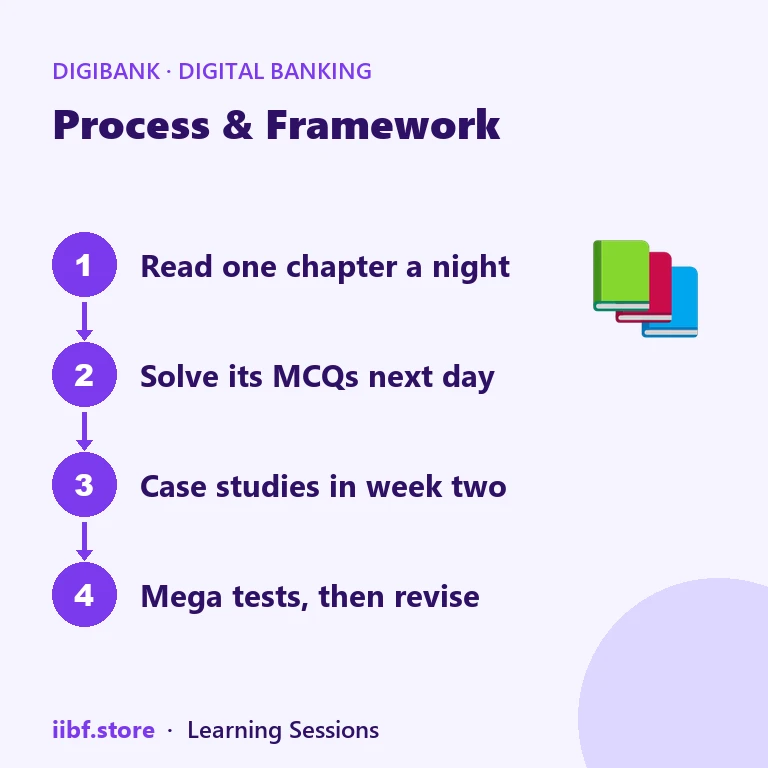
- 10 minutes: recall. Without opening the book, write three things you remember from yesterday's chapter.
- 40 minutes: read the new chapter once, with a pencil. Underline definitions, full forms, limits, and anything that has a list (types of cards, types of channels, features of a channel).
- 25 minutes: solve that chapter's MCQs while the reading is fresh, then mark what you got wrong.
The recall step feels awkward for the first two nights. Keep going. Pulling facts out of memory is what builds exam-hall speed; re-reading does not.
The 14-day Digital Banking study plan
Here is the full Digital Banking study plan in one table. It assumes about 75 minutes on weekdays and a longer block on weekends, and it keeps two buffer days for the things life throws at you. The 150 MCQs average out to roughly 15 per chapter across ten chapters; treat the MCQ column as a target, not a strict count.
| Days | What to read | MCQ target |
|---|---|---|
| Day 1 | Digital Delivery Channels | About 15, next evening |
| Day 2 | Cards | About 15, plus Day 1 errors |
| Day 3 | Automated Teller Machines (ATMs) | About 15 |
| Day 4 | Mobile Banking | About 15 |
| Day 5 | Internet or Online Banking | About 15 |
| Day 6 | POS Terminals | About 15 |
| Day 7 (Sunday) | Rest from new reading; redo every wrong MCQ from Module A | Wrong-answer redo only |
| Day 8 | Digital Banking and Financial Inclusion | About 15 |
| Day 9 | Marketing of Digital Banking Products | About 15 |
| Day 10 | Developments in Payment Systems in India and Digital Banking | About 15 |
| Day 11 | Future Trends in Digital Banking | About 15 |
| Day 12 | Case studies, first batch | Case-study questions, timed |
| Day 13 | Case studies, second batch, then your weak chapters | Timed set |
| Day 14 | One mega test, then review every error | One full mega test |
Why the order is what it is
Module A comes first because six chapters share vocabulary. Once you know the delivery channels, the cards and ATM chapters make more sense, and mobile and internet banking are easier to separate in your head. Financial inclusion, marketing, payment-system developments and future trends are shorter and more narrative, so they fit into the second week when your confidence is higher.
Day 7 deliberately has no new reading. Sit with the wrong answers from the first six chapters. Most candidates lose marks on the same few confusions (which channel does what, which limit applies where), and a single quiet Sunday hour fixes more than another chapter would.
How to use MCQs so they teach you
Solving questions is not the same as learning from them. Use this loop for every set:
- Attempt the set without looking at the text.
- Mark each wrong answer, and also each right answer you guessed.
- Go back to the chapter and find the exact line that settles each one.
- Write one short note per mistake, in your own words, on a single page labelled "my errors".
That "my errors" page becomes your last-night revision sheet. It will be far more useful than re-reading ninety pages, because it contains only what you get wrong.
If you want extra practice beyond any single book, the free mock tests on iibf.store and the free study material are worth using alongside your main text.
Handling case studies in the last week
Case studies feel heavier than MCQs because you must read a scenario, hold the facts in mind and then answer several linked questions. The 30 case studies in the book come with 120 questions, so you get four questions per scenario to practise on.
- Read the questions first, then the scenario. You will know what to look for.
- Time yourself. Set a limit per case and stick to it even in practice.
- When you get one wrong, check whether the mistake was in reading the scenario or in the underlying concept. They need different fixes.
Do not start case studies before you have covered the chapters. They test application, and application on half-learnt content only teaches you frustration.
Using mega tests as your dress rehearsal
The five mega tests carry 500 questions in total. Resist the urge to burn through all five in the first week. A mega test is useful only when you can review it properly, and a proper review takes as long as the test itself.
A sensible pattern: take the first one on Day 14 in a single sitting, early on a weekend morning if you can, with no phone and no notes. Spend the next day reviewing. Then, if you have more days before your exam, space the remaining tests out, one every two or three days, and review each before the next. The score matters less than the pattern of your errors.
What this plan will not do
A book and a schedule do not replace judgement. Be honest about the limits:
- The exam rules, syllabus and schedule are set by IIBF and can change. Check the official IIBF website for the current exam cycle, and use your own notes only after confirming them there.
- Reading a book alone will not give you exam-hall speed. Pair it with timed mocks, which is why the second week leans on practice.
- Fourteen days is a tight, focused target for someone who already works with these products. If digital channels are new to your role, stretch the plan to three weeks and keep the same order.
If you want the book that this plan is built around
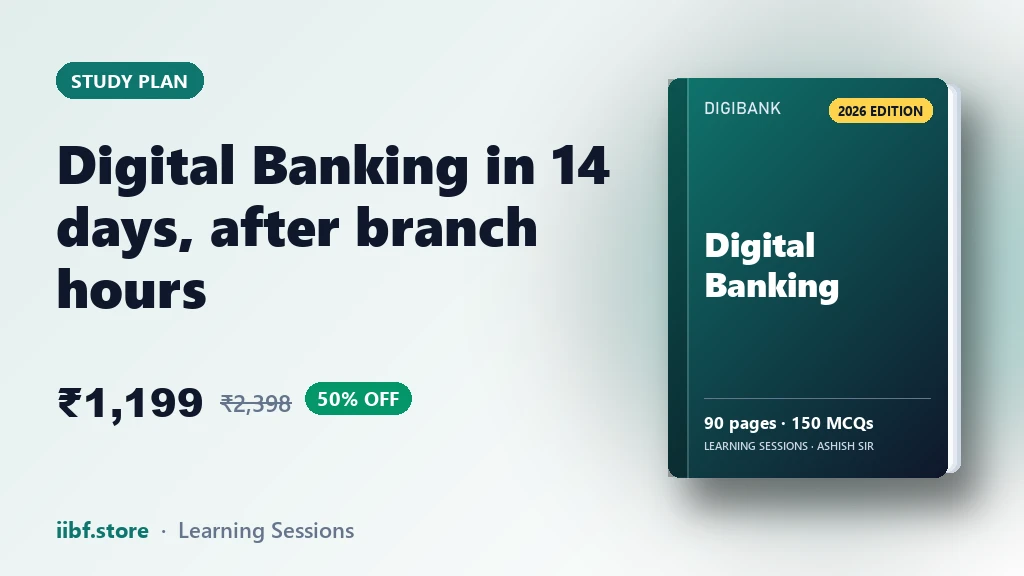
The plan above works with any solid material, but it was designed around the structure of the Digital Banking book: five modules, ten chapters, 90 pages, 150 MCQs, 30 case studies and 5 mega tests, all in the 2026 edition. It is listed at ₹1,199 against an MRP of ₹2,398, which is 50% off. Prices can change, so the book page is always the current source. You can also read the free sample on that page before deciding.
For more printed titles, see all books on iibf.store, and the blog has more study plans for other papers.
Final thought for tonight
Do not wait for a free week that will not come. Pick Day 1 from the table, open the first chapter tonight, and give it 40 focused minutes. A Digital Banking study plan only works once it has a Day 1, and every banker who cleared this paper while working full time started with one tired evening just like yours.
Frequently asked questions
Can I finish Digital Banking in 14 days while working full time?
Many bankers can, because they already handle cards, ATMs and mobile or internet banking at work. At about 75 minutes on weekdays and a longer block on weekends, the table above fits. If the products are new to you, stretch it to three weeks in the same order.
Should I read the whole book before attempting MCQs?
No. Solve each chapter's MCQs the next evening. Testing soon after reading shows you what actually stayed, and it spreads your effort across days instead of piling it at the end.
When should I start the mega tests?
After you have covered all ten chapters and at least one round of case studies. Take the first mega test around Day 14, review it fully, and space the others out so each one is reviewed before the next.
Where do I find the official exam dates and rules?
On the IIBF website at www.iibf.org.in. Exam schedules, eligibility and rules can change, so always confirm them there for the upcoming exam cycle.
Prefer revising from a printed book?
Chapter-wise books with MCQs after every chapter — minimal pages, complete coverage, delivered anywhere in India. Every book has a free sample to read first.
90 pages · 150 MCQs
Learning Sessions · Ashish Sir
132 pages · 225 MCQs
Learning Sessions · Ashish Sir
188 pages · 435 MCQs
Learning Sessions · Ashish Sir
117 pages · 236 MCQs
Learning Sessions · Ashish Sir
Learning Sessions · Ashish Sir
118 pages · 299 MCQs
Learning Sessions · Ashish Sir
Learning Sessions · Ashish Sir
Learning Sessions · Ashish Sir
Learning Sessions · Ashish Sir
115 pages · 255 MCQs
Learning Sessions · Ashish Sir
Learning Sessions · Ashish Sir
334 pages · 936 MCQs
Learning Sessions · Ashish Sir
Learning Sessions · Ashish Sir
115 pages · 344 MCQs
Learning Sessions · Ashish Sir
107 pages · 240 MCQs
Learning Sessions · Ashish Sir
Learning Sessions · Ashish Sir
131 pages · 672 MCQs
Learning Sessions · Ashish Sir
221 pages · 831 MCQs
Learning Sessions · Ashish Sir
128 pages · 524 MCQs
Learning Sessions · Ashish Sir
107 pages · 445 MCQs
Learning Sessions · Ashish Sir
148 pages · 478 MCQs
Learning Sessions · Ashish Sir
151 pages · 465 MCQs
Learning Sessions · Ashish Sir
148 pages · 375 MCQs
Learning Sessions · Ashish Sir
216 pages · 895 MCQs
Learning Sessions · Ashish Sir
109 pages · 300 MCQs
Learning Sessions · Ashish Sir
104 pages · 360 MCQs
Learning Sessions · Ashish Sir
82 pages · 297 MCQs
Learning Sessions · Ashish Sir
151 pages · 600 MCQs
Learning Sessions · Ashish Sir
98 pages · 282 MCQs
Learning Sessions · Ashish Sir
Quick quiz on this topic
5 exam-style questions from our free test bank — check yourself before you move on.
Practice this topic
Take a free mock test, download chapter PDFs, or watch a video class — all included on iibf.store.
Keep reading