Inside the IIBF Digital Banking book: modules, chapters, MCQs
It is 9:40 pm. You have closed the branch, reconciled the day, answered one last customer call on the way out, and now there is a certificate exam on the calendar that you promised yourself you would prepare for. The syllabus looks like a long list of channels, cards, payment systems and policy terms, and you cannot tell where to start. If that is you, this guided tour of the IIBF Digital Banking book is meant to give you a clear picture of what you would actually be studying, whether or not you end up buying anything.
Most tired candidates do not fail for lack of intelligence. They fail because the material feels shapeless. So before anything else, let us make it concrete: how many pages, how many chapters, what each module covers, and what one study session looks like when you sit down with the book.
Why the shape of a book matters more than its size
When you only have ninety minutes on a weeknight, a thick reference text is a risk. You open it, read for forty minutes, and realise you cannot say what you have actually covered. A compact book with a predictable structure works differently: each session has a start and an end, and you can tick it off.
Three things are worth checking in any book before you commit your evenings to it.
- Size: can you finish it at your real pace, not your ideal pace?
- Structure: is the material split into modules and chapters that match how the exam body groups topics?
- Practice: does it test you on what you just read, or leave you to find questions elsewhere?
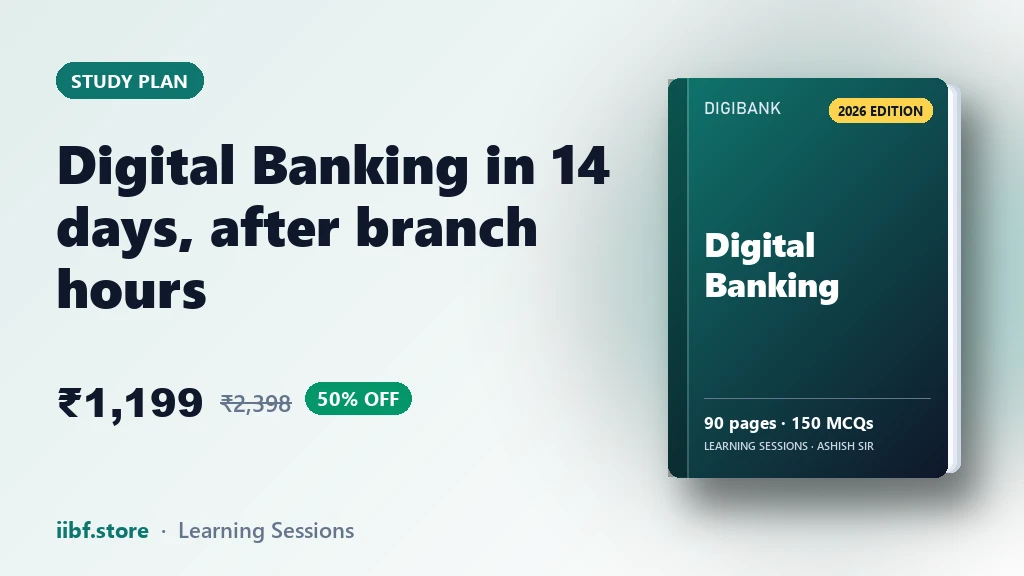
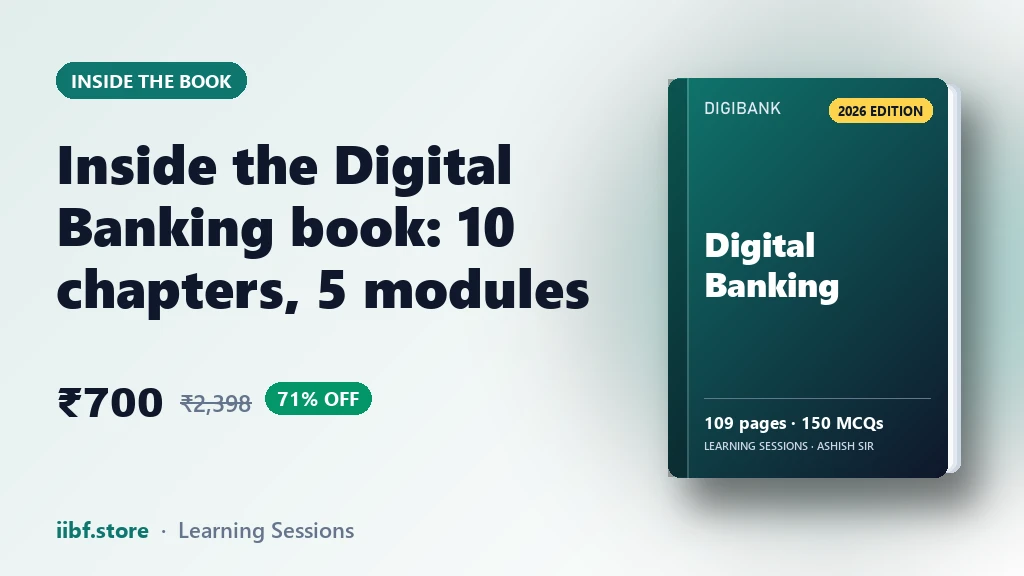
The IIBF Digital Banking book from iibf.store is a 2026 edition of 109 pages, split into 10 chapters across 5 modules, with 150 questions. That is a size a working person can plan around, which is the whole point of looking at the shape first.
The five modules, one by one
The book follows the module structure of the certificate course. Here is how the ten chapters are distributed, so you can see where the weight of your preparation will fall.
Module A: Digital Banking Products
This is the largest module, with six of the ten chapters: Digital Delivery Channels, Cards, Automated Teller Machines (ATMs), Mobile Banking, Internet or Online Banking, and POS Terminals. If you work in a branch, much of this will feel familiar from daily operations, which is good news. Your job is to convert that familiarity into exam-ready precision: definitions, features, and the way each channel is described in the course text.
Module B: Digital Banking and Financial Inclusion
One chapter, with the same title as the module. It connects digital channels to the goal of reaching people who were outside formal banking. Read it as a bridge between Module A and the policy-flavoured topics that follow.
Module C: Marketing of Digital Banking Products
One chapter on how digital products are marketed. Candidates from operations sometimes underrate this one because it feels less technical. Do not skip it; a single dedicated chapter is easy to finish and easy to score on if you have read it once properly.
Module D: Developments in Payment Systems in India and Digital Banking
One chapter on how payment systems have developed in India alongside digital banking. Payment systems change quickly, so use the book for the structure and concepts, and check the regulator's website for anything recent before the exam.
Module E: Future Trends in Digital Banking
The final chapter looks ahead. It is a good place to finish a first read, because it ties the earlier modules together.
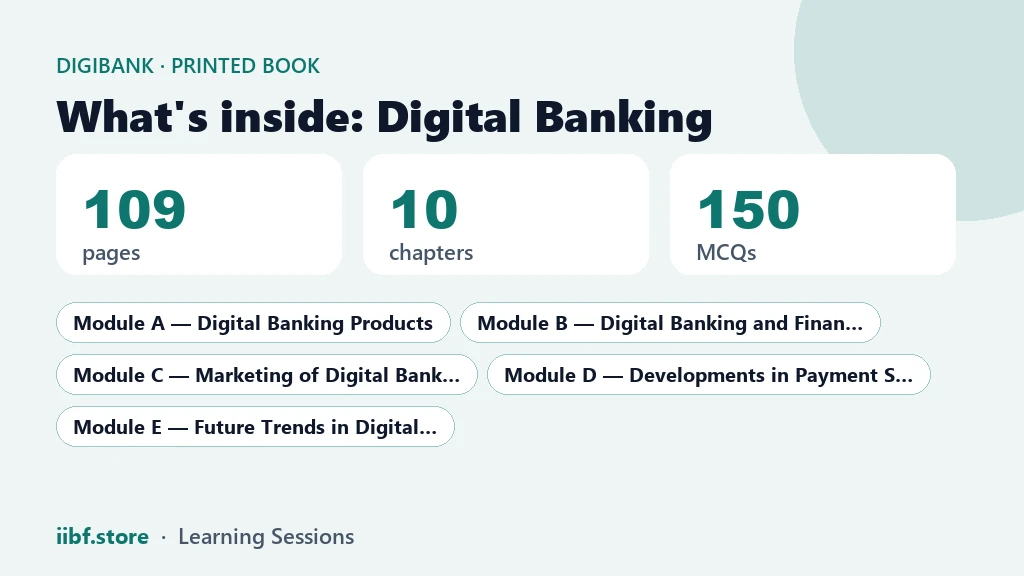
Notice the pattern: six chapters in Module A, then four modules with one chapter each. Practically, that means your first two or three weeks go into Module A, and the remaining four chapters can be taken as short, single-sitting reads.
What one chapter looks like when you sit down with it
Every chapter is built on the same simple rhythm: concise notes, then key points, then MCQs. The rhythm is more useful than it sounds, because it removes the decision-making that eats into tired evenings. You do not have to ask yourself what to do next; the chapter already tells you.
- Concise notes: read them once, slowly, with a pencil. Mark any term you could not explain aloud to a colleague.
- Key points: this is your revision layer. These are the lines you will re-read the night before the exam, so keep them handy.
- MCQs: attempt them without looking back. Wrong answers are not failures; they are a map of what to re-read.
If you take Cards as an example, the notes introduce the types and features, the key points compress them into lines you can revise in minutes, and the questions check whether the distinctions stuck. The same loop repeats for ATMs, Mobile Banking, and every other chapter.
Here is a table you can copy into your own notebook to track the first pass through the book. The caption matters because this is where the IIBF Digital Banking book turns into a schedule.
| Module | Chapters | Suggested sittings |
|---|---|---|
| A: Digital Banking Products | 6 | One chapter per sitting, six sittings |
| B: Financial Inclusion | 1 | One sitting |
| C: Marketing | 1 | One sitting |
| D: Payment Systems | 1 | One sitting, plus a check on recent regulator updates |
| E: Future Trends | 1 | One sitting, then a full revision pass |
Ten sittings for a full first read is a realistic target even with a full-time job. Spread across two or three weeks, it leaves room for the revision and practice that actually move your score.
The extras: case studies and mega tests
Beyond the ten chapters, the book carries two practice blocks that you will use after the first read.
- 30 Case Studies (120 questions): scenario-based passages followed by questions. These train you to apply a concept instead of just recognising it.
- 5 Mega Tests (500 questions): full-length practice sets for the end of your preparation, when you want to see how you hold up across the whole syllabus.
Between the chapter MCQs, the case studies and the mega tests, there is a lot of practice material here. Treat it as a ladder: chapter questions first, case studies in the middle, mega tests last.
How to sequence the practice
Do not jump into mega tests after one week of reading. Your first score will be low, and a low score on a tired Tuesday is the quickest way to lose motivation. Finish the chapters, do the case studies module by module, and keep the mega tests for the final stretch. If you want extra timed practice alongside, the free mock tests and the free study material on iibf.store cost nothing and are worth using.
A four-step method for using this book after work
You do not need a heroic schedule. You need a repeatable one. Here is the method that fits the structure of the book.
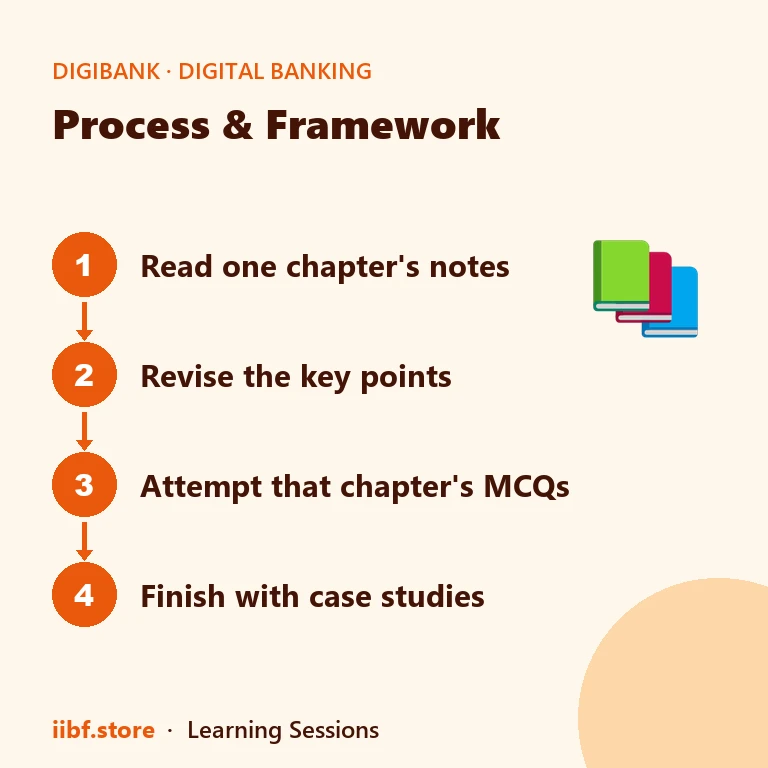
- Read one chapter's notes. One chapter per sitting, no more. Stop when the chapter ends, even if you have energy left.
- Revise the key points. Right after the notes, read the key points once. This takes minutes and fixes the chapter in memory.
- Attempt that chapter's MCQs. Do them the same day. Note the wrong answers in a small notebook.
- Finish with case studies. After a module is done, attempt the matching case studies to practise application.
On weekends, add a revision block: re-read the key points of every chapter you have finished and redo your wrong-answer notebook. By the time you reach the mega tests, you will have seen most of the ideas three times.
One honest limit: a book alone will not give you exam-hall speed. Pair it with timed mocks, and keep an eye on the official notices at the IIBF website for the schedule of the upcoming exam cycle and any syllabus updates.
Who gets the most out of this book
The IIBF Digital Banking book is most useful for a few kinds of candidates.
- Branch staff with little spare time: ten chapters and 109 pages are a manageable commitment.
- Candidates who forget what they read: the notes, key points and MCQs rhythm builds revision into every chapter.
- First-timers to the certificate: the module-wise layout shows you the whole course at a glance.
- People who have postponed before: a fixed, finite plan is easier to start than an open-ended one.
It is less suited to someone who wants a long, narrative textbook with deep background on every technology. This is an exam-oriented book, and it is built to be finished.
Price, the sample, and where to look next
At the time of writing, the book is listed at ₹700 against an MRP of ₹2,398. Prices can change, so the book page always has the current figure. There is also a free sample you can read before deciding, which is the sensible way to judge the style of the notes. You can browse the rest of the range at iibf.store/books, and more preparation articles are on the iibf.store blog.
Conclusion
A certificate exam feels smaller once you can see its shape. Five modules, ten chapters, 109 pages, 150 questions, then 30 case studies and 5 mega tests for later. Whether you use this IIBF Digital Banking book or another resource, copy the method above: one chapter per sitting, key points straight after, MCQs the same day, and mock tests near the end.
Frequently asked questions
How many chapters and modules does the book have?
It has 10 chapters across 5 modules. Module A covers six chapters on digital banking products, and Modules B to E have one chapter each.
What practice material is included?
The book has 150 questions in the chapters, plus 30 case studies with 120 questions and 5 mega tests with 500 questions.
Can I read a sample before buying?
Yes. The book page has a free sample, so you can judge the style of the notes before ordering.
Is the book enough on its own?
It is a strong base, but exam-hall speed comes from timed practice. Use free mock tests as well, and check the official IIBF site for the exam schedule.
Prefer revising from a printed book?
Chapter-wise books with MCQs after every chapter — minimal pages, complete coverage, delivered anywhere in India. Every book has a free sample to read first.





































Quick quiz on this topic
5 exam-style questions from our free test bank — check yourself before you move on.
Practice this topic
Take a free mock test, download chapter PDFs, or watch a video class — all included on iibf.store.
Keep reading