IT Security in Banking: ISO 27001, VAPT & the CIA Triad for IIBF 2026
Strong IT security is the foundation on. Every digital banking service rests. And the IIBF IT Security paper expects a thorough understanding of its principles.
Standards. Without sound IT security. Payment systems, customer data and the bank's reputation are all at risk.
This guide covers the core concepts. The international standards and the practical controls examiners ask about most often.
The CIA Triad and Core Principles
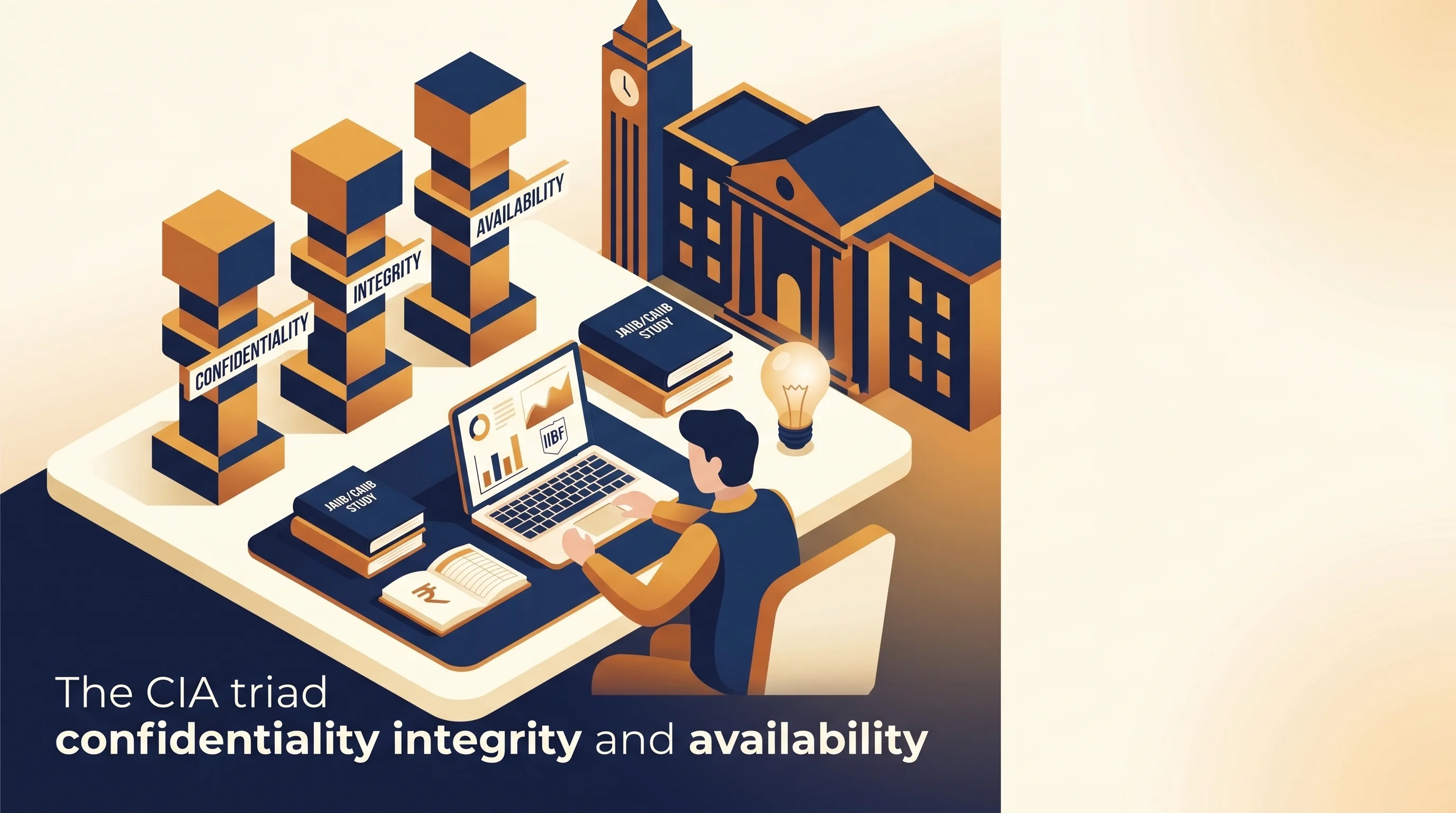
The conceptual heart of IT security is the CIA triad: Confidentiality. Integrity and Availability. Confidentiality ensures that information is accessible only to those authorised to see it.
Achieved through access controls and encryption. Integrity ensures that data is accurate and has not been tampered with. Protected by hashing, checksums and maker-checker controls.
Availability ensures that systems and data are accessible when needed. Supported by redundancy, backups and disaster-recovery planning.
Two further principles round out the model. Authentication verifies identity, typically through something you know, something you have and something you are, combined as multi-factor authentication. Non-repudiation ensures a party cannot deny having performed an action, achieved through digital signatures and audit logs. For the exam, be ready to map a control to the principle it supports — for instance, encryption to confidentiality and backups to availability. This mapping is the single most tested idea in IT security. Practise it with our IIBF IT security practice tests.
ISO 27001 and the ISMS
The leading international standard for IT security is ISO/IEC 27001. Which specifies the requirements for an Information Security Management System (ISMS). A systematic.
Risk-based approach to managing sensitive information. An ISMS follows the Plan-Do-Check-Act cycle: identify risks. Implement controls, monitor effectiveness and continually improve.
Certification signals to regulators. Customers that the bank manages information security to a recognised benchmark.
The standard is supported by ISO 27002, which provides a catalogue of controls across domains such as access control, cryptography, physical security, operations security and supplier relationships. Central to the ISMS is a documented risk assessment that identifies assets, threats and vulnerabilities, and a risk treatment plan that decides whether to mitigate, transfer, accept or avoid each risk. Banks also align with the RBI's IT and cyber security frameworks. For the exam, understand the ISMS lifecycle and that ISO 27001 is about management of security, not just technology. Reinforce the standards and domains with our IT security match game.
VAPT, Access Control and Encryption
A practical pillar of IT security is Vulnerability Assessment and Penetration Testing (VAPT). A vulnerability assessment systematically scans systems to identify known weaknesses, while penetration testing goes further by simulating a real attacker to exploit those weaknesses and test defences. Banks conduct VAPT periodically and after major changes, and the findings feed a remediation cycle. Regulatory expectations on VAPT and incident handling are detailed by CERT-In.
Access control enforces the principles of least privilege and need to know, granting users only the rights essential to their role, with privileged access tightly governed and logged. Encryption protects data confidentiality, using symmetric algorithms such as AES for bulk data and asymmetric public-key cryptography for key exchange and digital signatures. Public Key Infrastructure (PKI) manages the certificates that underpin secure communication. Together, these controls turn the abstract CIA principles into concrete protection. Deepen your technical grasp through our advanced banking technology course.

SWIFT, Cloud and Operational Resilience
Banks rely on the SWIFT network for cross-border messaging. And its Customer Security Programme mandates baseline controls to secure the local SWIFT environment. Harden systems and detect anomalies after high-profile heists exposed weaknesses.
Candidates should know that SWIFT is a secure messaging system. Not a fund-transfer or settlement system itself. Cloud security introduces the shared-responsibility model.
Where the provider secures the infrastructure. The bank secures its data and configuration.
Modern IT security extends into operational resilience: business continuity planning, disaster recovery with defined recovery-time and recovery-point objectives, and regular drills. The growth of zero-trust architecture — never trust, always verify — and continuous monitoring through a Security Operations Centre reflect how the field is evolving. A banker who understands the CIA triad, ISO 27001, VAPT and these operational practices can speak the language of IT security with confidence. Test your readiness with a timed IT security mock and read more on our study blog.
What is the CIA triad in IT security?
Confidentiality. Integrity and Availability — the three core objectives of information security. Supported by authentication and non-repudiation.
What does ISO 27001 certify?
It certifies that an organisation runs an Information Security Management System. A risk-based. Continually improving approach to managing information security following the Plan-Do-Check-Act cycle.
How does penetration testing differ from a vulnerability assessment?
A vulnerability assessment scans for known weaknesses. While penetration testing actively simulates an attacker to exploit those weaknesses. Test the effectiveness of defences.
Is SWIFT a payment settlement system?
No. SWIFT is a secure financial messaging network. It carries payment instructions between banks. Does not itself transfer funds or settle accounts.
Common Pitfalls and Final Tips
A frequent mistake in this paper is memorising definitions without being able to apply them to a scenario. The IIBF examiner often wraps the CIA triad. The ISO 27001 ISMS cycle. The role of VAPT inside a short case.
So practise translating each concept into a worked example rather than reciting it. Another common slip is confusing closely related terms. So keep a running list of easily-mixed concepts. Test yourself on the distinctions until they are automatic.
In the final week. Prioritise active recall over passive reading: attempt full-length mocks under timed conditions. Review every incorrect answer, and revisit only the topics where you stumble.
Manage the clock carefully in the exam hall by flagging difficult questions. Returning to them rather than losing momentum on a single item. Read each question stem twice.
Since negatively-phrased options such as "which is NOT" trip up even well-prepared candidates.
Finally, link your study to current developments, because the exam increasingly tests recent regulatory changes alongside core theory. Combine this disciplined approach with our timed IT security mock tests, the quick-revision match games and the detailed explainers on our study blog, and you will walk into the exam confident and well-prepared.
Conclusion
IT security rewards candidates who connect principles to practice: the CIA triad, the ISO 27001 ISMS, VAPT, access control and encryption, and the operational realities of SWIFT and cloud. Learn to map each control to the principle it serves, since that is the exam's favourite question style. Test yourself with a timed IT security mock and continue your preparation with our advanced banking course.
Quick summary in plain words
In short: keep it simple.
Read each point slow.
Take notes as you go.
Use the free tests to check what you know.
Watch the video if a part feels hard.
Do a bit each day.
Ask us on WhatsApp if you get stuck.
You can pass this exam.
Stay calm and trust your prep.
Come back to this guide often.
Small steps add up fast.
Skim the box below first.
Quick summary in plain words
In short: keep it simple.
Read each point slow.
Take notes as you go.
Watch the video if a part feels hard.
Do a bit each day.
Ask us on WhatsApp if you get stuck.
You can pass this exam.
Stay calm and trust your prep.
Come back to this guide often.
Small steps add up fast.
Skim the box below first.
Quick summary in plain words
In short: keep it simple.
Read each point slow.
Take notes as you go.
Watch the video if a part feels hard.
Do a bit each day.
Ask us on WhatsApp if you get stuck.
You can pass this exam.
Stay calm and trust your prep.
Come back to this guide often.
Small steps add up fast.
Skim the box below first.
Quick summary in plain words
In short: keep it simple.
Read each point slow.
Take notes as you go.
Watch the video if a part feels hard.
Do a bit each day.
Ask us on WhatsApp if you get stuck.
You can pass this exam.
Stay calm and trust your prep.
Come back to this guide often.
Small steps add up fast.
Skim the box below first.
Practice this topic
Take a free mock test, download chapter PDFs, or watch a video class — all included on iibf.store.