Resolution of Stressed Assets (IBC) Syllabus 2026 + Free PDF
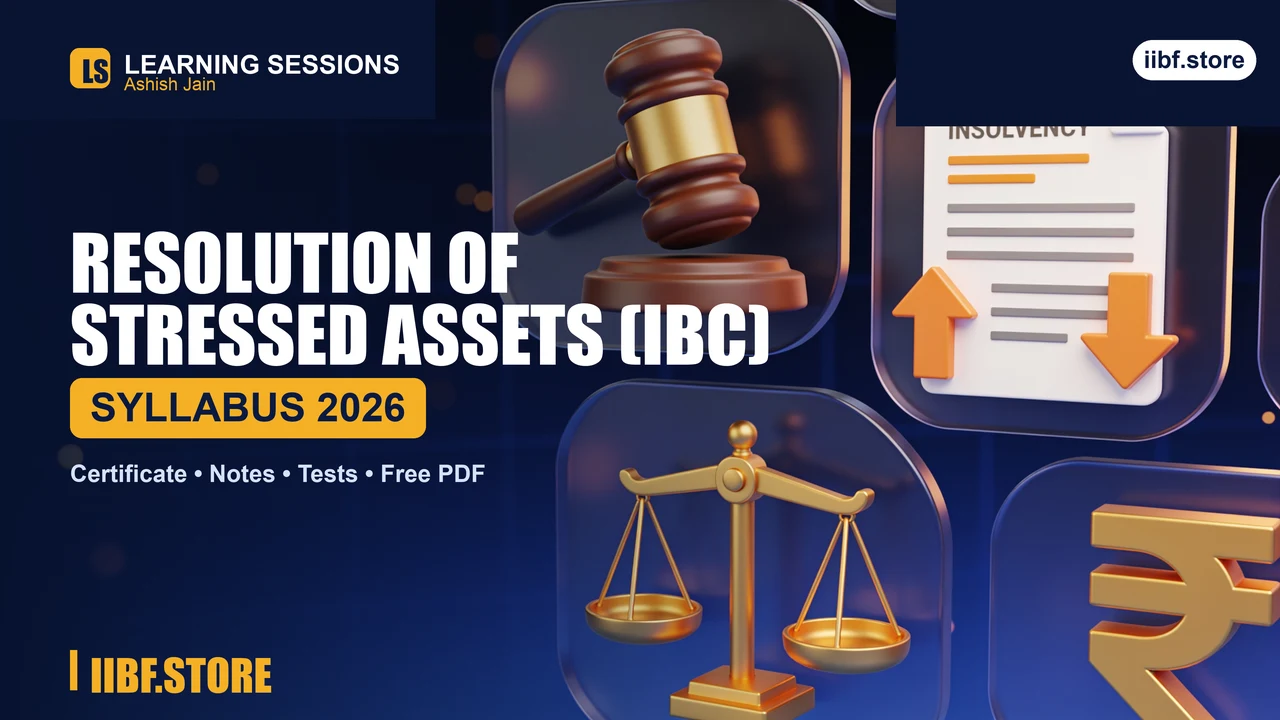
The Resolution of Stressed Assets (IBC) syllabus is the single most important document to keep open the day you decide to attempt this IIBF certification. Offered by the Indian Institute of Banking & Finance, the Resolution of Stressed Assets paper turns a working banker into a confident recovery professional who can read a stressed account through the lens of the Insolvency and Bankruptcy Code, 2016. This guide maps the complete 2026 syllabus chapter by chapter, shows you which provisions the exam now loves to test, and pairs each module with free tests, notes and games so your preparation is structured from day one. You can also download the official IBC syllabus PDF and keep it beside your study plan.
Key takeaways
- The Resolution of Stressed Assets (IBC) certification covers a single comprehensive paper of 14 chapters, grouped into modules on recovery laws, CIRP, non-corporate insolvency and other provisions.
- The paper is application and case-study driven — conceptual clarity on timelines, sections and roles beats rote learning.
- The CIRP core (Chapters 5–10) is where most marks sit; master it before anything else.
- Time-sensitive details such as default thresholds, fees and CIRP timelines change — always confirm them on the official IIBF notification and current IBBI regulations.
- Free chapter-wise mock tests, one-liners, notes and matching games on Learning Sessions are all aligned to this exact syllabus.
What the Resolution of Stressed Assets (IBC) Course Covers
The Resolution of Stressed Assets syllabus is built for professionals whose daily work touches non-performing and distressed accounts. It begins with the broad toolkit of credit recovery law and then narrows into the machinery of the Insolvency and Bankruptcy Code, the Corporate Insolvency Resolution Process (CIRP) and liquidation.
This certification suits recovery officers, credit officers, legal-cell staff, branch heads and any banker who wants insolvency expertise on their record. The course runs from the fundamentals of recovery law all the way to specialised areas such as the pre-packaged insolvency resolution process, individual insolvency and landmark case laws — a complete stressed-asset toolkit for the modern lender.
IBC Exam Pattern at a Glance
The Resolution of Stressed Assets examination is an objective, MCQ-based test delivered through the IIBF mode. Questions are deliberately framed around scenarios and case studies rather than plain definitions, so you should expect to apply the law rather than simply recall it.
You will face questions on who can trigger CIRP, the powers of the Adjudicating Authority and the distribution waterfall. Because of this, conceptual command over timelines, section numbers and the roles of each player matters far more than memorising paragraphs.
Before you register: the exact number of questions, exam duration and passing marks are revised by IIBF from time to time. Always confirm the current pattern from the latest IIBF examination notification — never rely on figures quoted second-hand.
Resolution of Stressed Assets (IBC) Syllabus 2026 — Chapter-Wise
The Resolution of Stressed Assets syllabus for 2026 is a single comprehensive paper of 14 chapters arranged across modules. The table below gives the full chapter list, the module each chapter belongs to, and what you actually learn in it.
| Ch | Module / Chapter | What you learn |
|---|---|---|
| 1 | Credit Recovery Laws for Banks (Overview of Credit Recovery & Insolvency Laws) | SARFAESI, DRT, Lok Adalat and the full recovery toolkit available to lenders. |
| 2 | Evolution of the Insolvency and Bankruptcy Code (Overview of Credit Recovery & Insolvency Laws) | Why the IBC, 2016 replaced fragmented laws and the objectives it serves. |
| 3 | Bankruptcy Laws — Cross-Country Experience (Evolution & Practice of Insolvency) | Global insolvency regimes (US, UK and others) and the lessons for India. |
| 4 | Structure of the IBC (Evolution & Practice of Insolvency) | The four pillars — IBBI, Insolvency Professionals, Information Utilities and Adjudicating Authorities. |
| 5 | Initiation of CIRP (Corporate Insolvency Resolution Process) | Who can trigger CIRP — financial creditors, operational creditors and the corporate debtor. |
| 6 | Commencement of CIRP (Corporate Insolvency Resolution Process) | Admission, moratorium, public announcement and constitution of the CoC. |
| 7 | Roles and Duties of the IRP and RP (Corporate Insolvency Resolution Process) | Powers of the IRP/RP, running the debtor as a going concern and verifying claims. |
| 8 | Catalysing a Successful Resolution Plan (Corporate Insolvency Resolution Process) | Information memorandum, resolution applicants, Section 29A and CoC voting. |
| 9 | Fast-Track CIRP & PPIRP (Corporate Insolvency Resolution Process) | The fast-track process and the pre-packaged insolvency route designed for MSMEs. |
| 10 | Liquidation & Voluntary Liquidation (Corporate Insolvency Resolution Process) | The liquidation order, the liquidator's role and the Section 53 priority waterfall. |
| 11 | Insolvency Resolution for Individuals and Firms (Non-Corporate Insolvency) | Personal guarantors, partnership firms and the role of the DRT. |
| 12 | Adjudication, Appeals, Offences & Penalties (Other Important Provisions) | The NCLT/NCLAT hierarchy, appeals to the Supreme Court and penal provisions. |
| 13 | Regulatory & Miscellaneous Aspects (Other Important Provisions) | IBBI regulations, cross-border insolvency and miscellaneous provisions. |
| 14 | Important Case Laws and Lessons Drawn (Other Important Provisions) | Landmark judgments shaping IBC jurisprudence and their practical takeaways. |
Notice how the four CIRP-heavy chapters (5 to 10) dominate the middle of the paper. That is your scoring zone, and your study plan should reflect it. You can pull the full chapter list in the official order straight from the downloadable IBC syllabus PDF.
Recently Updated Topics You Must Not Miss
Insolvency law moves fast through amendments and judgments, and the Resolution of Stressed Assets paper increasingly rewards candidates who know the current position. Give extra attention to the areas below — and always cross-check exact figures and provisions against the latest IBBI regulations and the official IIBF notification.
- Pre-Packaged Insolvency Resolution Process (PPIRP): the pre-pack route created for MSMEs blends a debtor-in-possession model with creditor-in-control safeguards. Expect direct questions on eligibility, the base resolution plan and the indicative timeline.
- Default threshold for initiating CIRP: the minimum default amount that triggers a corporate insolvency application has been revised, so older numbers are outdated. Verify the current threshold from the official notification before relying on any figure.
- Cross-border insolvency & CIRP timelines: proposals on adopting the UNCITRAL Model Law and clarifications on the outer CIRP timeline (including litigation periods) keep evolving through amendments and judgments. Study the current statutory position rather than a single fixed period you read once.
The IBC notes and tests on Learning Sessions are kept in step with these changes, so the provisions you revise here stay aligned with the latest released schedule and circulars.
Quick IBC One-Liners for Revision
Use these high-yield one-liners to lock in the concepts the Resolution of Stressed Assets paper tests most often.
How to Prepare for the IBC Exam — A Chapter-Grouped Study Plan
Because the Resolution of Stressed Assets paper is application-driven and section-heavy, a chapter-grouped plan works far better than reading the syllabus end to end. Here is a sequence you can map onto your available weeks.
- Build the base (Chapters 1–4). Understand recovery laws, the evolution of the Code, global experience and the four-pillar structure of the IBC. This is your foundation — go slow here so the later chapters click.
- Master the CIRP core (Chapters 5–10). This is the scoring heart of the paper. Drill initiation, moratorium, the CoC, resolution plans, Section 29A, PPIRP and the liquidation waterfall until your answers are automatic.
- Cover non-corporate insolvency and provisions (Chapters 11–13). Individual and firm insolvency, adjudication, appeals, offences and IBBI regulations carry direct, factual marks that are easy to bank.
- Lock in case laws (Chapter 14). Landmark NCLT, NCLAT and Supreme Court judgments are high-yield. Revise them alongside one-liners so the principle and the case name stay linked.
- Revise with mocks, one-liners and games. Alternate full-length IBC mock tests with one-liner revision and matching games so accuracy and speed rise together.
If you want a deeper walk-through of the engine of this paper, our explainer on the Corporate Insolvency Resolution Process under IBC 2016 breaks the CIRP timeline down step by step, and the guide to the liquidation process under IBC 2016 covers what happens when resolution fails.
How the Modules Map to Your Recovery Toolkit
It helps to see the syllabus the way the law actually works on the ground. The table below connects each module to the real-world question a banker asks when an account turns stressed.
| Module | Core question it answers | Key tools / players |
|---|---|---|
| Recovery & insolvency laws | What options exist before insolvency? | SARFAESI, DRT, Lok Adalat |
| Structure of the IBC | Who runs and regulates the process? | IBBI, IPs, Information Utilities, NCLT |
| CIRP | Can the company be revived? | CoC, IRP/RP, resolution plan, Sec 29A |
| Liquidation | If not, how are dues paid? | Liquidator, Section 53 waterfall |
| Non-corporate & provisions | What about individuals and appeals? | DRT, NCLAT, IBBI regulations, case law |
For the two pieces candidates most often confuse, study the role of the Committee of Creditors and the disqualifications under Section 29A of the IBC together — examiners love to test how the two interact.
Common Mistakes Candidates Make
A clear syllabus does not guarantee a pass. These are the avoidable errors that cost candidates marks in the Resolution of Stressed Assets paper.
- Memorising stale numbers. Default thresholds and CIRP timelines have been amended. Quoting an old figure in a scenario question is a guaranteed loss — confirm current values from the latest notification.
- Treating it as a definitions test. The paper is case-study heavy. If you only learn what a term means and not how it plays out in a moratorium or a CoC vote, you will struggle.
- Confusing the Adjudicating Authorities. NCLT for corporates, DRT for individuals and firms — mixing these up is one of the most common errors.
- Skipping case laws. Chapter 14 feels optional but is high-yield; landmark judgments appear regularly and are quick marks once revised.
- Practising too late. Reading without timed mock tests leaves your speed untested. Start attempting mocks early, not in the final week.
Free IBC Study Resources on Learning Sessions
A syllabus is only the starting line. You clear the Resolution of Stressed Assets exam by practising, and every Learning Sessions resource below is built around this exact syllabus.
- Chapter-wise IBC mock tests — timed, exam-pattern MCQs with instant answers and explanations.
- Matching games — gamified drills that make sections, timelines and IBC terminology stick.
- Full IBC subject notes — chapter-by-chapter study material you can revise topic by topic.
- All IBC guides — every Resolution of Stressed Assets article on Learning Sessions in one place.
- The IBC exam hub — your home page for classes, notes and tests across the whole certification.
Prefer a structured starting point? The complete IBC 2016 IIBF exam guide ties the whole certification together, and the CIRP explainer for IIBF is the ideal companion to Chapters 5 to 10.
Frequently Asked Questions
Is the Resolution of Stressed Assets (IBC) course worth it?
Yes. For anyone in a recovery, credit-monitoring, legal-cell or branch-banking role, this certification builds directly job-relevant skills in handling stressed accounts. It also signals genuine insolvency expertise to employers, which makes it one of the most practical IIBF certifications for NPA management.
How many chapters are there in the IBC syllabus?
The Resolution of Stressed Assets syllabus has 14 chapters, running from Credit Recovery Laws for Banks through to Important Case Laws and Lessons Drawn. They are organised across modules covering recovery laws, CIRP, non-corporate insolvency and other important provisions.
Where can I download the IBC syllabus PDF?
You can download the complete IBC syllabus PDF from the link in this guide. It lists every chapter in the official IIBF order, which makes it ideal for planning your study weeks.
Which part of the IBC syllabus carries the most marks?
The CIRP core — Chapters 5 to 10 — is the scoring heart of the paper. It covers initiation, the moratorium, the Committee of Creditors, resolution plans, Section 29A, PPIRP and liquidation. Prioritise these before moving to the non-corporate and provisions modules.
How should I keep up with updated topics?
Follow IBBI regulations and amendments to the Code, watch landmark NCLT, NCLAT and Supreme Court judgments, and use regularly updated notes and mock tests. Treat any specific threshold, fee or timeline as time-sensitive and confirm it on the official IIBF notification before the exam.
Is the IBC exam objective or descriptive?
It is an objective, MCQ-based test. The questions are application and case-study oriented rather than simple recall, so your focus should be on understanding how each provision works in a real stressed-asset scenario, not on memorising text.
Start Your IBC Preparation Today
A clear syllabus is half the battle won. Download the IBC syllabus PDF, map each chapter to a study week, revise with one-liners and matching games, and back it all with timed mock tests. Confirm the live exam pattern and any thresholds on the official IIBF notification, then trust your plan. With structure and steady practice, the Resolution of Stressed Assets certification is well within your reach — and the team at Learning Sessions is with you every step. For the authoritative source, you can always cross-check details on the official IIBF website.
Related Guides
📚 Free Learning Sessions resources — connect & crack your exam
- 📝 Free mock tests — chapter-wise, exam-pattern, with instant solutions
- 🎮 Matching games — gamified revision of key terms & concepts
- 📄 Study notes & PDFs — downloadable chapter material
- 🎥 Video classes on YouTube — subscribe to @learningsessions
💬 Want the full course? WhatsApp your course name to 8360944207 and our team will set you up.
📱 Study on the go — get our iOS & Android app at iibf.store/app.
Quick quiz on this topic
5 exam-style questions from our free test bank — check yourself before you move on.
Practice this topic
Take a free mock test, download chapter PDFs, or watch a video class — all included on iibf.store.