PLI for Bank Employees: How It Is Actually Calculated
Every year around results season the same joke does the rounds in bank WhatsApp groups. The bank announces a record profit, the dashboard turns green, the review meeting congratulates everyone — and then the incentive lands and somebody posts a screenshot with a caption about the eight lakh rupees they definitely did not get.
The short below runs on exactly that irony. It is worth watching, and it is worth being precise about afterwards, because a lot of bankers genuinely do not know how PLI for bank employees is computed. Once you see the formula, both the size of the payout and the frustration around it make complete sense.
i got PLI of 8 lakh being a scale 2 officer · Watch on YouTube
Where PLI came from
Performance Linked Incentive was introduced from the financial year 2020-21 under the 11th Bipartite Settlement and the 8th Joint Note signed with the Indian Banks' Association, dated 11 November 2020. Before that, public sector bank pay had almost no variable component tied to how the bank actually performed. PLI was the mechanism meant to change that.
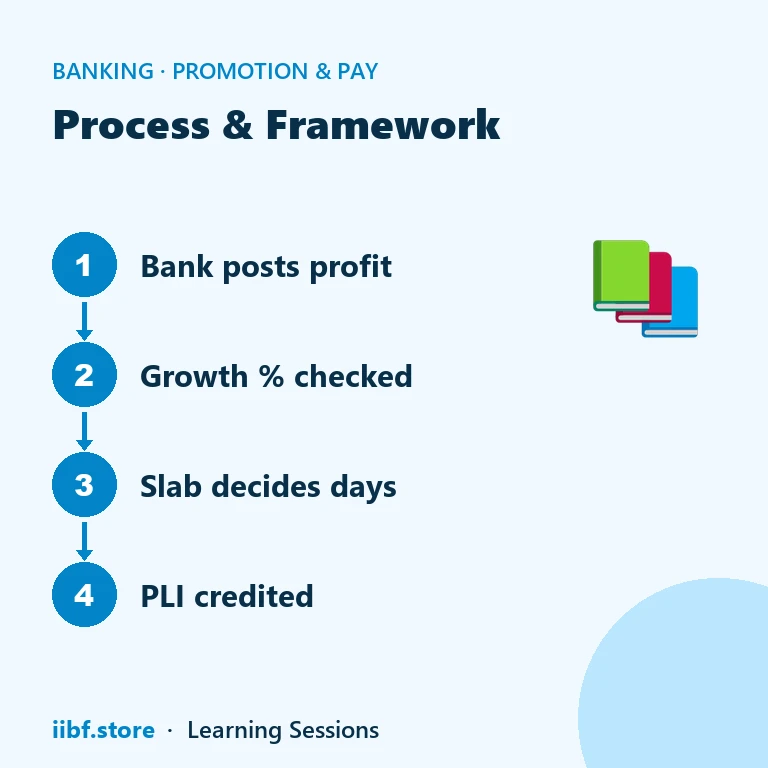
Two features of PLI for bank employees matter more than anything else. First, it is payable to all employees annually, over and above normal salary — it is not a management-grade bonus. Second, it is linked to the bank's own year-on-year growth in operating profit, not to the industry, not to net profit headlines, and not to your individual branch targets.
The actual slab
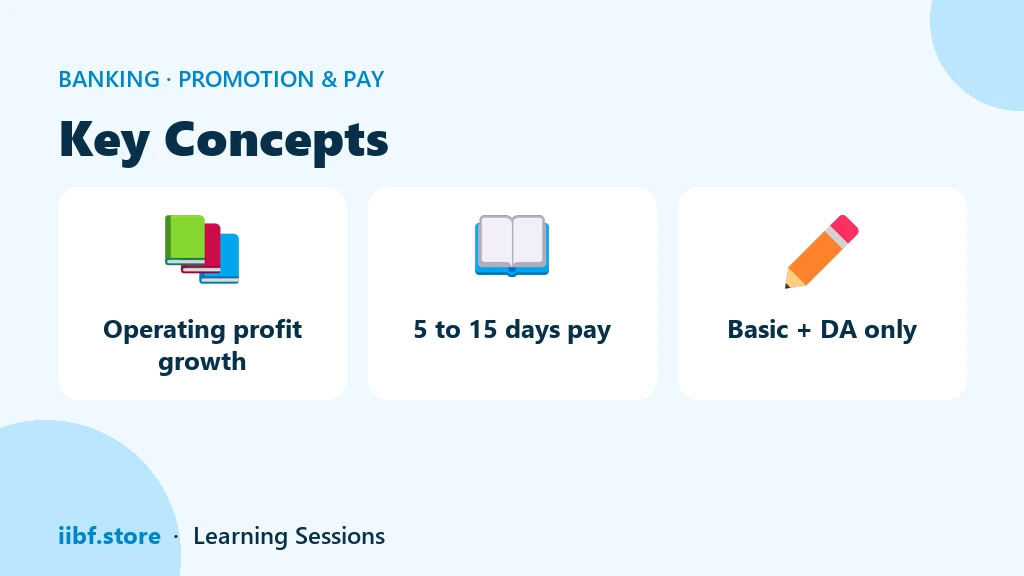
The matrix that governs PLI for bank employees is refreshingly simple once you see it. The PLI matrix decides how many days of pay you receive, where a "day of pay" means Basic plus Dearness Allowance. The scheme runs on a floor of 5 days and a ceiling of 15 days.
| YoY growth in operating profit | PLI payable |
|---|---|
| Below 5% | Nil |
| 5% to 10% | 5 days of pay |
| 10% to 15% | 10 days of pay |
| Above 15% | 15 days of pay |
Now the arithmetic, which is where the eight-lakh joke dies. Take a Scale II officer with Basic plus DA of roughly ₹1,20,000 a month. One day of pay is that figure divided by 30, so about ₹4,000. At the maximum 15-day slab, PLI works out to roughly ₹60,000 before tax. At the 5-day slab it is around ₹20,000.
Useful money, genuinely — and about an order of magnitude away from the number in the video title. Understanding PLI for bank employees as days-of-pay rather than a percentage of profit is the whole thing.
Why the gap feels so wide
Here is the context that makes the sarcasm land. Public sector banks recorded a net profit of ₹1.98 lakh crore in FY 2025-26, their fourth consecutive year of record performance, with aggregate operating profit at ₹3.21 lakh crore. Asset quality reached historic lows, with the gross NPA ratio at 1.93% and net NPA at 0.39% as on 31 March 2026. Aggregate business rose 12.8% to ₹283.3 lakh crore.
Those are extraordinary numbers, and they were produced by branch staff working with limited headcount. So when the reward for that shows up as 5 to 15 days of Basic plus DA, the reaction is not really about the amount. It is about proportion.
There is also a structural quirk worth knowing. Because the slab measures growth in operating profit rather than its level, a bank that performed superbly last year and merely matched it this year can pay nothing at all. Sustained excellence with flat growth scores zero on the matrix. A bank recovering from a weak base can hit 15 days comfortably. That is not a loophole — it is what a growth-linked formula does by design — but it explains why two bankers doing identical work at different banks get very different envelopes.
The part the video is really about
Strip away the number and the short is making a point about late sitting, not about money. Assigned work finished with sincerity is the job. Unpaid overtime, evening after evening, is not dedication — it is a cost you are absorbing personally, and no certificate reimburses it.
This is worth saying without cynicism: your health, your personal time, and your self-respect are not negotiable line items. A 5:30 exit after finishing your assigned work is not underperformance. The banks that posted these record numbers did so on the back of staff who were already stretched, and the incentive matrix does not measure the hours you gave beyond your roster.
If you want the reward side of your career to move meaningfully, the lever is promotion and specialisation rather than incentive slabs. A scale change alters Basic and DA permanently, which raises every future PLI day too. That is the compounding path. Certification is the standard route there — JAIIB and CAIIB remain the qualifications most directly tied to promotion eligibility across public sector banks, and the study planner is built for people fitting preparation around branch hours.
One last note on sourcing. Settlement terms, PLI matrices, and revisions are negotiated between the IBA and the unions, and figures circulating on social media are frequently outdated or simply invented. Public sector bank performance data is published by the Ministry of Finance, and banking regulation and disclosure norms sit with the Reserve Bank of India. When something about PLI for bank employees sounds too good to be true, check the joint note before you forward it.
Frequently asked questions
How much PLI do bank employees get?
Between 5 and 15 days of pay, calculated on Basic plus Dearness Allowance, depending on the bank's year-on-year growth in operating profit. Growth of 5-10% gives 5 days, 10-15% gives 10 days, and above 15% gives the maximum 15 days. Growth below 5% means no PLI is payable that year.
Is PLI paid to all bank employees or only officers?
PLI is payable to all employees of the bank annually, over and above normal salary. It is not restricted to officer cadre, and it is not an individual performance bonus — the payout is determined by the bank's overall operating profit growth, so every eligible employee in a bank receives the same number of days.
When was PLI introduced for public sector banks?
It was introduced from the financial year 2020-21 in terms of the 11th Bipartite Settlement and the 8th Joint Note signed with the Indian Banks' Association, dated 11 November 2020.
Can my bank pay no PLI even after posting a profit?
Yes. The matrix measures growth in operating profit year on year, not the absolute profit. A bank that posts a healthy profit but does not grow it by at least 5% over the previous year falls below the entry slab, so no PLI becomes payable even though the bank was profitable.
Prefer revising from a printed book?
Chapter-wise books with MCQs after every chapter — minimal pages, complete coverage, delivered anywhere in India. Every book has a free sample to read first.
131 pages · 672 MCQs
Learning Sessions · Ashish Sir
221 pages · 831 MCQs
Learning Sessions · Ashish Sir
128 pages · 524 MCQs
Learning Sessions · Ashish Sir
107 pages · 445 MCQs
Learning Sessions · Ashish Sir
148 pages · 478 MCQs
Learning Sessions · Ashish Sir
151 pages · 465 MCQs
Learning Sessions · Ashish Sir
148 pages · 375 MCQs
Learning Sessions · Ashish Sir
216 pages · 895 MCQs
Learning Sessions · Ashish Sir
109 pages · 300 MCQs
Learning Sessions · Ashish Sir
104 pages · 360 MCQs
Learning Sessions · Ashish Sir
82 pages · 297 MCQs
Learning Sessions · Ashish Sir
151 pages · 600 MCQs
Learning Sessions · Ashish Sir
98 pages · 282 MCQs
Learning Sessions · Ashish Sir
132 pages · 225 MCQs
Learning Sessions · Ashish Sir
188 pages · 435 MCQs
Learning Sessions · Ashish Sir
117 pages · 236 MCQs
Learning Sessions · Ashish Sir
Learning Sessions · Ashish Sir
118 pages · 299 MCQs
Learning Sessions · Ashish Sir
Learning Sessions · Ashish Sir
Learning Sessions · Ashish Sir
Learning Sessions · Ashish Sir
115 pages · 255 MCQs
Learning Sessions · Ashish Sir
Learning Sessions · Ashish Sir
334 pages · 936 MCQs
Learning Sessions · Ashish Sir
Learning Sessions · Ashish Sir
115 pages · 344 MCQs
Learning Sessions · Ashish Sir
107 pages · 240 MCQs
Learning Sessions · Ashish Sir
90 pages · 150 MCQs
Learning Sessions · Ashish Sir
Learning Sessions · Ashish Sir
Practice this topic
Take a free mock test, download chapter PDFs, or watch a video class — all included on iibf.store.