Transfer After Promotion in Bank: What Actually Changes

Ask any officer in an Indian bank what the scariest part of getting promoted is, and almost nobody says the interview. They say the posting order. A transfer after promotion is not a punishment and it is not bad luck. In most banks it is written into the promotion policy itself, and you agree to it on the day you sign the option form. Ashish sir put the whole thing into under a minute in the clip below; the longer, honest version follows.
Promotion and transfer in bank · Watch on YouTube
This is written for the officer who is genuinely undecided. You have cleared the process, or you are about to, and now you have to tell your family something. No motivational speech here, just how the system works and which parts of it you can actually control.
Why the move is built into the system, not added on top
Banks are branch networks, not head offices. Every scale carries a different set of powers: sanctioning limits, signing authority, custody of cash and gold, accountability for a branch's books. When you move from Scale I to Scale II, the bank does not simply need someone with a new designation. It needs that person sitting where the new powers are actually required. That is usually a different branch and often a different region.
There is a second reason, and it is a control reason rather than a staffing one. The Reserve Bank has consistently pushed banks to rotate staff in sensitive positions and to enforce mandatory leave, so that no single person sits on the same set of controls indefinitely. The supervisory thinking behind rotation, mandatory leave and fraud risk management is published on rbi.org.in. Promotion is the natural moment to apply that rotation, because the officer is moving anyway.
What transfer liability means in plain language
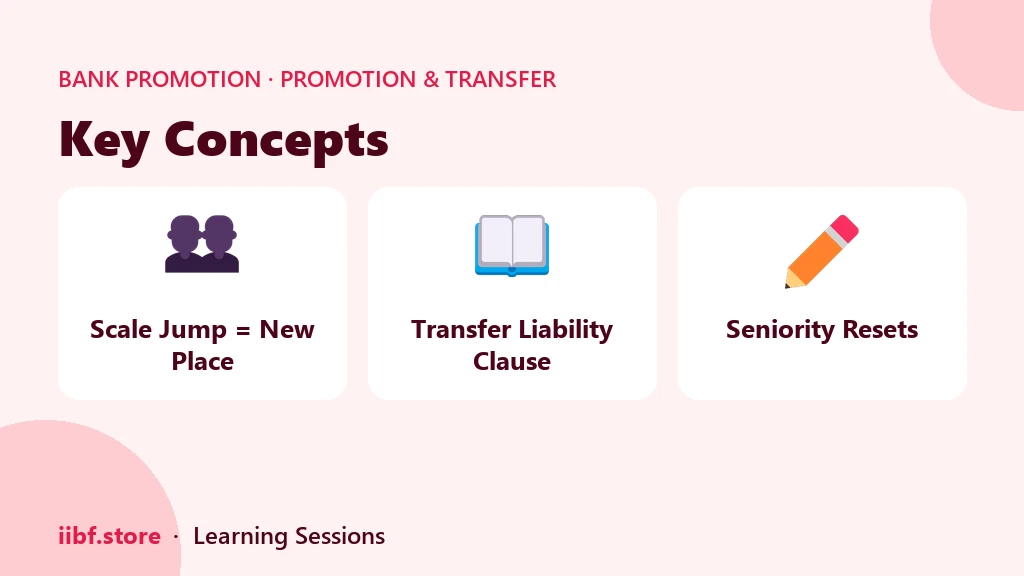
Most promotion policies carry a line like "the promotion carries transfer liability across the bank" or "all-India transfer liability". It means what it says. Once you accept, the bank may post you anywhere inside the geography that the scale covers. Scale I to Scale II is often inside the same zone or a neighbouring one. Scale III widens the map quickly. Senior scales are typically all-India.
Two things people consistently get wrong:
- Declining is usually allowed, but it is not free. Most banks permit an officer to decline, but many attach a cooling period before you can appear again. Meanwhile the colleagues who accepted move permanently ahead of you in the seniority list, and seniority is what drives every later posting and promotion.
- Preference is an input, not a promise. The option form asks for preferred centres. Vacancy position decides the outcome. Treat your preference list as a request that will be honoured only if the numbers allow it.
Because policies differ from bank to bank, the only document that binds you is your own bank's promotion policy circular for the current cycle. Read it before you sign anything. Do not rely on what a colleague remembers from three years ago.
Scale I to Scale II: what actually changes
| Aspect | Scale I (JMGS-I) | Scale II (MMGS-II) |
|---|---|---|
| Typical role | Branch officer, field officer, specialist desk | Manager or second-in-command at a branch, or a controlling office desk |
| Sanctioning powers | Limited, as delegated in the loan policy | Materially higher, with personal accountability for the decision |
| Transfer liability | Usually within a region or zone | Wider zone, often inter-state depending on the bank |
| Seniority effect | Fixed at the time of joining | Re-fixed by promotion date, which drives all later postings |
| Accountability | Process compliance | Credit decisions, staff supervision and audit outcomes |
The row that people underestimate is the last one. The pay difference between two scales is visible on a payslip. The accountability difference is not, and it is the part that changes how your working day feels.
The money question, answered honestly
A scale change raises basic pay and the allowances that sit on top of it, and it raises your eventual pension base. Over a full career the compounding is significant, which is why the standard advice is to take the promotion when it comes.
But the arithmetic is not only on the credit side. A transfer after promotion often creates two households instead of one, a school change mid-year, a spouse who has to choose between their own job and the move, and a travel bill that recurs every month. None of that appears in the increment letter. Officers who compare only the gross pay figure are the ones who feel cheated a year later.
Do the honest sum. Take the monthly increase in net pay, subtract the realistic monthly cost of running the new arrangement, and look at what is left. If the number is still positive and the posting is inside a geography you can live with, the decision is easy. If it is negative for a defined period and you can name the date it turns positive, it is still usually worth taking. If you cannot name that date at all, that is the conversation to have with your family before you sign.
How to prepare so the move does not wreck you
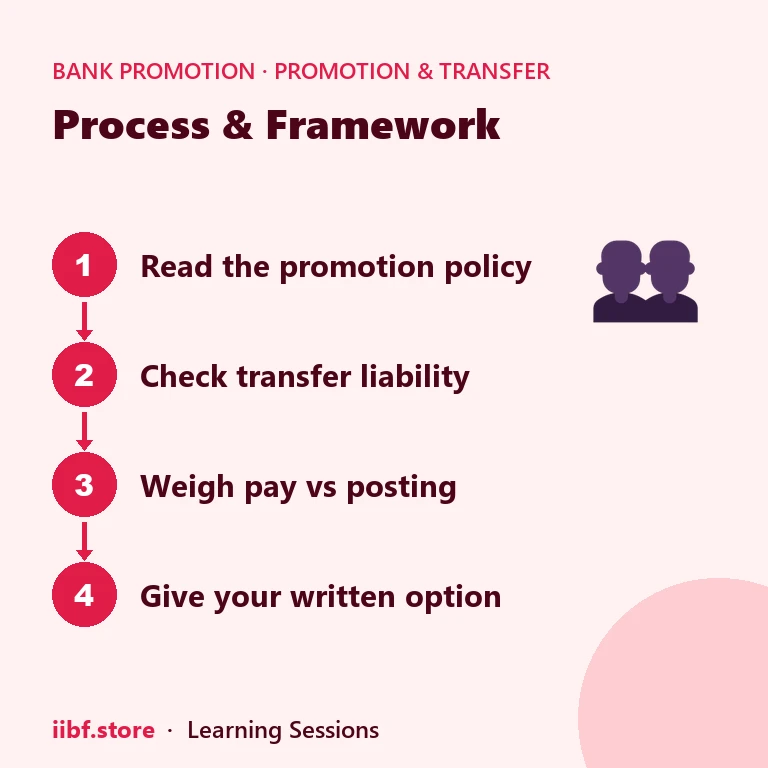
Preparation starts long before the result. Keep a personal file with your promotion policy, your last three appraisals, your certification certificates and your service record. When the option form opens you will have days, not weeks.
Rank your preferred centres by what your family can absorb, not by what looks good on paper. A centre with a school your child can join mid-session beats a metro posting that sounds prestigious. If your bank allows a request for a specific vertical along with the centre, use it. A credit desk in a mid-sized town is often a better learning posting than a crowded branch in a large city.
Finally, plan the handover you are leaving behind. Officers who leave a clean, documented handover are remembered by controllers, and controllers are the people who decide your next posting.
Where JAIIB and CAIIB fit into all of this
Certifications do not remove transfer liability. What they do is change which promotions you are eligible for, and how early. Most banks under the bipartite settlement grant increments for JAIIB and CAIIB and give weight to them in the promotion process, though the exact number of increments and marks varies by bank, so check your own HR circular rather than assuming.
The practical value is different from the paper value. An officer who has actually worked through the JAIIB syllabus handles a Scale II credit file with far less panic, because the terms in the file are already familiar. The same applies to CAIIB when you reach the point where you are analysing balance sheets rather than filling forms. If you are preparing while posted at a busy branch, build the study around your shift with a study planner and keep testing yourself with practice tests instead of only reading.
One last point that officers discover late. The period immediately after a transfer after promotion is the worst possible time to start a certification, because you are settling a house and learning a new branch at the same time. If a promotion cycle is coming, clear the paper before the posting order arrives, not after.
Frequently asked questions
Can I refuse a transfer after promotion and keep the promotion?
Generally no. The promotion and the posting come as a package, because the higher scale exists at a specific place. Most banks let you decline the promotion itself, but not the posting that comes with it. Check the exact wording in your bank's current promotion policy.
How far can I be posted after moving from Scale I to Scale II?
It depends entirely on your bank's policy and its vacancy position. Scale I to Scale II is commonly within the same zone or an adjoining one, while higher scales carry wider and often all-India liability. Your preference list is considered but does not override vacancies.
Does declining a promotion damage my career permanently?
It does not end it, but it has a real cost. Colleagues who accepted move ahead of you in the seniority list permanently, and many banks impose a cooling period before you can appear again. Take the decision knowing that seniority, once lost, is not recovered later.
Do JAIIB and CAIIB reduce the chance of a difficult posting?
No. They improve eligibility, increments and marks in the promotion process, but they do not change transfer liability. What they genuinely change is how prepared you are for the higher-scale work once you reach the new branch. Start with the free material on the Learning Sessions blog.
Prefer revising from a printed book?
Chapter-wise books with MCQs after every chapter — minimal pages, complete coverage, delivered anywhere in India. Every book has a free sample to read first.
131 pages · 672 MCQs
Learning Sessions · Ashish Sir
221 pages · 831 MCQs
Learning Sessions · Ashish Sir
128 pages · 524 MCQs
Learning Sessions · Ashish Sir
107 pages · 445 MCQs
Learning Sessions · Ashish Sir
148 pages · 478 MCQs
Learning Sessions · Ashish Sir
151 pages · 465 MCQs
Learning Sessions · Ashish Sir
148 pages · 375 MCQs
Learning Sessions · Ashish Sir
216 pages · 895 MCQs
Learning Sessions · Ashish Sir
109 pages · 300 MCQs
Learning Sessions · Ashish Sir
104 pages · 360 MCQs
Learning Sessions · Ashish Sir
82 pages · 297 MCQs
Learning Sessions · Ashish Sir
151 pages · 600 MCQs
Learning Sessions · Ashish Sir
98 pages · 282 MCQs
Learning Sessions · Ashish Sir
132 pages · 225 MCQs
Learning Sessions · Ashish Sir
188 pages · 435 MCQs
Learning Sessions · Ashish Sir
117 pages · 236 MCQs
Learning Sessions · Ashish Sir
Learning Sessions · Ashish Sir
118 pages · 299 MCQs
Learning Sessions · Ashish Sir
Learning Sessions · Ashish Sir
Learning Sessions · Ashish Sir
Learning Sessions · Ashish Sir
115 pages · 255 MCQs
Learning Sessions · Ashish Sir
Learning Sessions · Ashish Sir
334 pages · 936 MCQs
Learning Sessions · Ashish Sir
Learning Sessions · Ashish Sir
115 pages · 344 MCQs
Learning Sessions · Ashish Sir
107 pages · 240 MCQs
Learning Sessions · Ashish Sir
90 pages · 150 MCQs
Learning Sessions · Ashish Sir
Learning Sessions · Ashish Sir
Practice this topic
Take a free mock test, download chapter PDFs, or watch a video class — all included on iibf.store.