Bank Promotion Exam Notes 2026: What Is Inside the Six Volumes
It is 9:40 pm. The branch closed hours ago, the last reconciliation is finally done, and the promotion exam is somewhere on the horizon. You open a folder of forwarded PDFs, old circular scans and half-finished notes, and the syllabus feels endless. If that is your evening, you are not lazy and you are not behind. You are simply doing a full-time job and a second job of preparation at the same time.
This article is a tour of how our bank promotion exam notes are organised, so you can picture exactly what you would be studying before you spend a rupee. Even if you never buy anything, the way we have broken the syllabus into volumes is a method you can copy for your own notes.
Why a promotion syllabus feels endless
A bank promotion paper does not test one subject. In a single sitting you may be asked about the Banking Regulation Act, a KYC rule, a priority sector target, a forex term and a recent RBI direction. Each topic on its own is manageable. The trouble is that they are scattered across acts, master directions, circulars and textbooks, and nobody hands you a map.
Most tired candidates make one of three mistakes:
- They read in the order notes arrive, so they know a few chapters very well and others not at all.
- They read without testing themselves, so everything feels familiar until the question paper makes it strange.
- They collect more material every week and never finish any of it.
The fix is boring but it works: a fixed structure, small daily blocks, and questions after every topic. That is the thinking behind how the booklets are built.
How the six volumes are organised
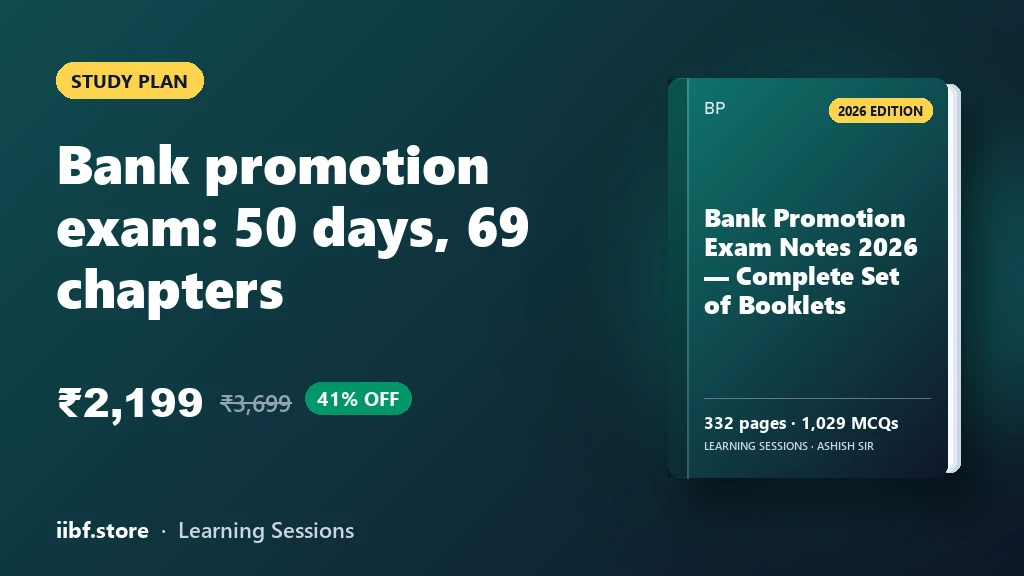
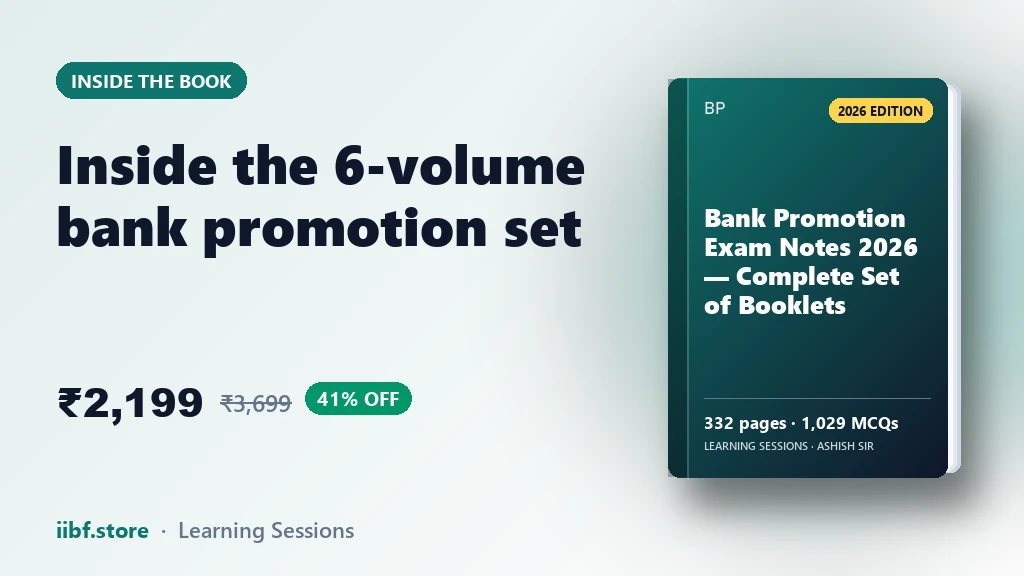
The set has 332 pages across six volumes and 69 chapters, with 1,029 MCQs spread through them. Instead of one giant book, you get six themed booklets you can carry, finish and tick off. Here is the map:
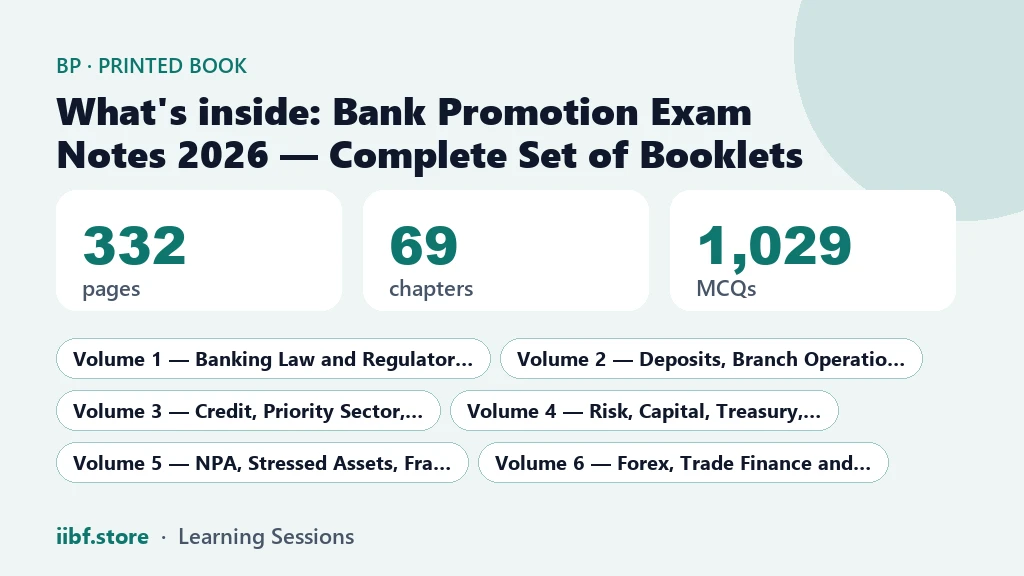
| Volume | Theme | Chapters |
|---|---|---|
| Volume 1 | Banking Law and Regulatory Framework | 12 |
| Volume 2 | Deposits, Branch Operations and Customer Protection | 15 |
| Volume 3 | Credit, Priority Sector, MSME and Government Schemes | 11 |
| Volume 4 | Risk, Capital, Treasury, ALM and Payment Systems | 11 |
| Volume 5 | NPA, Stressed Assets, Fraud, Recovery and Insolvency | 10 |
| Volume 6 | Forex, Trade Finance and Taxation for Bankers | 10 |
The order is deliberate. Law comes first because almost everything later rests on it. Branch operations and customer protection come next because they are what you live with every day. Credit, risk and treasury follow, then the recovery side, and finally the outward-looking topics of forex and tax.
Volume 1: the legal base
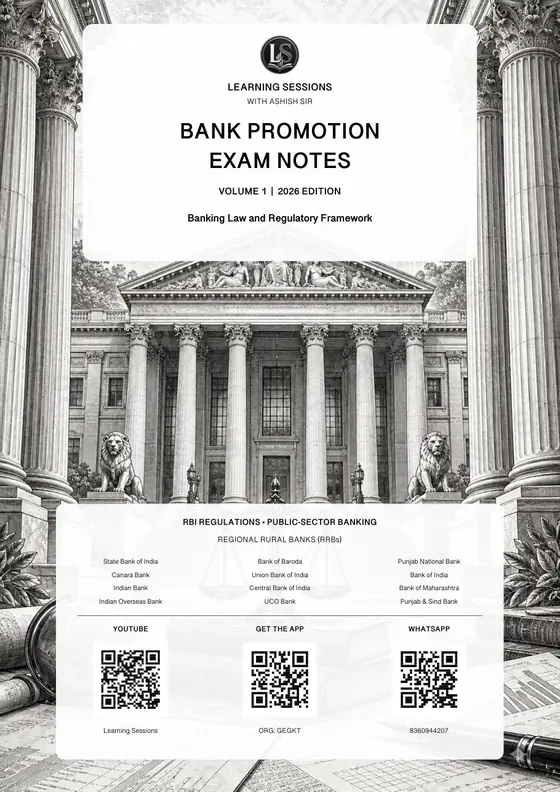
Twelve chapters cover the Banking Regulation Act, 1949, the Banking Laws (Amendment) Act, 2025, the RBI Act, 1934 and the Negotiable Instruments Act, 1881. They continue into the paying and collecting banker (cheques, CTS and Positive Pay), the banker-customer relationship, types of customers, loan documentation and stamp duty, securities, charges and mortgages, bank licensing, and loans to directors with the RTI Act.
Volume 2: the branch you know, in exam form
This is the largest volume at fifteen chapters: deposit interest rules, nomination, lockers and safe custody, deceased depositor claims, KYC and PMLA, financial inclusion and Jan Suraksha schemes, DICGC, customer service, the RBI Integrated Ombudsman Scheme 2026, the Consumer Protection Act, 2019, cyber fraud and mule accounts, data protection, the Account Aggregator framework, small savings and cash management.
Volumes 3 and 4: credit, then risk and money
Volume 3 takes credit appraisal, priority sector lending, MSME, TReDS, agriculture, housing, education, gold loans, digital lending and co-lending. Volume 4 moves to monetary policy, money markets, Basel III, liquidity and ALM, exposure norms, payment systems, the e-Rupee, green deposits, CAMELS, RBS and PCA, and investment classification.
Volumes 5 and 6: recovery, forex and tax
Volume 5 handles income recognition and provisioning, wilful defaulters, fraud risk, resolution of stressed assets, ARCs, the Limitation Act, SARFAESI, DRT, Lok Adalat, fair recovery practices and the IBC. Volume 6 closes with FEMA, LRS and TCS, forex dealing, bank guarantees, letters of credit and UCP 600, Incoterms, export finance, GST and the Income-tax Act, 2025 for bankers.
You can browse the full chapter list on the bank promotion exam notes book page and read the free sample before deciding anything.
What one chapter looks like
Every chapter follows the same rhythm, which is the real time-saver. You stop deciding how to study and just follow the pattern:
- Concise notes. The rule, the section or direction, and the logic behind it, in short paragraphs instead of legal prose.
- Key points. The facts an examiner loves to ask: thresholds, who does what, what is allowed and what is not.
- MCQs. Questions on that chapter alone, so you test yourself while the topic is fresh.
With 1,029 MCQs over 69 chapters, there is practice for every chapter. That is enough to expose whether you understood a topic or only recognised it.
A practical way to use a chapter on a weekday night: 20 minutes on the notes, 5 minutes on the key points, 15 minutes on the MCQs. Forty minutes, one chapter, and a clear score at the end. On a weekend you can double up.
The extras: awareness, economics and English
Beyond the six volumes, the set includes three extras: a Banking Awareness Capsule, Economics for the PNB promotion exam, and General English. These matter because promotion papers are rarely pure banking. Candidates who ignore English and economics because they feel "non-core" often lose marks where they were easiest to earn.
Treat the extras as your short-session material. They suit a bus ride, a lunch break or the ten minutes before sleep, when the heavier legal chapters would be too much.
A study plan built around the volumes
Because the structure is modular, planning becomes simple. Here is a method that fits a working schedule:
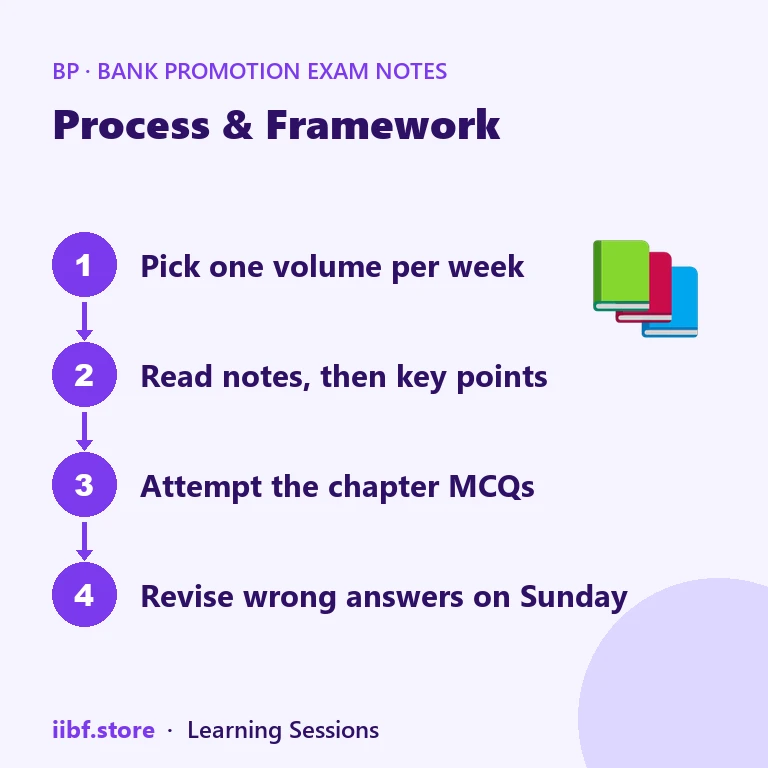
Pick one volume at a time
Never run two volumes in parallel. Choose the volume closest to your daily work first; confidence from an early win keeps you going. For many branch staff that is Volume 2, then Volume 3.
Read, then test the same day
Do not postpone MCQs to "after I finish the volume". Questions on the same evening are what move facts into memory.
Keep a wrong-answer list
Every missed MCQ goes into one page of your own notebook: the question in a line, the right answer in a line. On Sunday, revise only that page. After a few weeks it becomes the most valuable page you own.
| Day | Block | Time |
|---|---|---|
| Mon to Thu | One chapter: notes, key points, MCQs | About 40 minutes |
| Friday | Extras: awareness, economics or English | 20 to 30 minutes |
| Saturday | Two chapters plus a free mock test | 2 hours |
| Sunday | Revise the wrong-answer list | 45 minutes |
At this pace a 10 to 15 chapter volume takes roughly three weeks, and the whole set fits in a few months of steady effort. Adjust it to your own exam date, which you should confirm on the official IIBF website and your own bank's circular.
Who gets the most out of it
- Clerks and officers who know branch work but have never seen it organised as an exam syllabus.
- Candidates who postponed because the volume of material felt unmanageable, and want one structured source.
- Anyone short on time who needs notes that can be finished in small blocks.
- Revision-stage candidates who already studied once and want key points and MCQs to sharpen recall.
It is less suited to someone who wants full-length legal commentary on every act. These are exam notes, built to be finished, not a reference library.
One honest limit: any set of notes, ours included, will not give you exam-hall speed on its own. Pair it with timed practice. Our free mock tests and the free study material are a sensible companion, and you can compare other titles on the books page.
Price and how to decide
At the time of writing the complete set is listed at ₹2,199 against an MRP of ₹3,699, which is 41% off. Prices can change, so treat the book page as the current word. Start with the free sample, read one chapter, and see whether the style helps you. If it does, you have your answer. If not, you have lost nothing and still have the method above.
Whatever you choose, the principle holds: one volume, one chapter, one evening block, questions straight after. The bank promotion exam notes are only a tool; the habit is what clears the paper.
Frequently asked questions
How many chapters and questions are in the set?
The set has six volumes, 69 chapters, 332 pages and 1,029 MCQs, plus three extras: a Banking Awareness Capsule, Economics for the PNB promotion exam, and General English.
Can I read a sample before ordering?
Yes. The book page has a free sample so you can judge the style of the notes, key points and MCQs before you decide.
Is this enough on its own to clear the exam?
No single book guarantees a result. Use the notes for understanding, then add timed mock tests so you build speed and learn your weak areas. Check the official IIBF site and your bank's circular for the exam schedule.
How long should the whole set take?
At roughly one chapter a night on weekdays and a longer weekend session, most working candidates finish a volume in about three weeks. Your pace will depend on your job and the time you have.
Prefer revising from a printed book?
Chapter-wise books with MCQs after every chapter — minimal pages, complete coverage, delivered anywhere in India. Every book has a free sample to read first.






Practice this topic
Take a free mock test, download chapter PDFs, or watch a video class — all included on iibf.store.