Performance Management in Banks: A 2026 CAIIB HRM Guide

For any banker preparing for the CAIIB Human Resources Management paper, performance management is one of the most exam-heavy and practically useful chapters you will study. It is not the same as a once-a-year appraisal form. In a modern Indian bank, it is a continuous, structured process that links each employee's daily work to the institution's business plan, RBI-driven compliance targets and customer-service goals. Get this concept right and you can answer both the theory questions and the case-study style questions that the IIBF increasingly favours.
This guide breaks the topic down the way the syllabus does: what the process actually is, how appraisal and KPIs work, how feedback and reward systems close the loop, and where the system commonly fails. Throughout, the focus stays on Indian public-sector and private banks in 2026, so the examples are exam-relevant and grounded in how HR departments at SBI, PNB, HDFC Bank and ICICI Bank really operate.
What Performance Management Really Means in a Bank
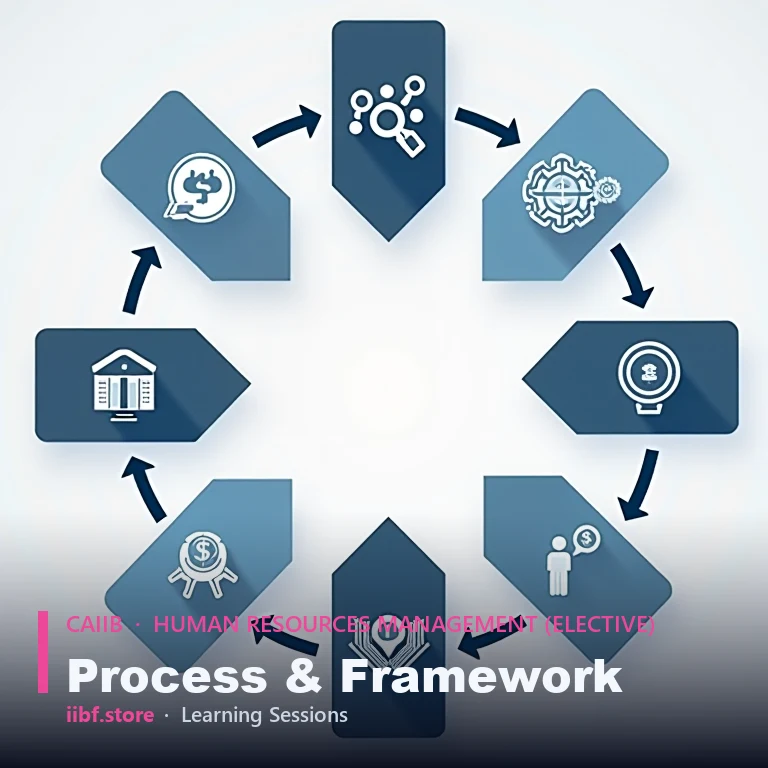
At its core, performance management is the ongoing cycle of planning, monitoring, developing, rating and rewarding employee output so that individual effort aligns with organisational strategy. The IIBF syllabus stresses that it is a system, not a single event. The classic cycle has four stages:
- Planning: at the start of the year, the manager and employee agree on goals, key result areas (KRAs) and measurable targets such as CASA growth, advances disbursed or NPA recovery.
- Monitoring: performance is tracked continuously through MIS dashboards, branch reviews and quarterly check-ins rather than waiting for March.
- Developing: gaps are addressed through coaching, e-learning, job rotation and IIBF certifications.
- Rating and rewarding: the appraisal score feeds into increments, promotions, incentives and career planning.
The distinction the exam loves is performance appraisal versus performance management. Appraisal is the backward-looking measurement event; management is the forward-looking, year-round system that includes appraisal but also goal-setting, feedback and development. In banks, this matters because regulators and boards now expect HR to demonstrate that pay, especially variable pay for senior staff, is genuinely linked to risk-adjusted performance, a principle reinforced by RBI's compensation guidelines for whole-time directors and material risk-takers.
Performance Appraisal Methods and KPIs Used by Indian Banks
Indian banks use a blend of traditional and modern appraisal methods, and the CAIIB exam expects you to recognise each by name. Traditional methods include the graphic rating scale, ranking, paired comparison and the checklist method. More advanced approaches that feature heavily in questions are:
- Management by Objectives (MBO): jointly set, measurable objectives reviewed against actual results. Widely used for officers and managers.
- 360-degree feedback: ratings collected from superiors, peers, subordinates and sometimes customers, used mainly for senior and leadership roles.
- Behaviourally Anchored Rating Scales (BARS): ties numerical ratings to specific observable behaviours, reducing rater bias.
- Balanced Scorecard: measures performance across financial, customer, internal-process and learning-and-growth perspectives, popular at the branch and zonal level.
The metrics themselves are Key Performance Indicators (KPIs). For a branch banker these typically combine business KPIs (deposit and advances growth, fee income, cross-sell ratio), quality KPIs (NPA slippage, audit rating, compliance breaches) and service KPIs (turnaround time, customer complaints, digital adoption). A common exam trap is confusing KPIs with KRAs: KRAs are the broad areas of responsibility, while KPIs are the specific, quantified measures within them. Understanding this difference is exactly the kind of conceptual clarity tested in the CAIIB HRM paper, and it also shows up in objective questions on the JAIIB Principles of Banking module.

Feedback, Counselling and the Role of the Appraiser
An appraisal score is useless if it is never communicated well, which is why performance management places heavy weight on the feedback interview. The IIBF syllabus expects candidates to know the principles of effective feedback: it should be timely, specific, behaviour-focused rather than personality-focused, two-way, and forward-looking. Good banks train appraisers to use the appraisal discussion as a coaching conversation, not a verdict.
Several feedback and counselling concepts recur in exam questions:
- The halo and horn effects — letting one strong or weak trait colour the entire rating.
- Central tendency — rating everyone as average to avoid conflict, a chronic problem in public-sector banks.
- Recency bias — over-weighting events from the last few weeks before the review.
- Leniency and strictness errors — consistently inflating or deflating scores.
The remedy is a structured process: documented evidence collected through the year, calibration meetings where managers compare ratings to ensure fairness, and a normalisation or bell-curve distribution that forces differentiation. Counselling extends feedback into development planning, where the manager helps the employee set learning goals, perhaps an IIBF certificate or a digital-banking course, and agrees on support. For exam revision, practising scenario questions on rater bias pays off; you can drill these through structured mock tests and reinforce the terminology with quick recall using the match game.
Reward Systems, Promotions and Linking Pay to Performance
The final loop of the cycle is reward. In Indian banks, performance feeds into a layered reward system: annual increments governed by bipartite settlements and the wage revision in public-sector banks, performance-linked incentives (PLI), promotions, and non-monetary recognition. Since the RBI's tightening of compensation norms, banks must ensure that variable pay for senior management and material risk-takers is deferred, risk-adjusted and subject to malus and clawback if performance later proves to have created hidden risk.
Exam-relevant reward concepts include:
- Intrinsic vs extrinsic rewards: recognition, autonomy and growth versus pay, bonus and perks.
- Equity theory and expectation theory: employees compare their effort-reward ratio with peers, so perceived fairness drives motivation.
- Pay-for-performance: tying a meaningful slice of compensation to measured results, balanced against the risk of encouraging mis-selling.
Promotion policy is a frequent question area. Public-sector banks typically use a mix of seniority and merit, with written tests, interviews and appraisal scores, while private banks lean more heavily on performance ratings and potential assessment. The thoughtful banker recognises the tension: reward systems must motivate without distorting behaviour, which is why customer-complaint and compliance KPIs act as negative weights that can pull an otherwise high scorer down. Staying current on the regulatory backdrop, including RBI circulars on compensation, is easier if you track updates through IIBF news and the latest policy RBI rates that influence business targets.
Common Pitfalls and Modern Trends in 2026
Even a well-designed system fails if execution is poor. The most common pitfalls the exam highlights are an over-emphasis on numbers that ignores behaviour and compliance, a once-a-year ritual with no continuous feedback, and ratings undermined by central tendency and bias. In 2026, Indian banks are moving toward continuous performance management: lighter, more frequent check-ins; data-driven dashboards; and the use of analytics to spot flight risk and skill gaps early.
Other live trends worth a line in your answer are the integration of competency frameworks, the growing weight on digital-adoption and customer-experience KPIs, and a stronger focus on ethics and conduct so that performance is never rewarded at the cost of compliance with norms such as KYC, AML under the PMLA 2002, and fair-practice codes. A modern bank treats performance management as a strategic HR lever, not a paperwork exercise. For deeper reading and exam strategy, explore more articles on the IIBF blog.
Frequently Asked Questions
📖 Also read: recruitment and selection in banks.
📖 Also read: conflict management in banks.
📖 Also read: emotional intelligence for bank managers.
Also read: succession planning in banks — Succession Planning in Banks: Building the Next Leadership Bench
What is the difference between performance appraisal and performance management?
Performance appraisal is the periodic measurement event that rates past performance. Performance management is the broader, continuous system that includes goal-setting, monitoring, feedback, development and rewards. Appraisal is one component; management is the whole year-round cycle that links individual output to the bank's strategy and compliance objectives.
Which appraisal methods are most important for the CAIIB HRM exam?
Focus on Management by Objectives, 360-degree feedback, Behaviourally Anchored Rating Scales and the Balanced Scorecard among modern methods, plus graphic rating scales, ranking and paired comparison among traditional ones. Knowing which method suits which level of staff, and the bias each one reduces, is frequently tested in objective and case questions.
How are rater biases controlled in bank appraisals?
Banks counter halo, horn, central-tendency, recency and leniency errors through documented year-round evidence, appraiser training, calibration meetings and a normalisation or bell-curve distribution that forces differentiation. Structured feedback interviews and multi-rater inputs such as 360-degree feedback further reduce single-rater distortion and improve the fairness of final ratings.
How is pay linked to performance in Indian banks in 2026?
Appraisal scores feed increments, performance-linked incentives, promotions and recognition. For senior management and material risk-takers, RBI norms require variable pay to be deferred, risk-adjusted and subject to malus and clawback. Compliance and customer-complaint KPIs act as negative weights, so high business numbers alone do not guarantee top rewards.
Final Takeaways
Performance management is a continuous, four-stage cycle of planning, monitoring, developing and rewarding that connects every banker's work to institutional strategy and regulatory expectations. Master the appraisal methods, KPIs, feedback principles and reward concepts in this chapter and you will comfortably handle both theory and case questions in the CAIIB HRM paper. Ready to test yourself? Take a full-length practice set on IIBF mock tests or enrol in the complete CAIIB course to lock in your score before exam day.
Authoritative compensation and conduct rules referenced here are issued by the regulator; read them directly at the Reserve Bank of India.
Free Revision PDFs — One-Liners & True/False
Printable last-minute revision sheets for Performance Management in Banks: A 2026 CAIIB HRM Guide: 20 quick-fire one-liners and 20 true/false questions, each with answers & explanations. Free to download and share.
Quick quiz on this topic
5 exam-style questions from our free test bank — check yourself before you move on.
Practice this topic
Take a free mock test, download chapter PDFs, or watch a video class — all included on iibf.store.
Keep reading