
5 CAIIB Exam Mistakes That Ruin Your First Attempt (2026)
Most CAIIB failures have nothing to do with intelligence or effort. They come from a short list of avoidable CAIIB exam mistakes that candidates repeat cycle after cycle — study habits imported from JAIIB, marks left on the table in numericals, and a passing rule that most people have never actually read. Fix these five and your first attempt stops being a trial run.
The 60-second version is below, straight from our Learning Sessions channel. The detailed fixes follow.
5 mistakes in CAIIB exams — 60-second Short (Learning Sessions) · Watch on YouTube
Mistake #5: Treating CAIIB like JAIIB Part 2
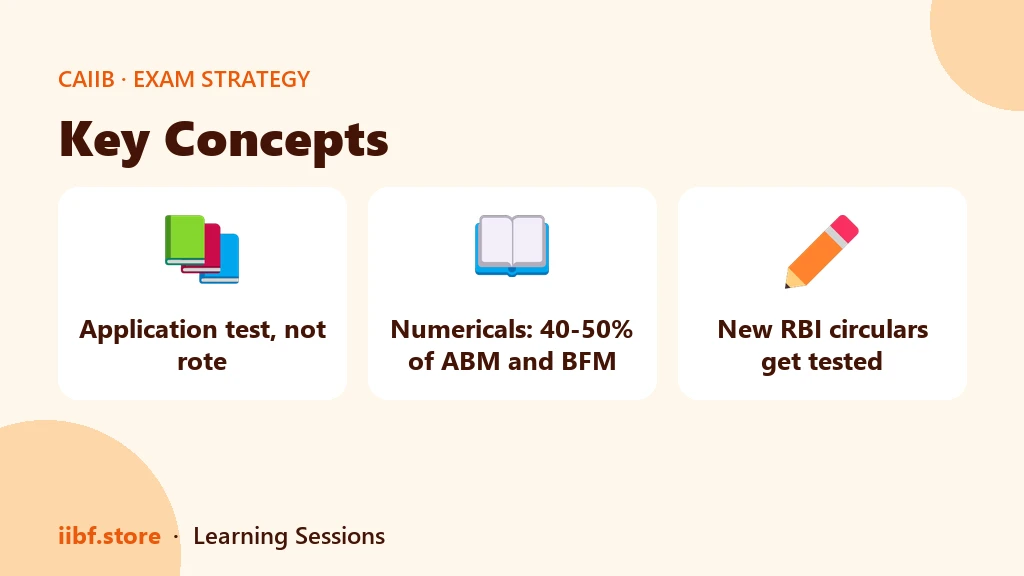
This is the most natural mistake in the world, because the exams look like siblings — same institute, same Macmillan books, same MCQ format. But JAIIB is largely a memory test: definitions, features, straight recall. CAIIB is an application test. The question does not ask you to define duration; it gives you a bond and asks what happens to its price when yields move 50 basis points. It does not ask what IRAC norms are; it gives you an account history and asks you to classify it.
Candidates who cleared JAIIB comfortably with rote learning walk into CAIIB with the same method and get ambushed. The fix is to change how you study, not how much: after every concept, immediately solve five application questions on it. If you can only recite it, you have not learned it yet — not by CAIIB's standard.
Mistake #4: Skipping numericals and case studies
Roughly 40–50% of the ABM and BFM papers comes from numericals and case studies — and these are precisely the questions most candidates run away from. Think about what that means: the majority of aspirants are competing for only half the paper, while the candidates who practise calculations quietly collect the other half almost uncontested.
The marks are where the crowd is not. Standard deviation, regression and probability in ABM; bond pricing, duration, forex arithmetic and capital adequacy in BFM — these repeat in recognisable patterns every cycle. Two or three numericals a day for eight weeks makes them routine. Skipping them means volunteering to fight for half marks.
Mistake #3: Reading only the Macmillan books
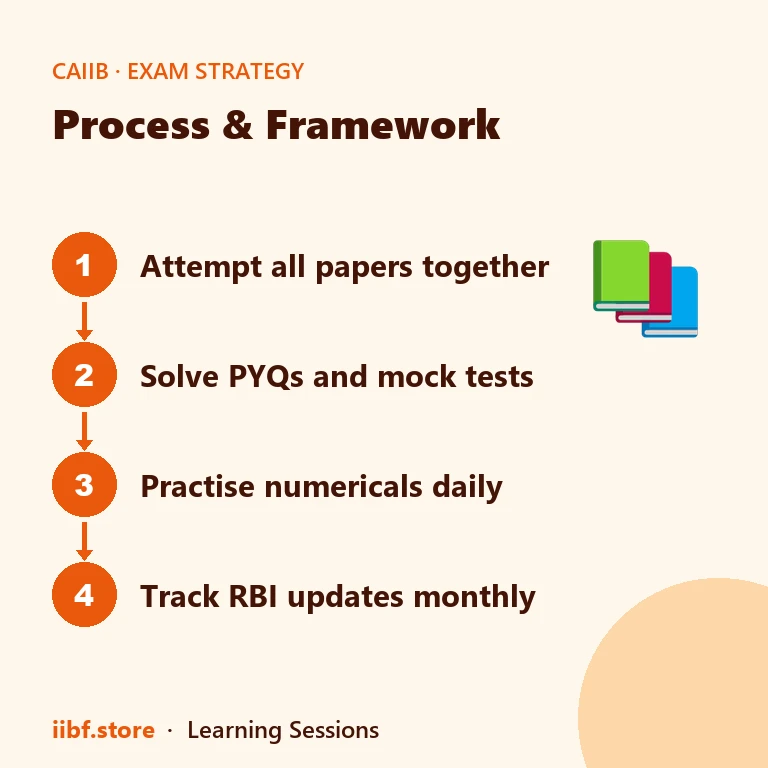
The Macmillan courseware is the syllabus — read it. But the book alone does not teach you the language of the exam: how IIBF frames a question, which chapters it mines heavily, what a distractor option looks like. Only previous-year questions and mock tests teach that dialect.
Candidates who walk in having read 900 pages but never sat a timed 100-question paper discover two brutal things simultaneously: the questions feel unfamiliar even when the concepts are known, and two hours is shorter than it sounds. Take full-length mock tests under exam timing from at least a month out, and review every wrong answer until you can explain why the right option is right.
Mistake #2: Ignoring fresh RBI circulars
CAIIB papers are set from the living regulatory landscape, not from a frozen textbook. New master directions, revised prudential norms, updated limits — the paper reliably picks up recent circulars, and in CAIIB there is some update to almost every chapter every year. A candidate quoting last year's numbers is wrong even when the textbook agrees with them.
The fix costs thirty minutes a week: skim the new circulars on the RBI website, and keep a one-page running list of changed numbers — repo rate, limits, thresholds, ratios. We track the headline figures on our RBI rates page precisely because they move under candidates' feet.
Mistake #1: Not knowing the passing rules (this one wastes whole attempts)
The biggest mistake is not academic at all. IIBF's passing rule has two routes: score 50 out of 100 in each paper, or score at least 45 in every paper with an aggregate of 50% across all papers in a single attempt — and the exam is cleared. That second route changes strategy completely.
A candidate who attempts papers one at a time must hit 50 in each, every time. A candidate who attempts all papers together has a safety margin: a rough day that ends at 46 in one paper can be rescued by a 58 in another. People who do not know this rule skip papers to "focus", and unknowingly throw away the aggregate cushion — wasting an entire attempt without realising it. Attempt everything together. The rule is on iibf.org.in, in the exam rules almost nobody reads.
Your December 2026 game plan
The next CAIIB cycle is close enough to plan backwards from. Registration runs from 1 to 21 September 2026 (late-fee slabs apply towards the end of the window). The papers then land on: ABM on 6 December, BFM on 12 December, ABFM on 13 December, BRBL on 20 December, and the electives on 27 December 2026 — always confirm against the official schedule on iibf.org.in before booking travel or leave. The calendar itself fixes nothing, though — most CAIIB exam mistakes are committed in these final months, when pressure replaces planning.
That leaves a clean five-month runway from today. A schedule that works: months one and two for concepts with daily application questions, months three and four for numericals and case studies plus weekly mocks, and the final month for previous-year papers, circular revision and your weak-area list. Our CAIIB course follows exactly this arc — concept classes, chapter tests and case-study drills for ABM, BFM, ABFM and BRBL — and the built-in study planner will space it out for your exam dates automatically.
Quick answers
If I score 44 in one paper but my aggregate is 55%, do I pass?
No. The aggregate route needs a minimum of 45 in every paper plus the 50% aggregate, in the same attempt. At 44, that paper is not cleared — though papers where you scored 50+ are, and you carry that credit forward.
Is attempting all CAIIB papers together really better than one at a time?
For most working bankers, yes. The syllabi overlap, the preparation momentum compounds, and only a full attempt activates the 45-plus-aggregate cushion. One-at-a-time feels safer but quietly removes your margin for a bad day.
Which CAIIB elective should I choose?
Pick the one nearest your daily work — Risk Management for credit and risk roles, Central Banking for treasury-adjacent roles, IT & Digital Banking if you live in systems. Familiarity is worth more marks than any "easiest elective" list.
Five CAIIB exam mistakes, five fixes, five months. Which of these were you making? The comment section under the video is full of people recognising themselves — better to recognise it now than in the results PDF.
Prefer revising from a printed book?
Chapter-wise books with MCQs after every chapter — minimal pages, complete coverage, delivered anywhere in India. Every book has a free sample to read first.
148 pages · 478 MCQs
Learning Sessions · Ashish Sir
151 pages · 465 MCQs
Learning Sessions · Ashish Sir
148 pages · 375 MCQs
Learning Sessions · Ashish Sir
216 pages · 895 MCQs
Learning Sessions · Ashish Sir
109 pages · 300 MCQs
Learning Sessions · Ashish Sir
104 pages · 360 MCQs
Learning Sessions · Ashish Sir
82 pages · 297 MCQs
Learning Sessions · Ashish Sir
151 pages · 600 MCQs
Learning Sessions · Ashish Sir
98 pages · 282 MCQs
Learning Sessions · Ashish Sir
131 pages · 672 MCQs
Learning Sessions · Ashish Sir
221 pages · 831 MCQs
Learning Sessions · Ashish Sir
128 pages · 524 MCQs
Learning Sessions · Ashish Sir
107 pages · 445 MCQs
Learning Sessions · Ashish Sir
132 pages · 225 MCQs
Learning Sessions · Ashish Sir
188 pages · 435 MCQs
Learning Sessions · Ashish Sir
117 pages · 236 MCQs
Learning Sessions · Ashish Sir
Learning Sessions · Ashish Sir
118 pages · 299 MCQs
Learning Sessions · Ashish Sir
Learning Sessions · Ashish Sir
Learning Sessions · Ashish Sir
Learning Sessions · Ashish Sir
115 pages · 255 MCQs
Learning Sessions · Ashish Sir
Learning Sessions · Ashish Sir
334 pages · 936 MCQs
Learning Sessions · Ashish Sir
Learning Sessions · Ashish Sir
115 pages · 344 MCQs
Learning Sessions · Ashish Sir
107 pages · 240 MCQs
Learning Sessions · Ashish Sir
90 pages · 150 MCQs
Learning Sessions · Ashish Sir
Learning Sessions · Ashish Sir
Quick quiz on this topic
5 exam-style questions from our free test bank — check yourself before you move on.
Practice this topic
Take a free mock test, download chapter PDFs, or watch a video class — all included on iibf.store.
Keep reading



