Moratorium Under Section 14 IBC: IBC 2016 Exam Guide
The moratorium under Section 14 IBC is one of the most heavily tested provisions in the Insolvency and Bankruptcy Code 2016 (IBC) syllabus, and for good reason: it is the legal shield that freezes a distressed company the moment the National Company Law Tribunal (NCLT) admits an insolvency application. For bankers, resolution professionals and IIBF aspirants alike, understanding this "calm period" is essential — it decides which recoveries can proceed, which are stayed, and how a corporate debtor is preserved as a going concern while creditors work towards a resolution plan. This guide breaks down Section 14 in exam-ready detail, with the exceptions, timelines and case-law nuances examiners love to probe.
🛡️ What the Moratorium Under Section 14 IBC Actually Freezes
When the Adjudicating Authority (the NCLT) admits an application to initiate the Corporate Insolvency Resolution Process, it must — by law — declare a moratorium under Section 14(1). This is not discretionary; it flows automatically from the order of admission and takes effect from the insolvency commencement date. During this period four categories of action are prohibited against the corporate debtor. First, the institution or continuation of any suit or proceeding, including execution of judgments, decrees or arbitration awards. Second, transferring, encumbering, alienating or disposing of any asset or legal right by the corporate debtor. Third, any action to foreclose, recover or enforce a security interest — including proceedings under the SARFAESI Act, 2002. Fourth, recovery of any property occupied by the corporate debtor from an owner or lessor.
The purpose is to create breathing space: creditors cannot dismember the company through parallel recovery actions, and the resolution professional can run the business as a single, protected pool of value. This going-concern principle is the backbone of the entire Code. If you are still building the foundations, revisit the structure of the IBC before layering on the moratorium rules.
💡 Exam Tip: The moratorium is declared by the NCLT (the Adjudicating Authority), not by the resolution professional or the Committee of Creditors. Getting the declaring authority right is a frequent one-mark grab.
⏳ When It Starts, How Long It Lasts
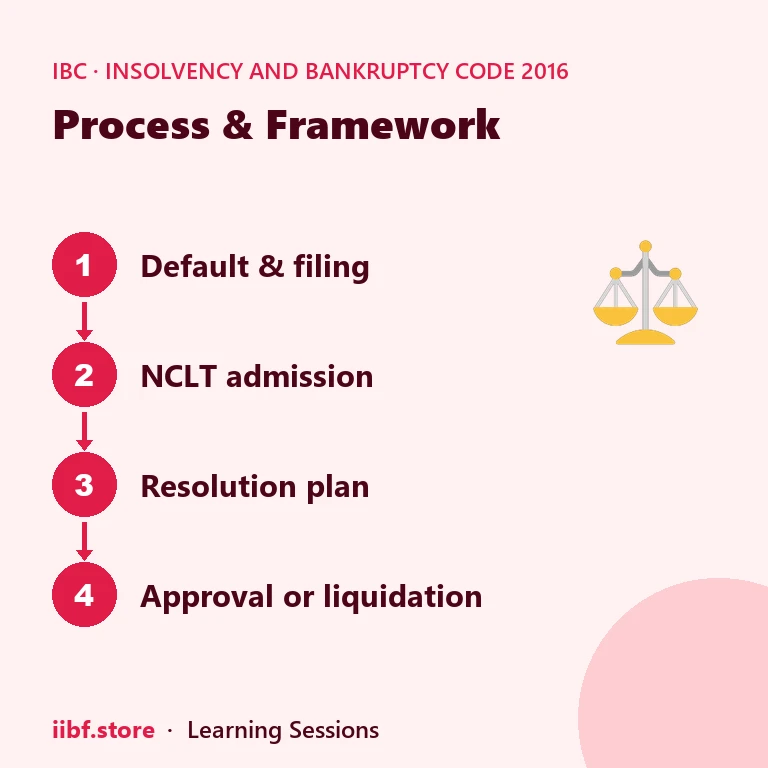
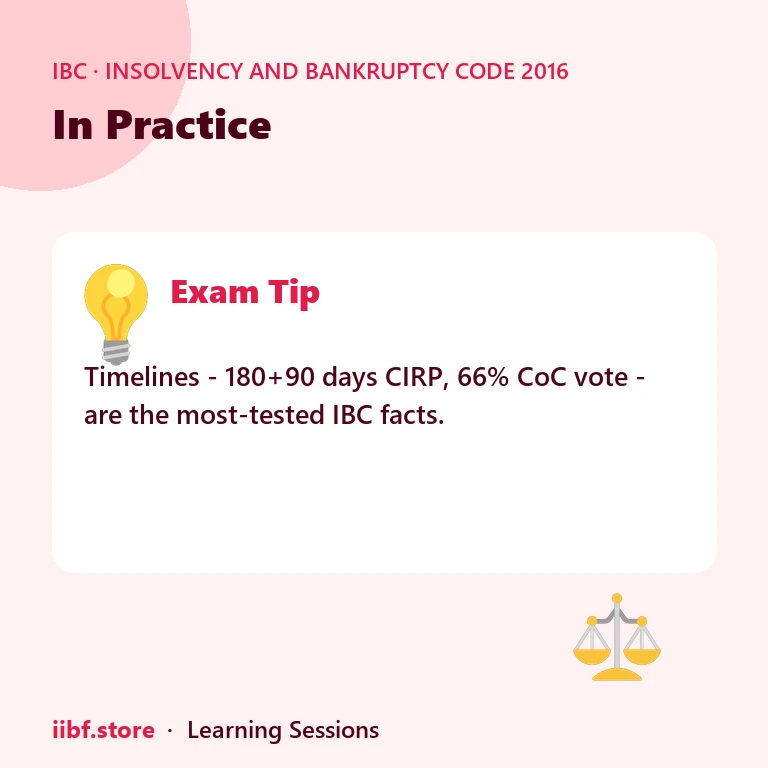
The moratorium under Section 14 IBC begins on the insolvency commencement date — the date the NCLT admits the application — and continues until the process ends. Under Section 14(4), it stays in force until the Adjudicating Authority either approves a resolution plan under Section 31(1) or passes an order for liquidation under Section 33. In other words, the "calm period" spans the entire duration of the Corporate Insolvency Resolution Process. The statutory CIRP clock of 180 days (extendable by 90 days, with an outer limit of 330 days including litigation) runs concurrently, so the moratorium and the resolution timeline effectively move together.
A key subtlety examiners exploit: the moratorium protects the corporate debtor's assets, but it does not extinguish the underlying debt or wipe out interest — it merely suspends enforcement. Nor does it apply to the assets of third parties such as guarantors, subsidiaries held for others, or property held in trust. Understanding exactly where the shield starts and stops separates a confident candidate from a guesser. For the fuller procedural picture, study how the commencement of CIRP triggers this protection, and how the initiation of the CIRP feeds into it.
📌 Remember: The moratorium ends on the earlier of two events — approval of a resolution plan (Section 31) or a liquidation order (Section 33). It does not simply lapse after 180 days.
⚖️ The Critical Exceptions in Section 14(2), (2A) and (3)
The moratorium is powerful but deliberately not absolute. Section 14(2) provides that the supply of essential goods or services to the corporate debtor cannot be terminated, suspended or interrupted during the moratorium period — the lights must stay on so the company can keep operating. The 2019 amendment inserted Section 14(2A), empowering the resolution professional to keep receiving supply of goods and services considered "critical" to preserving value and managing the company as a going concern, provided dues arising during the moratorium are paid.
Section 14(3) carves out two important carve-outs where the moratorium simply does not apply: (a) transactions, agreements or arrangements notified by the Central Government in consultation with a financial-sector regulator, and (b) — added by the 2018 amendment — a surety in a contract of guarantee to a corporate debtor. This second point is heavily examined: a creditor can still proceed against a personal guarantor even while the corporate debtor enjoys moratorium protection. This is closely tied to the mechanics of personal guarantor insolvency under IBC, and it is a favourite trap in multiple-choice questions. Section 14(3) also, through subsequent clarifications and the 2020 amendment, protects licences, permits, registrations, quotas and concessions from being suspended solely on the ground of insolvency.
⚠️ Common Mistake: Assuming the moratorium protects personal guarantors. Section 14(3)(b) expressly excludes sureties — creditors can enforce guarantees during CIRP.
📊 Moratorium: What Is Stayed vs What Continues
The clearest way to lock in Section 14 for the exam is a side-by-side view of what the moratorium blocks and what it deliberately lets through. Use the table below as a revision snapshot.
| Action / Item | Stayed by Moratorium? | Governing Sub-section |
|---|---|---|
| Suits, execution of decrees against the corporate debtor | ✅ Yes | 14(1)(a) |
| SARFAESI enforcement of security interest | ✅ Yes | 14(1)(c) |
| Transfer or disposal of the debtor's assets | ✅ Yes | 14(1)(b) |
| Recovery of property from the debtor by an owner/lessor | ✅ Yes | 14(1)(d) |
| Supply of essential / critical goods and services | ❌ No (must continue) | 14(2), 14(2A) |
| Proceedings against a personal guarantor (surety) | ❌ No | 14(3)(b) |
| Transactions notified by the Central Government | ❌ No | 14(3)(a) |
| Suspension of licences/permits on insolvency ground alone | ❌ No (protected) | 14(2A) / clarifications |
Master this grid and you can answer almost any Section 14 question at speed. To see how the moratorium interacts with clawback provisions, pair it with your reading on avoidance transactions under IBC, since both aim to protect the value of the corporate debtor's estate. If the resolution route fails and the company heads to liquidation, the priority of claims then follows the Section 53 liquidation waterfall.
🏦 Why the Moratorium Matters for Bankers and Recovery
For a lending banker, the moratorium changes the recovery playbook overnight. The instant CIRP is admitted, SARFAESI action, DRT proceedings and civil suits against the borrower company must stop. This is exactly why lenders often prefer to trigger or support the insolvency route deliberately — it consolidates all creditors into one forum and prevents a race to grab assets. Understanding this alongside the broader landscape of credit recovery laws for banks shows how IBC sits above SARFAESI and the DRT mechanism during CIRP.
Crucially, the moratorium is a pause, not a write-off. A secured creditor's charge survives; only its unilateral enforcement is suspended while the Committee of Creditors evaluates resolution plans. Bankers must also remember the guarantee carve-out — invoking a personal or corporate guarantee remains a live option and is often the fastest parallel recovery lever. Broader credit-delivery skills such as consortium lending also become relevant, since multiple banks in a consortium are all bound by the same moratorium once CIRP begins. For a structured revision path across all these provisions, browse the full Insolvency and Bankruptcy Code 2016 tag hub, and sharpen your timing with the free IIBF mock tests.
💡 Exam Tip: A secured creditor's security interest is not destroyed by the moratorium — enforcement is only suspended. The charge revives if CIRP fails and liquidation begins.
📚 Official reference: Always verify the latest rules, circulars and thresholds on the Insolvency and Bankruptcy Board of India (IBBI) website before your exam — regulations change and only primary sources are authoritative.
🧠 Practice MCQs: Moratorium Under Section 14 IBC
Q1. Under the IBC 2016, who declares the moratorium at the start of CIRP? (a) The Committee of Creditors (b) The resolution professional (c) The Adjudicating Authority (NCLT) (d) The Insolvency and Bankruptcy Board of India
Answer: (c) — Section 14(1) requires the Adjudicating Authority (NCLT) to declare the moratorium on admitting the CIRP application.
Q2. From which date does the Section 14 moratorium take effect? (a) The date the resolution plan is approved (b) The insolvency commencement date (c) The date the CoC is constituted (d) 14 days after admission
Answer: (b) — The moratorium operates from the insolvency commencement date, i.e. the date of admission of the application.
Q3. Which of the following is NOT stayed by the moratorium under Section 14? (a) SARFAESI enforcement against the corporate debtor (b) Execution of a decree against the debtor (c) Proceedings against a personal guarantor of the debtor (d) Transfer of the debtor's assets
Answer: (c) — Section 14(3)(b) excludes a surety in a contract of guarantee, so action against a personal guarantor may continue.
Q4. The moratorium under Section 14 continues until: (a) Exactly 180 days elapse (b) The CoC votes to close it (c) A resolution plan is approved or a liquidation order is passed (d) The IBBI issues a closure notice
Answer: (c) — Under Section 14(4) it lasts until approval of a resolution plan (Section 31) or a liquidation order (Section 33).
Q5. Which provision ensures supply of critical goods and services can be maintained during the moratorium? (a) Section 14(2A) (b) Section 29A (c) Section 53 (d) Section 7
Answer: (a) — Section 14(2A), inserted by the 2019 amendment, allows the RP to continue receiving critical supplies to preserve value.
Want chapter-wise mock tests with 100+ MCQs? Start practising free →
❓ Frequently Asked Questions
Does the moratorium under Section 14 IBC cancel the debt owed to banks?
No. It only suspends enforcement and recovery actions against the corporate debtor during CIRP. The debt, security interest and accrued interest remain intact; the creditor simply cannot enforce unilaterally while the moratorium is in force.
Can a bank proceed against a personal guarantor during the corporate debtor's moratorium?
Yes. Section 14(3)(b), inserted by the 2018 amendment, expressly excludes a surety in a contract of guarantee. Creditors can invoke and enforce personal or corporate guarantees even while the corporate debtor is protected.
What happens to essential utilities during the moratorium?
Under Section 14(2), supply of essential goods and services cannot be terminated or suspended. Section 14(2A) additionally lets the resolution professional keep receiving "critical" supplies needed to run the company as a going concern, subject to paying current dues.
When exactly does the moratorium end?
It ends on the earlier of two events under Section 14(4): the NCLT's approval of a resolution plan under Section 31, or an order for liquidation under Section 33. It does not automatically lapse after the 180-day CIRP window.
✅ Conclusion
The moratorium under Section 14 IBC is the legal "calm period" that keeps a distressed company whole while creditors pursue a resolution plan — freezing suits, SARFAESI action and asset transfers, while deliberately letting essential supplies flow and guarantee enforcement continue. Nail the declaring authority (NCLT), the start point (insolvency commencement date), the end point (resolution plan or liquidation), and the Section 14(3) exceptions, and you have covered the highest-yield questions on this topic. Ready to test yourself under exam conditions? Take a free timed quiz on the IIBF practice tests or explore structured prep in the JAIIB course to cement your IBC 2016 mastery.
Quick quiz on this topic
5 exam-style questions from our free test bank — check yourself before you move on.
Practice this topic
Take a free mock test, download chapter PDFs, or watch a video class — all included on iibf.store.