Co-Lending Model 2026: NBFC-Bank Partnership Guide

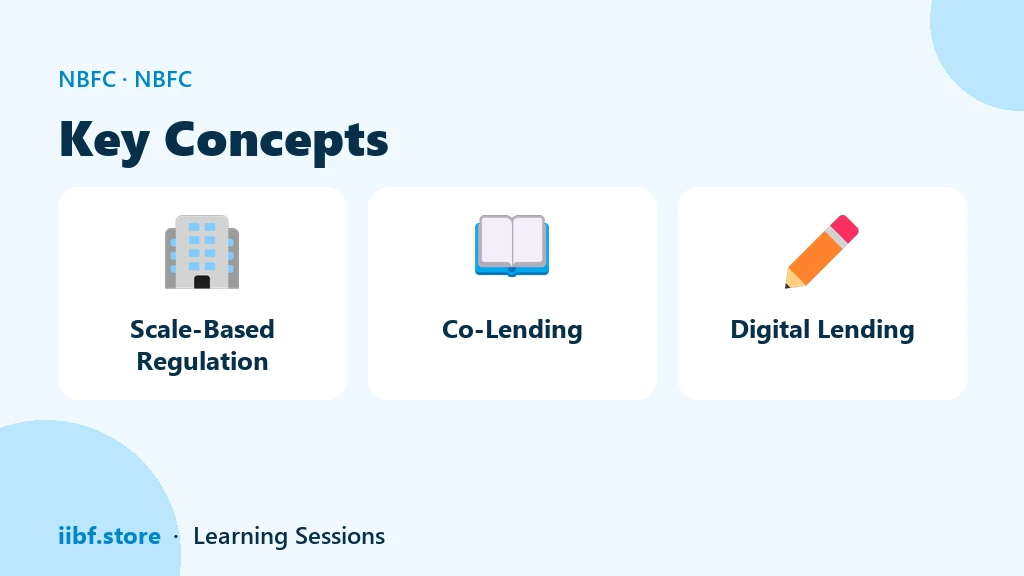
The co-lending model has become one of the defining features of India's credit landscape, and it is a must-know topic for anyone preparing for the IIBF NBFC certification in 2026. In simple terms, co-lending is a partnership in which a bank and a non-banking financial company (NBFC) jointly fund a single loan to a borrower, combining the bank's low-cost funds with the NBFC's last-mile reach. The Reserve Bank of India formalised this through its Co-Lending Model framework, and the arrangement has since channelled large volumes of credit into priority sectors, MSMEs, agriculture and retail borrowers who banks alone struggle to reach. This guide unpacks how the co-lending model works, who bears what risk, and why regulators and lenders alike have embraced it.
The logic is elegant. Banks have cheap deposits but limited rural and semi-urban distribution; NBFCs have deep last-mile networks and nimble underwriting but expensive funding. Co-lending marries these complementary strengths so the borrower gets credit at a blended rate that is cheaper than an NBFC-only loan.
How the Co-Lending Model Works
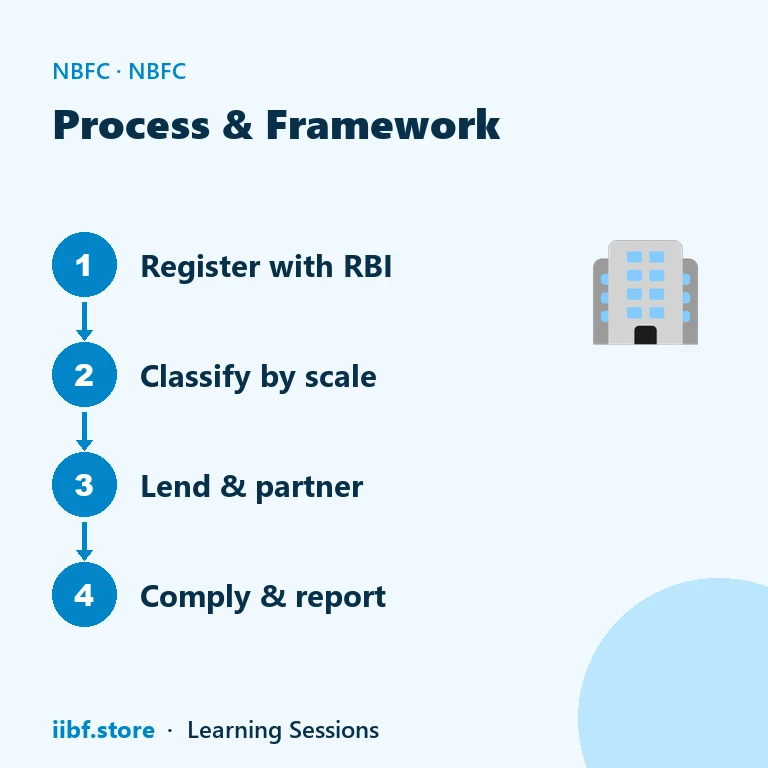
Under the RBI framework, a bank and an NBFC enter a master agreement to jointly originate priority-sector loans. The defining mechanics that candidates must remember are:
- Risk sharing — the NBFC must retain a minimum 20% share of each individual loan on its own books, so the typical split is 80% bank : 20% NBFC. This "skin in the game" keeps the originating NBFC aligned with credit quality.
- Two operating options — the bank can either take its share of every loan mandatorily as it is originated, or retain discretion to reject loans after the NBFC has underwritten them (the "back-to-back" variant).
- Single borrower interface — the customer deals with the NBFC as the single point of contact, even though two lenders fund the loan.
The NBFC typically originates, underwrites, services and collects, while the bank provides the bulk of the funds. This division lets each partner do what it does best and is why the model scaled so quickly after the framework was issued.
Blended Rates, Escrow and Interest Mechanics
Because two lenders fund one loan at different costs, the borrower pays a single blended interest rate — a weighted average of the bank's rate on its 80% and the NBFC's rate on its 20%. This blended rate is disclosed transparently to the borrower and is usually lower than a standalone NBFC loan, which is the customer's main benefit.
Cash flows are routed through a dedicated escrow account so that repayments are split between the two lenders in proportion to their shares, and neither can divert the other's money. Each lender maintains its own portion of the loan on its balance sheet, provisions for it, and reports it independently. Getting the escrow and blended-rate mechanics right is a common numerical question, so practise the split calculations in our NBFC mock tests.
KYC, Grievance and Regulatory Safeguards
Co-lending is attractive to regulators only if the borrower is protected, so the framework builds in several safeguards that candidates should be able to list:
- KYC compliance — both lenders remain responsible for adherence to KYC and AML norms; the NBFC cannot outsource the bank's obligations away.
- Grievance redressal — the borrower must have a clear complaint channel, and the arrangement must specify which partner handles grievances.
- Transparency — the interest rate, the identity of both lenders, and the split must be disclosed to the customer.
- Asset classification and provisioning — each lender independently classifies its share and provisions per RBI norms, so a slippage on one side does not automatically hide on the other.
The authoritative text of the Co-Lending Model framework and subsequent clarifications are published on rbi.org.in, which candidates should read directly. To place NBFCs within the wider financial system, revise alongside our JAIIB Indian Economy material and follow regulatory changes through our IIBF news updates.
Benefits, Priority Sector Impact and Criticisms
The co-lending model delivers real benefits across the system. For banks, it is an efficient way to meet priority sector lending (PSL) targets, because their share of an eligible co-lent loan counts toward PSL. For NBFCs, it eases the funding constraint and lets them originate more without ballooning their own balance sheets. For borrowers, it means cheaper, more accessible credit reaching the last mile.
The model is not without criticism. Concerns include operational complexity, the need for tight technology integration between two lenders, potential mis-selling if incentives are skewed, and the risk that banks lean too heavily on NBFC underwriting. In 2026, RBI continues to refine disclosure and conduct expectations to keep the model borrower-friendly. Reinforce the concepts with our NBFC terminology matching game before your exam.
Frequently Asked Questions
Related study material
Go deeper with the full chapter notes and the complete article hub for this subject:
What is the minimum share an NBFC must retain in co-lending?
Under the RBI Co-Lending Model framework, the NBFC must retain a minimum of 20% of each individual loan on its own books. The typical structure is therefore 80% funded by the bank and 20% retained by the NBFC, keeping the originator's incentives aligned.
How is the interest rate decided in a co-lending loan?
The borrower pays a single blended interest rate — a weighted average of the bank's rate on its 80% share and the NBFC's rate on its 20% share. This blended rate is disclosed transparently and is usually cheaper than a standalone NBFC loan.
How are repayments split between the two lenders?
Repayments flow through a dedicated escrow account and are divided between the bank and the NBFC in proportion to their respective shares. Each lender keeps its portion on its own balance sheet and provisions for it independently.
Why do banks like the co-lending model?
It helps banks meet priority sector lending targets efficiently and extend credit into rural and semi-urban markets they cannot reach alone, by leveraging the NBFC's last-mile distribution and underwriting while providing the bulk of low-cost funds.
Conclusion: Lock in the Co-Lending Model for Your Exam
The co-lending model brings together risk sharing (the 80:20 rule), blended rates, escrow mechanics, KYC safeguards and priority-sector benefits — a compact cluster of high-yield exam points. Learn the mechanics and the borrower-protection rules, and you will answer every co-lending question with confidence. Ready to check your grasp? Attempt a full NBFC mock test on iibf.store today.
Practice this topic
Take a free mock test, download chapter PDFs, or watch a video class — all included on iibf.store.