RBI Monetary Penalty on Banks: Why They Happen and How Compliance Prevents Them
When the Reserve Bank of India imposes a monetary penalty on a bank, compliance officers across the industry read the order closely — because an RBI monetary penalty on banks is rarely about one isolated slip. It usually flags a systemic gap in KYC/AML controls, IRAC classification, the loan system for delivery of bank credit, or adherence to customer-service and interest-rate directions. For BCP candidates, understanding why these penalties happen, and the statutory machinery — Sections 46 and 47A of the Banking Regulation Act, 1949 — behind them, is essential both for the exam and for real compliance work.
📜 Statutory Basis: Sections 46 and 47A of the Banking Regulation Act, 1949
Every RBI monetary penalty on a bank ultimately traces back to two provisions of the Banking Regulation Act, 1949. Section 46 is the criminal-prosecution route: a bank or its officers can be prosecuted before a court for specified contraventions, punishable with imprisonment, fine, or both, once the complaint is sanctioned. This route is used sparingly because it is slow, requires proof beyond reasonable doubt, and is reserved for serious wilful violations.
Section 47A is the administrative route RBI uses in the overwhelming majority of cases quoted in its press releases. It empowers RBI to impose a monetary penalty directly, without a criminal trial, for contravention of directions, licensing conditions, or specific provisions of the Act — including non-compliance with know-your-customer (KYC) norms, exposure ceilings, and reporting requirements. In aggravated cases RBI can apply Section 47A alongside supervisory action such as restrictions under Section 35A.
For BCP candidates, the exam distinction is straightforward: Section 46 needs a court and criminal intent; Section 47A only needs RBI to be satisfied, after due process, that a contravention occurred — a much lower and faster bar. This is why Section 47A orders are published almost every month, while Section 46 prosecutions are rare. Students should read this alongside the loans and advances regulatory restrictions chapter, since many Section 47A penalties trace back to breaches of exactly those restrictions rather than to fraud or wilful default.
| Aspect | Section 46 (Criminal Prosecution) | Section 47A (Monetary Penalty) |
|---|---|---|
| Forum | Court of law | RBI itself, administratively |
| Standard of proof | Beyond reasonable doubt | Reasonable satisfaction after hearing |
| Needs criminal intent | ✅ Yes, for imprisonment | ❌ No, a strict compliance breach suffices |
| Typical outcome | Imprisonment and/or fine | Monetary penalty only |
| Frequency in practice | Rare | Common — near-monthly press releases |
| Pre-decision hearing | Regular trial process | ✅ Show-cause notice plus personal hearing |
💡 Exam Tip: If a question asks which section lets RBI penalise a bank without going to court, the answer is almost always Section 47A, not Section 46.
🏛️ Inside RBI's Enforcement Process: Show-Cause Notice to Order
RBI's Enforcement Department does not impose a penalty overnight. The process usually begins with a supervisory finding — from a statutory inspection under RBI's risk-based SPARC framework, an off-site surveillance alert, or a market complaint — that is referred for examination against RBI's Enforcement Policy. If the department believes a contravention is made out, it issues a show-cause notice setting out the specific direction allegedly violated and the facts relied upon.
The bank must respond in writing within the prescribed period, and can request a personal hearing before an Enforcement Committee or senior RBI officials before any penalty is finalised — a natural-justice safeguard that BCP candidates are often tested on. At the hearing, the bank's compliance and legal teams present mitigating factors: whether the lapse was isolated or systemic, whether it was self-reported, and what corrective action has already been taken.
RBI then decides whether to close the matter, issue an administrative warning, or impose a monetary penalty under Section 47A. Every penalty order carries a standard disclaimer that the action is based on regulatory compliance deficiencies and is not intended to pronounce upon the validity of any transaction the bank has entered into with its customers — the exact wording is worth reading on RBI's official website, where these orders are published as press releases. This distinction matters for the exam: a penalty does not itself invalidate a loan, guarantee, or account; it flags a supervisory concern about process, which is why banks with disciplined controls under their guarantees, acceptances and finance to NBFCs function tend to see fewer such orders.
⚠️ Common Mistake: Students often assume a monetary penalty automatically cancels a bank's licence or voids customer transactions — RBI's own orders explicitly say otherwise.
⚠️ Recurring Themes: KYC-AML Lapses, IRAC Divergence and the Loan System for Delivery of Bank Credit
Across years of RBI enforcement action, a handful of themes repeat far more often than exotic new violations. The first is KYC/AML: banks penalised for delayed or incomplete customer due diligence, weak monitoring of suspicious transactions, or gaps in periodic KYC updation. The second is divergence in income recognition and asset classification (IRAC) — where RBI's supervisory assessment of a bank's non-performing assets differs materially from what the bank itself reported, suggesting a weak internal audit trail. Candidates should revisit the IRAC norms and wilful defaulters chapter, since divergence cases almost always trace back to the classification triggers covered there.
A third recurring theme is the loan system for delivery of bank credit — RBI's direction requiring large borrowers above a specified threshold to draw a minimum share of their fund-based working capital limit through a loan component rather than an overdraft-style cash credit account. Banks that let large borrowers bypass this loan-component requirement, or miscompute the mandated ratio, have drawn penalties even without any credit loss to the bank.
A fourth theme covers breaches of exposure norms and large-exposure reporting, often surfacing during routine inspections rather than being triggered by a customer complaint. None of these themes involve fraud in the criminal sense; they are process and reporting failures, which is exactly why Section 47A — not Section 46 — is the provision RBI reaches for almost every time.
💳 Customer Service and Interest Rate Directions: The Quiet Penalty Triggers
Beyond KYC and asset classification, a steady share of RBI penalties trace to two less-discussed areas: customer service and interest-rate directions on advances. RBI mandates specific practices around interest-rate resets on floating-rate loans, disclosure of the reference benchmark, and timely communication to borrowers when tenor or EMI changes — obligations covered in detail in the interest rates on advances chapter. Banks that reset rates without adequate notice, or fail to offer borrowers the option to switch between floating and fixed rates as directed, have been penalised even when the amounts involved were small, because the violation is systemic rather than a one-off error affecting a single customer.
Customer-service directions — covering grievance redressal timelines, mis-selling of third-party products, and fair treatment of priority segments — form another quiet but consistent source of enforcement action. Because these directions apply uniformly across the branch network, a control gap tends to show up in hundreds of accounts simultaneously, which is precisely the kind of systemic pattern RBI's supervisory teams are built to detect. For BCP exam purposes, the lesson is that monetary penalties are rarely about a single dramatic failure; they are about a control that was missing consistently, across many transactions, for long enough that it could not plausibly be one employee's mistake.
📌 Remember: RBI penalises patterns, not isolated errors — a single missed KYC update rarely draws action, but a bank-wide control gap almost always does.
🛡️ Building a Compliance Framework That Prevents Penalties
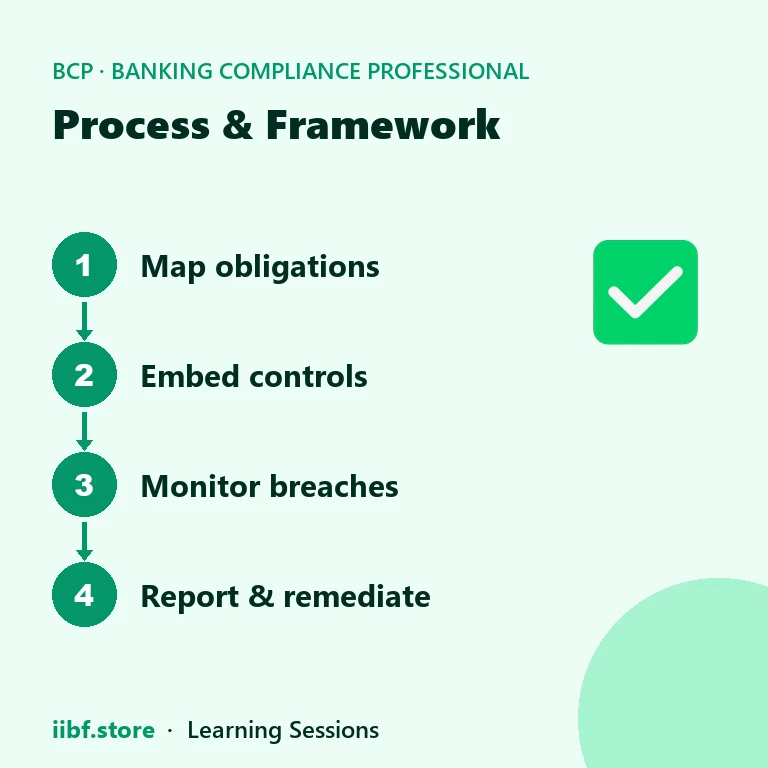
The most effective defence against an RBI monetary penalty on banks is not a faster response to show-cause notices — it is a compliance framework that catches divergence before a supervisor does. That starts with independent testing: compliance and internal audit teams re-performing IRAC classification on a sample of accounts, reconciling it against what is reported to RBI, and escalating any gap immediately rather than waiting for the annual inspection. A strong risk and control self-assessment process, reviewed regularly against the framework covered in Compliance Risk RCSA for Banks, is what turns this from a one-time check into a continuous control.
Second, banks need real-time monitoring of directions with numeric thresholds — exposure ceilings, the loan-component ratio, interest-rate reset timelines — because these are exactly the areas where a small system error compounds into a supervisory finding across thousands of accounts. Third, as explained in Independence of Compliance Function in Banks, the compliance function must sit independently of business lines, with a direct reporting line to the board or a board committee, so a flagged breach is escalated rather than smoothed over before it reaches senior management.
Finally, banks that self-report contraventions to RBI promptly, and can show a credible remediation plan at the personal-hearing stage, generally see this treated as a mitigating factor. Building this habit — track, escalate, remediate, disclose — is what separates banks with a clean enforcement record from those that appear repeatedly in RBI's penalty press releases.
🧠 Practice MCQs: RBI Monetary Penalties on Banks
Q1. Under which section of the Banking Regulation Act, 1949 can RBI impose a monetary penalty on a bank without prosecuting it in a criminal court? (a) Section 35A (b) Section 46 (c) Section 47A (d) Section 36AA
Answer: (c) — Section 47A empowers RBI to impose monetary penalties administratively for contraventions, distinct from Section 46's criminal-prosecution route.
Q2. A show-cause notice issued by RBI's Enforcement Department typically gives the bank the opportunity to: (a) appeal directly to the Supreme Court (b) request a personal hearing before a penalty is finalised (c) automatically get the penalty waived (d) transfer the matter to SEBI
Answer: (b) — The bank may reply in writing and seek a personal hearing before RBI decides on the penalty, as a natural-justice safeguard.
Q3. Which of the following is NOT among the recurring themes behind RBI's monetary penalties on banks? (a) KYC/AML lapses (b) Divergence in IRAC/NPA classification (c) Non-compliance with SEBI listing norms (d) Violation of loan system for delivery of bank credit directions
Answer: (c) — SEBI listing norms fall under SEBI's own jurisdiction, not RBI's typical banking-compliance penalty themes.
Q4. The "loan system for delivery of bank credit" direction primarily concerns: (a) a mandatory minimum share of working capital finance through a loan component for large borrowers (b) fixing the repo rate (c) classification of NPAs (d) KYC verification of new customers
Answer: (a) — It requires large borrowers above a specified threshold to draw a minimum share of fund-based working capital as a loan component rather than cash credit alone.
Q5. RBI's monetary penalty orders explicitly clarify that the action: (a) exempts the bank from further RBI supervision (b) is based on regulatory compliance deficiencies and is not intended to pronounce on the validity of any transaction with a customer (c) automatically cancels the bank's licence (d) replaces the need for a compliance audit
Answer: (b) — This is standard boilerplate in RBI penalty orders: the action concerns regulatory compliance, not the validity of customer transactions.
Want chapter-wise mock tests with 100+ MCQs? Start practising free →
❓ Frequently Asked Questions
What is the difference between Section 46 and Section 47A of the Banking Regulation Act, 1949?
Section 46 provides for criminal prosecution and imprisonment or fine through a court for specified contraventions, while Section 47A empowers RBI itself to impose a monetary penalty administratively, without a criminal trial.
Does an RBI monetary penalty affect a bank's licence?
Not directly. RBI penalty orders typically state the action is based on compliance deficiencies and does not by itself affect the validity of the bank's licence or its customer transactions; licence action is a separate, far more severe supervisory step.
What happens after RBI issues a show-cause notice?
The bank submits a written reply, may request a personal hearing before RBI's Enforcement Department or senior officials, and RBI then decides whether to impose a penalty, drop the matter, or issue a lesser action such as a warning.
Why do IRAC divergence and KYC lapses recur so often in RBI penalty orders?
These are the areas RBI reviews most closely during risk-based supervisory inspections, so gaps in asset-classification consistency and customer due diligence surface repeatedly across banks of all sizes, regardless of overall financial health.
An RBI monetary penalty on banks is best read not as a scandal but as a diagnostic — it tells you exactly which control an examiner found weakest, whether that was KYC updation, IRAC classification, the loan-delivery system, or an interest-rate direction. The same enforcement logic increasingly applies beyond banks: see how RBI's digital lending guidelines for NBFCs are enforced in a related subject. For more BCP exam-focused reading, browse every article under the banking compliance professional tag, check today's benchmark figures on the RBI rates tracker, and when you are ready to test yourself, attempt a full chapter-wise mock on IIBF Store.
Prefer revising from a printed book?
Chapter-wise books with MCQs after every chapter — minimal pages, complete coverage, delivered anywhere in India. Every book has a free sample to read first.














Practice this topic
Take a free mock test, download chapter PDFs, or watch a video class — all included on iibf.store.