ECGC export credit insurance: cover, ECIB and claims for banks
ECGC export credit insurance is the risk-transfer layer that sits between an Indian exporter, the bank that funds the shipment and an overseas buyer who may simply never pay. For the IIBF International Trade Finance paper this is a high-yield area, because the questions are rarely about definitions alone: they ask who exactly is the insured, which losses fall outside the cover, what percentage of the loss is settled, and what happens to a bank's provisioning and exposure once a claim is admitted. This note works through the standard policies issued to exporters, the Export Credit Insurance for Banks (ECIB) covers, the commercial versus political risk split, premium and claim mechanics, and recovery sharing.
🛡️ What ECGC export credit insurance actually covers
ECGC Ltd is a wholly owned Government of India company under the Department of Commerce, set up in the 1950s to make export credit safer for both exporters and lending banks. In the trade ecosystem it sits alongside EXIM Bank, DGFT and the export promotion councils as one of the institutional facilitation bodies that an ITF candidate is expected to place correctly.
The cover is built on a simple two-bucket classification. Commercial risks are risks attaching to the buyer: insolvency of the overseas buyer, protracted default (failure to pay within a specified period after the due date), and in defined situations the buyer's repudiation of goods after despatch. Political risks are risks attaching to the buyer's country or to the transit route: war, civil war or civil disturbance, imposition of new import restrictions or cancellation of an import licence after shipment, restrictions on transfer of funds or exchange remittance delays not attributable to the buyer, and additional handling or freight charges arising from interruption of the voyage.
Equally important is what is not covered. Losses arising from the exporter's own failure to perform the contract, disputes about quality or specification until the exporter obtains a decree from a competent court in the buyer's country, causes inherent in the nature of the goods, exchange rate fluctuation losses, and discrepancies in documents are outside the standard cover. The insurance is a credit risk product, not a performance, marine or currency hedge, and mixing these up is where most marks are lost.
💡 Exam Tip: If a question describes a loss caused by the exporter's own act or by a currency movement, the answer is almost always "not covered" — ECGC insures the credit risk of non-payment, not commercial performance or exchange risk.
📄 Standard policies for exporters: shipment comprehensive risk
The workhorse product for an exporter is the standard shipment policy, commonly described as the Shipment (Comprehensive Risks) Policy or SCR — "comprehensive" because it covers both commercial and political risks together. It is issued to an exporter selling on short-term credit terms, and it operates on a whole-turnover basis: the exporter is expected to offer all shipments made on credit terms, not merely the doubtful ones. That anti-selection principle is the reason the premium is affordable.
Two control numbers govern every such policy. The Maximum Liability is the ceiling on ECGC's total liability under the policy in a policy period, and it is fixed with reference to the exporter's expected turnover and credit terms. The credit limit is buyer-specific: before shipping on credit to a particular overseas buyer, the exporter applies for a credit limit on that buyer, and ECGC underwrites the buyer using credit reports. Shipments beyond an approved credit limit, or to a buyer for whom no limit was ever sought, may be held uncovered or covered only to a restricted extent.
Operationally the exporter files a monthly declaration of shipments and pays premium on the declared value, reports overdues within the period stipulated in the policy, and refrains from making further shipments to a defaulting buyer without ECGC's approval. Country classification matters too: ECGC groups countries into risk categories and may place restrictive cover conditions on those that are politically or externally stressed, a point that links directly to the country and credit risk management chapter of the syllabus. Specialised variants exist for small exporters, for buyer-wise exposure, for consignment exports and for medium and long-term contracts, but the SCR logic is the base on which the rest is built.
🏦 Export Credit Insurance for Banks: ECIB WT-PC and WT-PS
The second family of products insures the bank, not the exporter, and this distinction is the single most tested point in this topic. Under an Export Credit Insurance for Banks cover, the insured is the lending bank, the risk insured is the exporter's failure to repay export credit, and the claim is paid to the bank.
Two whole-turnover covers dominate. ECIB (WT-PC) — Whole Turnover Packing Credit — protects the bank against loss on pre-shipment advances granted to exporters for procuring, processing and packing goods meant for export. ECIB (WT-PS) — Whole Turnover Post-Shipment — protects the bank against loss on post-shipment finance such as purchase, negotiation or discount of export bills and advances against bills sent on collection. Individual (account-specific) versions of both exist, but whole-turnover covers carry a lower premium rate precisely because the bank offers its entire eligible portfolio and cannot cherry-pick weak accounts.
The bank's obligations under an ECIB are procedural and strict. The bank must grant the advance in conformity with normal banking prudence and the sanctioned terms, keep the advance within the discretionary limit fixed for each exporter (beyond which ECGC's prior approval is needed), submit periodical statements and pay premium on the outstanding advances, report defaults and overdues within the stipulated time, recall the advance and initiate recovery action including legal proceedings where required, and inform ECGC of any material adverse information about the exporter. Failure on any of these can reduce or defeat a claim even though the cover is technically in force. Because pre-shipment credit is granted before any export bill exists, the underwriting discipline here overlaps heavily with the working capital assessment logic covered in cash flow based lending.
⚠️ Common Mistake: Assuming an ECIB claim is triggered by the overseas buyer's default. It is not. The ECIB responds to the exporter's default to the bank; the buyer's non-payment is only the usual reason behind it.
📊 Percentage of cover, premium and the risk-event grid
ECGC never indemnifies the full loss. A fixed percentage of cover is stated in the policy or cover schedule, and the insured retains the balance so that its own credit discipline is not diluted. Exporter policies traditionally carry a high percentage of cover — commonly of the order of ninety per cent of the loss on the standard comprehensive policy — while ECIB covers for banks are set at a lower percentage, differentiated by the type of account and by the category of exporter. Rates and percentages are revised by ECGC from time to time, so always quote the figure appearing in the current schedule rather than a remembered number.
Premium follows the exposure. On exporter policies it is charged on the declared shipment value at a rate that varies with the country classification, the credit period and the payment terms. On ECIB covers it is charged monthly with reference to the advances outstanding during the period, so a bank that runs down its packing credit book pays less. Good claims experience is rewarded through a no-claim bonus, and adverse experience through loading or restriction of cover.
| Loss event | Risk type | Standard exporter policy | ECIB for banks |
|---|---|---|---|
| Insolvency of the overseas buyer | Commercial | ✅ Covered | ✅ Covered as the underlying cause of the exporter's default |
| Protracted default by the buyer after due date | Commercial | ✅ Covered | ✅ Covered once the exporter fails to repay the bank |
| War, civil disturbance or new import restrictions | Political | ✅ Covered | ✅ Covered |
| Default by the exporter to the financing bank | Credit risk on exporter | ❌ Not the insured event | ✅ This is the insured event |
| Loss from exchange rate movement | Market | ❌ Excluded | ❌ Excluded |
| Quality dispute until a decree is obtained | Contractual | ❌ Excluded | ❌ Excluded |
Read this grid together with the regulatory framework chapter, because the same transaction is simultaneously governed by FEMA realisation rules and by the insurance contract, and a delay in realisation can breach both.
⚖️ Claim filing, recovery sharing and the bank's exposure
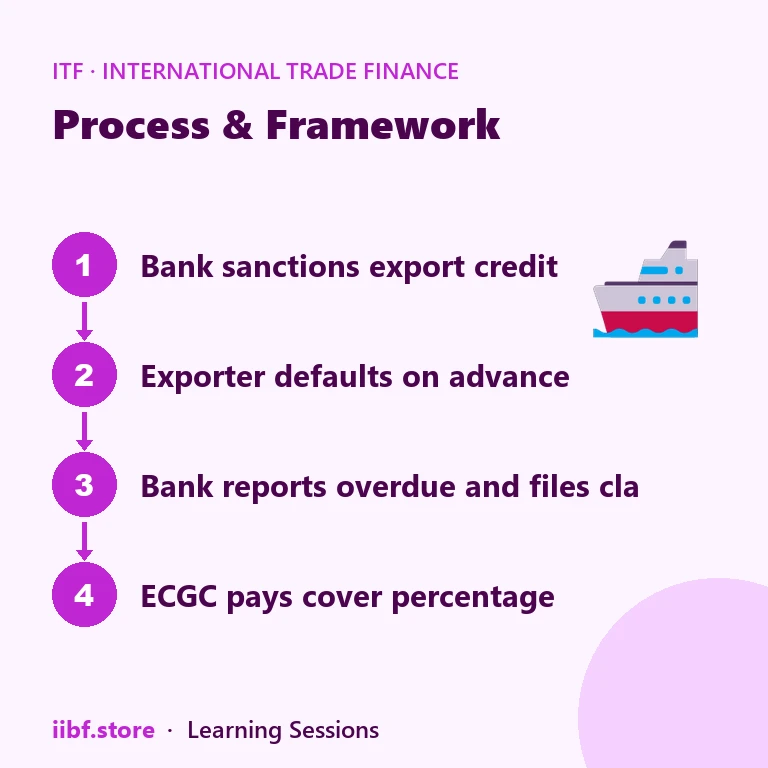
Claim mechanics are examinable in detail. The first duty is reporting: overdues and defaults must be intimated within the period prescribed in the policy or cover, generally through a periodical statement of overdues. The second is protective action: stopping further shipments or further disbursement to the defaulting party without approval, and taking recovery steps including legal action where advised. The third is filing the claim within the stipulated window after the loss event, supported by the shipping and financing documents, the credit limit approval, evidence of default and the record of recovery efforts. Premature filing, filing after the window has closed, or filing without having reported the overdue in time are the usual grounds on which claims are reduced.
Once ECGC admits the claim, it pays the agreed percentage of the loss. Recovery does not end there. Recoveries made after settlement are shared between ECGC and the insured in the same proportion in which the loss was borne, after first meeting the expenses of recovery. The bank or exporter therefore remains obliged to pursue the defaulter even after being paid; suppressing a recovery is a breach of the cover.
For the bank, the balance sheet consequences are material. Under RBI's income recognition and asset classification norms, where an advance is guaranteed or covered by ECGC, provision is required only on the portion of the outstanding that is not covered by the available guarantee, which reduces the provisioning hit on a slipped export account. Under the Basel III capital framework, an eligible guarantee permits credit risk mitigation on the guaranteed portion, so a covered export advance can attract a lower capital charge than an uncovered one — always verify the applicable treatment in the current RBI master circular and check prevailing policy rates and norms before quoting numbers. This capital and provisioning benefit is precisely why banks push exporters towards insured structures, and why non-recourse alternatives such as forfaiting in export finance are evaluated against ECIB-backed lending. Documentation discipline in the underlying settlement route also matters, whether the exporter routes bills through an LC or through the collection channel discussed in documentary collections under URC 522, and incentive receivables under the RoDTEP scheme for exporters are often the first source of recovery in a stressed export account.
📌 Remember: Cover percentage decides how much of the loss is paid; recovery sharing then follows that same ratio. If a cover pays 75 per cent of a loss, subsequent net recoveries are split 75:25 in the same proportion.
🧠 Practice MCQs: ECGC cover for exporters and banks
Q1. Under a standard ECGC Shipment (Comprehensive Risks) Policy, which of the following losses is NOT covered? (a) Insolvency of the overseas buyer (b) Protracted default by the buyer (c) Loss arising from adverse exchange rate movement (d) War in the buyer's country
Answer: (c) — ECGC covers commercial and political credit risks; exchange rate fluctuation is a market risk and is expressly excluded.
Q2. ECIB (WT-PC) issued by ECGC protects: (a) The exporter against the overseas buyer's insolvency (b) The bank against the exporter's default on pre-shipment advances (c) The overseas buyer against non-delivery (d) The negotiating bank against document discrepancies
Answer: (b) — Under an Export Credit Insurance for Banks cover the insured is the bank, and Whole Turnover Packing Credit responds to the exporter's failure to repay pre-shipment finance.
Q3. After ECGC settles a claim, amounts subsequently recovered from the defaulter are: (a) Retained entirely by the insured bank or exporter (b) Paid entirely to ECGC (c) Shared equally 50:50 irrespective of the cover percentage (d) Shared in the same proportion in which the loss was borne, after meeting recovery expenses
Answer: (d) — Recovery sharing mirrors the loss-sharing ratio, and the insured must continue recovery action even after the claim is paid.
Q4. For provisioning under RBI's IRAC norms, an export advance covered by an ECGC guarantee requires provision on: (a) The entire outstanding, ignoring the cover (b) Only the portion of the outstanding not covered by the available guarantee (c) Nothing at all, since the account is insured (d) Twice the normal rate because of country risk
Answer: (b) — Provision is made on the balance in excess of the amount available under the guarantee, which is why insured export accounts hurt the profit and loss account less.
Q5. Which of the following is classified as a political risk under ECGC cover? (a) Insolvency of the overseas buyer (b) Protracted default by the buyer (c) Cancellation of an import licence or imposition of new import restrictions by the buyer's country (d) The buyer's refusal to accept goods on quality grounds
Answer: (c) — Import restrictions, licence cancellation, transfer delays and war-type events are country risks; buyer insolvency and default are commercial risks.
Want chapter-wise mock tests with 100+ MCQs? Start practising free →
❓ Frequently Asked Questions
Who is the insured under an ECIB cover — the exporter or the bank?
The bank. Export Credit Insurance for Banks is a contract between ECGC and the lending bank, the insured event is the exporter's default in repaying pre-shipment or post-shipment credit, and the claim proceeds go to the bank. Exporter policies such as the shipment comprehensive risk policy are separate contracts where the exporter is the insured.
Does ECGC cover mean the bank need not take security or follow up recovery?
No. The cover is partial by design and is conditional on the bank behaving as a prudent lender: sanction within the discretionary limit, monitor end use, report overdues in time, recall the advance and pursue recovery including legal action. Recoveries are shared with ECGC, so follow-up continues even after a claim is settled.
Why is the percentage of cover lower for banks than for exporters?
Because the bank is a professional lender that is expected to retain meaningful skin in the game. A lower percentage of cover preserves underwriting discipline and discourages lax appraisal, while the whole-turnover basis keeps the premium rate low in exchange for the bank offering its entire eligible portfolio rather than only weak accounts.
Are quality disputes with the overseas buyer covered?
Not while the dispute is live. A buyer's refusal to pay on grounds of quality or specification is treated as a contractual dispute, and cover generally responds only after the exporter obtains a decree from a competent court in the buyer's country and the buyer still fails to pay. This is a frequent exam trap.
🎯 Conclusion and revision plan
Master four things and this topic is secure: the commercial versus political risk split with its exclusions, the difference between an exporter policy and an ECIB where the insured changes from exporter to bank, the mechanics of maximum liability, credit limits, percentage of cover and premium, and finally the claim-and-recovery chain with its effect on provisioning and capital. Revise these alongside the broader international trade finance topic hub, and consolidate with the trade finance products and documentation covered in the trade finance chapter. When you are ready to test recall under time pressure, run a full chapter-wise mock on the certification course dashboard and review every wrong answer against the exclusions list above.
Source and further reading: ECGC Ltd and the Indian Institute of Banking & Finance.
Practice this topic
Take a free mock test, download chapter PDFs, or watch a video class — all included on iibf.store.