Garnishee Order in Banking: A JAIIB PPB Guide 2026
A garnishee order is one of the more misunderstood topics in JAIIB PPB, yet it shows up in exam paper after exam paper because it sits at the intersection of law and everyday branch operations. When a court directs a bank to freeze a customer's balance to satisfy someone else's decree, the banker-customer relationship of debtor and creditor suddenly has a third party — the court — standing between them. Get the mechanics of a garnishee order wrong and a bank can end up paying twice: once to the decree-holder and once to an angry customer. This guide breaks the concept down the way JAIIB PPB actually tests it.
📜 What Exactly Is a Garnishee Order?
In law, the bank is called the "garnishee" — a third party holding money that legally belongs to someone else, the judgment-debtor (your customer). A civil court, exercising powers under the Code of Civil Procedure, can order the garnishee to pay the attached amount directly to the decree-holder instead of to the account holder. This works because of a foundational PPB concept: the banker-customer relationship for a deposit account is that of debtor and creditor. The bank owes the customer money; a garnishee order simply redirects who that debt is paid to. In tax-recovery matters, an income-tax or GST authority can issue a similar attachment under the relevant recovery rules, operating on the same underlying logic.
⚖️ Order Nisi and Order Absolute — the Two Stages
A garnishee order is served in two steps, and this sequencing is a favourite exam trap. First comes the order nisi ("unless") — a conditional, provisional attachment. On receiving it, the bank must immediately stop honouring cheques or withdrawal instructions up to the attached amount and hold the balance, but it does not yet pay the court. The bank gets an opportunity to show cause, for instance that the balance already carries a prior lien or belongs to a joint account with a non-judgment-debtor. If it raises no valid objection, the court confirms the attachment and issues the order absolute, directing the bank to actually remit the sum. Only at this second stage does money actually leave the bank — confusing the two stages is one of the most common errors branch staff make.
| Aspect | Order Nisi | Order Absolute |
|---|---|---|
| Nature | Conditional / provisional | Final / confirmed |
| Bank's immediate action | Freeze the attached balance | Remit funds to the court |
| Bank can still object? | Yes, show-cause opportunity | No, objection stage is over |
| Money actually paid out? | ❌ Not yet | ✅ Yes |
💡 Exam Tip: Order nisi = "freeze and show cause." Order absolute = "pay now." If a question describes a bank paying out immediately on the first notice, that is the wrong sequence.
🏦 How the Order Affects the Account in Practice
The attachment covers only the amount standing to the credit of the account when the order is served — not future credits, unless the order specifically extends to them. If the balance is less than the attached sum, the bank freezes whatever exists; it need not hold back future inflows retroactively. This affects related arrangements covered under the ancillary banking services chapter of JAIIB PPB — a mandate holder's authority to operate the account is suspended for the attached sum, since a mandate holder is only an agent and cannot defeat a court's attachment on the principal's funds.
For a joint account naming only one holder, banks generally attach only that holder's ascertainable share, and where shares are not separable, they seek the court's clarification first — a nuance examiners like to probe with "what should the bank do next" questions.
⚠️ Common Mistake: Students often equate a garnishee order with the bank's own right of set-off or lien. They are not the same — set-off is the bank recovering its own dues from the customer's balance; a garnishee order is a court redirecting funds to a third-party decree-holder.
🚫 What a Garnishee Order Does Not Attach
Not every rupee in a bank's books is fair game. Money held purely as a trustee or agent for someone else — funds in a trust account, or amounts collected for a third party not yet credited to the customer — generally falls outside a garnishee order, since the debtor-creditor relationship does not run between the bank and that customer for those specific funds. If the account is already under a prior, validly created lien for the bank's own dues, that claim typically takes priority over the attaching creditor. Safe deposit locker contents are also outside the order's reach, since the bank does not owe the customer a debt for those — it merely provides custody.
📌 Remember: A garnishee order attaches a debt (the bank's obligation to repay deposit money) — it cannot attach property the bank merely holds in safe custody or as trustee.
🧾 Documentation and Branch Response Checklist
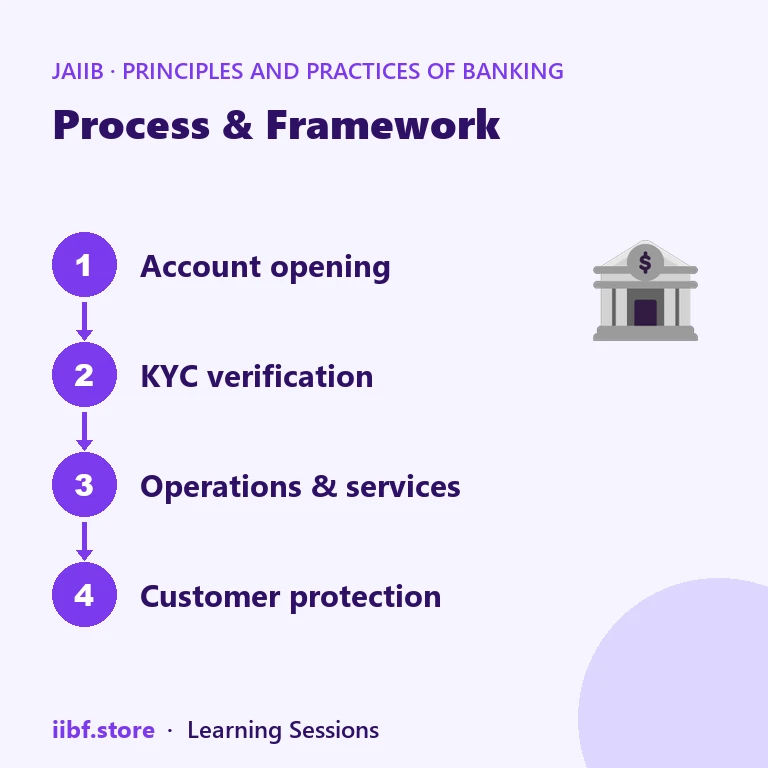
When a garnishee order lands on a branch, PPB expects candidates to know the sequence: verify the order is from a competent court, identify the exact account and amount, mark a hold, stop honouring instruments that would breach the frozen balance, and inform the customer in writing. This ties into how banks handle instruments presented for payment more broadly, a theme explored in the paying bank's responsibilities chapter, since a cheque presented after a valid attachment must be dishonoured to the extent of the frozen amount.
Aspirants preparing this topic alongside cheque collection responsibilities and the Banking Ombudsman Scheme 2026 guide will notice a pattern: PPB repeatedly tests how a bank balances customer duty against a superior legal obligation, whether from a court, a tax authority, or a regulator. If your syllabus also covers cash-flow arithmetic, the time value of money chapter in JAIIB AFM is a useful companion read.
Official sources: cross-check the latest syllabus, circulars and rates on the IIBF official website and the Reserve Bank of India.
🧠 Practice MCQs: Garnishee Order
Q1. A garnishee order attaches which relationship between the bank and its customer? (a) Trustee and beneficiary (b) Bailor and bailee (c) Debtor and creditor (d) Principal and agent
Answer: (c) — A deposit account makes the bank a debtor and the customer a creditor; the garnishee order redirects payment of that debt.
Q2. Under an order nisi, the bank should: (a) Immediately remit funds to the court (b) Close the account (c) Freeze the attached balance and await confirmation (d) Ignore the order until an order absolute is served
Answer: (c) — Order nisi is provisional; the bank freezes the sum but pays out only after an order absolute.
Q3. A garnishee order generally does NOT attach: (a) Credit balance in the customer's savings account (b) Articles kept in the customer's safe deposit locker (c) Balance in the customer's current account (d) Term deposit maturity proceeds
Answer: (b) — Locker contents are held in safe custody, not as a debt owed to the customer, so they fall outside the order's reach.
Q4. If a cheque is presented after a valid garnishee order has attached the entire balance, the paying bank should: (a) Honour the cheque as usual (b) Dishonour the cheque to the extent of the attached amount (c) Pay half the cheque amount (d) Refer the matter to the payee's bank
Answer: (b) — Once attached, the bank cannot use those funds to honour instruments; the cheque is returned unpaid for the attached portion.
Q5. A garnishee order is distinct from the bank's right of set-off because: (a) Both mean the same thing operationally (b) Set-off recovers the bank's own dues, while a garnishee order redirects funds to a third-party decree-holder (c) Set-off requires a court order while garnishee orders do not (d) Garnishee orders apply only to loan accounts
Answer: (b) — Set-off is the bank's own contractual right; a garnishee order is an external court direction benefiting a third party.
Want chapter-wise mock tests with 100+ MCQs? Start practising free →
Does a garnishee order apply to a loan account with a debit balance?
No. A garnishee order attaches money the bank owes the customer. A loan account with a debit balance is money the customer owes the bank, so there is no attachable debt for the court to redirect.
Can the bank inform the customer before freezing the account?
The bank acts on the court's order first and then notifies the customer that the account has been attached; it does not need the customer's consent, since the order is a binding legal direction.
What happens to the balance above the attached amount?
Only the specific sum mentioned in the order is frozen. The customer can continue to operate any balance above that amount in the normal course.
Is a garnishee order the same as freezing an account for KYC non-compliance?
No. A garnishee order is a court-directed attachment tied to a third party's decree, while a KYC-related freeze is a regulatory compliance action taken by the bank itself for a different reason entirely.
Carry This Forward Into Your JAIIB PPB Prep
Garnishee orders reward candidates who understand the underlying logic — debtor-creditor relationship, two-stage attachment, and clear boundaries on what can and cannot be attached — rather than rote memorisation. Revisit the related chapters, work through the MCQs above closer to your exam date, and pair this topic with more Principles and Practices of Banking articles on the blog. When you are ready to test recall under exam conditions, head over to iibf.store/tests or explore the full JAIIB course pack for structured, chapter-wise practice.
Quick quiz on this topic
5 exam-style questions from our free test bank — check yourself before you move on.
Practice this topic
Take a free mock test, download chapter PDFs, or watch a video class — all included on iibf.store.
Keep reading