Income Recognition and Asset Classification (IRAC) Norms: Provisioning and Ind AS 109 ECL

Mastering income recognition and asset classification is fundamental to the CAIIB Advanced Accounting & Auditing (CAAP) paper and to real banking practice. Income recognition and asset classification — together with provisioning, collectively called the IRAC norms — is the RBI-prescribed prudential framework that governs when a bank may book interest income, how it must categorise loan assets by quality, and how much it must set aside as provisions against potential losses. These norms ensure a bank's balance sheet reflects the true, conservative picture of its asset quality. All norms flow from master directions of the Reserve Bank of India.
💰 Income Recognition — The Realisation Principle
The core rule ✅: income from a non-performing asset (NPA) must not be recognised on an accrual basis; it is recognised only when actually realised. 📌 Once an account becomes an NPA, interest already accrued but unrealised in the current period must be reversed. This prevents banks from inflating profits with income they may never collect. 💡 Fees, commission and similar income on impaired accounts follow the same realisation discipline.
⏱️ The 90-Day NPA Rule
A term loan becomes an NPA when interest and/or principal remains overdue for more than 90 days. ⚠️ Related triggers you must know:
- Cash credit / overdraft: out of order — outstanding continuously exceeds the sanctioned limit/drawing power for 90 days, or no credits for 90 days. 📌
- Bills purchased/discounted: overdue for more than 90 days.
- Agricultural advances: two crop seasons (short-duration) or one crop season (long-duration) overdue. ✅
🗂️ Asset Classification & Provisioning
Assets are classified by how long they have been impaired, and each class attracts a minimum provision. This is the single most examinable table in CAAP. 📌
| Asset Classification | Indicative Provisioning |
|---|---|
| Standard (performing) | 0.25%–1% (sector-based) ✅ |
| Sub-standard (NPA up to 12 months) | 15% (25% if unsecured) ⚠️ |
| Doubtful — up to 1 year (D1) | 25% secured + 100% unsecured |
| Doubtful — 1 to 3 years (D2) | 40% secured + 100% unsecured |
| Doubtful — over 3 years (D3) | 100% |
| Loss asset | 100% 📌 |
An asset becomes sub-standard once it stays an NPA for up to 12 months, doubtful after remaining sub-standard for 12 months, and a loss asset when it is identified as uncollectible. To drill these percentages take the caiib mock test free and revise from concise caiib pdf notes.
📊 Ind AS 109 ECL Overview & LFAR
Ind AS 109 introduces the forward-looking Expected Credit Loss (ECL) model, a shift from the "incurred loss" approach. ✅ Under ECL, provisions are estimated across three stages:
| Stage | ECL Basis |
|---|---|
| Stage 1 (performing) | 12-month expected credit loss |
| Stage 2 (significant increase in credit risk) | Lifetime ECL ⚠️ |
| Stage 3 (credit-impaired) | Lifetime ECL + interest on net basis 📌 |
💡 Note: while listed NBFCs already apply Ind AS, RBI's IRAC norms continue to govern scheduled commercial banks pending full Ind AS adoption — the exam may test both the current IRAC position and the ECL concept. The Long Form Audit Report (LFAR) is the detailed questionnaire-based report statutory auditors submit to bank management and RBI, covering asset quality, advances, provisioning adequacy and internal controls. Reinforce these with the full CAIIB course, apply them on tests, read explainers on the blog, keep RBI rates handy, and revise via the match game.
🔧 Upgradation, Restructuring & Related Concepts
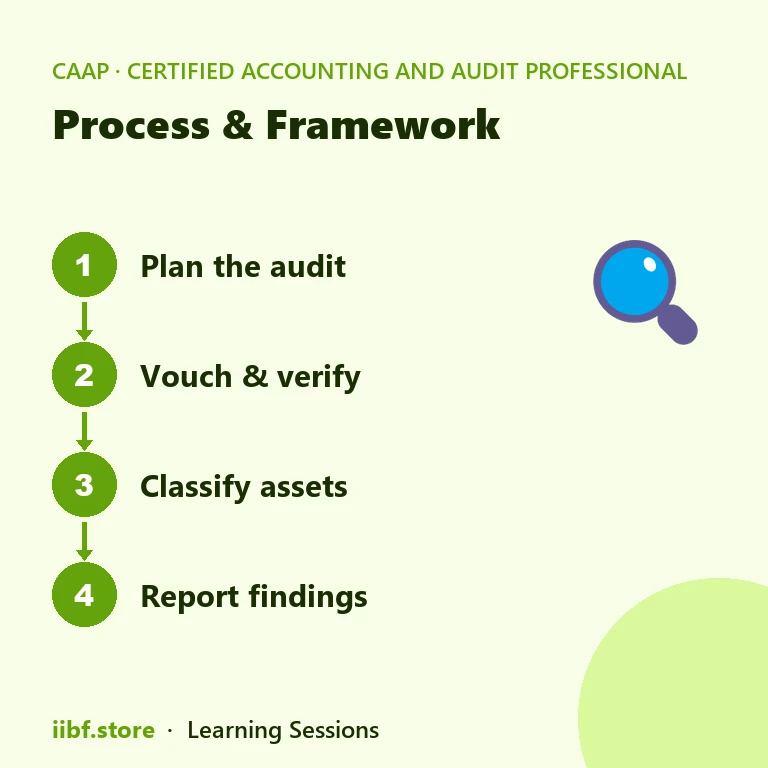
The CAAP paper tests not just classification but the movement of accounts between categories. 📌 Key rules:
- Upgradation ✅ — an NPA can be upgraded to standard only when the entire arrears of interest and principal are paid by the borrower; partial payment does not upgrade the account.
- Borrower-wise classification ⚠️ — all facilities of a single borrower are classified as NPA if any one facility becomes NPA (the "borrower-wise, not facility-wise" rule).
- Restructured accounts — on restructuring, a standard account is normally downgraded to sub-standard and attracts higher provisioning, subject to specified conditions.
- SMA classification 💡 — Special Mention Accounts flag early stress: SMA-0 (1–30 days overdue), SMA-1 (31–60 days), SMA-2 (61–90 days) — a favourite objective question.

📉 Why IRAC Norms Matter — The Bigger Picture
Beyond passing the exam, IRAC norms are the backbone of banking prudence and financial-system stability. Consider their impact:
| Objective | How IRAC Delivers It |
|---|---|
| True & fair balance sheet | Prevents overstatement of income and assets ✅ |
| Capital adequacy discipline | Provisioning erodes profit/capital, forcing prudent lending ⚠️ |
| Early stress detection | SMA framework signals distress before default 📌 |
| Comparability | Uniform norms allow regulators to compare banks fairly |
💡 A bank that classifies honestly and provisions adequately is far more resilient in a downturn. This is precisely why RBI's Asset Quality Reviews and IRAC compliance form a recurring theme in both the exam and real supervisory practice.
🧮 Worked Example & Common Exam Traps
CAAP often frames IRAC as a numerical or scenario question. 📌 Consider a term loan of ₹10 lakh that turns NPA and remains sub-standard: the bank provides 15% (₹1.5 lakh) if secured. If it slips to doubtful within one year (D1), provisioning jumps to 25% on the secured portion plus 100% on the unsecured shortfall. Grasping how the secured and unsecured components are provisioned separately is the single most common stumbling block for candidates. ⚠️
- Trap 1 — assuming provisioning applies to the whole outstanding uniformly; in doubtful assets it splits between secured (graded %) and unsecured (100%). ✅
- Trap 2 — treating partial recovery as an upgrade; only full clearance of arrears upgrades an NPA. ⚠️
- Trap 3 — confusing the 90-day term-loan rule with the "out of order" cash-credit rule. 📌
- Trap 4 — forgetting that standard-asset provisioning still applies to performing loans (0.25%–1%). 💡
Practise a spread of such scenarios and the IRAC section becomes one of the most reliable scoring areas in the entire CAAP paper. It also helps to remember that provisioning is a charge to the profit and loss account, so higher NPAs directly depress a bank's reported profit and, ultimately, its capital adequacy — linking this chapter neatly to the capital-adequacy and Basel topics you will study elsewhere in CAIIB. Additional related concepts worth revising are the treatment of government-guaranteed advances, the classification of accounts under consortium and multiple-banking arrangements, and the floating provisions that banks may build in good years to cushion future stress.
- Key takeaways 🎯
- Income from NPAs is recognised only on realisation, not accrual.
- 90 days overdue = NPA for term loans.
- Classification: Standard → Sub-standard → Doubtful (D1/D2/D3) → Loss.
- Provisioning rises with impairment age, up to 100%.
- Ind AS 109 uses a 3-stage forward-looking ECL model; LFAR reports on asset quality.
When does a term loan become an NPA?
When interest and/or principal instalment remains overdue for more than 90 days. Different rules apply to cash credit/overdraft (out of order) and agricultural advances (crop seasons).
Why can't income from an NPA be recognised on accrual?
Because collection is uncertain. RBI norms require income on NPAs to be booked only when actually realised, preventing overstatement of profits and capital.
What is the provisioning for a secure doubtful asset over three years?
100% provisioning is required for the D3 category (doubtful for more than three years), and for loss assets as well.
How does Ind AS 109 ECL differ from IRAC provisioning?
IRAC provisions are rule-based on the incurred loss/ageing of NPAs, whereas Ind AS 109 uses a forward-looking Expected Credit Loss model across three stages, recognising expected losses earlier.
🎯 Conclusion
Command over income recognition and asset classification, provisioning, ECL and LFAR turns CAAP into a scoring paper and makes you a sharper banker. This article walked through the realisation principle for income, the 90-day and out-of-order NPA triggers, the full classification ladder from standard to loss, the provisioning percentages for each category including the D1/D2/D3 doubtful sub-classes, the three-stage Ind AS 109 ECL model, the role of the LFAR, upgradation and SMA rules, and worked numerical traps. Keep the classification-and-provisioning table at your fingertips, because it appears in almost every CAAP attempt. Practise the numbers on our tests and build depth with the structured CAIIB course. Start revising the IRAC table today and turn asset quality into your surest source of marks.
Practice this topic
Take a free mock test, download chapter PDFs, or watch a video class — all included on iibf.store.